LUX* Maldives targets residents, expatriates with underwater festival programme

Maldives nationals and expatriates with valid work permits are being invited to an underwater festival being held next month at LUX* Maldives resort in South Ari Atoll as part of special offer to open up the proceedings to a wider number of guests.

Taking place between April 15 and April 21, 2013, the resort operator hopes to offer an “intense” variety of activities for guests at the festival, including opportunities to partake in free diving and learn underwater film making with experts from the BBC and National Geographic.

LUX* Maldives has announced that during the entirety of the festival – or at least as long as availability lasts – locals and working expatriates will be able to stay at one of the resort’s villas for a special rate of US$200 (MVR3,080) per night on a bed and breakfast basis.

Transfers from the capital of Male’ to the resort will be US$35 (MVR539), while a compulsory supplement of US$650 (MVR10,010) will be charged to all guests for participation in the festival.  These supplement covers a nine dive programme, as well as participation in the exclusive underwater photography and filming course.

The charge also includes a full day excursion to learn more about the whale shark – often identified as a must sea for underwater explorers in the country – a night dive, introductory courses on free-diving and apnea breathing techniques, as well as guided dives for the more advanced, the resort has said.

Filming beneath the waves and “getting the perfect shot” are to be the key focuses of the latest LUX* Maldives’ Underwater Festival – now in its second year.

Further news and reviews encompassing all aspects of the Maldives tourism industry can be found on Minivan News’ spin-off travel review site, Dhonisaurus.

Likes(0)Dislikes(0)

Police decision to reveal Ali Waheed corruption probe “concerning”: ACC

The Anti Corruption Commission (ACC) has alleged that a decision by police to reveal the corruption probe of opposition Maldivian Democratic Party (MDP) MP Ali Waheed was an attempt to politically intimidate the parliamentarian.

Last month, the Maldives Police Service claimed that it was probing into a corruption case involving Ali Waheed – who is also the deputy parliamentary group leader of MDP – in collaboration with the Anti Corruption Commission (ACC).

In a press conference held on Sunday, President of the ACC Hassan Luthfee stated that the commission sought assistance from police in gathering forensic evidences while investigating several cases, but raised questions as to why the police had found the interest to speak about the case involving Ali Waheed in the media.

Luthfee added that the commission intends to look into the matter claiming that it had sought police assistance, but not specifically for Waheed’s case.

The president of ACC said that he believed that revealing of details of the case by police now posed difficulties for the investigation process.

Speaking to Minivan News, Luthfee said that a lot of people believed that the case had a political motive, and to prevent loss of public confidence in its investigation the ACC had agreed that neither police nor themselves would reveal details to media unless through a joint statement.

“Perhaps revealing the details to media could be a way [police] carries out certain investigations. Maybe that is an investigation technique, but if it is carried out with such a [political] motive, then it is very concerning,” he said.

Luthfee added that he was “shocked” to see police revealing the details in the media when the commission had only requested technical assistance from the police.

“The commission do not have the resources needed to carry out certain types of corruption investigations, including cases involving bribery. That is why we had requested assistance from the police. But before providing any assistance, they revealed it to the media. I was shocked to hear about it from the media the next morning,” he said.

Police Media Official Sub-Inspector Hassan Haneef was not responding to calls at time of press.

Luthfee earlier confirmed that the commission sought technical assistance from police in investigating the case concerning the Thoddoo MP.

“We have earlier received complaints regarding the MP taking bribes following his defection from Dhivehi Rayyithunge Party (DRP) to the MDP. There were also claims that he had utilised the money he received as bribes to buy a house. We are investigating the matter,” Luthfee said at the time.

He added that the ACC had occasionally requested technical assistance from police in investigating corruption cases and that this case was no different.

Meanwhile, Ali Waheed in a press statement released earlier alleged that the case was a politically motivated attempt to intimidate him after Parliament’s Executive Oversight Committee (EOC) – on which Waheed sits as the chair – alleged flaws in the report by the Commission of National Inquiry (CNI) concerning the February 2012 transfer of power.

“I have been receiving threats from the government who have said that I and my family will be arrested if I do not resign from the MDP and as the chairman of the EOC. The threats were repeated after parliament Speaker Abdulla Shahid’s brother was arrested,” he alleged at the time.

Waheed further claimed that he had nothing to hide from the authorities and added that neither the ACC nor the police had asked him to come in for questioning, which he claimed “proved that there were no discrepancies”.

However, ACC President Luthfee responded to Waheed’s claim that he would be called in for questioning when “the time comes”.

“The government cannot manipulate me. I have the remote that controls me, not them,” said Waheed, concluding his statement.

Following Waheed’s high profile defection from then opposition Dhivehi Rayyithunge Party (DRP) to then ruling MDP in May 2011, several opposition MPs alleged that Waheed had sold himself to the then ruling MDP and former President Nasheed, a claim dismissed by Waheed.

Following the coverage, Waheed alleged that local journalists had politicised a private real estate dealing, in which he had won a fair bid for a beach house in Hulhumale’ and paid an upfront sum of MVR 1 million.

Waheed won the beachfront house for Rf4.6 million (US$300,000), bidding MVR 3020 (US$195) per square foot. His wife also reportedly won a house.

“The house will become my property only after I finish the rest of the payment within five years,” Waheed said in a press statement released at the time. “However, the story of this business transaction was spun in the media, with [outlets] writing ‘Ali Waheed and his wife have bought two houses in Hulhumale’ for Rf 9.4 million’ (US$600,000)’ in their headlines.’’

Local newspaper Haveeru claimed that the case involved Ali Waheed’s mother purchasing land in Male’ during October 2011. Haveeru alleged the net total of the sale stood at MVR 7.938 million (US$514,000), and suggested Waheed’s involvement in the transaction. However, it reported that the extent of Waheed’s involvement remained “unclear”.

Ali Waheed’s mother Zuhuraa had at the time claimed the money for the sale came from her husband’s savings, but some local media outlets have reported that the sale was funded by the construction giant TEP Construction Private limited.

Likes(0)Dislikes(0)

Court bans former President Nasheed from travelling abroad

Former President Mohamed Nasheed has said that the travel ban imposed against him will hinder his political campaign and party work.

Speaking to the Times of India, Nasheed stated that despite ending his 11-day stay at the Indian High Commission in Male’ last month, he was still not entirely free, adding that he “fears” an arrest warrant will be issued against him “any day”.

The former President sought refuge inside the High Commission building on February 13 after Hulhumale’ Magistrate Court ordered police to produce Nasheed at his trial hearing scheduled for later that day.

Nasheed has maintained that the charges against him – of detaining the Chief Criminal Court Judge during his final days in office – are a politically-motivated effort to prevent him contesting the 2013 elections.

Nasheed spent 11 days inside the commission building before making an unannounced exit on February 23, after a “deal” had allegedly been brokered between both Indian and Maldivian governments.

Despite Nasheed’s exit from the commission, the former President has now stated that the travel ban imposed by Hulhumale’ court – prohibiting him from leaving Male’ – shows the “politically motivated nature of the court”.

“I believe the Indian government is worried that if there isn’t a free, fair and inclusive election, there will be instability in the Maldives.

“However, if I am not allowed to travel outside Male and campaign, it means that there is no firmness to the understanding brokered by India. I fear the court might even issue a warrant against me any day,” Nasheed was quoted as saying in Times of India.

The former President claimed that there had been an understanding – rather than a deal – between the two governments that he would be able to conduct a peaceful political campaign and would participate in an inclusive election.

“The charges would not be dropped against me, but even if I became the president after the elections, the law would take its course. On my part I would create space for the Indian and Maldivian governments to settle the issue,” Nasheed said.

Despite Nasheed’s claims, an official from the Judiciary Media Unit told local media last month that the court had denied Nasheed’s request as he had not cooperated with the court on previous instances.

Responding to a question about President Mohamed Waheed Hassan Manik’s stance on the matter, Nasheed told Times of India that the President has yet to say anything.

“As president, he [President Waheed] should say clearly that the case against me is deferred. This deliberately created situation of suspended animation is going to harm our campaign,” Nasheed said.

President’s Office Spokespeople Masood Imad and Ahmed ‘Topy’ Thaufeeq were not responding to calls from Minivan News at time of press.

An official from the Judiciary Media Unit told Minivan News that he would attempt to find out more information regarding the length of Nasheed’s travel ban, however he was not responding to follow-up calls at time of press.

The former President was invited to be the guest of honour at the opening of the Cultural Season 2013 in Abu Dhabi in the UAE, by Sheikh Nahayan Mabarak Al Nahayan, Minister of Higher Education and Scientific Research.

Nasheed was also due to meet Commonwealth Secretary General Kamalesh Sharma, and was to visit Denmark on the invitation of the Danish government.

Likes(0)Dislikes(0)

Criminal Court sentences Shahum to life imprisonment for terrorism

The Criminal Court has sentenced 22 year-old Ibrahim Shahum Adam to 25 years imprisonment after the court found him guilty of terrorism.

The Prosecutor General pressed terrorism charges against Shahum after he murdered Mohamed Hussain, 17 of Beauty Flower House in Male’ in 2010 July.

Criminal Court’s verdict stated that according to witnesses, on July 30, 2010 at 4:45pm Shahum used a knife to attack Mohamed Hussain and other people who were watching a football tournament held in Maafannu stadium.

The Criminal Court said that Mohamed Hussain died from the injuries he received at 6:00am on July 31 and sentenced Shahum under article 6[a] of Terrorism Act, Act number 10/90.

Judge Abdulla Didi was the presiding judge in the case.

In August 2010 police arrested Shahum in connection with the murder of Mohamed Hussain. After extending his detention for six months, the Chief Judge of the Criminal Court Abdulla Mohamed released him citing a lack of cooperation from the then Nasheed government.

In June 2011, the Criminal Court sentenced Shahum to one year imprisonment after the court found him guilty of assault and battery.

The victim told the court that Shahum attacked him with a wooden plank after he refused to have tea with him.

Shahim is also charged with murder for his alleged involvement in the stabbing of 21 year-old Ahusan Basheer in 2011 near NC Park in the Galolhu district of Male’.

The trial continues in the Criminal Court.

Likes(0)Dislikes(0)

State Minister for Home Affairs slams President Waheed over govt’s criticism of flogging sentence

Minister of State for Home Affairs Abdulla Mohamed has challenged President Mohamed Waheed Hassan Manik over his stated attempts to review the flogging sentence given to a 15 year-old rape victim by the Juvenile Court, for an unrelated case of fornication.

The criticism follows a tweet by President Waheed in which he stated that he would push to review the Juvenile Court’s sentence of 100 lashes and eight months’ house arrest against the minor.

Mohamed, who is also the Vice President of the Civil Society Coalition, told local media that it was “not acceptable” that the country’s president was making remarks against a penalty proscribed in Islam and called for Waheed to repent.

The case has attracted widespread criticism from the international community, with Amnesty International launching a petition demanding the government repeal the sentence.

The Maldivian government – which is currently vying for re-election to the UN Human Rights Council, launched its campaign in Geneva on February 28 on a platform of “women and children’s rights and the rights of persons with disability” – has expressed “deep concern” at the decision to prosecute the girl.

“Though the flogging will be deferred until the girl turns 18, the government believes she is the victim of sexual abuse and should be treated as such by the state and the society and therefore, her rights should be fully protected,” said the President’s Office in a statement.

“The government is of the view that the case merits appeal. The girl is under state care and the government will facilitate and supervise her appeal of the case, via the girl’s lawyer, to ensure that justice is done and her rights are protected,” the statement added.

State Minister Abdulla’s comments echo similar sentiments made by the religious-conservative Adhaalath Party (AP), which issued a statement declaring that the girl “deserves the punishment” under Islamic Sharia law.

Local media reported Mohamed as saying he intended to meet with President Waheed in order to ask him to publicly apologise for his comments.

Mohamed further stated that the girl – who had also been raped by her stepfather – should be punished for committing and confessing to the sin of fornication, and that this penalty must not be challenged, local media reported.

Likes(0)Dislikes(0)

Male’ immigration shelter opened as Maldives pressured over migrant rights

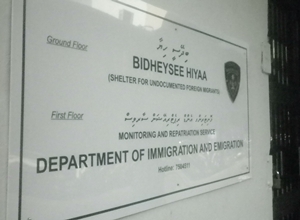
An immigration shelter intended to temporarily house unregistered and illegal immigrants is now up and running in Male’ as part of the government’s efforts to provide a more “humane” means of tackling immigration problems in the country.

Authorities have so far declined to provide exact details to media on the capacity or amenities available at the site, which the Maldives government has claimed will help to alleviate problems arising from the number of unregistered workers in the country at present.

With civil society, industry bodies and international experts continuing to raise concerns about the treatment and number of unregistered foreign workers in the Maldives in recent years, the country has come under increasing pressure to safeguard rights of migrants and curb people trafficking.

The Maldives has appeared on the US State Department’s Tier Two Watch List for Human Trafficking for three years in a row. Should it drop to tier three – the worst category- then the country is expected to face significant reductions in aid and potential travel restrictions on its citizens.

According to President’s Office Media Secretary Masood Imad, the immigration shelter, which was opened last month on Orchid Magu in Male’, forms part of a strategy to try and clear up the problems associated with illegal immigrants in the Maldives.

Masood contended that illegal or unregistered migrant workers were proving to be a significant drain on the national economy, with the shelter providing temporary accommodation before they can be repatriated.

The President’s Office recommended specific questions on the shelter be forwarded to the Department of Immigration and Emigration.

Immigration Controller Dr Mohamed Ali has confirmed to Minivan News that the site was now operational, but did not divulge any more information at time of press on how it would function or the facilities available.

“We will bring out a statement later,” he said. Minivan News is presently awaiting a response from immigration officials to a request to visit the shelter.

Shelter for undocumented foreign migrants, Orchid Magu, Male'

The government has in recent months launched a special campaign intended to raising awareness of the rights of foreign workers, while also last month ratifying eight “fundamental” International Labour Organisation (ILO) conventions intended to bring legislation on employee rights and trade unions in line with international standards.

However, independent institutions in the Maldives have maintained that the country is yet to ratify a core convention on protecting migrant worker rights, while no legislation is in place to punish those involved in smuggling workers though the country’s borders.

The Prosecutor General (PG’s) Office has also confirmed that a lack of legislation has meant no cases have been prosecuted against human traffickers in the Maldives at present.

“Corrupt immigration practices”

Just last month, a Maldivian trade union alleged that corrupt immigration practices and the use of unregulated employment agencies by private and state employers was limiting efforts to curb abuse of migrant workers and prevent illegal practices such as retaining their passports.

The Tourism Employees Association of Maldives (TEAM) claimed that while companies are not permitted to retain the passports of foreign workers, some hospitality operators – as well as unregulated third party agencies and government ministries – are still keeping employee travel documents without consent.

At the same time, a source with knowledge of the current immigration system told Minivan News that the practice of retaining passports – a long-standing habit of Maldivian employers – was a key contributor to human trafficking in the country.

“This is a common practice seen all over the world. But it creates major problems. If a foreigner wishes to go to law enforcement agencies for assistance, they will be asked to identify themselves with a passport,” the source said.

Third party agencies appeared to want to keep the passports to be able to “manipulate” foreign workers for their own financial advantage, the source explained.

Consistency

Meanwhile, the Human Rights Commission of Maldives (HRCM) has accused state and private sector employers in the country of lacking consistency in their efforts to address human trafficking, preventing “real” change in controlling illegal migration.

Speaking back in February 2013, HRCM member Jeehan Mahmoud told Minivan News that despite attempts under the present government to try and introduce new legislation, the Maldives had made little progress towards improving the treatment and rights of foreign workers over the last four years.

Addressing the current scope of unregistered foreign labour, Maldives Association of Construction Industry (MACI) President Mohamed Ali Janah said an estimated 40 percent of the foreign employees in the sector were thought not to be legally registered.

Considering these numbers, Janah said he could not rule out the involvement of organised crime in certain employment agencies, which supply a large amount of foreign labour to building sites in the Maldives.

Likes(0)Dislikes(0)