We will change the government according CoNI report, says Nasheed

Former President Mohamed Nasheed has said the opposition will change the government in the manner which was authenticated by Commission of National Inquiry (CoNI) report.

Speaking at a street rally in Malé held last night (January 3) by Nasheed’s Maldivian Democratic Party (MDP) and its new ally the Jumhooree Party (JP), Nasheed said all political parties had agreed that the findings of the report would be accepted even before it had begun.

“This very report stated that the transfer of power on February 7 was made in accordance with the laws – President Yameen, we are also going to change your government in that very path deemed legal,” he said.

After the Commonwealth-backed inquiry ended the MDP’s hopes of overturning the new administration, Nasheed described the final report as a setting a legal precedent for the overthrow of an elected government through police or mob action.

The Maldives was left “in a very awkward, and in many ways, very comical” situation, said the former president at the time of the report’s release in August 2012, “where toppling the government by brute force is taken to be a reasonable course of action. All you have to do find is a narrative for that course of action.”

The report into the circumstances surrounding Nasheed’s controversial resignation found that the change of government was “legal and constitutional”, and the events of February 6-7 “were, in large measure, reactions to the actions of President Nasheed”.

“The resignation of President Nasheed was voluntary and of his own free will. It was not caused by any illegal coercion or intimidation,” the report claimed.

“[I]t is evident that President Nasheed lost the support of the coalition supporting the MDP which had brought him to power and it is an irrefutable fact that MDP never enjoyed a clear majority in the Parliament,” read the document, pointing to factors that led to his departure from office.

Constitutional amendments

Nasheed claimed last night that as stated in the CoNI report, President Abdulla Yameen’s government had also lost legitimacy after JP leader Gasim Ibrahim – who backed Yameen in the 2013 presidential run-off elections – pulled out of the coalition.

“There is no support for President Yameen’s presidency. The support he received even with President Maumoon is 25 percent,” Nasheed stated.

He argued that the spirit of the Maldivian Constitution is aligned with the presidential system of governance, which demands that one individual gains over 50 percent of the voting population’s support.

This support failed to materialise in either the 2013 presidential elections, or in his own 2008 victory, noted Nasheed.

“The result is that the new government in its infancy loses legitimacy after coalition partners pull out”.

Nasheed also stated that the Maldivian people do not wish to create a dictatorial ruler with a super majority, but rather wish “to find a way in which the Maldives is ruled under the principle of dialogue and discussion”.

He subsequently claimed that constitutional changes needed to be brought in order to facilitate a system of democracy in which the government can function without a super majority, through discussions and dialogue between political figures and parties.

The MDP and the JP held a third round of discussions at Maafannu Kunooz on Sunday (January 1) night, agreeing to officially sign a document concerning their joint efforts to defend the Constitution.

The document, scheduled to be signed at a special ceremony on Thursday (January 5), will be followed by a joint rally that evening at the Carnival area in Malé.

Although the Adhaalath Party has decided against joining the alliance, the Maldives Trade Union has joined the opposition, claiming that the government’s persistent violations of the constitution have “eroded crucial checks and balances and accountability mechanisms”.


Related to this story

No coup, no duress, no mutiny: CNI report

MDP and JP reach agreement on defence of Constitution

Nasheed urges President Yameen to convene all-party talks

Likes(2)Dislikes(0)

Free trade feasibility talks begin with Chinese delegates

The Maldives government has started technical discussions with China regarding the feasibility of a free trade agreement between the two nations.

At a meeting held at the Ministry of Economic Development today (February 4), a technical committee consisting of experts from both countries engaged in discussions over what would be the Maldives’ first free trade agreement with a single country.

Haveeru reported economic development minister Mohamed Saeed as saying that the committee is tasked with determining the feasibility of such an agreement and identifying any potential difficulties.

“The truth is we want to set up the free trade agreement as soon as possible,” he told the paper.

He said the two main reasons in pursuing a free trade agreement with China were duty-free exports of fisheries products, and an increase in air travel between the countries which will bring more Chinese tourists to the Maldives.

Fish accounts for 98 percent of the Maldives’ exports, while Chinese tourists make up 30 percent of all visitors to the Indian Ocean nation.

Speaking with Minivan News today, former Economic Development Minister Mahmoud Razee said that free-trade is most advantageous when taken up by nations at the same level of development, with a demand for goods exported by both countries.

“Maldivian fisheries products are mainly imported by European countries, Japan, and America. The question is whether China imports enough fisheries products from the Maldives,” he said.

Razee also said noted that there was a potential risk of  China ‘dumping’ low quality and undesirable goods into the Maldivian economy.

Minister at the President’s Office Mohamed Shareef has previously said that free trade talks were initiated by the Maldives, and that China has taken a flexible approach with regards to the final agreement.

Last year, President Abdulla Yameen declared a foreign policy shift to the East, slamming the European Union after regulations resulted in the non-renewal of the Maldives’ preferential trade partner status.

The government’s decision to engage in free-trade with China was revealed in December 2014 after the cabinet’s economic council visited China to hold discussions on Chinese-assisted projects in the Maldives.

“The biggest advantage of the free trade will go towards fishermen. With free trade, the 12 percent export duty will be gone, thus the 12 percent becomes profit for fishermen,” said fisheries minister Dr Mohamed Shainee at the time.

The cabinet members’ visit to Beijing in December also saw the Maldives officially sign up to the Maritime Silk Road project, which will provide a trade route between China and east coast of Africa and the Mediterranean.

China currently has free trade agreements with eight countries – including Pakistan, Costa Rica, Peru, and New Zealand – as well as a regional agreement with the Association of South-East Asian Nations.

The Maldives is currently a member of the South Asian Free Trade Area, along with its fellow SAARC nations.


Related to this story

Maldives backs new Chinese investment bank, pursues free trade deal

Silk road deal to be concluded in China-Maldives economic committee

President Yameen slams “Western colonial powers,” declares foreign policy shift to East

EU refuses to extend duty-free status of Maldivian fish imports on human rights grounds

Likes(3)Dislikes(1)

Treasury bills and bonds rise to MVR17.6 billion, MMA reveals

The Maldives Monetary Authority (MMA) has revealed that the outstanding payments for treasury bills and bonds had risen to MVR17.6 billion at the end of 2014.

According to the Monthly Economic Review of December 2014, published yesterday (February 3), stocks of government securities comprising T- bills and T-bonds increased 22 percent and 55 percent, respectively, comparing monthly and yearly terms.

“As for the outstanding amount of T-bonds, it increased significantly in both monthly and annual terms and reached MVR6.4 billion compared to MVR3.1 billion recorded in November 2014,” the review stated.

The MMA’s economic review revealed that 103,744 tourists arrived in the Maldives in December 2014, which is 1 percent lower than the arrivals of the same period in 2013, due to the “decline in arrivals from Asia and Europe”, but an increase of 16 percent compared to November 2014.

Among Asian countries, China contributed the most tourists, with 363,000 of the 1.2 million visitors in 2014 – a year-on-year rise of 9.6 percent.

It was also noted that the occupancy rate of the Maldivian tourism industry as a whole decreased by two percent, from 76 percent in December 2013  to 74 percent in December 2014 due to the decrease in total bed nights by 3 percent, and the average duration of stay to 6 days.

Comparison of figures from November and December of 2014 suggest that there was a 12 percent increase in international reserves and a 17 percent increase in state revenue, leaving international reserves at US$614.7 million by the end of last year.

Reserves held at the end of November equated to 3.3 months of imports, compared to 2.3 months recorded at the end of November 2013, said the MMA.

“The increase in total revenue during December 2014 was largely due to a 32% growth in tax revenue (mainly contributed by the increase in T-GST receipts),” stated the monthly review.

Trade balance worsened by 42 percent in December 2014 compared to corresponding the same period in 2013, as imports rose by 34 percent while exports only increased by 11 percent.

“The growth in imports was mainly due to the increase in imports of transport equipment, while the growth in exports can be attributed to the rise in re-exports”.

According to a statement from Maldives Customs Services on January 14, imported goods in 2014 amounted to MVR30.7 billion – a 22 percent increase compared to 2013.

Customs figures also showed that the decline in exports saw the total value of goods leaving the Maldives in 2014 valued at MVR2.24 billion, compared with MVR2.56 billion in 2013.

(PICTURE: MMA MONTHLY ECONOMIC REVIEW – JANUARY 2015)


Related to this story

GDP to increase from 8.5 to 10.5 percent in 2015, says MMA

Parliament approves import duty hikes

Maldives economy “relatively buoyant” but fiscal imbalances continue to grow: IMF

Majority of dollar receipts spent on imports: MMA assistant governor

Likes(3)Dislikes(0)

Opposition alliance a “waste of time”, says Gayoom

Former President, and leader of the ruling Progressive Party of Maldives (PPM), Maumoon Abdul Gayoom has described the opposition’s alliance to defend the Constitution as a “waste of time”.

Gayoom told reporters that the current government has in no way violated the Constitution and that there is no reason for any party to talk about defending it.

“Therefore, when some people have come out claiming to defend the Constitution, it makes me laugh,” Gayoom told reporters before travelling to the Delhi Sustainable Development Summit (DSDS) this morning.

The former 30-year ruler, who will participate in the summit as a panelist and a speaker, also questioned the intentions of the opposition, stating that “our President Abdulla Yameen pays special attention to follow the Constitution”.

Gayoom’s comments are the first from a high level member of the ruling party since the Maldivian Democratic Party (MDP) and Jumhooree Party’s (JP) decision to work together in defending the Constitution.

The parties are alleging that the government is narrowing civil liberties, intimidating political opponents, and destroying state’s checks and balances.

PPM spokesman MP Ali Arif told Minivan News that the opposition parties were unable to specify which part of the Constitution the government has violated.

“We have asked them which specific part or article of the Constitution the government has violated. They cannot seem to answer the question. This is just noise, all these claims are baseless,” stated Arif.

He also said that amendments to the Judicature Act – which saw the removal of two Supreme Court judges, and amendments to the Auditor General’s Act – which saw the reappointment of the auditor general, were all legislative changes brought by parliament.

Former Auditor General Niyaz Ibrahim has suggested his removal – just days after an audit report implicated the tourism minister in a US$6 million corruption scandal – was not legal without changes to the Constitution.

The Civil Court has, meanwhile, said the People’s Majlis had “forced” the Judicial Services Commission to deem Chief Justice Ahmed Faiz and Justice Muthasim Adnan unfit for the Supreme Court bench without due process, through an “unconstitutional” amendment to the Judicature Act.

“In a democratic society the parliament brings changes to laws,” Arif told Minivan News today. “If the president does not wish to gazette the law, he can send it back but then again if the parliament passes the bill, it automatically becomes law. How is the president or government at fault?”

Meanwhile, the MDP and the JP held a third round of discussions at Maafannu Kunooz on Sunday (January 1) night, agreeing to officially sign a document concerning their joint efforts to defend the Constitution.

The document, scheduled to be signed at a special ceremony on Thursday (January 5), will be followed by a joint rally that evening at the Carnival area in Malé.

Although the Adhaalath Party has decided against joining the alliance, the Maldives Trade Union has joined the opposition, claiming that the government’s persistent violations of the constitution have “eroded crucial checks and balances and accountability mechanisms”.

The MTU was inaugurated in May 2014, with 180 members aiming to provide an independent voice for the protection of small and medium sized businesses.

Zahir formed the group after clashing with authorities over the new tax regime – introduced by the MDP government. He was investigated the the Prosecutor General’s Office last year for tax evasion.

(PHOTO: PRESIDENT’S OFFICE)


Related to this story

Maldives Trade Union joins opposition’s defence of Constitution

Adhaalath Party decides against participation in opposition talks

MDP and JP reach agreement on defence of Constitution

Nasheed urges President Yameen to convene all-party talks

MDP holds street rally in front of Gasim’s residence

Likes(2)Dislikes(0)

Transparency reviews the Majlis in 2014

Transparency Maldives has published its 2014 Majlis review, reporting that 10 bills were passed in 59 sittings of the 18th People’s Majlis.

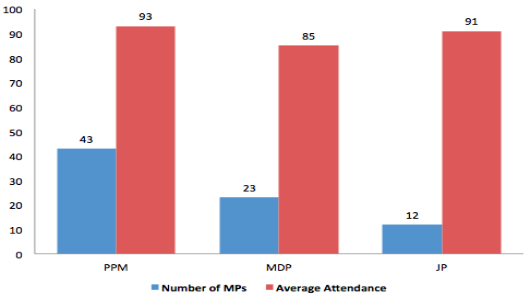
Of the 85 members elected to the expanded parliament in March, only 16 have had a flawless attendance record since, with an overall attendance figure of 90 percent.

The members from the opposition Maldivian Democratic Party (MDP) had the worst average attendance of the three main parties – 85 percent, compared with the Jumhooree Party’s (JP) 91 percent and the ruling Progressive Party of Maldives’ (PPM) 93 percent.

It was the Maldivian Development Alliance leader, and Progressive Coalition member, Ahmed ‘Sun Travel’ Shiyam who had the worst attendance of any MP, appearing at less than half the sessions, reported Transparency.

Other than the Adhaalath Party, for whom Makunudhoo MP Anara Naeem is the only MP, Siyam’s MDA was the only party whose representation in the 18th Majlis has remained stable.

Despite winning 33 seats in the March polls, the PPM has now gained an additional 11 MPs, while its former ally the JP has a net loss of 2 seats.

After winning a disappointing 26 seats in the house, the MDP lost 4 MPs to opposition parties as well as expelling Majlis Deputy Speaker ‘Reeko’ Moosa Manik from the party.

Legislation

The most important legislative changes brought by the Majlis in 2014 were the Anti-Money Laundering and Counter-Terrorism Financing Act, the new Penal Code, the Special Economic Zone Act, and amendments to the Judicature Act.

The report describes the benefit of the money-laundering bill as preventing terrorism financing, kleptocracy, narco-trafficking, human trafficking, illicit arms trafficking, counterfeiting currency, corruption, and transnational organised crimes.

“Money laundering has potentially destructive social and economic consequences. It allows criminals such as drug traffickers, corrupt officials, and transnational organised crime syndicates to introduce illicit proceeds or ‘dirty money’ into legitimate finance streams as legal funds,” explained the anti-corruption NGO.

The new penal code – to be introduced in April this year – represents the culmination of 10 years’ work and will replace an old code that has been described by legal experts as obstructing the course of justice due to its “outdated” nature, read the review.

“In April 2004, the new penal code was finally passed, making it the first modern, comprehensive penal code in the world to incorporate the major tenets and principles of Islamic law.”

Parliamentary group attendance

The report described the government’s flagship Special Economic Zones Act as laying “an edifice for economic, industrial, social, financial and infrastructural development.”

“It allows economic activities to be carried out under a relatively liberal manner through tax exemptions to investors and developers.”

Despite the promise of major ‘transformative’ investment – yet to be realised, the opposition has argued that the bill will “allow the government to conduct transactions broadly with no transparency and no opportunity for oversight, as a result of which the possibility of losing the country’s independence and sovereignty would be high”.

The SEZ was passed in August in the face of 300 proposed MDP amendments.

Appointments and dismissals

Regarding the changes to the Judicature Act – which facilitated the removal of two Supreme Court judges – Transparency’s report pointed out its previous concerns over the “political influence on the judiciary in the Maldives”.

Amendments requiring the reduction of the bench from seven to five in December saw the JSC swiftly select Chief Justice Ahmed Faiz and Justice Muthasim Adnan in a decision marked for its lack of transparency.

The Majlis’ subsequent approval of the pair’s dismissal was described as a “black day for the constitution” by Faiz, while UN Special Rapporteur Gabriella Knaul predicted a “chilling effect” on the work of the judiciary.

Finally, the review of the Majlis’ work for 2014 noted the appointment of a number of key figures, including Prosecutor General Muhuthaz Muhsin – appointed after political wrangling saw the constitutionally mandated deadline for filling the position missed by six months.

After the Supreme Court removed the Elections Commission’s senior leadership less than a month before the Majlis elections, MPs appointed Mohamed Shakeel and Ahmed Sulaiman to the commission in November. They were also joined by Ismail Habeeb Abdul Raheem and Amjad Musthafa in receiving Majlis approval.

The Majlis appointment of President Abdulla Yameen’s nomination of Hassan Ziyath as the new auditor general in November was also a source of controversy, with outgoing auditor general Niyaz Ibrahim arguing that his removal had been unconstitutional.

Niyaz was ousted as a result of last minute changes to the Auditor General’s Act, proposed to the the Majlis by the PPM on the same day the audit office published a report implicating tourism minister and deputy PPM leader Ahmed Adeeb in a US$6 million corruption scandal.


Related to this story

Transparency Maldives notes “grave concern” over undemocratic trends

Building trust – Transparency Maldives calls for enhanced asset disclosure

Transparency Maldives concerned over “stagnation of democratic consolidation”

Likes(1)Dislikes(0)

Maldivians fighting wars abroad a concern, says Police Commissioner

Commissioner of Police Hussain Waheed says that it is a cause of concern that Maldivians nationals are leaving the country to fight in wars abroad.

It is necessary for all police officers to work together in order stop Maldivians joining wars abroad, he told fellow officers at a police function held yesterday (February 2).

If police receive any information regarding such a case, he added, it should be investigated by the intelligence department and adequate preventative measures should be taken immediately.

The commissioner’s remarks closely follow reports that a former mosque employee at Malé’s Indhira Gandhi Memorial Hospital and his wife had travelled to Syria for Jihad, entering ISIS-held territory after travelling to Turkey via Dubai.

The exact number of Maldivians abroad for Jihad remains unclear, with Haveeru reporting a group of six having departed last week, as well as a dozen more said to have gone to Syria at the start of January.

Waheed has previously estimated that around 50 Maldivians are working with foreign rebel groups, dwarfing figures suggested by Home Minister Umar Naseer in December.

Commissioner Waheed has said that police are working with the Islamic ministry and relevant government departments to prevent radicalisation, though he said the variety of people travelling for jihad made it hard to target the most vulnerable groups.

Despite assurances that the activities of radicals are being monitored, the group said to have left in early January included a number of individuals known to police.

The group included Azlif Rauf – a suspect in the murder of MP Dr Afrasheem Ali, and an individual arrested over the disappearance of Minivan News journalist Ahmed Rilwan. A private investigation into Rilwan’s case implicated radicalised gangs in what is believed to have been the 29-years-old’s abduction.

Last month, four would-be jihadis were apprehended in Malaysia, with media reporting that they were brought back to the Maldives and released after the authorities seized their passports. A similar group were returned from Sri Lanka in November.

In November, a jihadist group called Bilad Al Sham Media (BASM) – which describes itself as ‘Maldivians in Syria’ – revealed that a fifth Maldivian had died in Syria.

Defending the government’s stance on extremism and ISIS, Islamic minister Dr Mohamed Shaheem Ali Saeed told the Majlis late last year that “Maldives will not allow Maldivians to go and fight in foreign wars”.

“We do not support their [ISIS] extremist policies. We have repeatedly appealed to our beloved youth to refrain from falling prey to these ideologies,” he said.


Related to this story

Hospital worker and wife latest to travel for Jihad

Over 50 Maldivian militants fighting in foreign wars, reveals Commissioner of Police

Maldives a “land of sin”, says jihadist after departing with family for ISIS territory

Islamic Minister advises Maldivians against participating in foreign wars

Likes(2)Dislikes(0)

Nasheed requests reappointments to Hulhumalé court be stopped

Former President Mohamed Nasheed’s legal team have requested that the appointment of new judges to the vacant positions on the Hulhumalé Magistrate Court bench be halted.

The stay order was submitted at today’s High Court hearing in Nasheed’s case against the Judicial Services Commission (JSC) over the legality of the appointment process to the magistrates court.

Despite Nasheed’s representatives insisting that the court consider the request during the hearing, presiding judges asked that it be submitted in writing, saying that the court will deliberate on the issue in a timely manner.

Responding to the request, JSC lawyer Hussain Ibrahim said he was unable to respond as he was unaware that the process of appointing new judges to the Hulhumalé Magistrate Court bench was underway.

Nasheed’s lawyers attempted to add new points to the original case, but the judges again asked that the new point to be submitted in writing, in spite of further protests.

“This hearing will only take arguments from both sides regarding the procedural issue raised by JSC. We will only allow this trial to be conducted as scheduled”, stated Abbas Shareef, the presiding judge.

The case was first raised in 2012, and challenges the legality of the bench, which was assembled to try the opposition leader for the detention of Criminal Court Judge Abdulla Mohamed during his presidency.

JSC’s procedural issue

The JSC lawyer stated that he had no points to add to the arguments made prior to the case’s suspension in April 2013. These included claims that the Hulhumalé bench had been appointed on the orders of the Supreme Court, meaning that the High Court could not deliberate on the decision.

Ahmed Abdulla, member of Nasheed’s team, noted that the letter regarding the appointment of the bench was sent by the Supreme Court in the capacity of the Judicial Council, despite it having been written under a Supreme Court letterhead.

Therefore Nasheed’s lawyers contested that the decision cannot be interpreted as a Supreme Court ruling but must be regarded “an administrative decision by an administrative body”, which would enable the High Court to deliberate on its legality.

The Judicial Council was created under the 2010 Judicature Act to oversee administration of the courts, but its duties were soon absorbed by the Supreme Court in what has been described as a centralising of judicial power.

Hisaan Hussain and Abdulla Shairu also spoke on behalf of Nasheed today, while Hassan Latheef also represented the Maldivian Democratic Party (MDP) leader in court.

Conclusion

The hearing was concluded after a brief statement by Nasheed in which he requested that the High Court grant him the permission to travel freely during the period in between hearings.

Nasheed also expressed his hope that the court had not expedited his case because “we are moving towards the shade of the new penal code, which does not include the article under which I have been charged”.

The presiding judge ended the session with the announcement that a hearing will be held next week in which the court will deliver its verdict on the procedural issues raised by the JSC, explaining to Nasheed that he will be granted permission to leave Malé after making requests in writing.

The MDP yesterday described Nasheed’s trial as the government’s attempt to eliminate President Abdulla Yameen’s political opponents and to prevent them from contesting in the 2018 presidential elections.

Nasheed’s lawyers have previously challenged – unsuccessfully – the establishment of a magistrates court in the Malé suburb, arguing that Hulhumalé is considered to be part of Malé City under the Decentralisation Act and therefore does not require a separate court.

United Nations Special Rapporteur on the Independence of Judges and Lawyers Gabriela Knaul has previously noted that the “appointment of judges to the case, has been set up in an arbitrary manner outside the parameters laid out in the laws”.

(PHOTO: MINIVAN NEWS ARCHIVE)


Related to this story

Nasheed trial part of drive to eliminate President’s opponents, says MDP

High Court to rule in appeal on Hulhumale’ court legitimacy

Hulhumale’ Court rejects case against former President Nasheed

High Court invalidates Hulhumale’ court’s rejection of case against former president

Supreme Court declares Hulhumale Magistrate Court legitimate

Likes(2)Dislikes(0)

Nasheed trial part of drive to eliminate President’s opponents, says MDP

The Maldivian Democratic Party (MDP) has accused President Abdulla Yameen of manipulating the judiciary to remove opponents, as court proceedings related to former President Mohamed Nasheed’s trial resume tomorrow.

In a press conference held ahead of the High Court trial challenging the legality of the Hulhumalé Magistrates Court’s bench, MDP spokesman Imthiyaz Fahmy suggested that “a very unpopular government” was trying to “invalidate the candidacy of all of President Yameen’s competitors”.

The case will consider Nasheed’s appeal against the assembly of the court’s bench, appointed to try him for the detention of Criminal Court Judge Abdulla Mohamed in January 2012.

Fahmy today suggested that the government’s attitude towards the judge’s detention – which stoked anti-government protests before Nasheed’s controversial resignation on February 7 – was reflected in the recent appointment of a fellow defendant in the case as defence minister.

“If the government believes that the case against President Nasheed is serious; if the case has any substance, why would the government appoint Moosa Ali Jaleel as the defence minister?” asked Fahmy.

Formerly the chief of defence forces, Jaleel retired after 32-years of service following Nasheed’s resignation, later telling parliament’s government oversight committee that he believed the MDP leader had “resigned under duress”.

Court proceeding

Fahmy today also suggested that the Supreme Court’s recent decision to reduce the period allowed for legal appeal was an effort to hastily sentence Nasheed before the implementation of the new penal code in April.

The court’s decision reduces the time allowed to file appeals in the higher courts from 90 days (180 for cases from the atolls) to ten, prompting legal experts to accuse the court of infringing upon the constitutional right to an appeal.

“The new penal code does not have the article under which President Nasheed is being prosecuted nor does it have a specified punishment,” continued Fahmy.

If convicted under the old legal code, Nasheed could face imprisonment or banishment for three years – leaving him ineligible for the 2018 presidential race, under Article 109 (f) of the Constitution.

Nasheed’s MDP has recently formed an alliance with the Jumhooree Party (JP) in defence of what it regards as persistent breaches of the Constitution. The eligibility of the JP’s leader, Gasim Ibrahim, is also under threat after the ruling Progressive Party of Maldives proposed constitutional amendments that would deem him too old to contest the presidency for a third time in 2018.

During tomorrow’s hearing, Nasheed’s legal team and the Judicial Services Commission – which assembled the Hulhumalé Magistrate Court’s bench – will be given ten minutes each to summarise arguments and raise further points regarding procedural issues raised before the case was halted in April 2013.

The judicial watchdog has raised a procedural issue claiming that the High Court does not have the jurisdiction to oversee the case.

After the announcement of the trial, Nasheed’s legal team had requested a one and a half month delay in the trials as further time was required to “review and research the case after recent developments in the judicial system”.

Nasheed’s lawyers have previously challenged – unsuccessfully – the establishment of a magistrates court in the Malé suburb, arguing that Hulhumalé is considered to be part of Malé City under the Decentralisation Act and therefore does not require a separate court.

United Nations Special Rapporteur on the Independence of Judges and Lawyers Gabriela Knaul has previously noted that the “appointment of judges to the case, has been set up in an arbitrary manner outside the parameters laid out in the laws”.


Related to this story

High Court to rule in appeal on Hulhumale’ court legitimacy

Hulhumale’ Court rejects case against former President Nasheed

High Court invalidates Hulhumale’ court’s rejection of case against former president

Supreme Court declares Hulhumale Magistrate Court legitimate

Likes(1)Dislikes(0)

ACC investigates corruption in teacher training bid

The Anti-Corruption Commission (ACC) will investigate corruption allegations made against the Ministry of Education by a private individual regarding the announcement of degree-level education for 2000 new teachers.

Speaking to Minivan News, ACC Information Officer Hassan Manik confirmed that an individual had filed a case, but refused to comment further on the ongoing investigation.

State Minister at the Education Ministry Dr Abdulla Nazeer, however, said that he was unaware of the case against the ministry, but that there was “some urgency” regarding the initiation of the degree programme.

After its president last week accused the ministry of intimidation following his criticism of recent changes to the sector, the Teacher’s Association of Maldives’ (TAM) has expressed concern over the ministry’s decisions, saying that a lot of teachers are concerned about job security.

“The association is concerned these abrupt decisions might have an impact on the education of the students as well. We sincerely request [the ministry] to refrain from making decisions which might weaken the profession, and cause some teachers to lose their jobs,” read a TAM press statement.

TAM President Athif Abdul Hakeem has publicly accused the government of going back on pledges to improve teachers’ salaries – the result of negotiations following a series of strikes last year.

The opposition has suggested that the qualification-based salary changes have resulted in 1,200 teachers applying for diplomas at Malé’s Mandhu College. The college has since been given an eviction notice by the ministry for an alleged breach of its lease – claims the college denies.

The complaint to the ACC regarding the teacher training claims the January 22 announcement was constructed in a way which unlawfully favours certain bidders, reports Raajje.mv.

The individual claimed that, with a deadline of February 5, prospective bidders effectively had only 12 days to prepare their offers, which was not enough to provide a detailed financial plan for a programme involving such a number of students spanning five years.

While claiming that some elements included in the bidding process contravened accreditation regulations set out by the Maldives Qualifications Authority, the individual is said to have alleged that the ministry was colluding with a Malaysian university.

Meanwhile, the ministry has published the new regulations on the provision of additional training for workers in the education sector, alongside a matching allowance to the 2015 salary, opening up the application for additional training.

A ministry press statement outlined the selection criteria for the programme and the points system for applicants, while giving a deadline of March 2 for applications.

State Minister Nazeer explained that the 2000 students to participate in the degree programme are not to be confused with the 2000 teachers who are to undergo further studies in order to bring them up-to-date with new minimum qualifications for teachers set out by the education ministry.


Related to this story

TAM President accuses Education Ministry of intimidation

Government had no choice but to increase teachers’ salary: MDP

Education Ministry hikes teachers’ pay by 35 and 15 percent

Teachers’ Black Sunday protest prompts government talks, strike decision pending

Likes(0)Dislikes(0)