MDP alleges 117 cases filed against February 8 2012 protesters “politically motivated”

The Maldivian Democratic Party (MDP) has called for “politically motivated” court cases against 117 protesters charged with terrorism and obstructing police duty on February 8 2012 be immediately discontinued.

Nine MDP members from Milandhoo Island in Shaviyani Atoll, 28 members from Kulhudhuffushi Island in Haa Dhaal Atoll and 80 members from Addu City are currently facing prosecution. The accused include mid-Hithadhoo Constituency MP Mohamed ‘Matrix Mode’ Rasheed as well as a number of councilors and branch heads from these islands.

“A lot of the accused [currently standing trial] were charged with terrorism offences and obstructing police duty,” said MDP Spokesperson and MP Imthiyaz ‘Inthi’ Fahmy.

The MDP “condemned, in strong terms, these cases of unlawful and blatant granting of selective impunity from justice and calls on all concerned authorities to immediately cease this selective litigation,” during a press conference held May 20, led by Imthiyaz and MDP pro-bono lawyers Abdullah Haseen and Mohamed Fareed.

The party said it regarded the “discriminatory” prosecutions as being politically motivated, biased judicial actions against hundreds of MDP members, and “outside the requisite edicts of the Constitution for judicial fairness and equability.”

The political party also voiced their “great concern” that despite the Commission of National Inquiry (CoNI) findings that “unlawful brutal acts” were committed by security services in February 2012, the report’s recommendations that actions be taken against the offenders have been “disregarded with impunity”.

“Why doesn’t the government take action against those police officers when there is clear evidence of police brutality? None of the police officers have been investigated or prosecuted in line with the CoNI,” said Imthiyaz.

The MDP alleged that “despite public irrefutable and credibly substantiated video and audio evidence showing security services personnel committing brutal assaults and inflicting inhuman bashings”, no credible investigations or judicial actions have been taken.

Current court cases against MDP members had meanwhile been “unduly hastened”.

“The police were seen to participate in a mutiny and they have openly and publicly viewed their opposition and hatred towards the MDP,” MDP Spokesperson Mohamed Zuhair told Minivan News at the press conference.

“As police investigation reports make up a substantive part of the legal cases being brought against MDP activists, how can these investigations be fair when police have been publicly on the record as biased and downright malicious [toward MDP supporters],” he continued.

“The MDP came out in a peaceful protest on the 8th, on the roads of Male’, and they were bashed up,” Zuhair said. “Our activists on the islands heard this and that escalated tensions on many islands where there are police stations. And then it became a kind of public uprising.”
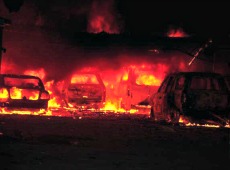
“Within that public uprising, our activists’ primary objective was to rally and to somehow show strength, but among those came in other elements, [who] set fire to places, and then escalated the whole thing,” he added.

Zuhair said given the state of the judiciary justice for the accused was not possible, “but we’ll have better recourse to due process through the high court and supreme court and through international redress.”

No grounds to prosecute

The trials were being conducted to “intimidate the people” because elections are “very near” and the entire process was politicised, MDP lawyer Haseen told Minivan News.

“They demanded the suspects be kept in remand claiming they had forensic evidence. And then when they’re produced in court, there is no forensic evidence or video footage submitted, only witness statements,” Haseen explained.

“They are telling the press they have the evidence and highlighting a lot of photographs with fire, but they are not submitting these – just witness statements given by rival political parties,” he said.

Haseen claimed senior Progressive Party of the Maldives (PPM) officials pointed out to the police who to arrest and were now providing the witness statements against the MDP protesters in court.

“The problem is that even the island judges are not competent judges. They don’t even know criminal procedure. That’s a larger fight that we are building our campaign with that on top – journey for justice,” Haseen added.

MDP lawyer Fareed concurred with Haseen that it is a “politically motivated conflict of interest” to have police and former-opposition political parties provide the only evidence – witness statements – against the MDP members on trial.

“There are not any grounds for prosecution,” Fareed told Minivan News.

He attended three hearings in Kulhudhuffushi, which took place May 19, against 11 MDP members, including two island councilors, and was also dismayed by how witness statements were taken.

“The court they did not have a recording system, so the judge he himself was writing the witness statements in favor of the state. It was very terrible,” Fareed recounted.

“When the first witness was presented, I asked him directly ‘were you there when these  things happened?’ and he replied ‘this is after one year so I don’t remember these things’.”

“That’s all that’s enough – whatever the witness says after that is not applicable, not acceptable,” he declared.

“When the prosecutor asked him [the same question], the witness said ‘That man may be there but I don’t know,’ however the judge himself had already written the witness statement in favor of the prosecution,” he added.

“If they continue this hearing, they should have a recording system otherwise we’ll have to stop it,” Fareed concluded.

“All courts have recorders”

Kulhudhuffushi Court Magistrate Ali Adam explained to Minivan News today (May 23) that “all courts have recorders”.

“When dealing with criminal cases we try to write witness statements, it is the best way,” said Adam. “Recordings can be changed or edited. There might be court staff who hold certain political ideologies who might tamper with the statements.”

“When listening to a witness statement a judge will only write relevant remarks and things related to the accused’s rights. The witness then signs the hand-written statement,” explained Adam.

“We do not consider anyone standing trial as a criminal. How can we face a person thinking he’s an enemy? We do not consider the individual’s personality or which political party he is in,” he added.

The Prosecutor General, PG spokesperson, and PPM MPs Ahmed Nihan and Ahmed Mahlouf were not responding at time of press.

Likes(1)Dislikes(0)

“Serious failings in the justice system entrenched impunity”: Amnesty International

Failure to prosecute police officers accused of human rights abuses and “serious failings in the justice system entrenched impunity” in the Maldives during the past year, Amnesty International has said in its annual report.

“These [failings] included the absence of codified laws capable of providing justice equally to all and the appointment of judges who lacked formal training in law without serious scrutiny of their legal qualifications,” the international human rights organisation stated.

“Throughout the year, authorities were accused of political bias for fast-tracking the prosecution of opposition supporters accused of criminal behaviour during rallies while failing to prosecute police and others suspected of committing human rights abuses during the same protests.”

The 2013 Amnesty annual report on the state of the world’s human rights observed that former President Mohamed Nasheed’s resignation on February 7, 2012 was “followed by months of protest and political repression.”

Nasheed resigned in the wake of a violent mutiny by Special Operations (SO) police officers, who assaulted government supporters, ransacked the ruling party’s Haruge (meeting hall), staged a protest at the Republic Square, vandalised the police headquarters, clashed with the military and stormed the state broadcaster.

Since the transfer of presidential power, the security services have used excessive force “to suppress demonstrations that were largely peaceful,” the report noted.

In June 2012, the Maldives Police Service (MPS) however denied “in the harshest terms” allegations of police brutality by Amnesty International.

“Supporters of the former President’s Maldivian Democratic Party (MDP) were targeted for attack in February. Detainees were subjected to torture and other ill-treatment,” the report continued.

“Targeted violence” against MDP members plunged the nation into “a human rights crisis” in February 2012, the Amnesty report contended.

“Throughout the year, security forces frequently attacked peaceful demonstrators, including MPs, journalists and bystanders, in the capital Malé or in Addu, both MDP strongholds. Officers clubbed them, kicked them and pepper-sprayed them directly in the eyes. Around the time of Mohamed Nasheed’s resignation, from 7 to 9 February, police targeted senior MDP members for attack and tracked down and assaulted injured protesters in hospitals,” read the report.

Amnesty also reported torture and ill-treatment in police custody, including “beatings, pepper-spraying the eyes and mouth, denial of drinking water and, in Addu, incarceration in dog cages.”

The report noted that a Commonwealth-backed Commission of National Inquiry (CoNI) established by President Dr Mohamed Waheed – which found that Nasheed resigned voluntarily – had taken note of “allegations of police brutality and acts of intimidation” and called for “investigations to proceed and to be brought to public knowledge with perpetrators held to account.”

Criminal proceedings have however yet to begin against a single police officer accused of human rights abuses in the aftermath of February 7.

Impunity

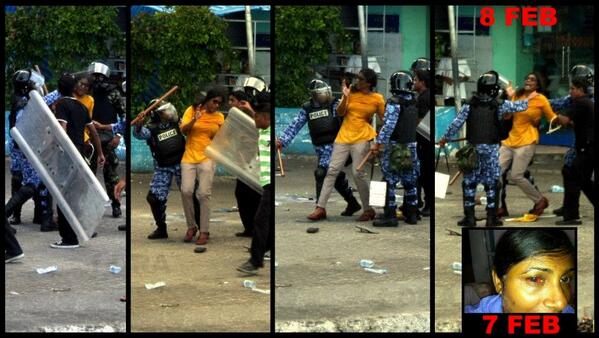
In August 2012, the Human Rights Commission of Maldives (HRCM) concluded that the police crackdown on a MDP march across Male’ on February 8, 2012 that left dozens of demonstrators injured was “brutal” and “without prior warning.”

Based on its findings, the HRCM recommended that the Maldives Police Service (MPS) and Police Integrity Commission (PIC) should investigate the “disproportionate” use of force – in violation of police regulations authorising use of less-lethal weapons – and initiate legal action against the responsible officers.

On February 8, thousands of MDP supporters took to the streets after Nasheed declared that his resignation the previous day was “under duress” in a “coup d’etat” instigated by mutinying SO police officers working with the then-opposition and abetted by rogue elements of the military.

The HRCM noted that 32 people filed complaints with the commission concerning varying degrees of injuries sustained in the crackdown and 20 people submitted medical documents of their treatment for injuries.

Among the injuries caused by the police baton charge, the HRCM report noted that several people were bruised and battered, one person fractured a bone in his leg, one person was left with a broken arm and six people sustained head wounds.

Two fingers on the left hand of one demonstrator were crushed, the report noted, and the victim had to undergo treatment at the operating theatre.

The PIC meanwhile revealed in December 2012 that it “recorded 24 individual cases of police brutality related to 7th and 8th February” and completed investigation into 12 cases.

Six cases were sent to the Prosecutor General’s Office (PGO) for criminal prosecution.

“In one more case, though police brutality was proven, there was insufficient evidence to identify the responsible policemen. Investigations of the remaining 12 cases is ongoing, but are expected to be completed soon,” the commission said in a status update.

In February 2013, PIC Chair Dr Abdulla Waheed told parliament’s Government Oversight Committee that it was investigating 29 police officers accused of using excessive force against MDP demonstrators.

The PIC chairperson could not confirm whether the commission’s recommendation to dismiss six officers of the 29 under investigation was acted upon.

He added that five cases were pending despite video evidence of police brutality as the officers could not be identified and 11 additional cases remained stalled over lack of sufficient evidence.

Former PIC Chair Shahinda Ismail had revealed that officers the commission had recommended for suspension had instead been given promotions. Shahinda resigned in October 2012 citing “major difference of opinion” with other members.

“What I’ve seen in the actions of institutions is that they have been giving a lot of space for the police to act with impunity,” she said at the time.

February 8 crackdown
An injured protester

While police baton charged the front of the protest march on February 8, Minivan News observed SO officers charging the crowd from a narrow alley leading to the Maldives Monetary Authority (MMA) building.

The SO officers used obscene language, pointed to and chased after individual MDP activists and severely beat unarmed civilians.

Parts of the attack from the rear were filmed by Al Jazeera, which reported on February 8 that “police and military charged, beating demonstrators as they ran – women, the elderly, dozens left nursing their wounds.”

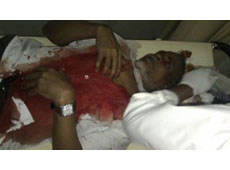
Former President Nasheed was reported among the injured, and received head injuries during the clashes. He was briefly taken under police custody before being released back into the crowd.

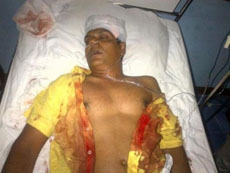
Minivan News also observed several youth with head injuries queuing up for x-rays in the waiting area outside the reception area at the Indira Gandhi Memorial Hospital (IGMH).

One young woman who had gone to IGMH with her sister was being treated for a head wound. A gauze wrapped around her head was spotted with blood, and she claimed the wound was still bleeding as she went in for an X-ray.

“The police were just standing there and suddenly we were being beaten with batons and pepper spray was thrown in our face. They threw us to the ground and kept beating us,” she said.

The BBC meanwhile reported “a baton charge by police on crowds gathered outside one of the main hospitals.”

“People scattered as officers sprinted towards them silhouetted against the lights of passing traffic,” the BBC’s Andrew North reported from Male’.

“Inside the hospital, dozens of Mr Nasheed’s supporters are still being treated for injuries, following earlier scuffles in the main square. Among them is Reeko Moosa Maniku, chairman of Mr Nasheed’s Maldives Democratic Party – who was with the former president when the clashes broke out. With a large head bandage and his shirt bloodied, he regained consciousness as we arrived. The police said they would kill me, he told us, as they beat me. Another MP was still unconscious in another ward.”

Likes(1)Dislikes(0)

Missing man discovered in dinghy 900 miles from Maldivian waters

A Maldivian national reported missing earlier this month after leaving the island of Fares-Maathoda in Gaafu Dhaalu Atoll in a dinghy has been discovered by a foreign vessel 900 miles from Maldivian waters.

The Maldives National Defence Force (MNDF) confirmed that Mohamed Falah, a 30 year-old man from Fares-Maathoda reported missing since May 9, had been found in “good condition” by the crew of a foreign vessel travelling to Malaysia.

The announcement of Falah’s rescue comes as authorities continue to advise members of the public to take precautions during sea travel – particularly over long distances – following “extreme weather” reported across the Maldives this month.

The MNDF has said searches are continuing for three other men thought lost at sea.

MNDF Spokesperson Colonel Abdul Raheem said authorities had initially been informed of Falah’s rescue through his family, before contacting the foreign vessel that discovered him.

He added that the Maldivian national was expected to arrive in Malaysia on the vessel on Saturday (May 25).

Falah’s wife Fathimath Nazeefa told local newspaper Haveeru that she spoken to her husband today, explaining that he was in “good condition” and had been well treated by the crew who rescued him.

Local media reported that Falah went missing after travelling from Fares-Maathoda to a nearby island to collect gravel needed for construction purposes.

“Necessary precautions”

Following concerns about extreme weather patterns, the Maldives Coast Guard last week published an announcement requesting “all travellers to take necessary precautionary measures before setting on their journeys due to the severe weather with heavy rain and thunderstorms… particularly in the northern and southern regions of the Maldives.”

Colonel Raheem said today that the MNDF was continuing to work with the Maldives Department of Meteorology to try and keep the public better aware of weather patterns in order to prevent further cases of vessels drifting and becoming lost in local waters.

“We cannot say that the condition with the weather is now ok, but it is certainly better at times,” he said.

Raheem said that the coastguard therefore continued to stress that anyone attempting sea travel should take precautions before a voyage.

He said that the MNDF Coast Guard therefore encouraged members of the public to contact its toll-free number 191 to get more information on suitable times for their journey.

“We welcome everyone to call the toll-free number and check the weather before they depart. We also encourage them to contact us if they are leaving on a long distance journey and also notify us when they arrive,” Raheem said.

Rescue attempts

The MNDF has said operations were continuing to locate three other men reported lost at sea this month, despite previously halting aerial search and rescue operations.

Speaking Monday (May 20), Colonel Raheem said that search and rescue operations for four men lost at sea – which at the time had included Mohamed Falah – were being downgraded.

He said at the time that although aerial operations have ceased, the reduced search efforts were being continued. An Indian Navy aircraft was previously assisting the MNDF Kurangi Helicopter with aerial search and rescue operations, but had recently departed the Maldives.

The three men still missing include Mohamed Sammoon, a 21 year-old surfer from Kolamaafushi Island in Gaafu Alif Atoll, who was reported missing around 4:30pm on May 4 after entering the ocean with a surfboard and being swept away by the current.

Two fisherman, identified as 39 year-old Hassan Rasheed from Maamigili Island in Alif Dhaalu Atoll and 32 year-old Abdulla Waheed from Maavashu Island in Laamu Atoll were also reported missing the same day along with the fishing vessel “Azum”.

The two crewmen and the 40 foot light-green fishing boat disappeared after departing from Mulak Island in Meemu Atoll en route to Maavah Island in Laamu Atoll, Sun Online reported.

With searches ongoing for the three men, Colonel Raheem said today that the coastguard had not presently received any additional reports of members of the public being lost in Maldives waters.

“There have been small incidents, but these are not major concerns,” he said.

Adverse weather

Hussein Waheed from the Maldives Department of Meteorology said extreme weather experienced over the last month was expected to improve over the next week.

“Right now we are still having rain, though we expect quite fine weather within the next three to four days,” he said.

Waheed added that adverse weather conditions this month been the result of the “early onset” of the traditionally wet South-West monsoon at the same time that a cyclone had formed in the Bay of Bengal area. The cyclone had since moved north-west towards India, the Maldives Department of Meteorology added.

Likes(1)Dislikes(0)

Police arrest 48 year-old man for allegedly molesting 10 year-old girl

A 48 year-old man from Hoadedhdhoo Island in Gaafu Dhaal Atoll has been arrested for allegedly abusing a 10 year-old girl over a year and a half, reports local media.

The child’s mother had began to suspect “something was wrong”, a source from the island told local media. The victim, a fourth grade student, then told her how the man had molested her.

The Hoadedhdhoo Island Council told local media the man had been arrested and was in police custody on Thinadhoo Island in Gaafu Dhaal Atoll. Police are currently investigating the case.

Likes(0)Dislikes(0)

Chief of Defence Force warns of increasing risk of terrorist attacks, youth enrolling in terror training camps

Chief of Defence Force Major General Ahmed Shiyam has warned of a rising risk of terrorist attack in the Maldives, during a joint local and US military inauguration to establish a level of alerts for terrorism in the country.

Shiyam cautioned against assuming the country was completely safe from terrorist attacks simply based on the fact that no major terrorist activities have been uncovered in the country to date, warning there was an increased risk of terrorist attacks stemming from “religious extremism and political turmoil.”

He added that while messages encouraging such activities are circulating via social media, these focused mainly against a certain group of people, or to encourage youth to partake in activities of ‘jihad’.

“Some [Maldivian] youth have already joined up with terrorist organisations. They are now travelling to various war zones and locations and enrolling in a number of terrorist training camps. Although some of these youth have managed to travel back to this country, the whereabouts of others remain unknown. This is a warning sign of how terrorism is spreading across our country,” Major General Shiyam stated.

He stated that it is immensely important for the security forces to be well-trained in counter-terrorism measures and to ensure the forces remain ready to respond should such an incident occur.

Speaking of the necessity to identify the challenges faced in counter-terrorism operations, Major General Shiyam emphasised the importance of reviewing and revising the country’s counter-terrorism policies.

Shiyam stated that terrorism is a danger that presents itself in many different forms, including but not limited to incidents which arise through political or social activities.

“Regardless of how these dangers come forth to us, ultimately the result is the same: that is the destruction of our nation’s social fabric,” Major General Shiyam said.

Increased pressure in 2012 to conform to stricter form of Islam: US

The US State Department’s 2012 Report on International Religious Freedom notes that, especially following the February 7 controversial transfer of power, there has been an increased pressure in the Maldives to conform to a “stricter interpretation of Islamic practices.”

The report highlighted that there have been increased reports of religious freedom abuses. Concerns were also raised over government restriction of religious freedom.

“There was an increasing use of religion in political rhetoric, which led to derogatory statements about Christianity and Judaism, and harassment of citizens calling for a more tolerant interpretation of Islam. Anti-Semitic rhetoric among conservative parties continued,” the report said.

The report also referred to statements made by President Waheed, who came to office following last year’s transfer of power.

“During the year, President Waheed warned the nation that foreign parties were attempting to influence the country’s ideology and promote secularism; he urged citizens to resist these impulses,” the report read.

The report further pointed out incidences of societal harassment and abuse targeted towards citizens, especially women, who do not conform to strict, narrow guidelines seen to acceptable in Islam.

No religious freedom, SOFA agreement: Islamic Minister

Minister of Islamic Affairs Sheikh Shaheem Ali Saeed has meanwhile said that the Maldives will not grant religious freedom following the release of the US State Department’s report, and further declared that he will not allow the government to sign the proposed Status of Forces Agreement (SOFA) with the United States.

“Religious freedom cannot be granted in the Maldives, Insha Allah [God willing]. The Constitution of the Maldives itself restricts such a thing from being permitted, nor do our citizens want such a thing. It is the responsibility of our citizens to safeguard our military interests and Insha Allah they will uphold that,” Shaheem is quoted as saying in local media.

Furthermore, “There is no way that the SOFA agreement can be signed, allowing foreign forces to stay on our land. Nor can we allow them to make the Maldives a destination in which to refuel their ships,” Shaheem said.

“The reason is, the US might attempt to use the Maldives as a centre when they are attacking another Muslim state. There is no way we will let that happen,” he said, asserting that he “will not compromise on the matter at all”.

A leaked draft of a proposed SOFA with between the Maldives and the US “incorporates the principal provisions and necessary authorisations for the temporary presence and activities of United States forces in the Republic of Maldives and, in the specific situations indicated herein, the presence and activities of United States contractors in the Republic of Maldives.”

Under the proposed 10 year agreement outlined in the draft, the Maldives would “furnish, without charge” to the United States unspecified “Agreed Facilities and Areas”, and “such other facilities and areas in the territory and territorial seas of the Republic of Maldives as may be provided by the Republic of Maldives in the future.”

“The Republic of the Maldives authorises United States forces to exercise all rights and authorities with Agreed Facilities and Areas that are necessary for their use, operation, defense or control, including the right to undertake new construction works and make alterations and improvements,” the document states.

The US would be authorised to “control entry” to areas provided for its “exclusive use”, and would be permitted to operate its own telecommunications system and use the radio spectrum “free of cost to the United States”.

The US would also be granted access to and use of “aerial ports, sea ports and agreed facilities for transit, support and related activities; bunkering of ships, refueling of aircraft, maintenance of vessels, aircraft, vehicles and equipment, accommodation of personnel, communications, ship visits, training, exercises, humanitarian activities.”

Former US Ambassador to Sri Lanka and the Maldives, now Assistant Secretary of State for South and Central Asia Robert Blake, told the Press Trust of India that the agreement referred to joint military exercises and not a future base-building endeavor.

“We do not have any plans to have a military presence in Maldives,” Blake said, echoing an earlier statement from the US Embassy in Colombo.

“As I said, we have exercise programs very frequently and we anticipate that those would continue. But we do not anticipate any permanent military presence. Absolutely no bases of any kind,” Blake said.

“I want to reassure everybody that this SOFA does not imply some new uptake in military co-operation or certainly does not apply any new military presence. It would just be to support our ongoing activities,” he said.

Likes(1)Dislikes(0)

50 companies fail to pay Business Profit Tax by April deadline: MIRA

A total of 50 eligible companies have failed to pay Business Profit Tax (BPT) to the Maldives Inland Revenue Authority (MIRA) by last month’s deadline, local media has reported.

Sun Online has reported that information shared by MIRA found that only 600 of a total of 650 companies eligible to pay BPT had paid the required funds by the deadline of April 30, 2013.

MIRA collected MVR 737,139,061 in BPT by the end of April 2013, according to the report. It received MVR 66,606,109 in BPT payments by April 2012.

Likes(0)Dislikes(0)

Presidential election regulations unveiled as rival parties slam state commitment to free and fair polls

The Elections Commission (EC) has unveiled new regulations  for the presidential election set for September 7 this year, claiming “comprehensive changes” have been made to the legal framework used five years ago.

EC Vice President Ahmed Fayaz told Minivan News that the latest regulations were drawn up with consultation from political parties and NGOs – providing more than just a “cosmetic change” to the framework used for the country’s first ever multi-party democratic elections in 2008.

Both opposition and government-aligned parties competing directly against President Dr Mohamed Waheed in September have alleged that even with new regulations in place, there were concerns that the incumbent was using state resources unconstitutionally to unfairly influence voters.

The allegations have been denied by the President’s Office, which maintains that it has done nothing to try and unfairly influence voters.

EC optimism

EC Vice President Fayaz said that despite the allegations raised by various parties this week, the commission was “very optimistic” about its ability to ensure elections were free and fair in September with the new presidential election regulations – said to have undergone drastic changes since 2008.

“The 2008 regulation was actually formatted in a rush and the EC was given about 60 days to do its work,” he said of the legal outline used for the last presidential election. “From the feedback we have received [regarding the new election regulation] nobody has said that they were bad,” he claimed.

The Regulation on the Presidential Election was published online Monday (May 20) in the Government Gazette.

Fayaz added that the EC had so far received “no formal complaints” from political parties in the country regarding concerns that September’s elections would not be free and fair.

Opposition Maldivian Democratic Party (MDP) MP and Spokesperson Hamid Abdul Ghafoor said he had not personally had chance to review the new regulations for September’s election at present.

Undermined

Ghafoor said that despite concerns about the functioning of the country’s independent institutions, the MDP had been “comfortable” with the ongoing work of the EC.

Yet no matter how comprehensive the new elections regulation for September’s vote was, he said MDP continued to hold concerns that credible elections were being undermined by both the recent conduct of the government and the country’s police and security forces.

Ghafoor claimed that party fear’s were partly based around the recent conduct of police around the country, as well as ongoing concerns raised by both the party and independent experts over the independence of country’s judiciary, as well as its watchdog body, the Judicial Services Commission (JSC).

Meanwhile, the Maldives’ Police Service has previously denied arresting approximately 50 people – primarily MDP supporters – the night prior to President Mohamed Waheed’s arrival in Addu City on May 8.

Addu City Mayor Abdulla Sodig told Minivan News that before Waheed’s arrival, close to 50 people were arrested, “and about 90 percent of those taken in were MDP supporters”.

These arrests were made under the “’Our Peaceful Addu City” operation, which the police have said was established to make the atoll “crime free”.

Political ends

Ghafoor also leveled criticisms at President Waheed directly, accusing him of unconstitutionally spending state fund on his own campaigning, while also making development pledges not included within budgeted funds during recent tours of the country.

He also pointed the centralised utilities ‘Fenaka’ corporation that was formed last June as an example of President Waheed’s use of government-owned enterprise to provide his own supporters with jobs.

“We have seen this government rape institutions like the police and state companies for their own political ends,” Ghafoor claimed. “These are unconstitutional actions we are seeing by the state.”

PPM “concerns”

MP Abdulla Yameen, presidential candidate for the government-aligned PPM, this week told local media that he understood “concerns” raised by MDP candidate Mohamed Nasheed regarding President Waheed’s use of state resources for campaigning.

“That is, the way [the government] is doing things, there are problems over whether we could reach free and fair elections. The Auditor General and ACC [Anti-Corruption Commission] have taken note of this,” Yameen told local media.

While accepting an incumbent would have advantages for campaigning while in power, Yameen called on the government to consult with the Auditor General’s Office and ACC to put rules in place for campaigning within legal bounds and in line with the principles of good governance.

The PPM parliamentary group leader also criticised the government’s decision to sack Dr Mohamed Jameel Ahmed from his position of home minister following his decision to stand against President Waheed as Yameen’s running mate.

The government at the time cited Dr Jameel’s decision to stand as Yameen’s running mate as representing a conflict of interest, claiming any other cabinet minister standing directly against Dr Waheed would also have to be dismissed ahead of September’s voting.

Cabinet ministers in a coalition government are not obliged to assist the president’s election campaign, Yameen added this week.

He also claimed that PPM has not been given the number of government posts promised by Dr Waheed more than a year ago with the formation of the coalition government.

Former Home Minister Dr Jameel, meanwhile said he believed that appointments to government posts and creation of government-owned companies ahead of the election was intended to influence the outcome.

Government response

The President’s Office has rejected allegations that the government was working to exert undue influence on voters through state resources or funds, accusing both the MDP and PPM of making allegations without any evidence.

President’s Office Media Secretary Masood Imad said that politicians seeking to run for office should therefore act responsibly and avoid making baseless accusations against the government.

“I will say on the record that we are not engaged in any activity that would give us an unfair advantage [in September’s election],” he said.

Responding directly to the MDP’s allegations that the state were using government-owned bodies such as the Fenaka Corporation to gain political influence, Masood claimed that the company was presently headed by a PPM member, leaving president Waheed’s Gaumee Ithihaad Party (GIP) with little influence to do so.

“Fenaka has much more PPM and MDP members working for it than it does GIP supporters,” he said. “Fenaka is headed up by a PPM member, so we do not have any control over this. We do already have difficulty with GIP members ringing us up and asking for jobs,” he said,

Masood concluded that President Waheed had done nothing to exert his influence on voters, claiming appointments made to state institutions following the controversial transfer of power remaining almost unchanged since they were formed under the present administration.

Likes(0)Dislikes(0)

Chief suspect in Afrasheem case changes testimony, confesses to MP’s murder

The chief suspect in the MP Dr Afrasheem Ali murder case has confessed to the crime in Criminal Court today, after previously denying his involvement in the attack earlier this month.

Hussain Humam, of Male’s Henveiru Lobby, told the court today (May 22) that he carried out the fatal attack on Afrasheem with the help of Ali Shan of Male’s Henveiru Hikost, and that the juvenile suspect in the case was also present.

Earlier this month, Humam confessed in court to multiple stabbings, robberies and at least one murder, but denied murdering the MP.

State prosecutors told the court that Dr Afrasheem’s DNA was found on the jeans Humam was wearing that night, local media reported.

During the court hearing today, Humam was given the opportunity to respond to the evidence produced against him.

Humam told the judge that “now that this is very clear I have nothing to say.” When the judge queried as to whether he was confessing, Humam replied “yes”.

The prosecution lawyers produced the statement Humam gave on December 7, 2012, when he was brought before the court to extend his pre-trial detention period, the statement given by the minor arrested in connection with the case, evidence supporting that Humam went to Dr Afrasheem’s house that night, evidences of Humam’s attack and evidence that Dr Afrasheem died of injuries caused to his body from the attack.

The prosecution told the court that the statement given by the minor and the statement given by Humam on December 7 matched the evidence, and told the court that Dr Afrasheem’s DNA samples were obtained from the jeans worn by Humam the night of Dr Afrasheem’s death.

The prosecution also said that there were witnesses who wanted to testify in court that they had learned Humam and a group of people had planned to murder Dr Afrasheem. The lawyers requested the judge keep the witnesses statements closed to the public.

When the judge asked Humam for his response was, he replied that he had already spoken of how Dr Afrasheem’s murder was carried out, and requested the judge to read out his statement given on December 7.

Humam then said that the idea of killing Dr Afrasheem was given to him by Maldives National Defence Force (MNDF) officer Azleef Rauf, who he met at the a baibalaa tournament held in 2012.

He said that at the baibalaa tournament Azleef had asked him not to get arrested, and that night sent him to pick up a kilogram of drugs from the airport that were smuggled in to the country by a Pakistani man. He said he dropped the drugs off to the house where a person he identified as ‘Mukkar’ lived.

Humam said he did it because Azleef had told him he would get half of the profit from selling it.

He said he was later sent by Azleef to Velidhoo island in Noonu Atoll to sell drugs, but the drugs they took did not sell and so he took it himself with a group of friends on the island.

Humam said he stayed on Velidhoo for three weeks and came back to Male’ on September 25, after Azleef called and asked him to come back.

According to Humam, after he came to Male’ he was invited to a coffee with Azleef, Javid and his brother ‘Jana’, where Azleef said that “I promise you will get MVR4 million if you murder Dr Afrasheem,” to which Javid’s brother ‘Jana’ replied “yes you will.”

Humam told the court that later he had met with a person called ‘Spy’ and Azleef where he asked them why he had to attack Afrasheem.

He said that they replied that one of the reasons they had to get rid of Dr Afrasheem was the remarks he made the day former President Mohamed Nasheed resigned.

Humam said Azleef had provided him with an identity card and money to buy SIM cards and mobile phones.

According to Humam, during that meeting ‘Spy’ and Azleef told him that they would meet again after Afrasheem had been murdered.

He said that on the evening of October 1, the night Afrasheem was killed, he went near the MP’s house to take a look after Azleef had asked him to do so.

The weapons and tools used in the attack were hidden in the house of a person called ‘Nangi’, Humam said.

He said he called ‘Nangi’ that night and asked him and Ali Shan [the second suspect charged with the murder] to come to his house.

When Shan and Humam went to Nangi’s house he came out with a big black dustbin bag which had jeans, tshirts, gloves, a machete and a bayonet knife.

The three of them went to the Henveiru park, got changed inside the park, and walked to Dr Afrasheem’s house. Humam said he waited inside the house for Shan to signal, who was waiting outside.

He said after a while Shan came inside and told him that Afrasheem was on the way, and 10 seconds later Afrasheem entered the house.

He said he then attacked Afrasheem with the machete and he felt to the ground, and then Shan came and attacked him with the bayonet knife.

Humam said he left the scene with Shan on a motorbike and stopped at the Shaheed Ali Mosque to wash his hands because he had blood on his jeans and tshirt.

He said he then went back to Henveiru Park and got changed again, and went to the Blue Bay Café where he again washed his hands.

Then he went inside the Henveiru Football ground to lie down, where he fell asleep and woke up the next morning when Azleef called him.

He said he walked out of the football ground to the near the State Bank of India, where he was arrested.

Humam said he had not received any amount of money from the murder, but said Azleef told him that he had received MVR1 million in advance.

He said he had seen himself hanged in his dreams and had talked about this to police officers. He also confessed that he had sent notes to Azleef through people released from pre-trial detention, and had tried to produce evidence in his defence.

Humam stated that on Ocotber 1, he spent the whole day drinking alcohol and smoking hash oil and did not go home after 3:00pm. He said that he finished four bottles of alcohol and smoked lots of hash.

He said he initially denied to the charges before thinking about what might happen to his family. But he said now wished to apologise to Dr Afrasheem’s family and repent.

When the Judge asked if there was anything else he would like to say, he said he would like to request the judge not sentence him to death.

MP Afrasheem was stabbed to death on the night of October 1 2012. His body was discovered by his wife at the bottom of the stairs of their apartment building shortly after midnight.

Humam’s next court hearing date has not yet been decided, Criminal Court Spokesperson Ahmed Mohamed Manik told Minivan News today.

“A lot of procedures need to be completed prior to Humam’s next hearing,” said Manik. “Afrasheem’s family will be brought in to see what they want [in regard to whether they call for Humam to receive the death penalty].”

Shan’s Criminal Court case has yet to start.

It is unclear whether police intend to make additional arrests in light of Humam’s allegations.

Given that the investigation process is ongoing, the police will “reveal information as it progresses,” a police spokesperson told Minivan News today.

Earlier this May, the Juvenile Court sentenced a minor arrested in connection with Dr Afrasheem Ali’s murder to eight months imprisonment after the court found him guilty of misleading the police investigation.

Police Commissioner Abdullah Riyaz has previously claimed the child “deliberately misled” police by providing false information during their investigation into Afrasheem’s murder. The minor was the “lookout” during the stabbing and subsequent murder of the moderate Islamic scholar, Riyaz had alleged on December 4.

Rauf and Javid were also previously detained by police over their alleged involvement in the case. Both were later released by the court.

Javid spent 45 days in detention in connection to the Afrasheem murder, after which time at the time his lawyer argued his continued detention was unconstitutional given there was no evidence to support keeping him in custody.

On the day of Javid’s release (January 17), his brother Shahin Mohamed was taken away “without any warning” by police whilst waiting with Javid’s family outside of the court. Mohamed was released from police custody three hours after he was taken away by police.

In December last year the MDP accused the police of attempting to pin Afrasheem’s murder on its members, instead of going after those guilty of the crime.

Commissioner of Police Abdulla Riyaz has previously alleged that the murder of the MP was “well planned” and worth MVR 4 million (US$260,000), the same amount stated by Humam in court.

Humam’s confession closely follows a statement from the UN team in the Maldives calling for the abolition of the death penalty.

At the same time, a US State Department report into religious freedom released earlier this week noted that one of the “more prominent theories” about the murder of moderate Islamic scholar and parliamentarian Afrasheem Ali was “that violent extremists viewed Afrasheem’s very public moderate approach to Islam as apostasy and killed him to send a message to moderate Muslims that a strict interpretation of Islam is the only acceptable approach.”

Likes(0)Dislikes(0)

Maldives UN team calls for abolition of death penalty, flogging

The UN country team in the Maldives has issued a statement calling for the abolition of both corporal punishment and the death penalty in the Maldives.

While the Maldives still issues death sentences, these have traditionally been commuted to life sentences by presidential decree since the execution of Hakim Didi in 1954, for the crime of practicing black magic.

Recent calls for presidential clemency to be blocked led former attorney general Azima Shukoor to draft a bill favouring the implementation of the penalty via lethal injection. It was met with opposition by several religious groups such as the NGO Jamiyyathul Salaf, which called for the draft to be amended in favour of beheadings or firing squads.

More recently, the state has called for a High Court verdict on whether the practice of presidential clemency can be annulled.

The Maldives continues to issue and implement flogging sentences for certain crimes, notably extra-marital sex. The vast majority of those sentenced are women.

An earlier call by UN High Rights Commissioner Navi Pillay in 2011 calling for a moratorium on flogging as a punishment for extramarital sex led to protesters gathering outside the UN building, carrying placards with angry slogans including “Islam is not a toy”, “Ban UN” and “Flog Pillay”.

Earlier this year, widespread global publicity of such a sentence handed to a 15 year-old rape victim led to two million people signing an Avaaz petition calling for an end to the practice of flogging in the Maldives.

In its statement, the UN team in the Maldives called for the Maldives to ensure its legislation and practices fulfilled the international human rights obligations to which it was signatory.

“The Maldives made a commitment following its Universal Periodic Review by the United Nations Human Rights Council in 2010 to maintain a moratorium on the death penalty, in line with its vote in favour of UN General Assembly Resolution 65/206,” the UN statement read.

“In view of the country’s more than 50-year moratorium, the United Nations calls upon the Maldives to take the opportunity to reaffirm its commitment to its international human rights obligations, and abolish the death penalty,” it added.

The UN noted that flogging as a punishment was prohibited under the Maldives’ international commitment “to prohibit torture and other cruel, inhuman, or degrading treatment or punishment under the International Covenant on Civil and Political Rights, the Convention on the Rights of the Child, and the Convention against Torture and other Cruel, Inhuman or Degrading Treatment or Punishment” – to which all three the Maldives has signed.

“The United Nations Country Team notes with particular concern the possibility in the Maldives of sentences of death, as well as corporal punishment to persons who committed crimes while below 18 years of age. These concerns have also been expressed to the Maldives by the United Nations Human Rights Committee in 2012, and the United Nations Committee on the Rights of the Child in 2007,” the statement read.

“Article 6(5) of the International Covenant on Civil and Political Rights provides, ‘Sentence of death shall not be imposed for crimes committed by persons below eighteen years of age’,” it noted, “while Article 37(a) of the Convention on the Rights of the Child provides, ‘No child shall be subjected to torture or other cruel, inhuman or degrading treatment or punishment. Neither capital punishment nor life imprisonment without possibility of release shall be imposed for offences committed by persons below eighteen years of age.’”

The UN noted that more than 150 countries have no either abolished the death penalty or ceased to practice it, “a global trend also seen among countries of the Organisation of Islamic Cooperation.”

“The United Nations Country Team stands ready to support the Maldives to ensure its legislation and practices fulfil its international human rights obligations,” it added.

Earlier in May the Juvenile Court issued the death sentence to two 18 year-olds found guilty of the February 18, 2012 murder of Abdul Muheeth of Galolhu Veyru House.

Three minors were charged in the case, and one was acquitted by the court. The two sentenced to death are both 18 years-old, although both were underage and minors at the time of the murder.

The sentencing led Amnesty International’s Deputy Asia-Pacific Director Polly Truscott to warn that the Maldives was “entering new and dangerous territory – imposing death sentences for crimes allegedly committed by children is alarming.”

The death penalty is widely supported in the Maldives as either adherence to stricter interpretations of Islamic Sharia, or as a perceived method of reducing violent crime.

Public opposition to the death penalty tends to rest more on a widespread lack of trust in the capabilities of the judiciary to implement such punishments fairly, with 50 percent of the country’s 207 judges reported to have less than grade seven education, rather than objections on human rights grounds.

Current revision to the new penal code by the parliamentary committee responsible have been challenged on religious grounds by figures such as Sheikh Ilyas of the Adhaalath Party – presently in coalition with President Mohamed Waheed’s Gaumee Ithihaad Party (GIP).

The chair of the religious conservative AP’s scholars’ council and member of the Fiqh Academy was summoned to the committee last week after claiming that the draft legislation (in Dhivehi) did not include Shariah penalties for fornication, apostasy and violent robbery.

The initial draft of the penal code was prepared by legal expert Professor Paul H Robinson and the University of Pennsylvania Law School of the United States, upon the request of the Attorney General in January 2006. The project was supported by the United Nations Development Program (UNDP).

“If it is passed, there is no doubt that there will be no religion in this Muslim society that claims to be 100 percent Muslim. There will be no Islamic punishments,” Sheikh Ilyas stated in a sermon delivered at the Furqan mosque in Male’ on March 23.

Likes(0)Dislikes(0)