Tourism industry GDP growth flatlined in 2012, reveals Finance Ministry

The tourism industry’s Gross Domestic Product (GDP) growth in 2012 declined by 0.1 percent following 15.8 percent growth in 2010 and 9.2 percent in 2011, the Finance Ministry revealed in a “Fiscal and Economic Outlook: 2012 to 2016” statement included in the 2014 budget (Dhivehi) submitted to parliament last week.

“The main reason for this was the political turmoil the country faced in February 2012 and the decline in the number of days tourists spent in the country,” the statement explained.

“The most important statistic used to measure productivity in the tourism sector is the total number of nights tourists spend in the country. As the most number of tourists to the country now come from China, we note that the low number of nights on average that a Chinese tourist spends in the Maldives has an adverse effect on the tourism sector’s GDP.”

However, despite negative growth in 2012, the tourism industry is expected to have grown by 5.5 percent in 2013, with a 5.2 percent growth rate forecast for 2014.

The Maldivian economy is largely dependent on tourism, which accounted for 28 percent of GDP on average in the past five years, and generated 38 percent of government revenue in 2012.
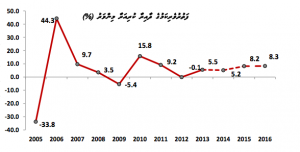
Tourism growth

According to the annual tourism yearbook published by the Tourism Ministry, the average occupancy rate of all tourist establishments in 2012 was 2.5 percent below the previous year – at 70.6 percent.

The major decline in occupancy rate was recorded from the resort/hotel sector, while the occupancy rate of guest houses and safari vessels remained constant at 23.4% in 2012,” the yearbook stated.

The average duration of stay fell from 8.6 days in 2009 to 6.7 days in 2012.

Moreover, following 20.7 percent growth in tourist arrivals in 2010 and 17.6 percent in 2011, the growth rate slowed to 2.9 percent in 2012, well below the annual average of 7.7 percent growth rate from 2008 to 2012.

The yearbook revealed that the overall positive was largely a result of the “outstanding performance” of the industry prior to the transfer of power in February.

“Fiscal discipline”

The outlook statement meanwhile observed that most economic and monetary problems facing the Maldives were “directly or indirectly related to the state’s ‘fiscal discipline.'”

The Finance Ministry noted that a fiscal responsibility law ratified in May stipulates that government debt must be brought below 60 percent of GDP within the next three years.

While public debt in 2012 stood at 78.6 percent of GDP in 2012, the outlook statement revealed that it had fallen to 72.6 percent this year.

However, the figure is expected to grow to 81 percent of GDP in 2014.

A budget surplus in the coming years would be necessary to reach the legally mandated target, the finance ministry stated.
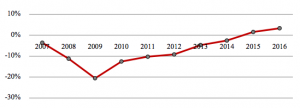
Fiscal deficit (as a percentage of GDP)

While the estimated fiscal deficit in the 2013 budget was MVR1.4 billion (US$90 million) or 3.6 percent of GDP, the deficit at the end of the  year would stand at MVR1.7 billion (US$110 million) or 4.7 percent of GDP, the statement noted.

The main reason for the higher than expected deficit spending was failure to implement proposed revenue raising measures intended to generate MVR1.8 billion (US$116.7 million) in new income.

The measures included hiking the Tourism Goods and Services Tax (T-GST) to 15 percent, raising the airport service charge to US$30, leasing 14 islands for resort development, raising tariffs on oil, introducing GST for telecom services, and “selectively” reversing import duty reductions.

In April, parliament rejected government-sponsored legislation to raise the departure tax on outgoing passengers, prompting Finance Minister Abdulla Jihad to seek parliamentary approval to divert MVR 650 million (US$42 million) allocated for infrastructure projects in the budget to cover recurrent expenditure.

The move followed a cabinet decision to delay implementation of new development projects financed out of the budget due to shortfalls in revenue.
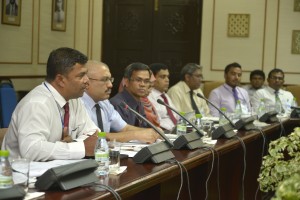
Meanwhile, Jihad reportedly told parliament’s Finance Committee last week that no foreign bank was willing to lend to the Maldives anymore because of instability.

When the new revenue did not materialise, Jihad said the finance ministry approached foreign banks to sell treasury bills, but was turned down. Some banks refused to roll-over previously sold T-bills, he added.

As a result, Jihad said, the government was forced to overdraw from the public bank account at the Maldives Monetary Authority.

Moreover, banks only agreed to buy T-bills at an 11 percent interest rate, Jihad said, which would not be sustainable for the government.

While MVR500 million (US$32 million) a month was needed to pay salaries and allowances for state employees, government income in some months was just MVR300 million (US$19 million), Jihad noted, leaving no option but to turn to the central bank.

Deficit and debt

The total public and publicly guaranteed external debt in 2012 stood at MVR11 billion (US$713 million) and was estimated to have reached MVR11.6 billion (US$752 million) this year, the outlook statement revealed.

A total of MVR2 billion (US$129 million) from foreign loans was disbursed in 2013 for development projects, with 7.44 percent from multilateral financial institutions, 34.5 percent from bilateral partners, and 51.8 percent from commercial banks.

The MVR839 million (US$54 million) estimated as budget support in 2013 meanwhile included US$25 million from a stand-by credit facility provided by India in 2011 and a US$29.4 million loan from the Bank of Ceylon.
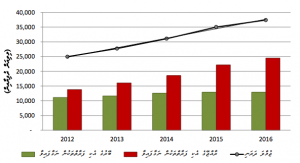
External and domestic debt

The external public debt is projected to increase to MVR12.5 billion (US$810.6 million) next year, the finance ministry noted.

Domestic debt in 2012 was MVR13.8 billion (US$895 million) and MVR16 billion (US$1 billion) in 2013. This figure is projected to rise by 15 percent to MVR18.5 billion (US$1.19 billion) next year.

The state’s total debt in 2013 is therefore estimated to be MVR27.7 billion (US$1.79 billion) – expected to rise to MVR31 billion (US$2 billion) in 2014.

The government spent MVR2.7 billion (US$175 million) in 2012 and MVR3.5 billion (US$227 million) in 2013 for loan repayment and interest payments to service foreign and domestic debts.

Likes(0)Dislikes(0)

PPM member asks Supreme Court to remove DRP leader from parliament

Progressive Party of Maldives (PPM) council member and prominent lawyer Mohamed ‘Wadde’ Waheed has filed a case at the Supreme Court requesting the court disqualify Dhivehi Rayyithunge Party (DRP) Leader and MP Ahmed Thasmeen Ali from parliament.

Wadde yesterday told local media that Thasmeen took a MVR2.9million (US$188,067) loan from Parliament Deputy Speaker Ahmed Nazim and did not pay the money back in accordance with a Civil Court ruling.

Nazim filed a case at the Civil Court in 2011 to recover MVR1.9million (US$124,513) unpaid out of the MVR2.9 Million (US$188,067) Thasmeen took from him as a loan.

Article 73(c) of the constitution states: “A person shall be disqualified from election as, a member of the People’s Majlis, or a member of the People’s Majlis immediately becomes disqualified, if he has a decreed debt which is not being paid as provided in the judgment.”

Wadde said that, although Thasmeen had now paid all the money, he did not pay according to the Civil Court ruling, which required the repayment of MVR320,000 (US$20,779) each month for six consecutive months to clear the debt.

The Civil Court ruling came in April 2011, with Thasmeen unsuccessfully appealing the case at the High Court the same month.

In June 2012, Nazim filed another case at the Civil Court because Thasmeen was not paying as per the Civil Court resulting in the court issuing a warrant freezing all the bank accounts of Thasmeen and ordering the Immigration Department to hold Thasmeen’s passport.

Lawyer Wadde was chosen to contest the Kaashidhoo parliamentary by-election for the PPM in March 2012, before the party decided to support now-MDP MP Abdulla Jabir – then a member of the Jumhooree Party – prompting public criticism from Wadde.

The lawyer was also at odds with his party’s senior leadership last month after filing a case in the Supreme Court challenging opposition MDP candidate and former President Mohamed Nasheed’s candidacy.

In October Wadde also submitted a case to the Supreme Court seeking a ruling against the motion passed by parliament to appoint Speaker Abdulla Shahid as interim head of state in the instance that an elected president cannot be installed by the constitutionally mandated date, November 11.

The same day, Wadde also submitted another case to the court asking it to rule that the MDP MP Ahmed Hamza’s appointment to the judicial watchdog – the Judicial Services Commission (JSC) – was conducted in breach of the constitution.

Last night, the MDP issued a statement condemning the filing of the case against Thasmeen, alleging that the PPM was trying to undermine the constitution through the Supreme Court.

The party called upon the PPM to stop all of its works against the spirit of democracy.

The MDP said the PPM was using the Supreme Court to defeat political opponents because is understood that it had been defeated in the political field.

The Supreme Court ruled on October 24 that both MDP MP Ali Azim DRP MP Mohamed Nashiz be stripped of their parliamentary seats over decreed debt. The ruling was subsequently rejected by the Parliamentary Privileges Committee, with scuffles ensuing between the military and MPs at the subsequent Majlis session.

The current MDP and DRP alignment constitutes a simple majority in parliament.

The party also said that the citizens would not allow the PPM to use courts under the influence of former President Maumoon Abdul Gayoom to deprive the MDP of its majority in parliament.

Likes(0)Dislikes(0)

Defence Ministry slams Majlis recruitment of independent security

The Ministry of Defense and National Security has slammed the People’s Majlis decision to establish an independent security unit to oversee the safety of MPs and Majlis premises.

In a statement issued on Saturday, the Defense Ministry said Article 105 (a) and (b) of the constitution mandated the security forces to oversee security of the People’s Majlis offices, facilities and protection of all members, and hence the Maldives National Defense Forces (MNDF) is currently in charge of the task.

“When the constitution has set out specific responsibilities and roles for the Maldives security forces, the Ministry of Defense and National Security, as the most important institution mandated to ensure security of the Maldives, does not believe that the People’s Majlis secretariat can hand over this task to any body that is not part of the security forces.

And this ministry does not believe that the protection of the People’s Majlis, and ensuring the security of the Majlis can be handed over [to another party] in violation of the constitution,” the Defense Ministry said.

The statement follows the Majlis Speaker Abdulla Shahid’s appointment of former MNDF officer Mohamed Haleem to the position of Sergeant at Arms and announcement to recruit an additional 104 security officers.

Majlis secretariat announced for a Sergeant at Arms after MNDF officers stormed the People’s Majlis to remove Maldivian Democratic Party (MDP) MP Ali Azim from its premises. Shahid condemned the move stating that under parliamentary regulations, the MNDF are to operate under instructions from the Speaker inside the Majlis premises.

Soldiers clad in combat fatigues removed Azim from the Majlis building on October 26 after the Supreme Court stripped Azim and MDP aligned Dhivehi Rayyithunge Party (DRP) MP Mohamed Nashiz of their seats over decreed debt. The Parliamentary Privileges Committee said it does not accept the “politically motivated” ruling.

The MDP and DRP currently control a simple majority in parliament. The DRP decided to back the MDP after its candidate Mohamed Nasheed gained 45.45 percent of the vote in the annulled first round of presidential elections on September 7.

Defending the Majlis

MDP MP and Spokesperson Hamid Abdul Ghafoor is currently taking refuge inside the Majlis following several attempts by police to arrest him and present him at the Criminal Court for a trial on alleged refusal to provide a urine sample. Hamid said the Criminal Court had fast tracked his case unlawfully and without due process to “purge” MDP MPs from parliament.

Refusal to provide urine can result in a one year jail sentence. If Hamid is found guilty, he may lose his parliament seat.

The Criminal Court on October 31 sentenced Hamid to six months in jail for disobedience to orders when he refused to comply with several criminal court summons.

However, Hamid will still be able to attend Majlis hearings after amendments to the Parliamentary Procedures the day before his sentencing permitting MPs to attend Majlis even if convicted of criminal offenses.

Speaking to Minivan News today, Hamid said: “I think it is very normal for a parliament to have its own security within its premises.”

DRP MP Rozaina also supported the move, saying: “In the system we have now, where courts, police and MNDF are politicized by the people leading these institutions, the Majlis definitely needs its own.”

The Inter-Parliamentary Union is currently in the Maldives to “to help find ways to improve trust and confidence between State institutions.” The IPU has expressed concern “the frequent intimidation, harassment and attack of MPs as they go about their work.”

The MDP led parliament also voted out Attorney General Azima Shakoor and has submitted no confidence motions against Defense Minister Mohamed Nazim, Prosecutor General Ahmed Muizz and deputy speaker and PPM MP Mohamed Nazim.

Three MDP MPs are currently on trial, while police have asked the PG to prosecute four additional MDP MPs.

MP Ali Waheed is on trial for disobedience to order for crossing a police barricade, while Hamid and Abdulla Jabir are on trial for alleged alcohol and drug abuse.

Police are charging MPs Alhan Fahmy, Imthiyaz Fahmy, and Mohamed Rasheed with contempt of court for criticizing the Supreme Court, and MP Ibrahim Rasheed with assaulting a police officer.

The MDP notes corruption charges against several government aligned MPs have been dropped since the controversial transfer of power in February 2012.

Likes(0)Dislikes(0)

STO head assures oil imports problem will be resolved

The Managing Director of the State Trading Organisation (STO) has assured that the country’s looming oil payment crisis will be resolved tomorrow after the central banking authority committed to financing overdue payments.

“MMA [Maldives Monetary Authority] has given certain commitments – we still need to arrange everything – tomorrow we are going to work on it,” Shahid Ali told Minivan News today.

Shahid told MPs last week that the STO would run out of oil as early as November 10 if it did not pay some of its US$20million oil debt.

“The exact amounts have not been agreed upon,” Shahid explained today (October 3). “Tomorrow we need to make at least some payments.”

During an emergency meeting of the Majlis Finance Committee last week – with both MMA Governor Dr Fazeel Najeeb and Finance Minister Abdulla Jihad in attendance – Shahid told MPs that government-owned companies owed the STO more than MVR600 million.

Jihad informed the committee that he had asked the MMA to provide MVR50 million to the STO but was told that the central bank could only arrange for MVR20 million as the public bank account was overdrawn.

The MMA governor said the state did not have the financial resources to provide the requested amount, adding that the central bank would be forced to print money to meet the government’s requirements.

In the event that the country runs out of oil on November 10, Jihad then said he would resign from his post.

“I am asking the MMA for cooperation to provide the funds. This is a basic necessity. Otherwise there is a fear that we could completely run out of oil. Funds have to be arranged for citizens’ basic needs even if the public bank account is overdrawn,” he said.

Minivan News was unable to reach Dr Najeeb at the time of press.

When asked if the MMA was printing money in order to finance the oil payments, Shahid simply repeated that the authority had “given certain commitments”.

The MMA’s quarterly figures show that the Maldives’ petroleum imports amounted to US$248.4 million in the first half of 2013 – representing 29 percent of the cost of all goods brought into the country.

Najeeb also told the Majlis Public Accounts Committee last week that state reserves were insufficient to balance the country’s growing deficit.

Local media reported Najeeb as warning that the state was on the verge of being forced to print money.

“Parliament must also consider ways to reduce the structure of the State. I think this is very serious. Or else, the value of our money will keep dropping,” the Governor was quoted as saying.

The MMA’s most recent Quarterly Economic Bulletin revealed that government finances had “further deteriorated in the first six months of 2013” due to a sizeable shortfall in expected revenue coupled with a marked increase in recurrent expenditure.

After measures to raise 15 percent of total revenue budgeted for 2013 – MVR1.8 billion (US$116.7 million ) – failed to materialise, Finance Minister Abdulla Jihad was forced to seek parliamentary approval to divert MVR 650 million (US$42 million) allocated for infrastructure projects in the budget to cover recurrent expenditure.

In recent months, the government has become increasingly reliant on the issuance of short term treasury bills in order to plug gaps in the current budget.

Whilst introducing a proposed MVR16.4 billion (US$1 billion) budget for next year to the Majlis last week, the Finance Minister urged the government to pursue austerity measures.

In November 2012, a team from the International Monetary Fund (IMF) advised that strengthening government finances was “the most pressing macroeconomic priority for Maldives”.

Likes(0)Dislikes(0)

Development requires democracy, says Nasheed, launching “Votun Ufaaverikan” campaign

A democratic government elected by the people is necessary for development of the country, former President Mohamed Nasheed said at a rally in Haa Dhaal Kulhudhufushi on Saturday (November 2) to launch the Maldivian Democratic Party’s (MDP) “Votun Ufaaverikan” (Contentment through the Vote) campaign.

The MDP presidential candidate said the party believes democratic principles were best demonstrated by the practice of reaching consensus through consultation advised in the Quran and Sunnah (teachings and practices of Prophet Mohamed).

“It will be hard to bring about the change we want, the development we want, without following these principles,” he said.

The most important lesson Maldivians have learnt in the recent past is that a democratic system of governance must be strengthened to achieve development, Nasheed said, adding that a “muddled” government could not ensure progress.

While the MDP government planned a number of development projects for Kulhudhufushi, he added, it came to a halt under the present “unelected government.”

An election was needed to resume the projects, he said, which includes the construction of a 22-kilometre road, a ferry terminal, a city hotel and a duty-free complex in addition to building housing units, securing opportunities for higher education, widening the ‘Hunaru’ skills training programme, and connecting the island to India via a ferry network.

Before the MDP government was “toppled” in February 2012, Nasheed said regional governments had committed to an Indian ocean passenger and cargo ferry service at the November 2011 SAARC summit in Addu City.

The MDP’s presidential election campaign was relaunched with the new slogan yesterday at 4:30pm with simultaneous events in 23 locations, covering all the atolls of the country.

Gatherings also took place in Malaysia and India, with Speaker Abdulla Shahid attending the function in Trivandrum.

In his speech at the main event, Nasheed said the purpose of an election was to offer a choice for citizens to pick the best policies and pledges.

In a democracy, he added, the role of opposition parties should be holding the government accountable and ensuring that campaign pledges were fulfilled.

However, instead of campaigning and presenting policies, Nasheed said rival parties were “using religion as a political weapon” to level false accusations against the MDP.

The “bitter consequence” of persistently claiming that the MDP was “irreligious or secular” was the creation of doubt in younger generations regarding religion, Nasheed contended.

Divisive rhetoric

Arguing that the country’s religious unity could be threatened by “backbiting” and divisive rhetoric, Nasheed appealed to religious scholars to refrain “for the sake of religion and the nation” from religion-based attacks.

As the Islamic faith of Maldivians was not lost or weakened under Portuguese rule, Nasheed said there was no possibility of any efforts to weaken the people’s faith ever succeeding.

Speaking at a campaign rally in Lhaviyani Naifaru on Thursday night, Nasheed accused former President Maumoon Abdul Gayoom of obstructing the presidential election to prevent consolidation of democracy in the Maldives.

The MDP’s political opponents were against establishing a democratic system of governance in the country, he contended.

“President Maumoon is someone who has never won in a vote. [Maumoon] winning 90 percent of the vote in these islands was a miracle, it wasn’t an election,” he said.

Elections were the means for ensuring development, Nasheed said, adding that the experience of the past two years have shown that only the MDP could govern in a democratic system.

Addressing supporters in Shaviyani Milandhoo the following night (November 1), Nasheed said MDP’s opponents were trying to maintain a “dictatorial regime” after preventing a presidential election from taking place.

“They do not want development. In truth, they despise the situation of the Maldivian people improving. They believe that development is an obstacle to their own businesses. They believe others entering the resort business is an obstacle to their businesses,” he said.

Meanwhile, speaking at a campaign rally on Saturday night (November 2) in Haa Alif Kelaa, vice presidential candidate of the Progressive Party of Maldives (PPM), Dr Mohamed Jameel Ahmed, reportedly said that Nasheed must be held accountable for the military’s detention of Criminal Court Chief Judge Abdulla Mohamed.

“I will only believe that the rule of law is enforced in the Maldives when the court sentences Nasheed for detaining Judge Abdulla. No one should doubt that this will happen. Nasheed must also be penalised for fraudulently selling the airport to GMR, the serious acts of corruption he committed, and the MVR 5 billion he stole while he was president,” he was quoted as saying by Sun Online.

Jameel also accused the MDP of torching government buildings on February 8, 2012, which he labeled “acts of terrorism,” and claimed that the party was also behind the brutal murder of MP Afrasheem Ali in October 2012.

The MDP could not return to power for these reasons, Jameel said, calling on other parties to unite and prevent Nasheed from winning the election.

Likes(0)Dislikes(0)

Police arrest MDP activist accused of vandalism during protest

Police have arrested a Maldivian Democratic Party (MDP) activist on allegations that he had vandalised a CCTV camera on Chandhanee Magu and attacked a police officer during an MDP protest on October 5.

In a statement, police said that Kamil Ibrahim of Beach Rest house in Ukulhas North Ari Atoll, was arrested yesterday (2 October) at around 11:30pm in a special operation conducted by the police, while he was staying at a house named Bahurein in Maafannu ward.

Police said that on October 5, Kamil Ibrahim broke through the police barricades and entered the green zone, vandalized a police CCTV camera installed in the junction where Chandhanee Magu and Orchid Magu meets and attacked a police officer in the area after threatening several police officers using a weapon and attempting to assault police officers.

Police said that the special operation was conducted after intelligence received information that Kamil was hiding in the house.

It was also revealed that two other men, suspected of being accomplices in hiding Kamil, have been sent summon chits to produce themselves to the police headquarters.

On October 13, police had issued a statement warning that legal action will be taken against anyone who assists Kamil Ibrahim in hiding from police.

On October 5, the MDP held a large protest calling for immediate elections. The meeting was attended by several senior MDP members and MPs including vice presidential candidate Dr Mustafa Lutfi, Chairperson ‘Reeko’ Moosa Manik and MPs Imthiyaz Fahmy, Ahmed Rasheed, Ahmed Sameer, Mohamed Shifaz, Mohamed Gasam and Ahmed Easa

The following day police issued a statement announcing that 12 MDP activists were arrested on charges of assaulting police officers, disobeying police orders, and obstructing police duties.

Likes(1)Dislikes(0)

President disappointed with “ill-informed and irresponsible allegations” by UN human rights chief

President Dr Mohamed Waheed has expressed disappointment with the “ill-informed and irresponsible allegations by the United Nations High Commissioner for Human Rights Navi Pillay”.

Pillay last week blamed the Supreme Court’s repeated interventions in the presidential election process for what she described as “the dangerous drift in the democratic process in the Maldives”.

“The government of Maldives rejects the claim that the Supreme Court and the Government are subverting the democratic process,” read a President’s Office statement.

“The United Nations must try to better understand the difficulties facing Maldives in their early phase of democracy, and provide support to find solutions rather than issue damaging statements from a distance,” the statement added.

The High Commissioner’s comment “undermines efforts of Maldives Supreme Court and the government to strengthen the Rule of Law in the country.”

Waheed’s rejection of Pillay’s criticism follows the response of the court’s Chief Justice, Ahmed Faiz, who quickly labelled the High Commissioner’s statements “irresponsible” and “poorly researched”.

“I harshly condemn UN High Commissioner for Human Rights Navi Pillay’s  false allegations regarding the Maldives Supreme Court’s work to uphold its constitutional duties and responsibilities. I do not believe she has any authority to speak in such terms,” stated Faiz soon after Pillay’s statement on Wednesday (October 30).

Following allegations of voter fraud following an otherwise-applauded September 7 poll, the Supreme Court annulled the vote after ruling that over 5,600 ineligible votes had been cast.

The ruling was based on a confidential police report, kept secret from both the public and the Elections Commission’s defence lawyers. A leaked copy of this report has emerged this week (English).

After a second election date had been scheduled for October 19, polling was again delayed after police argued that the court’s 16 point guideline had not been followed when two of the three candidates refused to assign their names to the new voter lists.

Pillay’s statement last week described the 16 point guidelines as “onerous”. She also pointed to the international community’s longstanding concerns over judicial independence in the Maldives.

In the context of such criticism, the UK Bar Human Rights Committee has described the decision to annul the election as “troubling”.

The latest date set for the first round of the election is November 9, with a potential re-run scheduled for seven days later.

President Waheed – whose constitutionally mandated term expires on November 11 – returned to the country on Thursday night following “a private visit to Singapore and Hong Kong.”

Waheed was reported in local media today as saying that the current constitution is in major need of revision.

“We have found out that the political system we have introduced is in need of changes so that our nation will not continue upon suicidal track,” the President was quoted as saying at an India Maldives Friendship Association function on Friday night.

The People’s Majlis has approved a motion for presidential power to pass to the Speaker of the House Abdulla Shahid during this interim period, although although government-aligned politicians have continued to suggest that the opinion of the Supreme Court should be sought on this matter.

In its initial election annulment verdict, the court the court had ruled that Waheed would be able to remain in power even after the expiry of his presidential term, citing the continuity of government principle.

Waheed has meanwhile claimed that he has no interest in remaining president “even a day beyond November 11”.

Likes(0)Dislikes(0)

Inter-Parliamentary Union delegation arrive for urgent visit

A delegation from the Inter-Parliamentary Union (IPU) has arrived in the Maldives in order “to help find ways to improve trust and confidence between State institutions”.

“The frequent intimidation, harassment and attack of MPs as they go about their work have been deeply worrying,” read an IPU press release.

The organisation’s request for an urgent visit was prompted by the growing list of cases – 24 in total – involving Maldivian MPs currently filed with the IPU’s Committee on the Human Rights of Parliamentarians.

Local NGO Transparency Maldives has meanwhile called upon the Supreme Court to ensure that all MPs are treated impartially whilst calling upon members not to abuse parliamentary privileges for personal gain.

The IPU delegation, having arrived on Friday (November 1), will spend one week in the country during which time it will meet with government leaders, senior parliamentary authorities – including Speaker Abdulla Shahid, Police Commissioner Abdulla Riyaz, and members of the Supreme Court.

The group will also meet with President Dr Mohamed Waheed – recently returned from a private trip to Singapore and Hong Kong.

“The mission not only aims to promote confidence and trust between State institutions ahead of the forthcoming election, but also to have a better understanding of recent allegations of human rights violations against members of parliament. These include arbitrary arrests, attacks and intimidation, including death threats,” says IPU head of human rights programmes and mission member, Rogier Huizenga.

The delegation’s arrival follows a fraught week in the People’s Majlis, during which two MPs were unseated by the Supreme Court – a decision subsequently rejected by the speaker.

Meanwhile, Maldivian Democratic Party (MDP) MP Hamid Abdul Ghafoor – who has sought refuge within parliamentary grounds – was handed a six month jail term by the Criminal Court.

Both the verdict for Hamid and for the MPs unseated by the Supreme Court were given in absentia, a tactic the MDP has described as reminiscent of “old autocratic practice”.

The party described the Hamid sentence as “the latest move by the Maldivian judiciary in a political witch-hunt to purge MDP MPs following the party’s newfound majority in parliament.”

Transparency Maldives

Whilst calling for neutrality in the courts, Transparency Maldives (TM) has also condemned what it characterised as “attempts to shape laws and rules for protecting personal interests of the Members of the Parliament and abuse of parliamentary privileges and the institution of the Parliament.”

In a statement last week, TM contended that such attempts “weaken the legal system and obstruct the rule of law. Similarly, such acts undermine the integrity of the Parliament, eroding public confidence in the institution.”

“Members of the Parliament must be provided with appropriate privileges and immunities in order to carry out their duties as lawmakers. However, Transparency Maldives reiterates its concern that the Parliamentary Privileges Act affords undue privileges and powers to the MPs,” the statement read.

The press release followed this week’s submission of amendments to the penal code, the Drugs Act and the parliamentary rules of procedure by the MDP.

The amendment to the penal code seeks to abolish article 81 regarding public servants exercising their authority to detain innocent persons. The MDP presidential candidate and former President Mohamed Nasheed is being charged under the article for the military’s detention of Criminal Court Chief Judge Abdulla Mohamed in January 2012.

The amendment to the Drug Act meanwhile proposes shortening the jail sentence for the offence of refusing a urine sample from one year to 15 days while the amendment to the parliament regulations would allow MPs convicted of a criminal offence to attend parliament and participate in votes.

In addition to his sentence for refusing to attend court hearings, MP Hamid stands charged of drug and alcohol offences, as well as allegedly refusing to provide police with a urine sample.

Likes(0)Dislikes(0)

Comment: The importance of presidential candidates’ meeting

Even as the rest of the world – and Maldivians too – had almost given up the country as being on the brink of a political and leadership chaos, it has bounced back with the kind of verve and nerve that democracy entails at birth. The three presidential candidates met in what was not an entirely unexpected turn, and declared their intention to try and complete the poll process in time for an elected president to assume office on 11 November, the D-day under the constitutional scheme and national tradition.

Meeting on Sunday night, former President Mohammed Nasheed of the Maldivian Democratic Party (MDP), and his rivals, Abdulla Yameen of the Progressive Party of Maldives (PPM) and Gasim Ibrahim of the Jumhooree Party (JP), unanimously decided to approach the Election Commission (EC) for advancing the poll-dates. If their combined effort next morning when the met the EC officials did not fructify, it owed to the existing electoral scheme – or, so it would seem.

As may be recalled, the EC had fixed 9 November for the first-round and 16 November for the second-round of the once-annulled and once-cancelled polls. The tradition under the continuing constitutional scheme for decades now has been for the elected president to assume office on 11 November. With the second-round of polls, if required for the victor to possess the mandated 50-percent vote-support, scheduled for 16 November, questions have begun to be asked from the highest levels on the possibilities of an emerging constitutional vacuum.

In their meeting, the three candidates claimed to have worked out a scheme for verification of the voters’ list individually. Whatever that may be, they seemed desirous to let nothing – including the possibly an allegedly faulty voter-list – come in the way of completing the poll process. Claims of ‘faulty voter-list’ were among the causes for presidential polls, originally scheduled for 7 and 28 September, getting inordinately and at times inadvertently delayed.

During their meeting on Sunday night, the three candidates decided to urge the EC to advance the first round to 2 November and the second round, if needed, to 9 November. Clearly, they wanted the poll process to be completed in time for the elected one from among them to assume office on 11 November. None of them wanted a constitutional vacuum to emerge in the country during its democratic infancy, particularly after incumbent President Mohammed Waheed expressed a desire to step aside before the deadline for transition.

Going by local media reports, the three candidates meeting the waiting media together after their talks with EC officials, did not elaborate on the EC’s reasons for not being able to conduct the polls. While drafting earlier poll-schedules, the EC had provided the required 21 days for completing the administrative work, comprising re-registration of new voters and those wanting to vote in a booth other than originally assigned. The latter in particular should have thrown up problems while advancing the poll after re-registration had been set in motion.

Under the law, any Maldivian citizen attaining 18 years of age on the day of (first-round) polling are entitled to register their names as voters. After the EC had fixed 9 November as the day for first-round polling and opened re-registration, advancing the poll dates would have been fraught with complications that the constitution’s framers did not foresee, and hence did not provide for. Nor did the 4-3 verdict of the Supreme Court that annulled the 7 September poll and setting out a 16-point guideline for re-poll provide for.

With all sections of parliament involved in the three-candidate negotiations, getting an emergency constitutional amendment Bill through the People’s Majlis would have been a formality. Outgoing President Mohammed Waheed Hassan Manik, who readily endorsed the three-candidate decision, may have also given his assent to such a constitutional amendment. Should any citizen affected by the measure go to the court, however, the process by itself would have been time-consuming, defeating the very purpose of the poll-advancement idea.

‘No’ to military rule

The three-candidate meeting and their meaningful proposal has brought back political pragmatism to the nation’s centre-table, where electoral expediency and excesses alone seemed to rule for a time. President Waheed, who had not very long ago dubbed himself the ‘most hated person’ for the international community and media, set the ball rolling instead, by sounding out the possibility of his resigning from office along with his entire Cabinet, including Vice-President Waheed Deen, for Parliament Speaker, Abdulla Shahid, to take over for a 60-day election-period, as per the Constitution. He followed it up with a letter to Parliament

With the MDP’s Nasheed having won the highest 45.45 percent vote-share in the annulled first-round, the party-led alliance jumped at President Waheed’s proposal. It got the house to pass a resolution on those lines. This is to be followed by a formal bill on the same subject in the coming days, it is said. However, such a course would require a constitutional amendment. The non-MDP alliance parties had boycotted the earlier vote on the resolution. They can be expected to boycott the vote on the upcoming Bill, also, should the MDP still go ahead with the proposal after the three-candidate confabulation.

To the extent the three candidates, their parties and coalitions have been able to distinguish between political realities, electoral exigencies and constitutional compulsions, the nation has been brought back from the brink. Likewise, the Jumhooree Coalition’s Hassan Saeed, vice-presidential running-mate to Gasim Ibrahim, has shot down the proposition of a possible term of ‘military rule’ post 11/11, if the first-round poll of 9 November does not produce a president-elect. The coalition was not considering the option, Saeed said a day after JP parliamentary group leader, Ilham Ahmed, had proposed the same in the house on Sunday.

Air of permissiveness

The JP – and other political outfits – may be in for a time of introspection, if not explanation, a vandal attacked the Indian High Commissioner’s car outside of the diplomatic mission. The car’s wind-screen was damaged, but fortunately, no one was inside the vehicle at the time. Earlier in the day, JP’s mouth-piece, Miadhu, quoted party Secretary-General Hussein Shah as saying that “a foreign Ambassador (had) requested (party founder and presidential candidate Gasim) not to go to court even if there is any vote-manipulations”.

The police are investigating the car-attack. In diplomatic terms, the attack means more for bilateral relations than may be visible and acceptable. Shah’s unsubstantiated claims and the attack on the Indian envoy’s car may have been independent episodes, but both are also reflective of an ‘air of permissiveness’ that has permeated down the democratic political culture in the country. On an earlier occasion, a senior aide of President Waheed attacked the then Indian High Commissioner by name. He was shifted out to a different position, which was considered an elevation, not a punishment, of sorts.

Needless to point out that the President’s Office, Parliament, the police and armed forces headquarters are all within a stone’s throw of the Indian High Commission. The stone that fell on the Indian side could very well have fallen on the other side, too. It only goes on to indicate the precarious nature of the nation’s politics and politics-driven people’s posturing just now. It comes a year and half after the prevailing mood and methods of this kind culminated in the controversial resignation of President Nasheed on 7 February 2012. Each party and politician continues to have a different take and cause for the events, versions and justifications of that day – all of them contributing to the current confusion and consequent impasse.

Likes(0)Dislikes(0)