Extraordinary Majlis session cancelled amid chaos, vandalism in chamber

An extraordinary meeting of the People’s Majlis was cancelled today after Speaker Abdulla Shahid’s microphone was vandalised during a Progressive Party of the Maldives (PPM) and Jumhooree Party (JP)-led effort to disrupt parliamentary proceedings.

Twenty-nine MPs of the Maldivian Democratic Party (MDP) had asked Shahid to schedule an extraordinary sitting claiming certain politicians were “destroying constitutional tenets and straying from the path of democracy”, as the JP seeks to annul the first round of September’s presidential polls in the Supreme Court.

Vilifushi MP Riyaz Rasheed and Gemanafushi MP Ilham Ahmed blew on whistles and vuvuzelas as PPM and JP members raised numerous points of order and shouted “rigged vote.”

Shahid took a short break at 10:00am to speak with Parliamentary Group leaders, but was unable to reconvene the session after a cable on his table microphone was cut.

The MDP – which placed first with 45.45 percent of the vote – has said it will table a no confidence motion against Attorney General Azima Shakoor after she intervened in support of the JP and change the composition of the Supreme Court bench.

The MDP and its recent ally the Dhivehi Rayyithunge Party (DRP) control a majority in the Majlis with a combined strength of 39 of the 77 MPs.

Likes(1)Dislikes(0)

Economic diversification vital for food and energy security, says government report

The Maldives continues to face huge issues of food security, last year importing 90 percent of all goods consumed, while also being one of the most “oil vulnerable” countries in the world, according to a government report calling for significant economic diversification.

According to the Maldives Economic Diversification Strategy (MEDS), released last week, the nation has become “over-dependent on tourism”, with the industry last year accounting for more than two thirds of the Maldives’ Gross Domestic Product (GDP).

The report concluded that such a reliance on one sector alone had left the country’s economy particularly susceptible to natural disasters and adverse financial conditions.

“The Maldives needs to bridge swiftly the gaps that are emerging from the short-term political aims and the long-term economic goals,” stated the report’s introduction.

“Our vision for the Maldives is to become a high income, resilient, inclusive economy by 2025,” it added.

The MEDS reported that fuel imports last year totaled US$488 million or 22 percent of annual GDP.  Meanwhile, US$389 million was spent bringing food into the country in 2012 – with demand predominantly made up of US$64 million in confectionery and beverages; US$60.1 million in meat, fish and seafood; and US$49.3 million in vegetables, root crops and spices.

The country’s official external debt was also said, on the basis of official figures, to have “increased significantly” to US$846.2 million – 38 percent of GDP – by the end of 2012, from US$ 959.1 million – 43 percent of GDP – in 2011.

Financial challenge

The government earlier this month said it hoped to secure longer-term financing to plug a shortfall in annual revenue that has seen the number of 28-day Treasury Bills (T-bills) sold by the state almost double by July 2013, when compared to the same period last year.

The comments were made just weeks after the Maldives Monetary Authority raised fears over the current “beyond appropriate” levels of government expenditure during 2013.

” Broad-based” economy

In an attempt over the next decade to transform the Maldives into one of Asia’s so-called “miracle economies”, such as Singapore and Hong Kong, the MEDS report, compiled by the Ministry of Economic Development, has outlined a ten sector strategy towards making the Maldives a “broad based export driven economy.”

“After having enjoyed rapid economic progress over three decades, our economic conditions changed dramatically following the Indian Ocean tsunami,” stated the report, which calls for a smaller, more prudent government moving forward.

“Since 2005, economic policy making in the Maldives has focused on crisis management. What is needed in the Maldives now is to move away from crisis related adhoc decision making to a clear vision, coherent strategies and coordinated policies.”

The MEDS report contained 10 sector specific plans for development of a more versatile economy. These include:

Transport

The government has pledged to boost the importance of transportation services to the economy by increasing their value to US$500 million by 2025 – from US$153 million last year.

According to the report, this focus will be achieved through expanding the capacity of existing transport hubs such as Ibrahim Nasir International Airport (INIA) and developing cruise ships terminals and a marina.

Despite this pledge, the government controversially scrapped a US$511 million contract signed under the previous administration with India-based infrastructure group GMR to develop and manage an entirely new airport terminal at INIA.

Earlier this week, Economic Development Minister Ahmed Mohamed was quoted in local media of accusing the former government of working to make the Maldives “an economic slave” to an unspecified foreign company.

Education

In the field of education, the government report has pledged a strategy of trying to develop higher education as a “priority expert sector” by working to transform the Maldives into a destination capable of attracting 15,000 international students a year.

Trade

For trading strategies, the MEDS has targeted developing local trade to increase value to US$500 million, from just US$96 million last year, partly through a focus on developing malls, boutique stores and e-shopping.

Tourism

In tourism, the Maldives will aim to nearly double current income value by 2025 through strategies to diversify into providing meetings, incentives, conferencing, and exhibitions – (MICE) facilities – in addition to wellness tourism and family orientated attractions.

The government has previously expressed a desire to commit to a number of these developments including the expansion of biospheres and developing other “value-adding” concepts via the Maldives’ fourth official tourism master plan, expected to be unveiled later this month.

The MEDS report anticipated that such developments would help increase the economic contribution of tourism to US$1.2 billion by 2025, from around US$555 million in 2012.

Health

The report has also pledged to develop the Maldives as a destination for international healthcare services via measures such as creating a medical college and a teaching hospital.

In June, the Ministry of Health identified current salary levels and staff safety as the key issues driving “shortages” in the number of trained medical staff coming from abroad to work at under-skilled hospitals in the Maldives.

Financial services

MEDS also expressed a desire to increase the financial service industry’s value to US$250 million by 2025 through the development of legal reforms and wider efforts to attract international banks to the Maldives.

The Maldives National Chamber of Commerce and Industries (MNCCI) argued in July that the country’s politicians had done little to address an ongoing shortage of US dollars and a lack of investment banking opportunities and arbitration legislation in the country.

Communication

The report pledges a strategy of increasing communication service value to US$500 million by 2025 – from US$159 million last year – by pursuing the development of IT parks in the nation as well as providing resorts specifically for research sabbaticals.

Agriculture

The MEDS also pledged to facilitate a means of boosting agricultural production to a value of US$ 150 million by 2025.

Campaigning back in May for the opposition Maldivian Democratic Party (MDP), former President Mohamed Nasheed unveiled an election strategy on the island of Kulhudhufushi in Haa Dhaal Atoll, that he claimed could lead the country to produce about 44 percent of the foodstuffs currently being imported into the country.

Likes(1)Dislikes(0)

Elections Commission asks Adhaalath Party VP to explain “irreligious” allegations against Nasheed

Adhaalath Party Vice President Dr Mauroof Hassan has said the Elections Commission Complaints Bureau has sent him a second request asking him explain his justifications for calling Maldivian Democratic Party (MDP) presidential candidate and former President Mohamed Nasheed ‘ladhini’ (irreligious).

Mauroof said that although the EC had asked him to provide a response before 12:00pm Sunday (September 22), he had not yet sent a reply.

“I am currently working on drafting a response and will send it in when I am able to complete it,” he told Minivan News, adding he could not say how long this might take.

Mauroof said the letter had been sent regarding a complaint received by the EC Complaint Bureau concerning remarks he had made against Nasheed at a Jumhooree Coalition rally on September 10.

The AP Vice President has told local media that regardless of how much he and his words were investigated, he will not stop referring to Nasheed as an “irreligious man”.

He further alleged that Nasheed was to be called ‘ladhini’ alleging he was harassing the religion of Islam, disregarding of religious matters and attempting to the role of Islam by separating state and religion.

Mauroof alleged that the independence of the EC could now be questioned as a result of its decision to look into the matter of Nasheed being called ‘ladhini’.

He further alleged that the MDP had on February 8, 2012, set ablaze many state institutions in various parts of the country and committed a multitude of other illegal acts, adding that he is “astounded by the EC’s complete silence” regarding these actions.

He expressed deep concerns, alleging that based on the EC’s actions, he currently sees it as a commission filled with members who are actually activists associated with MDP.

“Adhaalath does not understand democracy”: MDP MP Hamid

Speaking about the matter, MDP MP and Spokesperson Hamid Abdul Ghafoor described the AP Vice President’s words as “nothing but meaningless rhetoric”.

“The Adhaalath Party has never managed to get elected to the parliament or councils or such post. Their political failures are a result of their lack of understanding of how democracy works. They simply are unable to comprehend it,” he stated.

“Their description of EC as an MDP campaign office further displays their ignorance on how independent commissions work. The EC will look into any acts which are unconstitutional and against the election related laws and regulations. This is why they are looking into this specific case too.”

Elections Commission President Fuwad Thaufeeq and Vice President Ahmed Fayaz were not responding to calls at the time of press.

Likes(0)Dislikes(0)

Week in review: September 13-21

Following a full week of hearings into the Jumhooree Party’s election complaints, the High Court granted the party’s request to view the offending register – under supervision- though the party is still seeking greater access in order to prove its claims regarding fraudulent voters. Meanwhile, the Supreme Court accepted to hear the JP’s case seeking to annul the first round altogether.

After hearing the claims of former Attorney General – and vice-presidential candidate – Dr Hassan Saeed, which included deceased, repeated, and fake voters, the court ordered that the Elections Commission (EC) hand over the voter registry for inspection. Repeated calls to respect the outcome of the election from across the international community failed to impress Dr Saeed.

Maintaining that all allegations are without merit, the EC continued to prepare for the upcoming second round – scheduled for September 28 – officially announcing the first round results despite the JP’s attempts to delay.

The barrage of criticism, particularly from Gasim’s own Villa Television (VTV), led the EC to warn the Majlis that national security could be damaged by “unfounded claims of corruption”.

The national broadcasting commission began looking into VTV’s reporting of unsubstantiated content this week, whilst the police finished looking into the content of the EC’s rubbish, finding no incriminating documents.

Further protests against the EC have been promised by religious civil society groups. The conservative Jamiyathuh Salaf group singled out the Maldivian Democratic Party (MDP) for criticism in a nationally televised sermon that resulted in broadcasting commission being called before the Majlis once more.

The police appeared to have been drawn into the dispute as an alleged police intelligence document emerged on social media, alleging “some opportunity for fraud” and “illegal voting”. The report was quickly disowned by the police and condemned by the MDP, who also called the Majlis to reconvene tomorrow (September 22) in order to stop “undue influence of political parties in the judiciary”.

Elsewhere in the country, the police in Addu City searched a number of homes as part of their election security operation, whilst fears over black magic persisted in Guraidhoo – the local council refusing use of the school for polling.

President Dr Mohamed Waheed’s Gaumee Ittihad Party (GIP) followed its former coalition partner – the Dhivehi Rayyithunge Party (DRP) in choosing a candidate to back in the endangered run-off. Waheed’s party chose to support the Progressive Party of Maldives’ candidate in round two, whilst the DRP leaders were paraded before MDP supporters following last week’s decision to lend support to former President Mohamed Nasheed in the race – a decision that resulted in the sacking of DRP minister Ali Shareef.

Nasheed visited the house of JP leader Gasim on Thursday though the JP insisted no decisions on future alliances would be made before the courts have finished their work. When addressing a youth forum earlier in the week, Nasheed had expressed confidence that Maldivian democracy could withstand a handful of coups and rigged elections.

Disabled Maldivians demonstrated this week against the impending closure of the country’s only school catering to those with special needs, whilst the pervasiveness of politics was revealed as deaf interpreter Shaheez Abdulla gave an account of his recent stabbing.

The ongoing case of former Civil Service Commission Chair saw his access to the commission as well as his salary revoked after Mohamed Fahmy Hassan had continued to come into his former workplace.

Finally, details were revealed of the government’s cancellation payments to forensic accountants Grant Thornton as well as the circumstances of Swedish nationa Filip Eugen Petre’s flight from the country following his acquittal of charges relating to the deaths of a British couple in 2011.

Likes(0)Dislikes(0)

MDP proposes changes to Supreme Court bench and no-confidence motion against Attorney General

The opposition Maldivian Democratic Party (MDP) decided during a contingency meeting of the party’s national council on Friday (September 20) to pursue a no-confidence motion against Attorney General (AG) Azima Shukoor and change the composition of the Supreme Court bench through legislation.

The meeting took place after three consecutive days of lengthy Supreme Court proceedings of a case filed by the Jumhooree Party (JP) against the Elections Commission (EC) seeking annulment of the first round of the September 7 presidential election. The Supreme Court hearings adjourned for the weekend on Thursday.

At its meeting yesterday, the MDP national council adopted a resolution to undertake all necessary efforts to ensure that the presidential election would be free, fair and transparent and “decided only by the vote of the people and not by the courts”.

The resolution submitted by MDP MP Ahmed Hamza was passed with unanimous consent of all 51 members of the national council in attendance.

‘Certainty of the margin’

During the debate on the resolution, the MDP presidential candidate former President Mohamed Nasheed said it was important for all political parties – including the JP – to have no doubts over the integrity of the electoral process.

Nasheed said that the JP’s main issue was the narrow margin of 1.28 percent – a difference of just 2,677 votes – between its candidate Gasim Ibrahim and the Progressive Party of Maldives (PPM) candidate Abdulla Yameen Abdul Gayoom.

For the JP to accept the narrow margin, Nasheed said that the registry of voters had to be checked to verify the JP’s claim that ineligible voters were on the list.

Nasheed noted that the EC had published the registry in the government gazette for public scrutiny, after which the MDP had identified some 800 people in the list that were either deceased, underage or repeated more than once.

The question that has to be answered, said Nasheed, is whether more than 2,000 people who were not eligible to vote had cast their ballots.

The former president expressed confidence that electoral fraud had not occurred in the September 7 election even if there were problems with the voters registry.

Altering Supreme Court composition

“As experts are noting that some judges on the Supreme Court bench lack certain kinds of legal knowledge and experience, it is our view changes has to be made to the composition of the Supreme Court’s bench. That is, by amending the Judges Act,” Nasheed said.

Shortly before the MDP government was toppled on February 7, 2012, the party proposed a bill to amend the Judicature Act that would reduce the number of judges on both the benches of the Supreme Court and High Court.

MDP Spokesperson Imthiyaz Fahmy told Minivan News at the time that the amendments had been forwarded due to inefficiency of both the High Court and the Supreme Court in concluding cases.

In March 2013, the MDP national council, following a controversial Supreme Court ruling that overturned parliament’s decision to vote out Civil Service Commission (CSC) Chair Mohamed Fahmy Hassan on sexual harassment charges, passed a motion calling on its parliamentary group to seek to abolish the existing Supreme Court bench and replace it with a new panel of judges, including foreign judges.

Meanwhile, during Friday’s national council meeting, Nasheed also stressed the importance of speeding up the process of appointing a parliament representative to the Judicial Service Commission (JSC). The seat reserved in the JSC for a member of parliament was declared vacant after JP Leader Gasim Ibrahim formally became a candidate of the presidential election.

No confidence motion against Attorney General

During the debate, MDP MP Ahmed Sameer announced that the MDP parliamentary group has prepared a no-confidence motion against Attorney General Azima Shukoor.

Sameer contended that the Attorney General neglected her duties and has advocated on behalf of a political party against the EC, a state institution.

A special sitting of parliament during its ongoing recess has been scheduled for Sunday upon request by 29 MDP MPs.

Deputy leader of PPM’s Parliamentary Group Moosa Zameer told local media outlet CNM today that the PPM would not support such a motion against Shukoor in parliament.

Zameer said that although the PPM had not taken an official stand on the matter, the party would not support removal of its former council member.

However, with the support of at least six out of ten MPs of the Dhivehi Rayyithunge Party (DRP) – which recently decided to back former President Nasheed in the run-off election – the MDP would have enough votes in parliament to pass the no-confidence motion.

Likes(1)Dislikes(0)

International observers should “help, not hinder” state institutions: Foreign Ministry

President Mohamed Waheed’s government has called on international groups to “help, not hinder the state institutions in exercising their constitutional duties”.

The Foreign Ministry’s statement follows unanimous confidence from international election observers in the credibility of the first round of polling, and calls for the losing parties to accept defeat and allow the second round to proceed as scheduled on September 28.

Presidential candidate Gasim Ibrahim, who narrowly missed a place in the run-off with 24.07 percent of the vote, is pursuing a Supreme Court case to have the results annulled, alleging electoral impropriety. The Progressive Party of the Maldives (PPM) and Attorney General Azima Shukoor have intervened in the case against the Elections Commission.

The Elections Commission has challenged the veracity of the evidence and argued that even were it factual, it was not sufficient to alter the outcome of the first round.

“The Maldives, as a young democracy, continues to face a number of challenges in its journey towards consolidating democracy and strengthening its independent institutions. For this journey to continue the constitutional framework set up in the Maldives through a democratic process should be respected and the authority of the independent institutions should be upheld,” read the statement from the Ministry of Foreign Affairs.

“Elections are the primary means of democratic participation and it is an inalienable right of each individual. Similarly, attempts to resolve questions relating to the electoral process through democratic means, is also part of democracy. These fundamental principles of democracy and the rule of law should be accepted by all concerned,” the statement read.

“It has to be recalled that while the local and international observers and monitors did a commendable job in observing the elections, it is the State institutions that are constitutionally mandated to address any question related to the elections and electoral process. The Government, therefore, wishes to call on anyone interested in promoting democracy in the Maldives to help, not hinder, the State institutions in exercising their constitutional duties,” it added.

“Live up to your responsibilities”: UN Secretary General

UN Secretary General Ban Ki-moon has urged political leaders in the Maldives “to live up to their responsibilities, respect the democratic process, and continue to allow for a peaceful, inclusive and credible vote to take place in the second round.”

Ki-moon “stresses the utmost importance of the will of the Maldivian people being respected throughout the process”, and noted that the conduct of the first round had been “widely recognised as a success by international and domestic election observers.”

European Union: “Respect the electoral process”

The European Union delegation to the Maldives has encouraged “all parties to respect the electoral process” and stated that it “looks forward to the second round on 28 September and a peaceful transition.”

“It is essential to ensure that the outcome of these elections fully respects the wishes of all Maldivians and that the Maldives’ democratic institutions are safeguarded, in order to enable its government to confront the political, institutional, economic, social and environmental challenges the country faces,” the EU stated.

UK Foreign Office: “Crucial that all parties respect the outcome”

Noting that all election observers both international and local and judged the election to be transparent and competitive, “carried out peacefully and in good spirit”, UK Foreign Office Minister Alistair Burt has called on all presidential candidates “to respect the result of elections and the will of the people of Maldives.”

“The Commonwealth Observation Mission’s interim statement noted that the voting register ‘appeared to be accurate and robust’, and that party and candidate observers were present in all of the polling stations they had observed,” Burt observed.

“Ahead of the second round of elections planned for 28 September, we encourage all Presidential candidates to respect the result of elections and the will of the people of Maldives, work side by side for a peaceful transition and encourage calm amongst their supporters,” he said.

“We hope that the second round of elections will be held as scheduled, and conducted in a similar free, fair and peaceful manner. It is crucial that all parties respect the outcome of this free and fair democratic process and make progress in further strengthening democratic institutions in the Maldives.”

“There are always losers in every election”: Commonwealth Special Envoy

One of the strongest statements was issued on Thursday by Commonwealth Special Envoy to the Maldives Sir Donald McKinnon, who was appointed to monitor the Maldives following 7 February 2012’s controversial transfer of power.

“This election marks a renewal of the country’s democratic credentials, with an 88 percent voter turnout. This displays a determination to get the country back on to a sound democratic foundation,” McKinnon said.

International opinion was “firmly behind” the second round of elections proceeding as planned on September 28, he said, noting that “There are always losers in every election everywhere, but the winners here must be the people of Maldives. The results of their votes must be paramount to the process and the result.”

Transparency Maldives: “Don’t undermine results without credible evidence”

Locally-based NGO Transparency Maldives has also called on parties to the presidential election not to undermine the credibility of the results without evidence.

Transparency deployed the single largest team of election observers with 400 monitors across the country.

“In view of the cases submitted and allegations made at the High Court and Supreme Court of the Maldives regarding systematic vote rigging, Transparency Maldives notes that it did not find any evidence that support allegations of systematic election day fraud during the nationwide observation,” Transparency stated.

Transparency Maldives appeals to all actors and institutions to refrain from undermining the integrity of and confidence in the election day processes without credible evidence of fraud.

US State Department: “Respect the democratic process”

The United States issued a statement last week calling for all political parties to “respect the democratic process and continue to allow for a free, fair and peaceful vote to take place.”

“The first round of the Maldivian presidential elections on September 7 was widely hailed as a success and represented a victory for the democratic process in Maldives. The Commonwealth, United Nations, and local Maldivian observers joined the United States in congratulating the Maldivian people and the Election Commission for this successful process,” said Deputy Spokesperson for the US State Department Marie Harf.

“We encourage all parties and all presidential candidates to respect the results and work together for a peaceful transition for the benefit of the Maldivian people,” she added.

Statements by election observers “do not carry much weight”: JP’s lawyer Dr Hassan Saeed

Gasim’s running mate and – lawyer leading the party’s bid to annul the first round or delay the second – has meanwhile declared in court that the positive assessments of the poll by local and international election observers “do not carry much weight”.

“Yes, I even agree that the voting process went very smoothly. But those foreign observers don’t know the depth of the issues. Their words do not carry much weight,” Dr Saeed, a former Attorney General, told the Supreme Court during the second hearing last week.

Likes(1)Dislikes(0)

Comment: Plan B

This article first appeared on Dhivehi Sitee. Republished with permission.

On 19 September 2003 Evan Naseem, an inmate in Maafushi jail was brutally beaten and murdered by police, sparking off pro-democracy protests which ultimately led to the end of Maumoon Abdul Gayoom’s authoritarian regime.

Now, a decade later, the Supreme Court is expected to reach a verdict on whether or not to annul the votes cast in the presidential election held on September 7, the second democratic election ever to be held in the Maldives. A Supreme Court ruling that orders a revote would amount to a court order for an authoritarian reversal – there would be no second round on September 28, or on any other day in the near future.

Tragic as it is, this seems to be the most likely outcome of the hearings, for this road to the Supreme Court is where this election was always going to lead – it was planned this way. No matter what the election results were — if they put Mohamed Nasheed in the lead, the ultimate decision of who wins would be made by the judiciary, the most corrupt and dysfunctional of the three separated powers.

The judiciary is the biggest blunder of the Maldivian democracy. Nowhere near enough effort was made to free it from authoritarian clutches during the two and a half years of democratic governance.

First came the dismissal of Article 285 as ‘symbolic’, leaving all corrupt and unqualified judges on the bench in direct violation of the new Constitution; then the silent coup in the Supreme Court, followed by continuous violations of the Constitution and rule of law by the Judicial Service Commission (JSC), none of which were dealt with adequately.

It was the corruption in the judiciary that contributed most to the events of February 7. The decision taken by the executive and the security forces to arrest the most subversive of judges – Abdulla Mohamed – was the weapon which authoritarians used most effectively to incite agitation and anger against Nasheed’s government, sustaining nightly protests until the police joined the street protesters and, together with those pulling their strings, presented Nasheed with the choice: resign or die.

Of course, the post-coup government took absolutely no action to reform the judiciary. To even expect them to do so would be the height of delusion. In the turbulent aftermath of the coup, former JSC member Aishath Velezinee who had attempted to thwart every one of JSC’s violations of the law, put it all together in book form; and several international experts brought out report after report with recommendations on how to reform the judiciary – to no avail. Most disappointingly, MDP, despite the bitter lessons of the past, took no concrete action either.

By July this year, judicial corruption had got to the stage where a judge could continue to sit on the Supreme Court bench despite being caught on camera having sex with three prostitutes in a Colombo hotel room. This man, Ali Hameed, will be one of seven men who will today decide whether or not our votes count.

That this is where it will all come to was becoming clear in the lead up to the election when Gayoom’s Progressive Party of Maldives (PPM) began making noises about going to the courts if there were discrepancies in the vote count.

While MDP and Mohamed Nasheed never stopped campaigning since the CoNI report in August 2012, which – with the blessing of the international community – legitimised the coup, PPM candidate Yameen hardly ever left the comfort of his own house to meet with the people whose votes he supposedly needed to be elected as president.

Ever since the election in which the Maldivian people resoundingly endorsed Mohamed Nasheed and said an equally loud ‘No’ to Mohamed Waheed Hassan Manik – the large façade that helped block from view the dirtiness of the coup – the entire country has been plunged into manufactured ‘uncertainty’ over the results.

First Gasim Ibrahim of Jumhooree Party went into hysterics, maintaining that he was the winner ‘if you minus the 90,000 votes’ that Nasheed received. Backing him are the same dark forces working in the name of religion that so cleverly contributed to the coup. Adhaalath Party’s Sheikh Imran Abdulla, Islamic MinisterShaheem Ali Saeed, Sheikh Ilyas Abdulla, and lately Salaf Jamiyya’s star preacher Sheikh Adam Shameem, have all come out to call for an uprising against ‘the Godless Nasheed’ in the name of Islam.

The idea is to provoke, provoke, and provoke MDP supporters and other democracy activists to come out on the streets in protest so that the security forces can crack down on them, creating an environment in which holding elections become ‘unsafe’. So far, the MDP has been able to keep calm and continue with their campaigning for the second round, deliberately ignoring the relentless smear campaign against Nasheed and the daily negative campaigning, even the ridiculous black magic and sorcery antics. But for how long?

In parallel with all this has been the forward march towards the courts. Gasim Ibrahim led it, but who is pushing him? In the beginning, it seemed to me almost certain that Gasim and Yameen were in on this together. They cooked up a plan to run for presidency so they can split the votes and then later form an ‘everyone but Nasheed’ coalition that would defeat him in the second round. But, information from a reliable source negated this theory. One individual who left Gasim’s JP shortly after the election to join the MDP relayed this story:

“Former military man Mohamed Fayaz [or F.A, as he is commonly known], one of the main coup-enablers who put his support behind Gasim, advised him to join Yameen following the election results. What else was there for Gasim to do?

Gasim responded with unbridled anger, swore at FA, and told him: ‘I would rather walk into the sea with my wives and children than join Yameen.’”

Gasim is absolutely convinced he should have won. It is clear from the speech he made on September 9 in which he kept talking of his belief that he should have got 70,000 votes, not 50,000. Many have pointed out that Gasim is looking at the election as a business transaction. He poured in enough money to buy 70,000 votes, so he expects to get them. Gasim is, after all, the biggest tycoon in town.

Helping Gasim remain committed to the delusion is running mate Dr Hassan Saeed, once Nasheed’s advisor, then Waheed’s. He respected neither. Shortly after the coup, he was secretly recorded describing Waheed as the weakest politician in the Maldives. Now he’s behind Gasim, advocating in court on his behalf to annul the first round of September 7, not because he believes in Gasim’s ability to be President, but because it will prevent Nasheed from returning to power – Hassan Saeed’s (and a fair few coup leaders’) reason for being.

Gayoom and Yameen, ever the political vultures, have swooped in on the carcass of Gasim’s dreams, seeing it as the opportunity they have been waiting for, if not working behind the scenes to create. They have brought out to advocate on their behalf one of their big guns – Attorney General Azima Shakoor, the woman of void ab initio fame who annulled the largest foreign investment agreement in the history of the Maldives with the stroke of a pen and absolutely zero respect for national or international law.

Without so much as asking the Elections Commission about the alleged discrepancies in the vote registry, she was busy all day Wednesday arguing against the institution. As is habitual for PPM and other coup-makers, she cited the Constitution to justify her presence – Article 133 allows the Attorney General to enter into any case if it involves the interests of the people and/or State.

Problem is, she is not advocating on behalf of the people or the state but for Gayoom, her master since childhood. PPM and JP are taking strength from each other. The courts (including the High Court) have asked for evidence of discrepancies to back their claims, which neither party have been able to provide so far. Yesterday Dr Saeed argued that such evidence is unnecessary; given that the Attorney General – the Attorney General! -has stated that there are discrepancies.

What evidence does the court need when it has the AG’s word? It matters not that she has been lying through her teeth, saying that the National Registration, too, has filed several complaints against the voter registry at the Elections Commission when the registry has done no such thing.

Elements of the police, most likely the very same ones that enabled the coup on February 7, are in on it, of course. As the court asks for evidence, they are busy manufacturing it. Operation Blue Wave – the ominous strategy of providing ‘special training’ to hundreds of policemen and women and stationing them across the country to prepare for ‘inevitable discrepancies’ – is now bearing fruit. Despite the confirmation from over a thousand domestic and foreign observers that it was a free and fair election with a bare minimum of errors and absolutely no room for vote stuffing, the police are finding fresh ‘rigging’ attempts on a daily basis.

Despite renewed appeals from both local and foreign actors to respect election results, circulating on the social media today is also a ‘leaked’, ‘secret’ report of eight pages that count thousands of instances of alleged vote fraud. What this forgery resembles most is the similarly constructed CoNI report of August 2012. But, of course, there will be many hundreds who will believe it. Just as there are thousands who still believe the CoNI report.

To spur on the radical elements within the security forces, leaders of the ‘Godless Nasheed’ anti-campaign, the ‘rent-a-sheikhs’, have been targeting the police and military in their hate-mongering. Not satisfied with mentioning them in every public lecture as custodians of Maldivian nationalism and Islam, Sheikh Adam Shameem addressed them in two special lectures intended especially for them yesterday and early this morning.

Shameem’s hate-filled public lecture – broadcast on state TV and repeated on the private channels owned by coup-makers – was frightening, arguing against democracy, especially multi-party democracy, as a Western evil imported to destroy Maldivian faith in Islam. If this is what he said publicly, one can only imagine what he told the security forces in their barracks.

What the plan seems to be right now is this: the Supreme Court is to rule today that there must be a revote, which means that there will be no second round on September 28, nor a President by November 11, as is stipulated in the Constitution. Already, Madam Void ab Initio has voided void itself, saying not having a president would not leave a power vacuum.

If this Plan B  is implemented, it is inevitable that the electorate, 88 percent of whom turned out to vote on September 7, will feel dejected, disheartened, and angry. Chief among them will be the 95,000 people who voted for Nasheed and against the coup and the authoritarian reversal. They will pour out onto the streets, just like the thousands who did on the streets of Male’ on February 8. If this happens, the final phase of Plan B will be implemented: rogue elements within the security forces led by coup-makers will crackdown on them brutally, violently, and without conscience. And with their batons and their bullets, they will try to kill all hopes of restoring democracy in the Maldives in any foreseeable future.

But, as Mohamed Nasheed said earlier this week, it is unlikely that Maldivians will let democracy die, having fought so long  and come this far.

“People might try to rig two or three elections. [They] might try to arrest some people. And there might even be three or four coup d’etats. But, overall, I don’t see this curve slumping too much.”

The fight in which most of the country joined in 10 years ago from today is set to continue, for as long as it takes.

Dr Azra Naseem has a PhD in international relations

All comment pieces are the sole view of the author and do not reflect the editorial policy of Minivan News. If you would like to write an opinion piece, please send proposals to [email protected]

Likes(3)Dislikes(1)

Parents protest as disabled childrens’ school faces closure

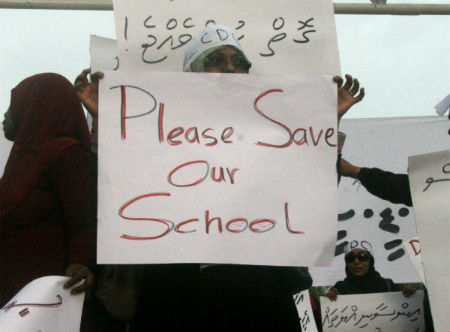
The parents of pupils at Male’s Care Development Centre (CDC) gathered at the artificial beach on Thursday, imploring the government to fulfil its obligation to provide their children with an education.

Amongst the placards held aloft, some read, “Don’t deprive us of education”, whilst others asked “Should disabilities be a reason for being maginalised?”

More specifically, one sign read “Give the CDC a building”.

The Maldives’ only specialist school for disabled children is facing closure after the government failed to follow up on a verbal agreement to extend the lease on its new premises, Deputy Director of the Care Society Aishath Looba explained.

“All children with disabilities should be able to go to school, and the government schools don’t have the opportunity for all of them…a lot of children who come to the Care Society have severe disabilities and it is the only service they receive in the country,” said Looba.

“If the Care Society could not continue with the services provided at the CDC, a lot of the children would have no other place to go. The government are obligated to provide those services for them.”

With finances for the current premises only secured until December, the 41 children – of varying mental and physical disabilities – are facing a future without their constitutional right to an education free from discrimination.

Up until July this year, the Care Society had been running the school from a rent-free premises, but the ending of this agreement has seen the group forced to find an additional MVR48,000 (US$3,100) a month.

The government has provided a new building – just yards from the site of yesterday’s protest – but the extensive repairs needed have meant that the building is unsuitable without substantial investment.

“Renovation is not the word – we have to construct the building,” said Looba

With the lease on this new property set to expire in 2015, Looba explained that this uncertainty was deterring new investors.

“We have been trying to increase the duration of the period, a lot of people have said they could help if the period was longer – say 20-30 years.”

“There’s no choice left without the school”

One parent at today’s demonstration explained the great sacrifice she and her husband had made to bring her children to Male’ from Noonu Atoll to receive the education unavailable to them in the atolls.

“As a parent, I believe even children with disability have to become part of society,” said Ameena, who estimated that up to half of the pupils had been brought to Male’ solely to attend the CDC.

“There’s no choice left without the school. When the CDC closes, the only choice is to return to the island, there is no sustainability in Male’.”

Looba urged the government to decide whether it considered a specialised school important, regardless of who provides these vital services.

She went on to suggest that the verbal agreement for lease extension given earlier this year may have simply been a government ploy to prevent similar demonstrations.

Looba also cited political state of the country as one of the reasons why new sponsors for individual children had been hard to come by in recent months.

“Rent is secured up to the end of december – half from Universal, some from Bandos, and some from the Islamic Ministry. But if we have to try so hard to secure the rent, how can we run the programmes?”

“When we started we had to beg the parents to send their children to school, now the parents are coming and begging us to take their children to school. We have come a long way and the Care Society deserves more respect and support from everyone, especially the government,” she explained.

“There are so many thousands of kids who really require support and are not getting anything special in the islands. This is an example for all parents that they can be an advocate for their children, we want to see parents in the islands saying you should take our children to school.”

“We won’t stop it – even if we don’t get any support – we are going to continue that work.”

At the time of publication Minivan News was awaiting response from the Ministry of Education, whilst ministers from the Housing Ministry were not responding to calls.

Likes(0)Dislikes(0)

Foreigner acquitted of resort crash deaths flees Maldives after prosecutors seek to withhold passport

A Swedish national acquitted this month of causing a quad bike crash that killed two British tourists has fled the Maldives, even as state prosecutors urgently sought to withhold his passport ahead of a possible appeal.

Filip Eugen Petre was acquitted on September 5 by the Criminal Court of all charges relating to his alleged role in a quad bike accident that resulted in the deaths of British couple Emma and Johnathon Gray at Kuredu Island Resort in August 2011.

According to a leaked communique drafted by the Prosecutor General’s Office (PGO) and later obtained by Minivan News, the Maldives Police Service – under a court order – returned the passport of the accused in the early hours of September 7.

Just hours earlier, the PGO had sought to file an “urgent appeal” against the decision after concerns that a “serious miscarriage of justice” could occur if the accused was allowed to leave the country without a final decision on whether to appeal his case.

According to the PGO, Petre left the Maldives in the early hours of September 7, the same day of the country’s presidential election.

“The Prosecutor General’s Office was notified at approximately 4:20pm [hours after he was acquitted on September 5] that the accused demanded his passport be returned by the Maldives Police Service,” read the leaked communique.

“As we had not received any document detailing the grounds for the [Criminal Court’s] Judgment, Maldives Police Service was advised by Prosecutor General’s Office to make a written submission to the controller of immigration requesting that the accused’s passport be withheld for 7 days under the immigration Act of the Maldives.”

Minivan News understand that prosecutors were still awaiting a detailed summary of the Criminal Court’s judgement on the case at time of press.

Communication breakdown

Immigration Controller Dr Mohamed Ali confirmed this week that he was not aware of receiving any request from the police to withhold Petre’s passport for the seven days.

Minivan News was awaiting a response at time of press to requests for information from Police Commissioner Abdulla Riyaz and Spokesperson Chief Inspector Hassan Haneef to establish if the institution had responded to the PGO’s request to withhold Petre’s passport.

“On September 6, 2013, (which is one day before the Presidential election) a Friday which is usually a public holiday, at approximately 9:00pm, we were informed that the accused had filed a motion in Criminal Court demanding that his passport be released,” wrote the PGO.

“Maldives Police Service was summoned before the Criminal Court and was questioned extensively on the request to withhold the passport. We were informed at approximately 10:08pm that an order was made by Criminal Court Chief Judge Abdullah Mohamed for Maldives Police Service to release the accused’s passport.”

The PGO wrote that it was “mindful” of the challenges of extraditing Petre should the High Court opt to appeal at a later date, particularly due to the absence of a relevant bilateral treaty with Sweden .

“However remote or challenging its enforceability could prove, we would attempt to obtain an order of stay to prevent the release of the accused’s passport for seven days,” read the communique. “[This] would give this office time to receive a summary judgment and to make a preliminary decision to appeal in the High Court and thereby attempt to obtain an assurance of the accused’s return to the Maldives.”

The PGO said that, on September 6, the High Court had accepted a request by Prosecutor General Ahmed Muizz to open the court after 10:00pm to try and file a motion to temporarily prevent authorities returning Petre’s passport.

“Due to the lengthy administrative process of opening a state owned building on a public holiday at such a late hour, we decided to request that we be allowed administrative facilities available at Maldives Police Service to prepare an urgent appeal to the High Court to prevent what we strongly believe could be a serious miscarriage of justice given the circumstances,” wrote the communique.

“We were informed of the decision of Maldives Police Service to release the passport of the accused at approximately 12:56am on September 7, 2013.”

“We were also informed by the High Court that we would have to appeal the judgment of Criminal Court, which is a near impossibility as we had no documentation on the grounds for the acquittal except for handwritten notes taken by the prosecutor during judgment hearing. The High Court requested that we make the submissions the next morning.”

According to the PGO, whilst working on an appeal later that morning – election day in the Maldives – the office was informed by the Maldives Police Service at 10:54am that Petre had left the country at 01:25am.

“We have requested Criminal Court for the case report and we shall review the case for all possible avenues of appeal, despite the possible challenges of having the accused appear before the high court in the event of such an appeal,” added the PGO.

Previous hearings

Petre’s case was reported to have come to standstill in March this year, as the Criminal Court awaited responses from the parents of the deceased, regarding their preferred form of punishment for the accused.

However, both police in the UK and the respective families of the deceased insisted at the time that the families respective decisions had been submitted and then re-submitted to the court.

Petre’s acquittal was said to have been based on the argument that prosecutors had failed to prove the accused had driven the quad bike linked to the incident, according to the PGO.

In previous hearings of the trial, prosecutors claimed that the charge of ‘disobedience to order’ of which Petre was accused had resulted from his decision to carry people on a vehicle which was not intended for passengers.

Then presiding Judge Abdul Baary Yousuf declared in court during earlier hearings that Petre’s lawyer had himself confessed during the trial that his client had driven the quad bike carrying Emma and Jonathan Gray as it crashed on the tourist property.

The father of the accused – Kureudu Island Resort resort shareholder Lars Petre – in a statement previously published in Minivan News also admitted that his son had been driving the quad bike on which the couple had been riding.

Judge Yousuf was later dismissed from his post pending disciplinary hearings into his conduct, with Criminal Court Chief Judge Abdulla Mohamed presiding over the case on February 2, 2013, according to the PGO.

“On September 5, 2013, a hearing was scheduled in criminal court at 11:00am presided by Judge Abdullah Didi. The Judge questioned whether there was anything further to be said in the matter by either the State or the accused,” the PGO claimed.

“Thereafter, the state was questioned as to explain the basis for the criminal charge. Our Prosecutor explained in great detail as to what had transpired in the hearings so far and also highlighted the fact that the accused had admitted to driving the quad bike and that the Court had ruled that the accused could not retract the admission. The judge questioned the accused whether he was driving the quad bike and the accused refused to answer the question.”

Judge Didi then pronounced on September 5 that as the accused had denied the charges, the burden was upon the prosecution to prove the case. He then held a second hearing the same day to acquit Petre.

Seeking culpability

Contacted this week over the details of the leaked communiqué, Robert Oldfield, a relative of Emma and Johnathon Gray, told Minivan News that the families of the deceased had been left disappointed by Petre’s acquittal.

Oldfield stressed that both families did not believe there had been any “malice” resulting in the incident that killed the couple.

However, based on previous admissions in court that Petre had been driving the quad bike, he had hoped that the country’s courts would establish Petre’s culpability for the deaths.

“He [Petre] should have held his hands up and admitted he was driving the bike that has resulted in the death of two people and left their child an orphan,” Oldfield said. “To my mind, it’s the cowards way out,” he added after being informed that Petre has since left the country.

Oldfield reiterated that the families of the deceased had not wanted the accused to face any severe or long-term action, but had nonetheless wished to see justice served in relation to outlining responsibility for the crash.

Jonathan Gray’s mother Cath Davies told UK-based newspaper the Halifax Courier in March 2012 that the prospect of Petre facing the death penalty was “shocking. It’s absolutely horrendous.”

Likes(2)Dislikes(0)