“Crime is more important than party” says PPM, after suspected cop killer is revealed to be member

The crime is more important than the political party the criminal is from, the Progressive Party of the Maldives (PPM) has said during a press conference, after it was revealed that the suspect arrested in connection to the murder of Lance Corporal Adam Haleem murder is a registered member of the party.

In the wake of police officer’s murder, government-aligned parties including PPM and cabinet ministers have vociferously blamed the ousted former President Mohamed Nasheed and his Maldivian Democratic Party (MDP) for the murder, claiming that MDP’s ongoing protests against the police in the capital Male’ provoked the attack on Kaashidhoo island.

The MDP have held consecutive demonstrations since the controversial resignation of former President Nasheed on February 7, who contends that he was forced to do so “under duress” amid a police and military-backed coup.

The protests often have led to multiple arrests and violent clashes between the security forces and protesters, with rising concerns of police brutality, torture and human rights violations.

However, in response to the accusations, the MDP released a photo of the arrested suspect Mohamed Samaah, 22, and a screenshot of the Elections Commission’s party registry showing him listed as a member of the PPM.

Local media reports said that Samaah, from Suvaasaage of Kaashidhoo, has a multiple criminal records including drug, assault and theft.

PPM’s Council Member Ahmed Saleem today contended at a press conference that “Party is not important. What’s important is the crime committed by the criminal,” after a reporter asked him to verify the claim.

“We have also heard people say that he is from PPM. But we have not checked if it’s true. The reality is that MDP members have been registered under other parties by mistake,” Saleem added.

“But, whatever party [the suspect] is from, no police officer or citizen should be attacked,” he noted.

Meanwhile, the MDP has also alleged that the suspect was a key supporter of Jumhoree Party (JP) MP Abdullah Jabir, who won the Kaashidoo constituency in the recent by-election with official endorsement from PPM.

The MDP  today released another photo with the suspect allegedly standing next to Jabir, while JP leader Gasim Ibrahim is seen nearby giving a speech.

Jabir’s wife Dhiyana Saeed, the newly-appointed Minister for Gender and Human Rights, is also pictured in the image.

Speaking to Minivan News today, Jabir rejected any possible links between the suspect and his party, accusing the MDP and media sources including Minivan News of propagating false rumours.

“This suspect has nothing to do with the JP,” he said.

Conversely Jabir said that the suspect had actually been working with MDP candidates at local elections, as well as being mentioned in a police report at the time for attacking a member of the JP’s own campaign personnel.

“There is evidence of this and reports of the incident with the Kashidoo police.  Anyone can check this,” he added.

Likes(0)Dislikes(0)

Comment: Blame game hardly solves problems

Lance Corporal Adam Halym of Maldives Police Service was on his way to start a new shift, leaving his baby daughter and loving wife at home, when he was mercilessly knifed and murdered in a dark alley leading to Kaashidhoo Police Station. He never returned home.

I strongly condemn the heinous crime of killing an officer of the law and as well the eight innocent people, whose blood was spilled before him. Thoughts, prayers and well wishes are with all those victims family at time of this great tragedy.

While the families and public is grappling with the aftermath of this ongoing carnage, much more appalling than the gruesome murder of the police officer is the notorious blame game started by the politicians. It took one or two hours tops before prominent political figures, most of them holding key portfolios in current government, to sinisterly twist the tragedy and manipulate in ways that it advantageous to their own political stand or disadvantageous to their political opponents. The former president Mohamed Nasheed and his party MDP  was on the receiving end of much of the accusations.

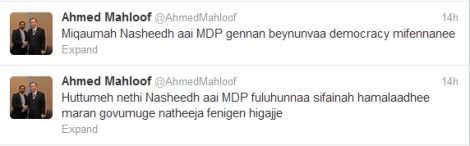
On twitter Ahmed Mahloof, MP for Galolhu Dhekunu Constituency, was amongst the first to break the news by posting a tweet saying “Innaalillahi vainna ilaihi raajioon” (a Quranic verse Muslims recite upon hearing the news of someone’s death) and ” mikamuge zinmaa seedha MDP nagan jeheyne”(MDP should directly take the responsibility of this)” along with a hyperlink to the news story on the Haveeru website.

Among many other tweets that followed, government-aligned Progressive Party of the Maldives (PPM) MP Mahloof emphatically blamed Nasheed and the MDP. One tweet when translated reads, “What we are seeing is the democracy Nasheedh and MDP wanted to bring to this country” while the another tweet reads: “We are seeing the result of Nasheed and MDP calling to attack police and military officers non stop.”


One hour into Mahloof’s tweets President Waheed himself posted a tweet saying “Strongly condemn the killing of a policeman while on duty. Enough of hate mongering against officers of the Law.”

In a subsequent tweet  an hour later the president emoted: “No excuses to kill anyone let alone policemen on duty. Shame on cowards hiding behind anonymity and inciting violence.” While he does not elobarate on who the “anonymous” is,  his counterparts have clarified it well with their own facts: Nasheed and MDP killed LCPL Adam Halym.

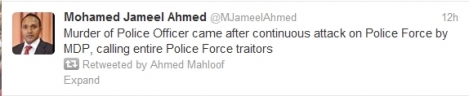
Here is what the Minister of Home Affairs said:

Not just that, while the President, his ministers, and other key government officials were all commotional on twitter, Dr Ibrahim Didi, Qasim Ibrahim and Abdullah Jabir – belonging to Jumhoree Party of Dr Waheed’s unity government – were doing their fair share of the blame game on VTV during late hours of last night.  They reiterated the crux of the above mentioned tweets, blaming Nasheed and his party.

I am taken aback by the heedless audacity of especially government officials to create a diversion from the real issue, by using the oldest tactic in the book: the blame game. Every second spent accusing Nasheed and the MDP is a second wasted by the current government to address the cause of the  issue. At a time when the government is expected to take proactive and immediate measure to ensure the safety and security of the people of Maldives they are engrossed in politically assassinating their opposition party and its presidential candidate for the murder of LCP Adam Halym.

In the very press statement from police about the brutal murder of Adam Halym it was clearly stated that a suspect was brought under custody. The police already had a lead. Local media concurrently identified the killer as Mohamed Samah from the same island.

Only hours later more details were reported on local media shedding light on the attack and the killer: Samah has a criminal record for aggravated assault among other crimes and was also released  from police detention to house confinement the previous day.

The police have not revealed that Nasheed, the MDP or for that matter any political party had a role in the murder of Adam Halym: but from the few reports surfacing in the media, we can draw a conclusion that it was indeed a a preventable crime carried out by a dangerous criminal who found his murderous opportunity through a loophole in the very system that is intended to keep his like at bay.

But these facts did not get in the way of the vociferous accusations echoed by the self declared political pundits, nor did it stop MDP from making counterblasts over social networks, spreading picture of the suspected killer alleging that he was in fact from the government-aligned PPM’s members.

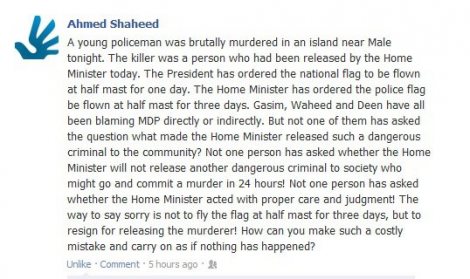
One of the most noticeable remarks was made on Facebook by former Foreign Minister Dr Ahmed Shaheed:

While Dr Shaheed has rightly indicated to what really lead to the murder of LCPL Adam Halym, it would be unfair not to say he has again shot the blame at Home Minister. Doesn’t only a judge have the jurisdiction to release a criminal from police custody to house arrest? So why blame the Home Minister who has no direct authority under the current legal framework to release a criminal from police custody to house arrest?

Why are not we questioning which court or judge released Samah, only to kill a police officer in less than 24 hours?  Has the judiciary failed us again and this time we had  to pay with the life of an officer of the law? If it wasn’t a judge, who gave the authority to police to move the criminal?

These are fundamental questions that lurks around the murder of Adam Halym that neeed to be answered by the police, before we engross ourselves in this “you killed him” game, helping no one except fuelling the opportunistic politicians ready to feed on humanity when it suits them.

At difficult times like this, we humans might blindly seek solace in band aid solutions like the death penalty. Implementing dealth penalty right now in Maldives would only be a coping mechanism that would would provide a temporary relief to the community but leave the root cause of the problem untouched.

It was just few days ago that the whole nation came to a standstill over the murder of lawyer Najeeb. Najeeb’s murderer has said in court that he was inebriated at the time of killing.

Afterwards when his faculties were back to normal and realised what he had done, he cried  in regret.  Moving onto LCPL Adam Halym’s murder, what are the chances Samah too was intoxicated during the murder? More importantly would implementing death penalty prevent an angry, intoxicated person from murdering someone? Since drugs have become the root cause of all mischief in Maldives, and since the punishment under Islam for spreading mischief on Earth is capital punishment, isn’t it more just and appropriate to sentence drug lords to death?

Half of the youth population are enslaved to these substances marketed by these “untouchable” drug lords. They have destroyed lives of thousands of youth and their families. More will follow if we do not stop the menace and provide better opportunities for the younger generation.

Samah found his chance to kill LCPL Adam Halym through a loophole in the judiciary. Therefore when God has specifically prescribed in Quran “ Take not life, which God has made sacred, except by way of justice and law” how can we entrust the current judiciary, with its major loopholes, to rule “by way of justice and law”? For God’s sake, prerequisites laws to implement the death penalty do not even exist in Maldives as of yet and who knows when they will be passed. Let’s be realistic.

We know that Islam stipulates strict conditions that prevent arbitrary administration of any penalty, no matter how mild it is. The Prophet Mohamed has instructed us to“Avert punishments if suspicions arise”. According to Dr Hamdy Murad, an Islamic thinker and Professor of Sharia at Al-Balqa Applied University, “Suspicion means that for any offence that cannot proved 100 percent, so to speak, punishments should be averted.”

In the case of Murrath and Hana, the couple who murdered lawyer Najeeb who were sentenced to death with a fortnight, isn’t there room for suspicion? Did no one hear the girl say she did not kill him and was sleeping while her boyfriend did it?

Besides, should we not question why a convicted criminal like Murrath – who was suppose to be in jail – and Samaah, a criminal with a record of multiple assaults – was out of the streets instead of confinement?

In the wake of such tragic events, it is tempting to blame someone for the pain simply because it absolves the person from shouldering any responsibility. But, one must not forget the most effective tool we can utilise for hate mongering is these slanderous accusations. It never yields solution or heals the scars, but fuels more hatred and divisions in the community.

More than ever, we as a nation need to skip this blame game and find solutions to address the real issues that have jeopardised the very fundamental human right our people have: the right to life.

All comment pieces are the sole view of the author and do not reflect the editorial policy of Minivan News. If you would like to write an opinion piece, please send proposals to [email protected]

Likes(0)Dislikes(0)

Ports Workers Union accuse MPL of employee “rights violations” for political activism

The Maldives Ports Workers Union (MPWU) has accused the Maldives Ports Ltd (MPL) of violating employee rights, alleging the state-owned company has unfairly dismissed four employees due to their political activism.

In a letter on July 12 to MPL CEO Mahdi Imad, Chairperson of the MPWU Ibrahim Khaleel said: “Although the constitution guarantees freedom of expression and freedom of assembly, it is now common within MPL to stop employees from expressing certain political views, and violate the Employment Act by unfairly dismissing employees and transferring employees to different departments without prior warning or explanation of any offense committed.”

Speaking to Minivan News, Khaleel said the company mainly targeted employees who supported the ousted Maldivian Democratic Party (MDP).

“They send people with cameras to MDP protests to check which MPL employees take part in the protests,” Khaleel said. The MDP has taken to the streets for the 11th consecutive day demanding fresh polls, alleging President Mohamed Nasheed was ousted in a coup d’état on February 7.

In addition to the four employees who have been dismissed, 30 have been suspended and 10 have been transferred from their position at the Malé port to Thilafushi Island port, Khaleel said.

In his letter, Khaleel called on the MPL to “respect an employee’s right to exercise freedoms granted in the constitution and by participating in political activities in his or her free time” and asked the company to withdraw blocks on “social media including facebook, twitter and gmail.”

In response, Imad in a letter on July 16 accused the MPWU of dividing employees and promoting the interests of a certain political party and threatened to take action against the union.

“We have received reports that the union is attempting to divide employees and promote the interests of a certain political party. Hence, I order and advice you not to do so. If this happens in the future, we will have to take action against you,” he said.

Further, access to social-networking sites had been blocked because they “often propagate un-Islamic, sinful activities and propagate the interests of Jews,” Imad said.

Khaleel denied Imad’s allegations, stating that “When MDP was in power, we had a lot of difficulty in registering the union. The MPL management at the time wrote a letter to the Home Ministry requesting that they deny our registration. We are not a political organization, we work for employee rights.”

The MPWU has been contact with other ports workers unions in the region to discuss steps to take next, Khaleel said.

In May, porters working at MPL went on strike after the management confiscated their TV for “watching too much Raajje TV.” Government aligned parties have accused Rajje TV of being aligned with the MDP.

Minivan News also documented the suspension of seven staff at MPL in April. The company claims staff were suspended for violating “norms of good behavior” outlined in the code of conduct, but staff told Minivan News they had been suspended for taking part in MDP protests.

Likes(1)Dislikes(0)

Judge Abdulla’s human rights violated, no physical abuse: HRCM

The Human Rights Commission of Maldives (HRCM) has told local media that while Criminal Court Chief Judge Abdulla Mohamed had “not been subject to any form of physical abuse“ during his controversial 22 day detention, attempts had been made to violate his fundamental human rights.

Haveeru today reported that HRCM President Mariyam Azra had said that its investigation had uncovered evidence that the judge, who was detained during the administration of former President Mohamed Nasheed over allegations that he posed a threat to national security, had faced attempts to remove him from his post and send him abroad.

The opposition Maldivian Democratic Party (MDP), who had been in government during the time of Judge Abdulla’s detention, today raised concerns over what it claimed was the “complicit irresponsibility” of the HRCM – a body it alleged was biased towards the political interests of former President Maumoon Abdul Gayoom.

Local media reports today claimed that HRCM President Azra had opted against giving the names of those involved in the alleged abuse of the judge’s human rights.  HRCM also declined to give any other details at present that could influence any potential trials after charges were filed against Nasheed and several senior figures in the Maldives National Defense Force (MNDF) this week.

Azra was not responding to calls when contacted by Minivan News at time of press.

The HRCM used today’s press briefing to publicise its concerns that “efforts” had been made to “coerce” the judge to commit unspecified actions that would have contravened his human rights.

“Serious concerns”

Responding to the press briefing, the opposition Maldivian Democratic Party (MDP) – of which Nasheed is the current presidential candidate – said it held “serious concerns” in the selective nature of the HRCM’s investigations.

MDP MP Hamid Abdul Ghafoor today alleged that the HRCM’s investigation had now formed the basis of criminal charges filed against Nasheed.  The case was today returned to the Prosecutor General’s (PG’s) Office after the Hulhumale’ Magistrate Court said it did not presently have jurisdiction to hear such a case.

In March, the Prosecutor General Ahmed Muizz told Minivan News that the completion of the Nasheed cases was being delayed whilst police reviewed certain aspects of the investigation.

Ghafoor claimed that the decision to move ahead with the charges this week raised questions about allegations of political influence on the HRCM and the information it made available to the PG’s Office.

“I believe there is a very strong link between the HRCM holding this media briefing today and Islamist factions linked to [former President] Gayoom,” he added. “This week this faction has been very active in lobbying the HRCM, the Police Integrity Commission (PIC) and even the president himself.”

Just last month, Deputy leader of the Progressive Party of Maldives (PPM) Umar Naseer has expressed his confidence that the Prosecutor General’s (PG) investigation into charges against former President Mohamed Nasheed will see his imprisonment before the scheduled elections in July 2013.

“We will make sure that the Maldivian state does this. We will not let him go; the leader who unlawfully ordered the police and military to kidnap a judge and detain him for 22 days will be brought to justice,” local paper Haveeru reported Naseer as having said.

The PPM was formed by former President Gayoom, who also serves as head of the party.

HRCM investigation

Former President Nasheed became the first Maldivian president to be summoned before the HRCM in March this year in connection to his alleged role in the controversial detention of Judge Abdulla.

Nasheed had been requested to attend a HRCM hearing filed to try and understand who was responsible for taking the decision to arrest the judge. The former president attributed the initial arrest call to his Defence Ministry, on the grounds of “protecting” national security relating to alleged ethical concerns about the judge.

The summons of the former president was the first of three cases filed at the HRCM involving Nasheed. These cases all relate to potential human rights abuses allegedly carried out both by and against Nasheed during the lead up and aftermath of a controversial transfer of power that saw President Dr Mohamed Waheed Hassan installed as his successor.

Representatives of Nasheed’s legal counsel at the time claimed Nasheed has used his testimony to claim that he had been informed by the Home Ministry that the judge had allegedly posed a “national threat” – prompting his eventual detention.

The MDP MP added that Nasheed then claimed that the Home Ministry had communicated with the Defence Ministry on the situation, which in turn led to the decision to arrest the judge after bodies like the Judicial Service Commission has raised alleged concerns over his ethical conduct.

“I was told Abdulla Mohamed would not comply with the police’s summons to investigate allegations [against him],” Nasheed later stated at a press conference following the meeting with the HRCM.

“The Home Minister wrote to the Defense Minister that Abdulla Mohamed’s presence in the courts was a threat to national security. And to take necessary steps. And that step, the isolation of Abdulla Mohamed, was what the [Defense] Ministry deemed necessary.”

Nasheed claimed additionally that he had sent representatives to Girifushi to check on Judge Abdulla Mohamed’s well-being during his detention, alongside allowing the HRCM to visit the judge.

The MDP has also alleged that the decision to arrest the judge was related to a number of possible misdemeanour’s that had been attributed to him dating back several years.

In November, the national court watchdog, the Judicial Service Commission (JSC), was ordered to cease an investigation into Judge Abdulla Mohamed by the Civil Court under an action the judge himself instigated.

MDP spokesperson and MP  Imthiyaz Fahmy contended following Nasheed’s first HRCM summons on March 21 that it was ironic that a leader he claimed who had openly discouraged the use of torture and actively campaigned against human rights abuses, had become the country’s first former leader to have been called in front of the HRCM.

Likes(0)Dislikes(0)

Parliament committees reconstituted

A compromise agreement between parliamentary group leaders to rework the composition of standing committees was approved with 60 votes at today’s sitting of the People’s Majlis.

Two consecutive sittings were cancelled last week to allow parliamentary group leaders to agree on the reconstitution, which was triggered by opposition Maldivian Democratic Party (MDP) MP Hassan Adil joining the government-aligned Jumhooree Party (JP).

Section 101(b) of the parliamentary rules of procedure stipulates proportional representation in the committees, stating that the number of MPs each party has should be taken as the basis for determining the composition of the 11-member standing committees.

The beginning of today’s sitting was meanwhile delayed to 1:00pm as talks continued between parliamentary group leaders to finalise the agreement. The sitting concluded immediately after the vote was taken, which saw 60 votes in favour and one against.

Following days of negotiations and disagreement over control of powerful oversight committees, a deal was struck on Thursday between the government-aligned People’s Alliance (PA) and the formerly ruling MDP.

The PA – led by Deputy Speaker Ahmed Nazim – gave up its seat on the Government Oversight Committee to the former ruling party in exchange for one of the MDP’s four seats in the Finance Committee.  The PA however gave their Finance Committee seat to the JP.

The agreement sees MDP gain control of the Government Oversight Committee with six seats out of eleven.

Meanwhile, the former main opposition Dhivehi Rayyithunge Party (DRP) has two seats in each of the 13 committees, while the Progressive Party of Maldives (PPM) has three seats in seven committees and two seats in six committees.

Following the approval of the reworked composition by the full Majlis today, Speaker Abdulla Shahid expressed gratitude to Deputy Speaker Nazim and parliamentary group leaders for their cooperation in reaching the agreement despite “serious disagreement”.  He went on to urge MPs to continue in the “spirit of compromise.”

The agreement reached today, said Shahid, was the result of lengthy discussions last night among the speaker, deputy speaker, Majority Leader Ibrahim Mohamed Solih and DRP Leader Ahmed Thasmeen Ali.

Likes(0)Dislikes(0)

PG files charges against former President Nasheed over Judge Abdulla’s detention

Prosecutor General Ahmed Muizz has filed charges against former President Mohamed Nasheed and the former defense minister Tholhath Ibrahim Kaleyfaanu for their alleged role in detaining Criminal Court Chief Justice Abdulla Mohamed in January.

Abdulla Mohamed was a central figure in the downfall of former President Nasheed, following the military’s detention of the judge after the government accused him of political bias, obstructing police, stalling cases, links with organised crime and “taking the entire criminal justice system in his fist” to protect key figures of the former dictatorship from human rights and corruption cases.

Nasheed and Tholhath stand charged with violating Article 81 of the Penal Code, which states that the detention of a government employee who has not been found guilty of a crime is illegal. If found guilty, Nasheed and Tholhath will face a jail sentence or banishment for three years or a Rf 3000 fine (US$193.5).

The case was filed at the Hulhumalé Magistrate Court. In a statement today, Muizz said he intends to levy the same charges against former Chief of Defense Forces Moosa Ali Jaleel, Brigadier- General Ibrahim Mohamed Didi and Colonel Mohamed Ziyad.

Home Minister Mohamed Jameel in a post on social media Twitter has said the “historic criminal trial” is the “first step towards the national healing process.”

President Dr Mohamed Waheed Hassan’s spokesperson Abbas Adil Riza told Minivan News the president will not “interfere with the independent Prosecutor General’s decisions.”

In April, Nasheed told the UK’s Guardian that he did not like arresting a judge, but he “just couldn’t let him [Abdulla Mohamed] sit on the bench.”

“There is a huge lack of confidence in the judiciary, and I had to do something and the constitution calls upon me to do that. It’s not a nice thing to do. And it’s not a thing that I would want to do. And it’s not a thing that I liked doing. But it had to be done,” he added.

Judge arrest

The chief judge was detained by the military, after he had opened the court outside normal hours, to order the immediate release of current Home Minister and deputy leader of the Dhivehi Quamee Party Jameel who was arrested after President’s Office requested an investigation into “slanderous” allegations he made that the government was working under the influence of “Jews and Christian priests” to weaken Islam in the Maldives. The judge’s whereabouts were not revealed until January 18.

As Judge Abdulla continued to be held, Prosecutor General (PG) Ahmed Muizz later joined the High Court and Supreme Court in condemning the MNDF’s role in the arrest, requesting that the judge be released.

The police are required to go through the PG’s Office to obtain an arrest warrant from the High Court, Muizz said, claiming the MNDF and Nasheed’s administration “haven’t followed the procedures, and the authorities are in breach of law. They could be charged with contempt of the courts.” He then ordered the Human Rights Commission of the Maldives (HRCM) to investigate the matter.

Judge Abdulla’s arrest sparked three weeks of anti-government protests starting in January, while the government appealed for assistance from the Commonwealth and UN to reform the judiciary.

As protests escalated, elements of the police and military mutinied on February 7, alleging Nasheed’s orders to arrest the judge were unlawful. A Commonwealth legal delegation had landed in the capital only days earlier.

Nasheed publicly resigned the same day, but later said he was forced to do so “under duress” in a coup d’état. Nasheed’s Maldivian Democratic Party (MDP) has taken to the streets in recent months calling for an early election.

Judge Abdulla was released on the evening of February 7, and the Criminal Court swiftly issued a warrant for Nasheed’s arrest. Police did not act on the warrant, after international concern quickly mounted.

“Father- figure”

Former President’s member on the JSC and whistleblower Aishath Velezinee for several years contended that Abdulla Mohamed was a central, controlling “father figure” in the lower courts, answerable to former President Maumoon Abdul Gayoom and a key figure responsible for scuttling the independence of the judiciary under the new constitution.

“When Abdulla Mohamed [was arrested by Nasheed’s government] I believe the opposition feared they were losing control over the judiciary, and that is why they came out on the streets. If you look at the so called public protests, it was opposition leaders and gang members. We did not see the so-called public joining them – they were a public nuisance really,” Velezinee observed, in an interview with Minivan News.

“For nearly three weeks they were going around destroying public property and creating disturbances. It wasn’t a people thing – we can say that. We locals – we know who was there on the streets. There is footage and evidence available of it. We’ve seen the destruction they were causing in Male’ every day.”

Following the arrest of the judge, Nasheed’s government appealed to the international community – in particular the Commonwealth, the International Committee of Jurists (ICJ) and the UN – for assistance in resolving the spiraling judicial crisis. A Commonwealth team arrived in the Maldives the day before Nasheed’s government was overthrown after a group of police sided with opposition demonstrators, attacking the military headquarters and seizing control of the state broadcaster.

Velezinee bemoaned the local and international focus on the arrest of the judge rather than the decline of the institution that led Nasheed’s government to such desperate interference in the judiciary.

“To the international community [the protesters] were a crowd of people – and to them that’s the public. It’s a public protest to them. But it was not. We need to consider who was involved in the free Abdulla Mohamed campaign. These are the same people I have previously accused of covering up and being conspirators in the silent coup,” Velezinee told Minivan News.

Charges against Judge Abdulla

The first complaints against Abdulla Mohamed were filed in July 2005 by then Attorney General Dr Hassan Saeed – now Dr Waheed’s political advisor – and included allegations of misogyny, sexual deviancy, and throwing out an assault case despite the confession of the accused.

Among the allegations in Dr Saeed’s letter was one that Judge Abdulla had requested an underage victim of sexual abuse reenact her abuse for the court, in the presence of the perpetrator.

In 2009, those documents were sent to the oversight body JSC, which was requested to launch an investigation into the outstanding complaints as well as alleged obstruction of “high-profile corruption investigations”.

The JSC decided not to proceed with the investigation on July 30, 2009. However in November 2012, the JSC completed an investigation into a complaint of ethical misconduct against the judge.

The report, which the commission has not yet publicly released, recommended action against Judge Abdulla for allegedly violating the Judge’s Code of Conduct by making a politically biased statement in an interview with DhiTV.

Abdulla then filed a case against the JSC in the Civil Court requesting that it invalidate the JSC’s report, claiming that DhiTV took his statement out of context. He also asked for and was granted a Civil Court injunction to halt any action by the judicial watchdog.

The commission appealed the verdict at the High Court, claiming that the Civil Court had disregarded the commission’s constitutional mandate which allowed it to take action against judges, and argued that the court did not have the jurisdiction to overrule a decision of its own watchdog body. However, the appeal was rejected in April.

Abdulla’s case against the JSC continues. Civil Court Judge Maryiam Nihayath in May ordered the commission to submit all documents relating to Abdulla’s ethical misconduct.

HRCM investigation

Nasheed became the first president to be summoned before the Human Rights Commission of the Maldives (HRCM) when he was asked to testify regarding his role in the arrest of Judge Abdulla in April. Nasheed used his testimony to claim that he had been informed at the time by the Home Ministry that the judge allegedly posed a “national threat” – prompting his eventual detention.

The former president additionally claimed that the Home Ministry had communicated with the Defence Ministry on the situation, which in turn led to the decision to arrest the judge after watchdog bodies like the Judicial Service Commission (JSC) had raised alleged concerns over his ethical conduct.

“I was told Abdulla Mohamed would not comply with the police’s summons to investigate allegations [against him],” Nasheed later stated at a press conference following the meeting with the HRCM.

“The Home Minister wrote to the Defense Minister that Abdulla Mohamed’s presence in the courts was a threat to national security. And to take necessary steps. And that step, the isolation of Abdulla Mohamed, was what the [Defense] Ministry deemed necessary.”

second case involving Nasheed has also been sent to the prosecutor general by the police that involved the confiscation of bottles of alcohol allegedly found at his residence shortly after his presidency ended.

Likes(3)Dislikes(0)

MDP supporters target follow-up Colombo protest

Sri Lanka-based supporters of the Maldivian Democratic Party (MDP) have announced plans to protest outside the Maldives High Commission in the capital of Colombo tomorrow afternoon.

Organisers of the demonstration, which will be held between 4:00pm and 6:00pm outside the High Commission building on Melbourne Avenue, have claimed that hundreds of Maldivian expatriates and MDP supporters are expected to be in attendance.

The demonstration will focus on condemning the government of President Dr Mohamed Waheed Hassan, which the party contends came to power in a “coup”, for not facilitating early elections this year, as well as drawing attention to alleged examples of brutality conducted by police and military under the present administration.

The protest will also reportedly “express solidarity with friendly nations” and organisations like the Commonwealth.

The intergovernmental organisation, along with the EU, has called for elections to be held before the end of 2012 as a means to restore political stability to the country.

The Commonwealth had also asserted pressure on the Maldives government to reconstitute the Commission of National Inquiry (CNI) set up by President Waheed to probe the circumstances behind February’s controversial transfer of power.

Tomorrow’s protest comes one month on from a similar demonstration held by the MDP in Colombo.  Local media at the time reported that a “few dozen” demonstrators had been in attendance during the previous High Commission protest.

Likes(0)Dislikes(0)

Between the lines on Chaandhanee Magu – Maldives protests continue into seventh day

Chaandhanee Magu is normally one of the busiest streets of Male’, the tourism hub of one of the world’s smallest and most congested capital cities.

Yet at 11:30pm on the night of Saturday July 14, an eerie silence fell on the street, save for the distant, tinny, looped sounds of the opposition Maldivian Democratic Party’s (MDP) protest anthem “Chis Chis Kolliyas”, and the synchronised thumping of police shields hitting tarmac.

The protests, or “MDP mayhem” as they have been reported in some local media outlets, reflect seven consecutive days of anti-government demonstrations by opposition party supporters.

Amidst widespread allegations in both local and international media of police brutality, attacks by protesters on police and reporters, and numerous arrests – as midnight approached yesterday, the demonstrations – much like the country’s wider political landscape – were at a stand-off.

Police reports

According to provisional police reports, nine people were arrested during the night’s protests.  Two of those arrested have already been released. Police Spokesperson Sub-Inspector Hassan Haneef confirmed that one officer had sustained a minor injury during clashes, but insisted that there had been no use of hoses or rubber bullets. Demonstrators have meanwhile complained of the arbitrary use of pepper spray and mistreatment of female protesters by security services.

Front lines

For the anti-government protesters and police gathered at either end of Chaandhanee Magu last night, the street represents the current front line of political dissatisfaction that has followed the controversial transfer of power in February.

Chaandhanee Magu, usually a gauntlet of brightly coloured souvenir shops for tourist and resort visitors to traverse, was last night lined by members of the press and photographers, all waiting for an escalation in clashes between the two sides.

For a brief period leading up to midnight, almost a dozen or so police officers stood back from the barriers in an apparently restrained and hands-off approach. Meanwhile, anti-government figures standing behind the temporary barricades tried themselves to bring a sense of order to the mocking chants and heckling of the country’s security forces.

Despite the ongoing tension and traces of pepper spray in the air, the atmosphere verged between noisy and almost playful to sudden bouts of cat and mouse baiting of police by anti-government figures in the crowd.

Later that evening, when the semblance of self-enforced order broke down into the sporadic confrontations that have been the hallmark of the week’s protests, a handful of protesters were quick to have their say to foreign-looking media as they made their way past barriers set up by police.

“They are a coup government. This is a coup police,” said an animated middle-aged man making his way down towards police stationed at the junction of Republican Square down from Chaandhanee Magu.   “We are completely unarmed here.”

Unarmed in a conventional way, perhaps. Throughout the evening Minivan News observed  isolated cases of small bottles filled with water and shoes being thrown from the crowd at officers.  On one occasion, a sandal narrowly missed several journalists clustered behind the barriers.

Provocation?

Either in playful defiance, or an attempt at provocation, some protesters in between chanting and singing were seen kicking over and hauling away temporary barriers, before security forces responded by entering the crowd to return the symbolic if ineffective structures.

The occasional charges by police into the crowd lead to chaos, with demonstrators screaming and photographers sometimes being caught in the fray as officers sought to breach the protest lines. During one such charge, a handful of protesters were taken behind police lines, the barriers were replaced, and the songs and chanting then continued as if nothing had happened.

Despite a willingness among some protesters to remove the barriers, other figures in the crowd appealed for caution, calling for order on the opposition’s front lines.

A local man dressed as an “alternative” police chief, decked out in his own bespoke yellow uniform, issued orders to the crowd over a megaphone, mocking police whilst chastising one protester for attempting to kick over a barrier.

Among the throng of younger and middle-aged protesters is Naeema, a mature yet highly-animated protester in her sixties wearing a cowboy hat, who surged past the barricades brandishing an MDP flag and shouting at police, to the mirth of the gathered crowd.

Several figures from the former government at points arrived to survey the scene, but the biggest reception at the barricades is for the country’s former President Mohamed Nasheed – now leader of the political opposition.

At the stroke of midnight Nasheed, who was reportedly pepper sprayed earlier in the evening after police attempted to drive back the gathered crowds, returned to the protest, creating a swell of excitement and applause from his supporters.

In an act of either statesmanly defiance – or perhaps awareness of calls from senior government politicians for his arrest – the former president stood silently just behind the barriers set up by police, as supporters attempt to incite a response.

“You can see how he energises the crowd I think,” observed a a young woman upon Nasheed’s arrival at the barriers.

As the “excitement” led to temporary barriers again pushed away back into the crowd, protesters began to push forward down Chaandhanee Magu towards the gathered police forces further down the road.

Nasheed nonetheless remained behind the metaphorical police banner, aware of the potential for arrest – a line, politically, he seems unwilling to cross.

With Republican Square part of a so-called “Green Zone” due to its close proximity to politically sensitive areas of the capital – including the President’s Office and military headquarters – stationed officers carried plastic shields that were used to push the gathered crowd back down Chaandhanee Magu.

As the crows increased, the dozen or so police on duty bolstered their numbers in order to drive back and split protesters at the junction.  At the same time, military forces were seen preparing a water hose to disperse protesters – a measure not used that night.

With more riot police, the crowd was forced back along Chaandhanee Magu, Fareedhee Magu and Medhuziyaaraiy Magu by shield-carrying officers to a cacophony of howls and screams.

Government condemnation

The government today released a statement condemning “acts of violence carried out by opposition activists”.

According to the President’s Office, party activists led by former President Nasheed were charged with continuing to “harass” government officials and law enforcement officers.

“Similarly in the early hours of July 12 2012, MDP activists torched a newly built police station in Noonu Atoll Holhudhoo. A number of journalists have been injured by activists, including a television presenter from private broadcaster DhiTV,” the statement read.

President Mohamed Waheed Hassan said that efforts were underway to restore “restore peace and calm” to the Maldives.

“Those responsible for these cowardly acts will be brought to justice. We urge the leadership of the MDP to call an end to these violent acts being carried out by their activists and participate in resolving disagreements through the correct mechanisms,” the President said.

“Targeted intimidation”

The MDP meanwhile moved to condemn what it alleged was the “targeted intimidation of women protesters” by the government, amidst what it claimed were “five months of ongoing peaceful protests”.

The party, issuing an official statement, pointed to a number of arrests of prominent female party activists, including the MDP Youth Wing President Aminath Shauna this weekend, as proof of efforts by the government to deny the rights of protesters in the country.

“The MDP have previously highlighted and expressed concern over the current regime’s steps to narrow constitutional rights through their representatives in the legislature, and through collusion with a judiciary which is far from independent,” the party claimed in a statement.

MDP MP and spokesperson Hamid Abdul Ghafoor said the authorities practised a skewed justice.

“Not one single police officer has been charged or prosecuted in connection with the widespread police brutality in the country since Feb 7 [this year],” he said. “Over 700 protesters have been arbitrarily detained, and many of them tortured and sexually abused.”

As allegation and counter allegations continue to pass between the country’s two opposing forces, by 3:00pm this afternoon barricades were again being set up by security forces across the “Green Zone”.

Traffic meanwhile continued to pass by Chaandhanee Magu. Come tonight, the barriers will no doubt be back, as will the songs and chanting – all as if nothing has happened.

Likes(0)Dislikes(0)

Violence escalates in Malé as police clash with MDP protesters

The Maldivian Democratic Party’s (MDP) protests in Malé escalated into violence over the weekend, with police and protesters sustaining injuries, arrests of demonstrators, intimidation of reporters, attacks on police, torching of police vehicles and vandalism of several businesses.

The MDP has vowed to continue street protests from July 8 until President Dr Mohamed Waheed’s administration is brought to an end. The party alleges President Mohamed Nasheed was deposed in a coup d’état on February 7 and has called for early elections.

Police arrested more than 65 protesters over the weekend, including the MDP Youth Wing President Aminath Shauna on Friday evening, and President Nasheed’s former legal advisor Hisaan Hussein on Saturday evening.

Shauna was released by the Supreme Court on Saturday at 9:00pm, after Chief Criminal Court Judge Abdulla Mohamed ruled that she not take part in protests for 21 days.

On Thursday night Minivan News observed dozens of policemen with riot gear and batons charging at protesters gathered at the junction of Chaandhanee and Fareedhee streets at approximately 1:00am. Protesters had heckled police and refused repeated police orders to disperse from the area. Some had also thrown empty water bottles at police.

A Minivan News reporter was among the crowd that ran before the police into the Sultan Park near the protest area. Pavement stones were flying in the park, but it was not clear who was throwing them. The crowd then gathered at the Chaandhanee and Majeedhee Magu junction afterwards. Minivan News saw a truck full of policemen driving through the streets at high speed, and individual policemen threatening and taunting protesters.

In a statement on Friday, police said MDP’s protests on Thursday night had turned into “riots” with protesters attacking law enforcement officers with chilli-infused water and pavement stones. A police officer was diagnosed with retrograde amnesia after being hit on the head, police claim.

The MDP have meanwhile accused President Waheed’s administration of systematically undermining civil and political rights, stating that police had “baton-charged demonstrators, used pepper spray and reportedly fired rubber bullets at unarmed protesters.”

Those arrested also included two disabled women, the MDP said.

“Demonstrators were always within demonstrating area set by regulation when police violently dispersed the crowd,” the MDP claimed. Police also attacked and beat President Nasheed’s former Human Rights Ambassador Mohamed “Go-go” Latheef and Malé Mayor “Maizan” Ali Manik, the party claimed.

The protest continues at the Chaandhanee Magu and Fareedhee Magu junction at the time of press.

Zero tolerance, say police

In a statement on Friday, police claimed protesters had attacked nine law enforcement officers “while a group of MDP activists brutally beating other security personnel and hitting his head has sent the officer into a retrograde amnesia.”

According to police, officers repeatedly asked the protesters to disperse from the area after midnight, but protesters threw glass pebbles and heavy lead balls at the police. The police were then forced to show “zero tolerance” to control the “atrocity” against them, the statement read.

Protesters attacked police media personnel, beat and threw a 45-year old man into the sea, broke the window panes of two shops, snatched seven mobile-radio sets and attacked several police officers, the police claimed.

In the attacks on the police, several police vehicles were damaged and one was set on fire, police added.

“The mob went on savaging the Male’ City streets, attacked another police officer and damaged his police motor bike near Masjid-Al-Zikra, a mosque in Majeedhee magu close to the junction. The mob also throwing pave stones to a police vehicle broke its window panes near the Le’cute’ shop, and a few yards east to the central junction on Majeedhee Magu scorched another motor bike,” the statement read.

Commissioner of Police Abdulla Riyaz on Twitter on Friday said he had instructed the Operation Commander to take necessary action to minimise injuries to police officers. Police Spokesperson Hassan Haneef explained Riyaz’s statement to local media Sun Online as meaning an instruction to take action to disperse protests at the first sign of violence.

Meanwhile, the Police Integrity Commission (PIC) on Thursday evening conducted breathalyzer tests on police on duty after protesters alleged police on duty were intoxicated. The test results were negative.

“Rights in full retreat”

The MDP has condemned police attacks on its MPs, journalists and protesters. MDP members have posted photos on social media depicting bruises and bloody cuts allegedly caused by the police.

MDP Spokesperson Hamid Abdul Gafoor said “civil and political rights are in full retreat. The police are responsible for daily human rights violations but nobody is ever prosecuted for these crimes – impunity has become the norm.”

The MDP has condemned the arrest of its Youth Wing President Aminath Shauna, and claims the arrest was “highly targeted.”

Police have denied any political motive behind Shauna’s arrest and said she was charged with obstruction of police duty.

Shauna’s arrest has meanwhile sparked international media attention with an online petition and a Twitter campaign calling for her release. A professor at Westminster College in the US state of Missouri has asked President Barack Obama to seek Shauna’s release. Shauna graduated from Westminster College in 2008.

“I fear for her safety and her life. I call on President Obama to demand her immediate release from prison and to grant her political asylum in the United States. She is the victim of political repression,” Professor of Political Science John Langton told newspapers the Fulton Sun and the Kansas City Star.

Criminal Court Judge Abdulla Mohamed released Shauna at 9:00 pm on Saturday evening on the condition that she does not take part in protests for 21 days.

Reporters attacked

Reporters of private television station Raajje TV, which broadcasts live coverage of MDP protests, told Minivan News they had to stop coverage after receiving death threats at around 4:00am on Friday.

Cameraman Ibrahim Riyaz said police had been verbally abusive towards him and journalist Zaidhullah Shabeen all night.

“When protesters set fire to the motorbike, a police officer came looking for us. Then we heard other police officers in riot gear say, ‘let’s beat them, destroy them and the station,’” he said.

Raajje TV reports its cameraman Mohamed Shanoon fell unconscious after being baton-charged and suffered a collarbone injury on Wednesday night.

The Committee to Protect Journalists (CPJ) has expressed concern over attacks on journalists from police and protesters. Private television station DhiTV’s presenter Mohamed Ameeth was mobbed by protesters on Wednesday evening.

Friday

Violence was relatively low on Friday night. Nineteen people were arrested, and police said they had dispersed protesters at 2:00am “without the use of force.”

However, protesters told Minivan News police in trucks had driven at them at high speeds causing protesters to scatter.

“We were afraid they would run us over,” protester Ahmed Yasmin said.

Likes(4)Dislikes(0)