Indian US$25 million budget support loan delayed after Maldives fails to complete paperwork

A US$25 million state loan from India required to help balance the Maldives’ budget for the remainder of 2012 has been delayed after the government failed to submit the requested paperwork, a diplomatic source has revealed.

A representative for the Indian High Commission in the Maldives – who asked not to be named – told Minivan News that despite recent diplomatic tensions between the two nations, funding had actually stalled due to the Maldives’ government failing for over a month to submit the papers needed to complete the financing deal.

Although the Finance Ministry has now played down previous budget concerns, the US$25 million in funding agreed by India was last month deemed vital by the Finance Minister to ensure the government’s remaining spending in 2012 was met.

While the loan agreement still stands, the diplomatic source stressed that concerns within the Indian government about perceived anti-India sentiments from senior political figures in the Maldives could yet have a bearing on financial support offered to the country.

“Because of the current situation in the Maldives there is a perception in the Indian government that its interests are being treated unfairly,” he said. “[The government] will have the final say on approving any loan and these comments will be taken into account.”

Tensions have increased between the two countries this month as senior Maldivian government officials step up their efforts to oppose a contract signed under the previous administration with Indian infrastructure group GMR to develop Ibrahim Nasir International Airport (INIA).  The contract represents the largest foreign investment ever undertaken in the country’s history.

In an arbitration case held last week, the High Court of Singapore rejected an attempt by the Maldives Airports Company Limited (MACL) to release an injunction blocking the government from taking action in the Civil Court of Maldives blocking GMR’s offset of the airport development charge (ADC).

Yet according to rumours circulating on social media sites, the government will allegedly cancel the GMR contact at a cabinet meeting today on the back of calls from some coalition parties to “renationalise” the airport.

Tweets were being circulated speculating that a Chinese intermediary was prepared to pay for the contract termination and take over the airport development.

Finance Minister Abdulla Jihad said he did not wish to comment on the matter or the loan delay at present ahead of the state budget being unveiled on November 27.

Meanwhile, recently appointed State Finance Minister Abbas Adil Riza – who publicly labelled Indian high Commissioner  D M Mulay “a traitor” earlier this month over the airport development – and Economic Development Minister Ahmed Mohamed were not responding to  Minivan News at time of press.

India has also this week called for the Maldives government to repay US$100 million in treasury bonds by February 2013.

Amidst increased diplomatic tensions, Finance Minister Abdulla Jihad told Minivan News earlier this week that he was unaware of the reason for the delays in receiving the US$25 million loan, requesting the question be put to the Indian High Commission in Male’.

In response, a High Commission of India representative said it had waited for over a month before Maldivian authorities this week returned a draft amendment needed to process the loan. The high commission has said it could now proceed and forward the finance request to the Indian government for final approval.

“We had sent the government the draft amendment, to which they have now have agreed. However is it unlikely they are going to get the funds soon as the decision must be sent to the cabinet for approval,” the source said, adding that the agreement would need to be first sent to India’s Ministry of External Affairs. “The Maldives government will also need to complete certain steps to obtain the funds. For instance, it will have to open a bank account with the State Bank of India for the loan.”

The US$25 million loan was agreed as part of the $US100 million standby credit facility signed with Prime Minister Manmohan Singh in November 2011.

“Deep trouble”

According to the high commission source, the credit facility had been initially agreed after the previous government of Mohamed Nasheed found itself in “deep trouble” and in need of financial assistance by late October last year.

These financial concerns were said to have been exacerbated following the controversial transfer of power on February 7, leading to fears the country may face a sovereign default.

According to the high commission, these initial loan payments were expedited at the time by Indian authorities on an emergency basis  on the grounds that the correct paperwork would be completed at a later date.

However, these emergency conditions were no longer said to be in place.

“This was an extreme situation and we did not want the government to have to default,” the diplomatic source claimed, adding that the Maldives was now required to complete all requested paperwork as had been agreed.

Of the US$100 million credit provided by India, half the amount was agreed to be provided as part of budget support, while the remaining US$50 million would be set aside to aid local business by importing products from India.

However, the diplomatic source said that this agreement had been amended on several occasions to allow for a further US$25 million to go towards supporting the state budget.

Despite previously claiming that the Maldives would be unable to support state spending without securing the additional US$25 million budget support loan from India, Finance Minister Jihad announced this week that the issue of covering the government’s wage bill for the remainder of 2012 was “no longer a major concern”.

Jihad added that his department was working to secure private sector funding to make up any shortfalls in budget support.

However, he did not give further details on the nature of the private sector groups presently being sought.

Jihad claimed that a “significant” part of the private sector focus would be through issuing treasury bills (T-bills) to the private sector as recommended earlier this year by the IMF.

“When we opened up treasury bills to the private sector initially there was no response,” he said. “However, there have now been consultations with private groups.”

T-bills, which are sold by governments all over the world, serve as a short-term debt obligation backed by sovereign states. In the Maldives, T-bills have a maximum maturity of six months, after which time they must be repaid.

Foreign borrowing

Earlier this year, President Waheed reportedly said he would not resort to borrowing from foreign governments in order to finance government activities.

“I will not try to run the government by securing huge loans from foreign parties. We are trying to spend from what we earn,” he was reported to have told the people of Nilandhoo.

Despite Waheed’s reassurances, October saw a number of state owned institutions face disconnection from the capital’s power grid as bills amounting to around MVR 150 million (US$9.7 million) were owed to the State Electricity Company (STELCO).

Since coming to power in February, the government has committed to reimbursing civil servants for wage reductions made during the austerity measures of the previous government, amounting to Rf443.7 million (US$28.8 million), to be disbursed in monthly instalments over 12 months from July.

A MVR 100 million (US$6.4 million) fuel subsidy for the fishing industry was also approved by the Majlis Finance Committee, with the hope of stimulating the ailing sector.

The overall deficit for government expenditure has already reached over MVR 2 billion (US$129 million). Jihad has told the Majlis’ Finance Committee that he expected this figure to rise to MVR 6 billion (US$387 million) by year’s end – 28 percent of GDP – alleging that the previous government left unpaid bills equal to over one third of this anticipated deficit.

Former Minister of Economic Development Mahmood Razee has previously told Minivan News that this increased expenditure in the face of a pre-existing deficit represented the government “ignoring reality.”

“If they don’t get the loan, they will have to cut travel expenses, stop certain programs – take drastic measures or get another loan,” said Razee, claiming that the only alternative would be to sell treasury bills.

Following reports in August that the government was attempting to raise funds through the sale of treasury bills, former Finance Minister Ahmed Inaz claimed such a measure would not address IMF concerns about state spending, prolonging economic uncertainty.

Likes(0)Dislikes(0)

MP Muthalib calls for killing of former President’s Special Envoy Ibrahim Hussain Zaki

Adhaalath-aligned MP Ibrahim Muthalib has called in parliament for former President Mohamed Nasheed’s Special Envoy, Ibrahim Hussain Zaki, to be “hanged to death” as a “traitor to the Maldives”.

Speaking in the parliamentary chamber on November 26, Muthalib called for the arrest of Zaki, claiming that “traitors have to be killed” else they will “destroy the country”.

Muthalib’s comments follow those made by Adhaalath Party Leader Sheik Imran at the ‘GMR go home’ rally earlier this month.

Speaking at the rally, Sheik Imran reportedly stated that Zaki would “leave both worlds” on the day GMR is “chased out of the country”.

The latest threat comes after Zaki warned India that rising fundamentalism in the Maldives threatened the country’s economic interests.

Zaki told reporters that the attack on the GMR contract is “an Islamic fundamentalist issue”, adding: “When Islamic fundamentalism takes over the country, if the Lashkar-e-Taiba can take over the country, then I have no choice [but to call in forces from India].”

Zaki previously claimed that many top figures within the Adhaalath Party were educated in Pakistan and draw their philosophy from the hard line Salafist form of Islam.

Indian media reported on Thursday that: “Zaki, 67, a former minister in successive Maldivian governments headed by former presidents Maumoon Gayoom and [Mohamed] Nasheed, said he would have called for Indian forces to protect the multi-million-dollar investment by Indian infrastructure firm GMR Group.”

India’s Daily News & Analysis reported Zaki as saying that fundamentalists in the Maldives “have links with terror group Lashkar-e-Toiba” and warned that if Islamic fundamentalism goes unchecked the country could turn into a terror state that threatens Indian security.

Muthalib alleged that Zaki’s motivation to defend the GMR deal came from fear of having to spend “a long time in jail” or face “a death sentence” as an investigation would prove that he had accepted “large amounts of money” as bribes from the Indian company.

“Honourable Speaker, these are traitors to the nation. They have to be killed. If they are not killed and left to live, the country will be ruined. They will destroy the country,” Muttalib said, as recorded in parliament’s minutes.

“Therefore, I am calling on the Maldivian government one more time to arrest Ibrahim Hussain Zaki as quickly as possible and, after conducting a trial against him, to hang him to death as a traitor the the Maldives.”

MP Muthalib further alleged that Zaki was “the chief architect” of 1988 failed coup attempt and called on the government to launch an investigation into his alleged involvement.

However, the article in which Zaki was quoted, notes that he is “known in India as the man who telephoned then Indian prime minister Rajiv Gandhi to seek help when Gayoom was threatened by a coup in 1988”.

Muhthalib stated that Zaki was “once again attempting to have Malabars invade the country”. He also called on the government to strip Zaki of the title of honour previously given to him by the state.

Following the remarks, Speaker Abdulla Shahid said calling for a person’s death in the Majlis chamber was “unacceptable.”

Zaki’s remarks “threat to national security”: Defence Ministry

In a statement on Friday (November 23), the Defence Ministry condemned Zaki’s remarks made to Indian media “in the harshest terms” and contended that “such actions are very dangerous [threats] to national security and encourage activities that would harm the country’s independence and sovereignty.”

Zaki responded to the criticism faced by his comments through a statement released yesterday (November 25), claiming that his comments were “misrepresented”.

“The comments I made were directly related to long-standing security cooperation between India and the Maldives, and the common interest of both countries in ensuring peace, stability, law and order in the Maldives, and the emerging international law obligation of Responsibility to Protect. They respond directly to the growing political violence in the Maldives with clear international dimensions,” said Zaki.

He further states that it is “ludicrous” to suggest that India would receive a request that violates the sovereignty of the Maldives.

“My comments in India were completely within the framework of the United Nations resolution 44/51 on Protection and Security of Small States, which the Maldives proposed to the UN in 1989 and of which I am the author. They were fully consistent with the principles set out in UN resolution 2625 and with the regional and the bilateral agreements in force between the two countries.

“To suggest that a call for proactive regional security cooperation was tantamount to treason only reflects the international outlook of those currently governing the Maldives; and I strongly disassociate myself from any such imputation,” added Zaki.

Political groups within the Maldives have been calling for the government to annul the Ibrahim Nasir International Airport (INIA) development contract with Indian infrastructure giant GMR.

The Adhaalath party have played a pivotal role in the anti-GMR campaign, staging multiple protests and an issuing an ultimatum for the government to adhere to.

The first six-day ultimatum to “reclaim” the airport was originally announced by the party earlier this month. However, this was extended to November 30 after no action had been taken by the government by the end of the six-day deadline.

Following the latest ultimatum Sheikh Imran warned of “direct action” should there be no conclusion to the dispute by November 30.

Defence of Mohamed Fahmy

Muthalib rcently caused controversy over his comments relating to the dismissal of President of the Civil Service Commission Mohamed Fahmuy on charges of sexual harassment.

Muthalib spoke against removing Fahmy, excusing his actions as being “encouraged” by Satan.

“If we are to make our women nude and exposed, and then send them out to mingle with men, then why speak of protecting them? Honourable Speaker, this cannot be done in this manner. If a man and a woman are in a room alone, Satan will be there as the third person and will encourage sinful activities,” Muthalib said.

“Their place is in their houses, to serve their husbands and look after children. If we give them the opportunity to go out and mingle then we can no longer talk about their dignity and protection. It is people who harass women who are now speaking in their defense here today,” he further added.

Likes(0)Dislikes(0)

Dr Waheed will be PPM presidential candidate, predicts former President Nasheed

President Dr Mohamed Waheed Hassan Manik will become the presidential candidate of the Progressive Party of Maldives (PPM) with the backing of its leader Maumoon Abdul Gayoom, former President Mohamed Nasheed has predicted.

Speaking at a rally in Shaviyani Foakaidhoo on Saturday night during the on-going ‘Journey of Pledges’ northern tour, Nasheed alleged that his former vice president held secret consultations with PPM interim leader and figurehead, former President Gayoom, before the controversial transfer of presidential power on February 7.

“Dr Waheed has been scheming with President Maumoon for about two years, that I know of,” Nasheed said. “Sometimes in an uninhabited island in Baa Atoll, other times in Alivaage [Gayoom’s former residence]. They have been discussing and talking in different places. Anyone who thinks of carrying out a coup d’etat will know that one thing you need for it is a disloyal vice president.”

Nasheed noted that the post of vice president was not included in the old constitution that was twice revised during Gayoom’s 30-year rule.

The Maldivian Democratic Party (MDP) presidential candidate reiterated his allegation that Gayoom orchestrated a “coup d’etat through Dr Waheed” on February 7.

A week before Nasheed’s resignation in the wake of riot police assaulting MDP members and ransacking the party’s meeting hall followed by a police mutiny at Republic Square, Dr Waheed met with opposition politicians at his official residence at 1:00am, after which they pledged allegiance to the then-vice president and called on the security forces not to obey then-President Nasheed.

“In my view, Maumoon is trying to make Dr Waheed PPM’s presidential candidate,” Nasheed said on Saturday night.

He added that Gayoom’s intention was to rule by proxy, alluding to a sultan who wielded power through a sibling on the throne while residing in Egypt.

Nasheed suggested that PPM’s presidential primary was being pushed back because PPM parliamentary group leader, presidential hopeful and half-brother of Gayoom, Abdulla Yameen, would not accept Waheed becoming the party’s candidate.

Addressing party members at a rally on Thursday night to celebrate PPM’s first anniversary, Yameen reportedly claimed that PPM was the only party within the ruling coalition that was defending the government and expressed disappointment with the coalition becoming “fractured.”

Nexbis deal

Yameen also called on the government to “immediately” terminate the controversial border control system agreement with Malaysian company Nexbis and contended that the project was detrimental to the state.

The parliament’s minority leader also criticised the government’s hesitancy to cancel the agreement despite the Anti-Corruption Commission’s (AAC’s) findings of alleged corruption in the deal.

Local media meanwhile reported that parliament’s Finance Committee decided during a closed-door session on Thursday to instruct the executive to halt the project. The decision would however have to be approved through a vote on the Majlis floor following consideration of a report by the committee.

In September, the ACC informed the committee that the deal would cost the Maldives MVR 2.5 billion (US$162 million) in potential lost revenue over the lifetime of the contract.

Following its investigation into alleged corruption in awarding of the contract to Nexbis, the ACC requested the Prosecutor General’s Office (PGO) press criminal charges against former Controller of Immigration Ilyas Hussain, brother-in-law of President Waheed.

Almost a year after the case was forwarded to the PGO however, no charges have been pressed against the former immigration chief to date. The ACC alleged that Ilyas Hussain had abused his authority for undue financial gain.

Ilyas – a senior member of Dr Waheed’s Gaumee Ihtihad Party (GIP) – was transferred from the post under President Nasheed when the corruption allegations first surfaced.

His successor Abdulla Shahid expressed concern over both the cost and necessity of the project, calculating that with continued growth in tourist numbers Nexbis would be earning US$200 million in revenue over the 20 year lifespan of the agreement.

Following Dr Waheed’s swearing-in as president on February 7, Ilyas was reappointed controller of immigration. He was however replaced in May with Dr Mohamed Ali and appointed State Minister for Defence.

Former President Nasheed meanwhile alleged in his speech on Saturday that Dr Waheed’s GIP’s Deputy Leader Mohamed ‘Nazaki’ Zaki was complicit in the corrupt dealings in his role as Ambassador to Malaysia.

“Before the [border control] system was established, before there was even a contract in effect, I later heard that equipment was kept in some warehouses in Male’,” he said, claiming that the warehouses were owned by Nazaki Zaki.

Nasheed added that he “agreed completely with Yameen” that the allegations should be investigated.

Delayed congress

Meanwhile, PPM announced in October that its first national congress has been postponed for a third time. The party’s charter however stipulates that a congress must be held within six months of its formation to elect leaders, after which a primary would take place to select a candidate for the upcoming presidential election.

Local daily Haveeru reported a source within the party citing “political turmoil” as the reason for the delay.

The party held its inaugural convention in October 2011.

Meanwhile, in August, Waheed told the Hindu during a visit to Sri Lanka that he was “contemplating” running for office in 2013.

“What I have said is that our administration supports the earliest date for Presidential elections allowed under the Constitution. That in my mind will be July, 2013. I am hoping that the election will be at that time,” he was quoted as saying.

In the same month, former President Gayoom publicly welcomed the prospect of Dr Waheed competing in a primary for the party’s ticket.

In May, PPM Deputy Leader Umar Naseer told local media that Dr Waheed could potentially become the party’s presidential candidate. Naseer however claimed earlier that Waheed would not stand for re-election.

Dr Waheed is currently leader of the GIP, which has no representation in either the People’ Majlis or local councils and just 2,515 registered members, according to the latest figures from the Elections Commission (EC).

By comparison, PPM currently has 17,486 members and is the minority party in parliament. The party has also won nine out of 12 by-elections held since its inception last year.

Speaking at the PPM rally last week, Gayoom urged senior leaders of the party to be mindful of the party’s unity during the upcoming primary. The party’s national congress is now scheduled for January 2013.

NasheedIn his speech, Nasheed meanwhile urged MDP members to begin the presidential campaign with the consideration that PPM’s candidate will be Dr Waheed with Dhivehi Qaumee Party (DQP) Leader Dr Hassan Saeed as his running mate.

“This is how I see the picture,” he said. “I am someone who tries to study how President Maumoon does thing. I don’t believe that things could transpire differently after this.”

Nasheed went on to say that the MDP would “easily” beat Dr Waheed as the PPM’s presidential candidate in 2013.

The former President observed that PPM’s strength was in “small islands” and the “the smaller the island, the more support it has,” which was akin to “a disease” that causes the tormented to defe the tormenter.

However, Nasheed noted that in the local council elections in February 2011, MDP won nine out of 11 seats in the Male’ City Council, all six seats in the Addu City Council and made clean sweeps of a number of larger inhabited islands such as Kulhudhufushi in Haa Dhaal atoll and Thinadhoo in Gaaf Dhaal atoll.

Likes(0)Dislikes(0)

“Not the right time” to reveal the details of MP Afrasheem’s murder, says Police Commissioner

Commissioner of Police Abdulla Riyaz has stated that the Maldives Police Service (MPS) believes it is “not the right time” to reveal the details behind the brutal murder of Progressive Party of Maldives (PPM) MP Afrasheem Ali.

In an interview given to local newspaper Haveeru this Sunday, the commissioner said that police would disclose the information only when it gained full “confidence” in the case and said investigations were still being carried out.

Riyaz claimed that the case was “high profile” and therefore a lot of things needed to be confirmed and validated before details were disclosed to the public.

“The investigation is going very well, and so far very successfully indeed. I will reveal the details of the case to the public. But I am not going to say it will happen on a specific date,” he said.

High profile murder

MP Afrasheem was brutally stabbed to death on the night of October 1 , outside his home.

The MP who was a renowned religious scholar in the country, known for moderate views towards Islam – was found murdered after returning from an appearance on the “Islamee Dhiriulhun” (Islamic Life) programme broadcast on state television. He had appeared on the show alongside Deputy Minister of Islamic Affairs Mohamed Qubad Aboobakuru.

The local media reports suggested that the MP was stabbed four times in the back of the head and a chunk of his skull was missing, and that he had also suffered stab wounds to the chest and neck. The MP was rushed to ADK hospital where he was pronounced dead.

He was was buried shortly before 5:00pm the following day at Asahara cemetery in Male’.

Thousands gathered for the funeral prayers which took place at the Islamic Center. The prayers were led by former President and leader of Afrasheem’s party, Maumoon Abdul Gayoom.

Initially, four suspects were arrested by police in connection to the murder and the Criminal Court extended the detention period of the arrestees for an additional 15 days.

However, a female suspect arrested – Maldivian Democratic Party (MDP) activist Mariyam Naifa – was given a conditional release on October 21 while the detention of the remaining two suspects were extended for another 15 days.

Another suspect was also arrested later in November, after police claimed he was wearing the same colored shirt as someone caught on CCTV footage near the area where Afrasheem was murdered.

Police at the time stated that two US Federal Bureau of Investigation (FBI) officials were providing “technical consultancy” in investigating the murder of the MP.

The MDP has since alleged that the arrests were politically motivated, expressing concerns that the “brutal murder of a respected and elected member of the Parliament” was potentially being used to frame political opponents.

In a press conference held on October 3, Assistant Commissioner of Police Hassan Habeeb dismissed the claims stating that they were “not arresting people based on their political affiliations.”

“Anybody who has compassion and magnanimity will not compete for Afrasheem’s seat” – Home Minister

Following the murder, Elections Commission (EC) announced that the by-election for MP Afrasheem’s seat would be held on December 1. Following the announcement, three candidates announced their candidacy to contest the elections.

The candidates included Afrasheem’s brother Ibrahim Ameem from PPM, Dr Ahmed Ashraf from the MDP, who lost to Dr Afrasheem in the previous parliamentary election in 2008, and an independent candidate.

Both the PPM and MDP have been vigorously campaigning for the seat while President Mohamed Waheed Hassan and Home Minister Mohamed Jameel Ahmed were also seen frequently visiting the island and making speeches in favor of the government-aligned PPM candidate.

During an official visit to the island, President Waheed claimed that his administration had achieved a lot of development on the murder case of Afrasheem while in a more recent trip, Home Minister Jameel expressed concerns relating the death of the MP to MDP.

Speaking at a function held on Meedhoo in Raa Atoll island on Sunday, Jameel stated that he was “highly concerned” over the remarks made by the senior figures of MDP, including former President Mohamed Nasheed,which he claimed undermined the credibility of the forensic evidence that the police already had.

“I am deeply concerned over what we have found out from the investigation so far. [I believe] in this country, everybody should be responsible for their actions,” he said.

The minister further added that it was the MDP that criticised the statements made by the government-aligned parties in the defense of MP Afrasheem Ali while he was alive, and said it surprised him when the MDP all of a sudden became so concerned about the murder.

He called on the people of the Ungoofaaru Constituency that they should hand over the parliamentary seat of the constituency to the family of deceased MP Afrasheem Ali, as he was the PPM candidate for the seat.

“We’ve got to take back the seat where it was. There are a lot of reasons for us to act in that manner,” he said.

“Anybody who has compassion and magnanimity will not compete for that seat,” the Home Minister added.

“Politicising MP Afrasheem’s murder” – former President Mohamed Nasheed

The remarks made by President Waheed and Home Minister Jameel were met by severe criticism by the opposition MDP.

In a tweet, former President Mohamed Nasheed claimed that the senior officials of the current government including President Waheed were making political statements over the death and claiming that their remarks lack the backing of sufficient evidence.

Nasheed vowed that if elected, he would find the real murderers of MP Afrasheem Ali, and said he had repeatedly called on the police to reveal the truth about the case instead of utilising it for political gain.

In a statement released by his office, Nasheed expressed concern over the government’s actions to politicise the “tragic murder”. He claimed that politicisation of the case “may leave the real murderers free to re-commit such crimes”.

The statement also expressed concerns over the remarks made by the police commissioner over the case.

“The office is deeply concerned over the fact that just six days before the b-yelections are to take place for the seat vacated following Dr Afrasheems murder, the government and the Maldives Police Service claim they have found Dr Afrasheem’s murderer,” read the statement.

However the Police Commissioner denied the claims stating that under his watch, he would make sure all the details presented to the courts as well as the public were free from political influence.

So far, police have yet to reveal any substantial details of the case. Police have previously arranged a press conference but canceled it at the last minute.

Likes(0)Dislikes(0)

UN defends role in Maldives, emphasises “political impartiality”

The Office of the UN Resident Coordinator has issued a statement defending the UN’s activity in the Maldives and reiterating its “strict impartiality toward political parties”.

The statement follows a recent accusation from the Maldivian Democratic Party (MDP) that while “the IPU, CMAG, Canada, the Human Rights Committee, the EU and certain international NGOs such as Amnesty International and the International Federation for Human Rights have expressed varying degrees of alarm at the Maldives’ backsliding on democracy and human rights, others including the UN Resident Coordinator and the Office of the High Commissioner for Human Rights have remained shamefully silent.”

“Since February’s overthrow of the Maldives’ democratically-elected government, key parts of the international community have remained silent regarding the widespread human rights violations taking place,” the party’s spokesperson, MP Hamid Abdul Ghafoor, said in a statement.

“To remain silent in the face of injustice is to be an accomplice to that injustice,” he added.

In a statement released on Sunday, the UN said it “continues to be concerned that the current situation in the country may have an impact on the country’s development”, and noted examples of the international organisation’s activities in the Maldives.

“As a trusted partner, the UN has spoken repeatedly in public and in private over the course of several years and three governments on democracy, development, and human rights. Most recently, the Secretary-General spoke of the need for political dialogue, national reconciliation, and respect for the constitution. He called on all parties to exercise maximum cooperation and restraint,” the UN stated.

“The High Commissioner for Human Rights and Special Rapporteurs have engaged robustly and provided considerable support over the years on human rights, which has been further strengthened by the recent deployment of a human rights adviser,” the statement noted.

“The UN team in Maldives, led by the Resident Coordinator, works as part of the larger UN strategy focusing on development, human rights and support to democracy. Our primary and overriding interest is to work for the development of the country and the betterment of the lives of its people. It does this on the basis of a programme of cooperation signed with the government in the interest of the people of the Maldives. We do our work with national institutions in government and civil society, the private sector, and directly with communities.

“The UN team has been deeply engaged in building national capacity, and in urging and assisting Maldivians to take the lead in overcoming deep rooted national challenges. We will continue to provide support and advocate vigorously a renewed focus for development that builds on the gains of the past, and focuses on the needs of the country,” the organisation stated.

Likes(0)Dislikes(0)

No response from government over ADC amendment proposal, reveals letter from Rao to Waheed

Chairman of Indian infrastructure giant GMR, G M Rao, has reiterated the airport developer’s proposal to exempt Maldivians from paying the contentious airport development charge (ADC), in a personal letter to President Mohamed Waheed Hassan Manik.

Rao’s letter, dated November 21 and obtained by Minivan News, proposes that an increased fee of US$28 be levied from all international departing foreign passengers, in order to compensate for an ADC exemption for Maldivian passport holders.

Rao’s letter, sent on November 21, states the importance of the ADC and that the current non-levying of the ADC was benefiting international foreign passengers rather than the government.

“The ADC significantly contributes to the cash flows of [GMR Male International Airport] and undoubtedly, in turn significantly benefits the GoM and the Maldives Airport Company Limited (MACL) by way of concession fee payments.

“The said non-levy of ADC and Insurance Surcharge (IS) has resulted (at the costs of GMIAL and eventually MACL/GoM) in an entirely unintended benefit to the international foreign passengers who are enjoying and would enjoy in future as well, the enhanced facilities and privileges at the airport without commensurate payment,” the letter reads.

Following a Civil Court case filed in 2011 by the then-opposition Dhivehi Qaumee Party (DQP) blocking GMR from levying ADC from international foreign passengers, GMR – under instruction from a letter sent by MACL – has been deducting ADC revenue from concession fees due the government.

Following the removal of ADC, the government has received a succession of bills from the airport developer throughout 2012.

In the first quarter of 2012 the government received US$525,355 of an expected US$8.7 million, after the deduction of the ADC. That was followed by a US$1.5 million bill for the second quarter, after the ADC payable eclipsed the revenue due the government.

Combined with the third quarter payment due, the government now owes the airport developer US$3.7 million.

According to Rao, the proposal exempting Maldivian passport holders from ADC and instead charging all international departing foreign passengers from INIA an increased ADC fee, is out of “deference to the Maldivian public sentiments” and to “ensure the unintended financial loss to GMIAL, MACL or GoM is contained”.

So far however, Rao states that has been no correspondence from the President’s Office regarding the proposal prior to the sending of the letter.

Minivan tried to contact the President’s Office, but there was no response at time of press.

MACL’s report “ridden with calculation errors”.

A further report addressed to President Waheed, entitled: ‘Concession Agreement dated 28th June 2010 relating to INIA, Male – purported report submitted by MACL regarding benefits to Maldives’, goes on to provide “accurate” and “factual” information relating to the benefits to the Maldives that the GMR-Malaysia Airports Holdings Berhad (MAHB) Consortium envisages.

Commenting on MACL’s recently prepared report that implies airport concession will have a negative impact on the Maldives, the GMR report claims it is “ridden with calculation errors” of which are “not only highly misleading but are full with errors and oversight”.

“It is estimated that over the concession period, GMR-MAHB will pay more than MRF 32.5 bilion to MACL as concession fee and MRF 12.5 billion as Passenger Service Chards (PSC) to the government.

“MACL report claims that if MACL operate the airport, they will make a profit of MRF 60 billion. However, once the errors in their report are corrected it will show that they will make a profit of MRF 18 billion only.

“The report also claims that when GMR-MAHB is operating the airport, MACL will make only MRF 21 billion. However, once the errors are corrected it will show that MACL will receive a concession fee of MRF 32.5 billion from GMR- MAHB,” GMR’s report claims.

Recently there has been mounting pressure from parties within the Maldives calling for the government to annul the agreement with Indian infrastructure giant GMR.

According to rumours circulating on social media sites, the government will allegedly cancel the GMR contact at a cabinet meeting on Tuesday. Tweets were being circulated speculating that a Chinese intermediary was prepared to pay for the contract termination and take over the airport development.

However asked to confirm or deny these rumours, Economics Minister Ahmed Mohamed said he was “unaware of any such action”.

Likes(0)Dislikes(0)

High Court concludes hearings of state’s appeal case over MP Hamid Abdul Ghafoor’s arrest

High Court has concluded hearings of the appeal filed by the state following the release of Maldivian Democratic Party (MDP) MP Hamid Abdul Ghafoor by Kulhudhuffushi Magistrate Court.

MP Ghafoor was arrested along with Jumhoree Party (JP) MP Abdulla Jabir and several senior opposition figures on the uninhabited island of Hodaidhoo on November 16, for alleged possession of drugs and alcohol. Police in a statement released following the arrests claimed that 10 people were arrested during a ‘special operation’ on the island.

Police claimed they found large amounts of “suspected” drugs and alcohol during the raid and stated that the arrests were made “based on information received by police intelligence”. Sub-Inspector Hassan Haneef earlier told Haveeru that the suspects were arrested with alcohol and “hash oil”.

State requests order to re-arrest MP Hamid Abdul Ghafoor

During Sunday’s appeal, the state prosecutors requested an order to re-arrest the MDP MP and invalidate article 202(d) of the Parliament Regulation that bars the police from arresting an MP ahead of a no-confidence motion in parliament.

The state prosecutors argued that Ghafoor should be kept under police custody or else he may “influence” the witnesses that the state wished to present to the court. They also claimed that some of those 21 people arrested might also have evidence.

State prosecutors said that police had informed them that Ghafoor possessed an ‘intoxicant’ when he was arrested but had refused to provide urine to police to conform whether he was under the influence of drugs or alcohol.

However, Ghafoor’s lawyer Hisaan Hussain said her client denied the charges levied by the state.

She also contended that Ghafoor did not possess the capacity to influence the witnesses by the state arguing that the only witnesses the state had produced were the police officers who made the arrests.

She also claimed that according to an earlier rule established by the Supreme Court, an institution cannot in their own capacity decide to not to adhere to a section of a law or a regulation on the grounds that it contrasted with the constitution, unless a court of law ruled such a section invalid.

She therefore challenged that police could not decide for themselves that the article 202(d) of the Parliament Regulation was invalid, and that thereby the arrest of MP Ghafoor was unlawful.

During the hearing, the judges posed several questions to the state prosecutor, Aishath Hana.

In one such question, the panel of judges questioned whether the court could decide on the validity of the article 202(d) of the Parliamentary Regulation, in an appeal that concerned extension of a detention.

Responding to the question, the state prosecutor said that the request to invalidate the article of parliamentary regulations was made because Kulhudhuffushi Magistrate Court had also referred to the same article in releasing the detainees.

Chair of the judges panel, Judge Abdul Ghanee Mohamed, responded stating that the court will consider Kulhudhuffushi Magistrate Court’s decision to refer to the concerned article when issuing the verdict.

However the court rejected the state’s request to invalidate the concerned article stating that the request was filed in contrast to the established procedures of the court.

The panel of judges also inquired about the progress of the investigation of Ghafoor’s case, to which the police who had been present in the hearings said that statements from all the officers involved in the arrests had been taken.

Police during the hearing also stated that while Hodaidhoo was an uninhabited island, it was questionable as to whether alcohol had been found on the island.

The court concluded the hearings and stated that a date would be announced later on which it would decide on the case.

“Attempt to frame” – MP Hamid Abdul Ghafoor

Speaking to Minivan News, Ghafoor claimed the case was an attempt by the government to “frame” opposition politicians for attempting to impeach the President.

“I am a parliament member who is working to bring an end to this government through legitimate means. Now they want to frame me for possession of drugs and sentence me so that I would not be able to do that,” he said.

Ghafoor described the current developments as a “desperate” attempt by the government to unseat MPs opposed to the current government.

“After the coup, we have been working on ways to defeat this coup government through the parliament. Now we see even political parties that initially opposed us starting to support us. They  have started to work with us as well. This is what this government fears most,” he explained.

Ghafoor claimed that the government had been monitoring each and every move of their political opponents including himself, and alleged that their phone calls are “continuously recorded”. This, he added, was what led the police to arrest them on the island of Hodaidhoo, where they had gone to “discuss our concerns about the government”.

“I don’t see it any other way. This is clearly a politically motivated case,” he contended.

Meanwhile, the MDP also claimed the arrests wer politically-motivated and stated that it was an attempt to disrupt parliament ahead of a no confidence motion against President Dr Mohamed Waheed Hassan Manik, and an amendment to voting procedure to make such votes secret.

Last week an amendment to voting procedure to make such votes secret initiated by the opposition MDP MP Ahmed Shifaz was defeated in the parliament floor by 34 to 39 votes. However, MDP MP Ibrahim ‘Bondey’ Rasheed has again re-submitted the amendment to Parliament’s Privileges Committee.

“It is such a coincidence that whenever the Waheed government wants to frame those critical of their government, they come up with trumped up charges and very often it is something to do with alcohol,” said former MDP Chairperson Mariya Ahmed Didi, in a statement.

Likes(0)Dislikes(0)

JP Legal Committee member files Supreme Court case to cancel seats of DRP MPs Nashiz and Azim

The Jumhoree Party’s Police and Legal Committee member Mohamed Haleem Ali has filed a case at the Supreme Court asking it to rule Dhivehi Rayyithunge Party (DRP) MPs Ali Azim and Mohamed Nashiz unfit to stay in their elected seats following the Bank of Maldives’ foreclosure on their loans.

“The civil court’s ruling number 935 of 2009 asks them to pay back the debts to BML. They didn’t. So I have submitted this case in accordance with subclause one of Article 73(c) and 74 of the constitution,” Haleem stated.

Subclause 1 of Article 73 of the Constitution of the Maldives states that a candidate for membership or a sitting member of the parliament would be disqualified if he has a decreed debt which is not being paid as per court rulings.

Article 74 states that any question concerning the qualifications or removal of a member of the People’s Majlis shall be determined by the Supreme Court.

MPs Nashiz and Azim have been in parliament since the 2009 election, the same year in which the civil court order them to pay the BML debts.

Asked why Haleem was submitting the case nearly three years into the debt case, after the Civil Court had Thursday ruled BML could sell the mortgaged property in lieu of payment by the guarantors, he replied: “Their seats would have been lost after the first month’s failure to pay as per the court order anyway. They are only able to sit in there because the Supreme Court has so far not ruled on the matter.”

The Supreme Court has confirmed that the case submission has been registered at the court. However, a court official said that the court has not yet made a decision on whether or not to accept the case.

JP concerned Haleem acted without consulting party

JP Spokesperson Moosa Rameez said the party had no role in filing the case against the DRP MPs.

“In fact, we are very concerned that Haleem submitted the case without any consultation whatsoever with the party. He’s not an ordinary member of the party, he sits on one of our committees. He ought to have discussed this within the party first. We only learned about it when it was covered in local media,” Rameez said.

Haleem responded saying that he had submitted the case in his personal capacity, and that he felt no need to consult with the party on personal decisions.

“As a party, JP would never wish loss or harm on anyone. I have no comment on the party’s position. However, I did this as an individual, for the betterment of the society. I am a lawyer by profession and felt it was time to take the initiative to bring this to the Supreme Court’s attention,” Haleem stated.

All parties are picking on us as we are the most popular party: DRP

DRP MP Abdulla Mausoom declined from commenting on the case in court, stating that everyone has the right to submit cases to courts, and to defend themselves in whatever way possible.

“I do know, however, that all parties are picking on DRP now. This is because DRP is currently the most promising party for the 2013 elections. Everyone from MDP [Maldivian Democratic Party], PPM [Progressive Party of Maldives] to all the presidential candidates are feeling threatened by DRP due to our popularity,” Mausoom added.

MP Azim has previously alleged that the case of BML debts being scheduled to coincide with the voting on secret balloting during no confidence motions is politically motivated. Azim further alleged that President Mohamed Waheed had tried to intimidate him, asking him to vote in a particular way, offering to cancel the court hearings in return.

Azim had been promptly summoned back to court after he subsequently voted in favour of secret balloting.

DRP Leader Thasmeen Ali declined from commenting on these allegations, stating that he had “not yet discussed the matter in detail” with Azim.

“Now it’s the Supreme Court that will come to a decision on the parliament seat. I believe the court will rule on this in the correct manner in which it should be done,” Thasmeen stated.

Minivan News tried contacting DRP MPs Mohamed Nashiz and Ali Azim. Nashiz was not responding to calls while Azim’s phone was switched off.

Likes(0)Dislikes(0)

Comment: Master or puppet?

This article first appeared on DhivehiSitee. Republished with permission.

The Maldives does not have a leader and is currently under the control of an unidentified shadowy ‘group of leaders’, according to… the President. It is an astonishing statement for any leader to make.

There is much to suggest Waheed is as helpless as implied by his public whingeing. He does not, for instance, seem to have any authority to keep his own house in order. There are several examples.

Very early on in his presidency Waheed’s Special Advisor Hassan Saeed was secretly recorded describing Waheed as: “politically the weakest person in the Maldives.”

In the United States, decorated Army General Stanely McChrystal had to resign after his aides were reported mocking Vice President Joe Biden. In the Maldives, Saeed, with his Jekyll and Hyde personality, remains in position.

Same with Abbas Adil Riza, the President’s Spokesperson. Riza’s ‘emotional outburst’ against the Indian High Commissioner left Waheed with diplomatic egg on his face. Yet, Riza remains authorised to speak for the President.

Would Waheed get rid of them if he had a choice? Judging from how quickly he fired his Transport Minister and Human Rights Minister, the answer is ‘yes.’ Abbas and Saeed made Waheed look an even bigger fool than did Shamheed and Dhiyana.

Waheed is a man particularly fond of his reputation. He recently wrote:

If he had a choice, it is unlikely Abbas and Saeed would ever be gainfully employed again, let alone be his closest aides.

When Waheed fired Shamheed and Jamsheed, supporters cheered the President’s ‘decisiveness’. But firing them exhausted the extent of Waheed’s authority. This is why: after February 7, like generals divvying up the spoils of a war, each party in the so-called Unity Government claimed for itself ‘slots’ in the Cabinet.

This dodgy power-sharing agreement is what has come to be known as the Coalition Government and appears to be the cabal of equal leaders Waheed was referring to.

Under the new system, cabinet portfolios can only be given to individuals nominated by a particular party. If a close aide or a cabinet minister offends the President beyond his tolerance, he is free to fire them (depending on which party’s nominee it is). But he cannot hire the replacement. Only Party Greats have the authority to do so.

Party Greats, the elected leaders and leading personalities of various parties in Waheed’s Unity Government, are also beyond Waheed’s influence. This applies regardless of how often they mock, patronise or harm Waheed’s presidency.

Among these petty generals, Sheikh Imran Abdulla stands out. Imran is currently heading one of the stupidest political campaigns in history—a ‘Jihad’ to take back the ‘Maldivian Airport for Maldivians’. For God’s sake.

Imran is the President of the Islamist Adhaalath Party and runs a lucrative Rent-a-Sheikh business. That is, in exchange for the right sort of political or financial returns, he agrees to bring his religious ideology to bear on whatever issue is causing headaches for his paymasters.

In the last two weeks, Imran has given the President not one but two ultimatums. Currently, the President has until the end of the month to fulfil Imran’s demands, or else.

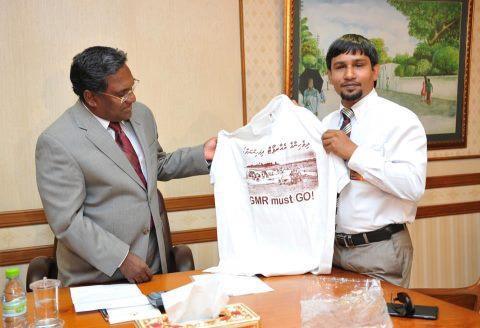
Even under such circumstances, Waheed poses for pictures with leaders and nationalistic paraphernalia of Imran’s ‘Airport Jihadists’.

Hard to believe any President would willingly look such a fool.

Maldives Police Service also seems well beyond the reach of Waheed’s leadership. In the early hours of last Friday the 16th, it ran what has been named an  ‘Intel-led Drug Bust Operation’ resulting in the arrest of two MPs and several senior members of MDP. It involved scores of officers swimming onto a desert island in the dark to ambush the targets at a weekend getaway.

Police found a hefty stash of alcohol on the island, and kept the arrested in handcuffs for hours. Family members are alleging they were badly beaten up in custody.

Waheed appeared as ambushed by police behaviour as were the targets of their Operation. Commissioner of Police Riyaz Abdulla said:

Such operations are not carried out by Police after informing the President or the Home Minister. This institution does not have any political influence.

For a president with any real authority, there would have been at least a courtesy call from the police, not a flippant explanation like Riyaz’s.

Is the President a puppet? Not according to…the President. In the same letter cited above, he wrote:

Nasheed accuses me of being a puppet of the former President Maumoon Abdul Gayoom. This is an accusation I reject.

There is currently a no confidence motion pending against Waheed in the Parliament. Last monday, MPs were due to decide whether or not the impeachment vote could be kept secret. The general opinion seems to be that if MPs are allowed to vote secretly, they will choose to get rid of Waheed.

MPs were ambushed in Operation Alcohol just two days before the vote. With the desert island debacle still fresh in everybody’s minds, the motion to put the impeachment to a secret vote failed narrowly.

The Inter-Parliamentary Union (IPU) has said it is difficult not to see the arrests as politically motivated. It really does not take a conspiracy theorist to link the arrests with the no confidence motion.

If Waheed is pulling the strings, then he ordered the arrests. And, if the arrested MPs’ families are telling the truth, he also ordered them humiliated, intimidated and beaten up. No puppet can pull strings like that.

There are more ways to see Waheed than suggested by Waheed. He is neither puppet no master but the curtain behind which the show was planned. He was the fig-leaf that gave the appearance of legitimacy to a coup. In return for ‘ascendency to the Presidency’, Waheed promised he will not resign until 2013, not matter what. Even if it means looking like a right puppet.

All comment pieces are the sole view of the author and do not reflect the editorial policy of Minivan News. If you would like to write an opinion piece, please send proposals to [email protected]

Likes(1)Dislikes(0)