India calls in debts of US$100 million; “not a major concern” says Finance Minister

Despite India requesting repayment of US$100 million in treasury bonds by February 2013, Finance Minister Abdulla Jihad has said his earlier fears that the Maldives would be unable to cover expenditure for the final months of 2012 were “no longer a concern”.

Jihad told Minivan News that India was also yet to provide a final US$25 million installment of a promised loan, one Jihad said just last month was vital to ensure the Maldives could cover its wage bill.

The Maldives is now required to pay US$50 million in T-bond payments to India by next month, with a second payment due in February, local media has reported.

The Finance Ministry said the debt would be repaid through state reserves, which Sun Online reported could fall to US$140 million (MVR2.2 billion) once the payments to India are settled.

Concerns over state reserves are shared by the International Monetary Fund (IMF), which earlier this month called on the Maldives to introduce a raft of new measures to try and raise revenue and cut spending to alleviate a ballooning fiscal deficit.

“The fiscal deficit is expected to rise in 2012 to 16 percent of GDP [Gross Domestic Product] in cash terms, and likely even higher if one accounts for the government’s unpaid bills, accumulated in an increasingly challenging environment for financing,” the IMF mission stated, following its visit to the Maldives.

Finance Minister Jihad said that as part of trying to balance the country’s expenditure, the Economic Ministry was attempting to secure private sector funding to make up any shortfalls in budget support resulting from a lack of funds anticipated from India. However, he did not give further details on the nature of the private sector groups presently being sought.

Jihad claimed that a “significant” part of the private sector focus would be through issuing treasury bills (T-bills) to the private sector as recommended earlier this year by the IMF.

“When we opened up treasury bills to the private sector initially there was no response,” he said. “However, there have now been consultations with private groups.”

T-bills, which are sold by governments all over the world, serve as a short-term debt obligation backed by sovereign states. In the Maldives, T-bills have a maximum maturity of six months, after which time they must be repaid.

Meanwhile, Jihad said the Finance Ministry had received no notice from Indian authorities regarding when it may receive the final US$25 million installment of a US$100 million loan agreed late last year.  The finance minster said his department had been given no ultimatum or conditions to be met by Indian authorities in order to receive the money.

“I don’t know why the delay [in receiving the funds] has happened. You would need to ask the Indian High Commission about that,” he said.

The  US$25 million was agreed as part of the $US100 million standby credit facility signed with Prime Minister Manmohan Singh in November 2011.

Diplomatic tension

Tensions between India and the Maldives has risen in recent months as divides within the coalition government of President Mohamed Waheed Hassan began to appear over opposition to a contract signed by the previous government, to develop and manage the country’s main airport with Indian infrastructure group GMR.

The divides have threatened to spill into a major diplomatic incident in recent weeks, after the President’s Office issued a release distancing itself from the comments of its own spokesperson, Abbas Adil Riza, who had accused India’s representative in the Maldives of being “an enemy and a traitor to the Maldivian people”.

The dispute between the government and GMR – currently being heard in an arbitration case at Singapore’s High Court – has become increasingly acrimonious with ongoing demonstrations across Male’ and even the water ways surrounding the airport.

The demonstrations have been backed by certain parties within President Waheed’s coalition government, who have set him an ultimatum of reneging on the contract by the end of the month.

While the GMR contract is not implicitly backed by other coalition parties, several senior party figures have opted against plans to “take to the streets” in calling for the airport to be “renationalised” or acting in a manner that could potentially damage future foreign investment in the country.

The GMR contract, which was overseen by a number of organisations including the International Finance Corporation (IFC) – a member of the World Bank group – represents the largest ever foreign investment in the Maldives. President Waheed himself told Indian media that his government was committed to protecting foreign investments in the Maldives, despite questioning elements of the deal.

Foreign borrowing

Earlier this year, President Waheed reportedly said he would not resort to borrowing from foreign governments in order to finance government activities.

“I will not try to run the government by securing huge loans from foreign parties. We are trying to spend from what we earn,” he was reported to have told the people of Nilandhoo.

“The Maldivian economy is fine. Don’t listen to whatever people say. We don’t have to [worry] about the Maldivian economy being in a slump,” he was quoted as saying at the time during a rally in Meedhoo.

Despite Waheed’s reassurances, October saw a number of state owned institutions face disconnection from the capital’s power grid as bills amounting to around MVR 150 million (US$9.7 million) were owed to the State Electricity Company (STELCO).

Responding to the institutions’ blaming of his ministry, Jihad at the time told Sun that the finances were simply not there.

“We are not receiving foreign aid as was included in the budget. How can we spend more than we receive? That’s why those bills are unpaid. We can’t spend money we don’t have,” he told the paper.

Since coming to power in February, the government has committed to reimbursing civil servants for wage reductions made during the austerity measures of the previous government, amounting to Rf443.7 million (US$28.8 million), to be disbursed in monthly installments over 12 months from July.

A MVR 100million (US$6.4 million) fuel subsidy for the fishing industry was also approved by the Majlis Finance Committee, with the hope of stimulating the ailing sector.

The overall deficit for government expenditure has already reached over MVR2billion (US$129million). Jihad has told the Majlis’ Finance Committee that he expected this figure to rise to MVR 6 billion (US$387 million) by year’s end – 28 percent of GDP – alleging that the previous government left unpaid bills equal to over one third of this anticipated deficit.

Former Minister of Economic Development Mahmood Razee has previously told Minivan News that this increased expenditure in the face of a pre-existing deficit represented the government “ignoring reality.”

“If they don’t get the loan, they will have to cut travel expenses, stop certain programs – take drastic measures or get another loan,” said Razee, claiming that the only alternative would be to sell treasury bills.

Following reports in August that the government was attempting to raise funds through the sale of treasury bills, former Finance Minister Ahmed Inaz claimed such a measure would not address IMF concerns about state spending, prolonging economic uncertainty.

In August, the current Finance Ministry announced its own austerity measures intended to wipe over MVR2.2billion (US$143 million) from this year’s budget deficit though few of these propositions have as yet been followed through.

Likes(0)Dislikes(0)

JP MP Abdulla Jabir summoned to police regarding island raid, alleged alcohol consumption

Jumhoree Party (JP) MP Abdulla Jabir exercised his right to silence on Saturday after being summoned by police in connection with alleged alcohol consumption on the island of Hondaidhoo.

Jabir continued to claim that police had beaten him in Hondaidhoo in Haa Dhaal Atoll, further stating that he held Home Minister Dr Mohamed Jameel Ahmed and President Mohamed Waheed Hassan Manik directly responsible for the actions of the police.

Police Commissioner Abdulla Riyaz was also accused of incompetence by Jabir, who then vowed to sue the police chief for personal damages.

Jabir was arrested with nine other individuals on November 15 over the alleged possession and consumption of alcohol.

Maldivian Democratic Party (MDP) MP and Spokesperson Hamid Abdul Ghafoor was also summoned by police in connection with the same case and exercised his right to silence.

Both Jabir and Ghafoor were released from Kulhudhuhfushi Magistrate Court following their arrests. However, the refusal to extend their detention period by Kulhudhuhfushi Court has recently been appealed at the High Court.

Jabir said that he would vote in favour of the no-confidence motions against President Waheed and Home Minister Jameel, further alleging that President Waheed had deceived JP.

Suspicion has surrounded the motives behind the island arrests, with Maldivian Democratic Party alleging they were a politically-motivated attempt to disrupt parliament ahead of a no confidence motion against the President.

A delegation from the Inter-Parliamentary Union (IPU) also expressed their concern over the circumstances behind the MP’s detention, stating “We find it difficult to believe in light of the circumstances and timing of the arrests that the parliamentarians were not targeted for political reasons.”

Days prior to the downfall of the then ruling MDP government on February 7, Jabir switched to JP where he had won the Kaashidhoo constituency seat in parliament. At the time, he had praised President Waheed and defended the coalition government.

However, Jabir today said the legitimacy behind the change of government on February 7 had not been determined by a court of law and hence called for an early election.

Jabir further questioned the validity of the Commission on National Inquiry’s (CNI) report into the transfer of power on February 7.

In addition to Jabir and Hamid, former opposition Maldivian Democratic Party (MDP) President Ibrahim Hussain Zaki and former Press Secretary Mohamed Zuhair, his wife Mariyam Faiz, Zaki’s son Hamdhan Zaki, Seenu Hulhudhoo Reefside Jadhulla Jameel, two Sri Lankans and a Bangladeshi were among the ten people arrested from Hondaidhoo.

In relation to the motion filed to remove Jabir from the deputy leader’s post of JP, he said the move had been initiated by “children” who had been given posts in President Waheed’s government.

Likes(0)Dislikes(0)

UN “shamefully silent” on Maldives’ human rights abuses: MDP

The provisional findings of the Inter-Parliamentary Union (IPU)’s human rights mission to the Maldives should “act as a wake-up call” for other members of the international community, the opposition Maldivian Democratic Party (MDP) has said in a statement.

“Sadly, since February’s overthrow of the Maldives’ democratically-elected government, key parts of the international community have remained silent regarding the widespread human rights violations taking place,” said the party’s spokesperson, MP Hamid Abdul Ghafoor.

“While the IPU, CMAG, Canada, the Human Rights Committee, the EU and certain international NGOs such as Amnesty International and the International Federation for Human Rights have expressed varying degrees of alarm at the Maldives’ backsliding on democracy and human rights, others including the UN Resident Coordinator and the Office of the High Commissioner for Human Rights have remained shamefully silent. To remain silent in the face of injustice is to be an accomplice to that injustice.”

Following its visit the IPU delegation noted on Thursday that it was “difficult” to believe that the recent series of arrests of MPs were not politically motivated.

IPU delegation member Francis Pangilinan, a Philippine Senator, described the circumstances surrounding the recent police raid of Hondaidhoo in Haa Dhaal Atoll and arrest of MPs on charges of alcohol consumption as “very worrying”.

“An impressive team of unidentified police and an army of officers allegedly carried out the arrests, reportedly without a warrant and ill-treated the MPs,” said Pangilinan.

“We are well aware that the consumption of alcohol and drugs is forbidden in the Maldives, but we find it difficult to believe in light of the circumstances and timing of the arrests that the parliamentarians were not targeted for political reasons.”

The delegation further expressed their concern over the failure to punish the police officers who used “excessive force” against MPs earlier this year.

The delegation stressed that the issues raised were an internal matter, and that the IPU could only monitor and communicate with the necessary authorities in the hope that a resolution will come “sooner or later”.

“The outside world is not going to resolve these issues. Instead Maldivians sitting down, ultimately talking to each other to solve the issues of controversy is the only way,” said South African Parliamentary expert Peter Lilienfeld.

MP Ghafoor, who was one of the MPs arrested, meanwhile observed that “gradually, the international community, which for a while was fooled by the appallingly one-sided report of the so-called Commission of National Inquiry, is starting to understand the true nature of the Waheed regime.

“The truth is this: unless Waheed can be pressed into calling early elections, the rapid encroachment of the police state will continue – until it will be impossible to turn it back. It is time for the UN Resident Coordinator and others to wake-up to this fact,” he said.

Minivan News was awaiting comment from UN Representative in the Maldives, Andrew Cox, at time of press.

Likes(0)Dislikes(0)

Zaki’s remarks “threat to national security,” claims Defence Ministry

The Ministry of Defence has said widely-reported remarks by Special Envoy of former President Mohamed Nasheed, Ibrahim Hussain Zaki that the previous government would have sought Indian military assistance to protect its economic interests in the Maldives, constitute a “threat to national security”.

In a statement on Friday, the Defence Ministry condemned the remarks “in the harshest terms” and contended that “such actions are very dangerous [threats] to national security and encourage activities that would harm the country’s independence and sovereignty.”

“If we were in the government, definitely we would have done it by now… definitely [asked for] their [Indian forces] to be on the ground,” Zaki was quoted as saying during a recent visit to the country.

The former Secretary General of SAARC reportedly warned India that rising fundamentalism in the Maldives threatened the country’s economic interests.

“Zaki, 67, a former minister in successive Maldivian governments headed by former presidents Maumoon Gayoom and [Mohamed] Nasheed, said he would have called for Indian forces to protect the multi-million-dollar investment by Indian infrastructure firm GMR Group,” Indian media reported on Thursday.

“The attack on GMR contract is an Islamic fundamentalist issue,” Zaki told reporters.

Zaki explained that “many top figures in the Adhaalath Party are educated in Pakistan and draw their philosophy from the hardline Salafist form of Islam.”

“When Islamic fundamentalism takes over the country, if the Lashkar-e-Taiba can take over the country, then I have no choice [but to call in forces from India],” Zaki was quoted as saying, “referring to the Pakistan-based militant group that India blames for the 2008 Mumbai terrorist attack.”

India’s Daily News & Analysis reported Zaki as saying that fundamentalists in the Maldives “have links with terror group Lashkar-e-Toiba” and warned that if Islamic fundamentalism goes unchecked the country could turn into a terror state that threatens Indian security.

Meanwhile, according to the Indian Express, Zaki’s meetings with External Affairs Minister Salman Khurshid, National Security Advisor Shiv Shankar Menon and Foreign Secretary Ranjan Mathai were “a clear signal from New Delhi of its unhappiness with Male’ over its handling of the opposition in that country to the GMR agreement for airport development.”

The Indian Express reported that Zaki received treatment at the Indian Army’s Research and Referral Hospital for injuries sustained during his arrest from an uninhabited island last week on charges of alcohol consumption.

Following his arrest and hospitalisation, former Human Resource Minister and Maldivian Democratic Party (MDP) lawyer Hassan Latheef tweeted that Zaki was “severely beaten by baton and handcuffed for hours”.

Zaki told the Express that he was thrashed with “boots and electric batons” for hours. “There was no space on my body where I was not hit,” he said.

External Affairs Minister Kurshid and his wife were meanwhile “old friends,” Zaki said.

Earlier this month, India’s Business Standard reported that Indian companies operating in the Maldives were expressing concerns over political interference derailing their substantial investments in the country.

“A recent meeting held with the Maldivian Housing Minister [and a joint venture between developers SG18 and Indian super-conglomerate TATA] is said to have ended abruptly with officials from the firm and the Indian High Commission being asked to leave,” the Standard reported.

“Maldivians’ airport to Maldivians”

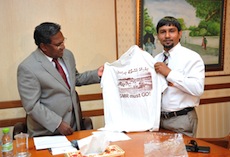
Waheed with anti-GMR t-shirtThe Adhaalath Party has been at the forefront of a campaign to renationalise the airport dubbed “Maldivians’ airport to Maldivians” led by parties of the ruling coalition.

Remarks by government spokesperson Abbas Adil Riza at a protest rally by the coalition earlier this month, alleging that Indian High Commissioner D M Mulay has been bribed by GMR, triggered a diplomatic incident and saw the government dissociate itself from the comments.

Meanwhile, Adhaalath Party President Sheikh Imran Abdulla said at a press conference last week that there should not be any further discussions or negotiations with the Indian infrastructure giant and reiterated calls for the government to immediately terminate the agreement.

While the head of the religious conservative party had given the government a deadline of six days to “reclaim the airport” at the rally on November 9, the ultimatum was later extended to November 30.

On Thursday, the anti-GMR campaign presented a petition with 35,000 signatures to President Mohamed Waheed Hassan Manik. The petition was handed to Dr Waheed by Sheikh Imran before a meeting at the President’s Office.

Speaking to press following the meeting, State Minister for Home Affairs Abdulla Mohamed said that the President assured the group that the dispute would be resolved in line with “the wishes of the Maldivian people” and that a decision would be made after a cabinet meeting.

With its second ultimatum, the group warned the government that it would have to resort to “direct action” unless the concession agreement was not terminated by November 30.

“Independence and sovereignty”

The press release from the Defence Ministry meanwhile referred to article 67(d) of the constitution, which states that every citizen has a responsibility “to promote the sovereignty, unity, security, integrity and dignity of the Maldives.”

The Defence Ministry appealed to politicians against making remarks that could undermine “national independence and sovereignty” and “issuing threats of confrontation and the use of force.”

The statement also warned that the Defence Ministry would take “necessary legal action against anyone who commits an act that harms the independence and sovereignty of the nation.”

Likes(0)Dislikes(0)

Supreme Court overrules Juvenile Court’s summoning of Speaker of Parliament

The Supreme Court on Thursday overruled a request by the Juvenile Court for Speaker of Parliament Abdulla Shahid to attend the court and answer questions regarding medical insurance for judges.

The Supreme Court noted that making arrangements with the relevant authorities to provide health insurance for judges and their dependents was part of the mandate of the Department of Judicial Administration.

“A Juvenile Court Judge has ordered me to his court today to respond to his queries regarding his health insurance approved by Parliament,” Speaker Shahid tweeted on Thursday.

Two hours later, Shahid revealed that the Supreme Court had “issued a writ of mandamus quashing the Juvenile Court Judge’s order stating Juvenile Court has exceeded its mandate.”

Article 39(a) of the Judges Act (Dhivehi) of 2010 states that health care for judges, their spouses, parents and children under the age of 18 must be provided by the state either in the Maldives or overseas under a medical scheme.

Local media reported last week that health insurance for judges and their dependents had not been provided since the introduction of the universal health insurance programme Aasandha in January 2012.

“We did not summon him. We just requested his presence for a discussion. Health insurance had not been provided to the judges of only [the Juvenile Court]. We have just taken the initiative in this matter,” a Juvenile Court official was quoted as saying.

However, the parliament secretariat informed the Juvenile Court that it could not summon the Speaker.

The Supreme Court writ of mandamus (Dhivehi) meanwhile revealed that the court asked Shahid to attend at 1:00pm on Thursday (November 22).

The order or request was made after not receiving a reply from the Speaker to a letter sent on November 4 requesting health insurance for Juvenile Court judges.

The letter had demanded a reply within a specified period, according to the Supreme Court writ.

The apex court determined that the summons or request to answer its queries was made “outside the legal responsibilities of the Juvenile Court.”

Former President Mohamed Nasheed meanwhile condemned the Juvenile Court’s attempt to summon the Speaker.

“I see the courts trying to establish judicial dictatorship. It’s got to stop,” Nasheed tweeted.

The Juvenile Court incident came during a week when two MPs from Speaker Shahid’s government-aligned Dhivehi Rayyithunge Party (DRP) were repeatedly summoned to court over longstanding unpaid debts to the Bank of Maldives.

DRP MP Ali Azim alleged political motivation behind the summons following a vote on Monday to conduct no-confidence motions through secret ballot.

Meanwhile, in March 2011, the Judicial Service Commission (JSC) moved the current Chief Judge of the Juvenile Court, Mohamed Naeem, from the Civil Court to the Juvenile Court as a disciplinary action for disregarding decisions of superior courts.

Then-Civil Court Judge Naeem had refused to hear cases involving the Attorney General’s Office before parliament approved the reappointment of then-Attorney General Dr Ahmed Ali Sawad.

Naeem’s decision defied precedents set by both the Civil Court and High Court, which ruled that the AG could represent the state at court before receiving parliamentary consent.

However, a few days later the JSC appointed Naeem as the chief judge of the Juvenile Court.

Likes(0)Dislikes(0)

Comment: Maldives battle-lines getting redrawn?

With the Jumhoree Party (JP) voting in Parliament unlike the rest of the partners in the government, and President Mohammed Waheed Hassan sacking one more of its Ministers, battle-lines seem to be getting redrawn in the Maldives all over again.

The opposition Maldivian Democratic Party (MDP) lost the vote for secret-ballot on no-confidence motions – one is now pending against President Waheed – by 34-39 with two absentees in the 77-member house, including the Speaker, but the JP decision has exposed the chinks in the government’s armour that had remained underneath until now.

In a way, the early JP decision to vote for secret-ballot may have triggered the current political crisis, independent also of the anti-GMR protests that are centered on the Indian developer-concessionaire for the Male international airport. The sacking of JP Transport Minister Ahamed Shamheed the previous week has been followed by that of State Minister for Gender, Fathimath Dhiyana Saeed.

Minister Saeed had appeared with her husband and JP parliamentarian Abdulla Jabir at a weekend news conference, condemning his arrest on charges of alcohol-consumption, and alleged roughing-up, consequent hurt and humiliation at the hands of the police. Jabir was not alone in all this.

Simultaneously, President Waheed seems to have put on hold the JP’s new nominee for Transport Minister. Ameen Ibrahim is a vice-president of the party and chairman of the VTV of the Villa Group, owned in turn by JP founder, Gasim Ibrahim. He was named to succeed Shamheed after President Waheed stood his ground on not restoring the latter. Simultaneously, however, President’s Office Spokesperson Abbas Adil Riza, one of the recent entrants, quit the JP, protesting against the party’s vote on the secret-ballot.

What make the current developments interesting is the presidential aspirations of JP’s Gasim Ibrahim. He was among the first serious contenders for the presidency to announce his candidature in the elections that are due in 2013. Having bagged over 15 per cent of the popular-vote in the first-ever multi-party, direct elections to the presidency in 2008, Ibrahim is believed to command a ‘committed vote-bank’, which he transferred to MDP’s Nasheed in the second run-off round, thus contributing to the latter’s victory. With the nation purportedly poised for an equally keen contest the next time too, the current political developments have the potential to advance the presidential poll date, as desired and demanded by the MDP, ever since President Nasheed quit office on February 7.

Avoidable embarrassment

Despite winning the vote against secret-ballot on anticipated lines, the government faced avoidable embarrassment in Parliament when a member charged President Waheed and his aides with influencing him to “vote in a particular way” on the issue of secret-ballot. Ali Azim is one of the two MPs against whom the civil court had cancelled summons earlier in the day on Monday, for non-payment of dues to the state-run Bank of Maldives (BoM). Under the Maldivian law, proclaimed debtors cannot continue as MPs until they had cleared their dues – and at times have to get re-elected after their seats are declared vacant.

The government has promptly and predictably denied Azim’s charge. It is unclear if the MP intends moving a breach of privilege motion against all those whom he had named inside the house as influencing him to vote in a ‘particular way’ on the secret-ballot.

Media reports on his parliamentary expose, if one, did not mention any substantial evidence to prove his point. For now, the charge lends credence to the opposition MDP’s charge that the government was using all means to influence and/or intimidate MPs. If there are more on the treasury benches, as claimed, they are yet to speak up – or, act otherwise on issues of concern to the government.

‘Anti-GMR, not anti-India’

On a parallel track, which may have been side-lined to an extent by the more immediate political developments inside and outside Parliament, a junior Minister claimed that the on-going anti-GMR protests should not be construed as anti-India protests. In a pointed reference to the Indian concerns expressed by the Spokesperson of the Ministry of External Affairs (MEA) in New Delhi recently, State Minister of Tourism, Arts and Culture, Ahmed Shameem, claimed that the issue related to a company owned by ‘some Indians’ but was registered in another country and did not pay taxes to India.

The issue thus did not relate to India or the Indian Government, the Minister said.

“No demonstrations have been held in Maldives against India. No anti-India sentiments were expressed in any of the demonstrations held… India should not, therefore, be worried over a non-existent matter.”

Elaborating, Minister Shameem said, “We have no issues with India. We have no issues with any Indian citizens in Maldives, and likewise we have no issues with any of the employees of GMR. The issue is with the agreement made by the former Government (of President Nasheed) with GMR. All we want is to annul that agreement.”

Miadhu quoted Minister Shameem as also saying that they had clarified the position even in the Friday night’s rally of the National Alliance. He recalled that religion-centric Adhalathth Party leader “Sheikh Imran and others stated this very clearly. They clarified that there is no threat to any Indian citizen in Maldives”. As may be recalled, the protestors have resorted to a combination of religion and patriotism to target GMR, continuing from where they had left the ‘December 23 Movement’ after the February 7 resignation of President Nasheed.

Tirade against envoy continues

Minister Shameem went on to claim that the Indian government had been misinformed of the reality of the situation by people in the Maldives. He urged the Indian government to seek authentic information about the situation in the Maldives directly without contacting any third party.

Minister Shameem belongs to President Waheed’s Gaumee Itthihaad Party (GIP), and it is unclear why the response to the Indian MEA’s statement should come from someone not attached to the Maldivian Foreign Ministry.

Almost simultaneously, Minvian News confirmed that President’s Office Spokesperson Abbas Adil Riza stood by his controversial statement that Indian High Commissioner Dyaneshwar Mulay was a “traitor to Maldives, and corrupt”.

The opposition MDP had earlier taken the issue to parliament, with members claiming that the comments were against diplomatic protocol and could affect bilateral relations with India. MDP parliamentarian Eva Abdulla alleged that the remarks made by Riza were not those of his own but were rather made under “direct orders” of President Waheed, as Minivan News reported.

Riza got not-so-unexpected support from Abdul Azeez Jamaal Aboobakr, MP belonging to the Progressive Party of Maldives (PPM), founded by former President Maumoon Abdul the the Progressive Party of Maldives (PPM), founded by former President Maumoon Abdul Gayoom.

The PPM is the single largest political group supporting the Waheed government in parliament, and Aboobakr said that a person’s freedom cannot be limited because of his employment. He told parliament that Riza too had his freedom of speech – and recalled that the latter had prefaced his public utterances on High Commissioner Mulay as his personal views.

According to Minivan News, the majority of PPM members in parliament attempted to defend Riza, and tried to switch the focus onto the Indian envoy. However, in an apparent contradiction to its comments in parliament, the PPM on November 12 issued a statement dissociating the party from the ‘slanderous’ allegations made against High Commissioner Mulay, Minivan News said further. Earlier, the President’s Office too had distanced himself from Riza’s statement.

In the past, PPM leaders had spoken about the need for re-negotiating the GMR agreement, not ousting them from the airport construction-cum-concession contract. The party’s position on the issue is unclear. So is the current position of the Dhivehi Raayathunge Party (DRP), another of the Government parties originally founded by President Gayoom, and from which he is estranged now.

Over the previous weeks, DRP leader Thasmeen Ali and other leaders have spoken against the moves to oust GMR, but have not been heard of since. On the crucial secret-ballot issue the DRP, like the PPM, voted with the government and against the MDP amendment.

‘India need not be concerned…’

At the same time, in what read like a loaded statement, Minivan News quoted President Waheed’s interview to the news agency, Press Trust of India (PTI), that New Delhi “need not be concerned with affairs in the Maldives”. He claimed further that “this is not a problem that we have with GMR, but with a bad agreement… We have to pay GMR US$1.5 million per month under the current arrangement of the agreement in operation, and that is beyond our capacity”.

The reference was to the erstwhile MDP-led government of President Nasheed offering to compensate GMR for the loss of revenue, after a local court struck off the original provision for levying $25 entry fee for Maldivians using the Male airport. Ironically most government parties today, barring President Waheed’s GIP, were in the opposition at the time the GMR contract was signed – and had opposed it through political, legislative and legal means.

Otherwise too, President Waheed may have a point, when he says the government is strapped for cash to pay GMR every month. Tourism had sustained economic development up to a point, but for growing with the growth, the nation needs large investments in the infrastructure sector in particular. The skewed governmental revenue-model from the resort-centric tourism industry is incapable of sustaining the economy. This is also the crux of the fiscal problem that the Nasheed government inherited and left behind – after attempting to address wide-ranging economic reforms, which came with the IMF-driven austerity measures, affecting the common man as much as the large pool of public servants.

Against this background, the Waheed government may not have any answers to the question of much larger repayments that may become necessary if the GMR agreement were to be annulled, as being sought by street-protestors in Maldives, and the international arbitrators in Singapore, whom GMR has approached under the agreement for redress, rule in its favour. Of equal concern should be the unwillingness of other overseas investors to put their money in Maldives, a nation until now known for easy repatriation procedures that had attracted funding for the resort industry in the first place.

The alternative could be that Maldives has already identified an external underwriter, now lurking in the side-lines, to either pay-off or buy-out GMR, or have other weapons in its arsenal to avoid/minimise those payments.

The Adhaalath Party, which had set a November 15 deadline for the government to take-over the Ibrahim Nasir International Airport (INIA) from GMR has extended the same till the month-end.

For its part, GMR has reiterated its willingness to re-negotiate the position under the existing agreement. Yet, it is unclear if the Maldivian government is willing to re-negotiate the deal as ruling combine leaders used to say from time to time, or would have the time, energy and inclination to do so, and that domestic political developments of the kind flagged by the JP vote on the secret-ballot and allied issues would not overtake the same.

To the extent, the GMR issue and the political crisis could overlap in more ways than one, and more often than anticipated, with consequences for the nation and its near-exclusive import-driven economy.

The writer is a Senior Fellow at Observer Research Foundation

All comment pieces are the sole view of the author and do not reflect the editorial policy of Minivan News. If you would like to write an opinion piece, please send proposals to [email protected]

Likes(0)Dislikes(0)

Civil Court orders DRP MPs Azim and Nashiz to hand over mortgaged property as payment for BML loans

The Civil Court has ruled on Thursday that the properties mortgaged in relation to the Funaddoo Tuna Products unpaid loans are to be handed over to the Bank of Maldives (BML) within a period of 15 days.

The ruling permits BML to then sell the property in order to settle the payments. The mortgaged properties are Madivaru Yacht, Reethi Beach Resort and Funaddoo.

BML said in court today that as a result of delaying payment, the due amount has now risen from MVR 117 million (US$7,587,549) to MVR 206 million (US$13,359,274) , once the loan interest is added.

Representatives of the bank said in court today that the accounts of the individual guarantors have been frozen, according to local media. The guarantors are Dhivehi Rayyithunge Party MPs Ali Azim and Mohamed Nashiz, and Ahmed Rasheed of Rafeeguge.

The bank also said that the passports of the DRP MPs have now been held, preventing them from departing the country.

BML declined from commenting on the issue at time of press as the matter is an ongoing case.

Voted against Waheed’s wishes, court summons again: MP Azim

DRP MP Ali Azim has stood by his earlier allegation that the case being carried through now is politically motivated.

The police were given an order to present MPs Nashiz and Azim to court under detention, while the hearing was scheduled for the same time as the taking of votes in parliament to approve secret balloting for impeachment votes.

The court order was first cancelled a few hours after it was issued. Police Media Official Sub-Inspector Haneef had at the time said that the reason provided by the court was that the presiding judge had been abroad, and other cases had been scheduled.

Azim stated in parliament that he had received calls from President Mohamed Waheed Hassan, President’s Political Advisor Ahmed Thaufeeg and Spokesperson Abbas Adil Riza, asking him to cast the vote on secret balloting in a way they preferred. He alleged that they had offered to stop the summons if he voted in line with them.

Azim had said in parliament then that he was “not the least bit surprised” that Waheed had called, adding that Waheed had called previously for similar matters, including the Football Association of Maldives (FAM) elections.

However, the MP subsequently voted in favour of secret balloting.

The Civil Court then summoned the MPs to court again, and the hearing was held Thursday.

“We were summoned to court, and then there was the attempt to intimidate me. When I voted against his wishes, the court immediately summons me back again. I believe this is politically motivated,” Azim said today after the hearing.

DRP Leader Ahmed Thasmeen Ali, MP Mohamed Nashiz and Speaker of Parliament Abdulla Shahid were not responding to calls at the time of press.

Likes(0)Dislikes(0)

“Difficult” to believe arrests of MPs “not politically motivated”: IPU

The circumstances behind the arrests of Jumhoree Party (JP) MP Abdulla Jabir and Maldivian Democratic Party (MDP) MP Hamid Abdul Ghafoor for their alleged possession of alcohol have been labelled “very worrying” by delegates from the Inter-Parliamentary Union (IPU).

Findings compiled by the three-person delegation raised further concerns over the failure to punish police officers who used excessive force on MPs earlier in the year.

At a press conference held today (November 22), the delegation revealed their findings following a three-day mission to the Maldives over alleged human rights abuses of MPs.

The delegation consisted of Philippine Senator Francis Pangilinan from IPU’s Committee on Human Rights of Parliamentarians, South African Parliamentary expert Peter Lilienfeld and Head of the Human Rights programme, Rogier Huizenga.

Pangilinan said that the circumstances surrounding the arrests of Jabir and Ghafoor earlier this month were “very worrying” and that the delegation found it “difficult” to believe it was not politically-motivated.

Both Jabir and Ghafoor – along with eight others – were arrested on the island of Hodaidhoo in Haa Dhaal Atoll for the alleged possession of alcohol and drugs.

The arrests were made days prior to a vote on whether or not a no confidence motion against President Mohamed Waheed could be voted with a secret ballot.

Following Jabir’s subsequent release by the Kulhudhuffushi Magistrate Court, the State has asked the High Court for an order to re-arrest Jabir.

State Prosecutor Hana Waheed requested High Court cancel the Kulhudhuffushi Court ruling, which stated that that there were no grounds to arrest Jabir.

Section 202.D of Parliament’s rules of procedure states that MPs cannot be arrested while there is a no-confidence motion before parliament to impeach the president or remove a cabinet minister, judge or member of an independent commission from his or her post.

However according to Hana, Article 202 of Parliament Standing Orders is against the constitution, and she requested the court to cancel the article and issue an order to arrest Jabir.

At a press conference this morning, Pangilinan from the IPU delegation said: “The circumstances of the arrest are very worrying. An impressive team of unidentified police and an army of officers allegedly carried out the arrests, reportedly without a warrant and ill-treated the MPs.

“We are well aware that the consumption of alcohol and drugs is forbidden in the Maldives, but we find it difficult to believe in light of the circumstances and timing of the arrests that the parliamentarians were not targeted for political reasons.”

The delegation further expressed their concern over the failure to punish the police officers who used “excessive force” against MPs earlier this year.

In March, the Maldivian Democratic Party (MDP) parliamentary group submitted cases alleging police brutality against the former ruling party’s MPs to the IPU’s human rights committee at the 126th Assembly held at Kampala, Uganda.

The cases targeted police brutality against MDP MPs on February 7 and 8, in particular on the latter date during a heavy-handed police crackdown on an MDP protest march that left scores injured and hospitalised, including former MDP parliamentary group leader and Hulhu-Henveiru MP ‘Reeko’ Moosa Manik and Maafanu South MP Ibrahim Rasheed ‘Bonda’.

“The delegation is deeply concerned that the police officers who used excessive force against the members of parliament earlier this year have not yet been punished, and that Members of Parliament appear to remain subject to intimidation.

“The delegation points out that in several of the cases in the use of excessive police force, there is clear video evidence available which should have enabled the authorities to take effective and swift action. The delegation therefore calls on authorities to do everything possible to expedite their efforts to a successful conclusion,” Pangilinan said.

Findings from the mission also revealed a lack of trust in the government from the general public and called for parliament to rectify this perception.

“The parliament does not help itself when it is perceived by the public as largely helping itself rather than the ordinary citizens,” Pangilinan added.

The delegation stressed that the issues raised were an internal matter, and that the IPU could only monitor and communicate with the necessary authorities in the hope that a resolution will come “sooner or later”.

“The outside world is not going to resolve these issues. Instead Maldivians sitting down, ultimately talking to each other to solve the issues of controversy is the only way,” said Peter Lilienfeld.

The murder of Progressive Party of the Maldives (PPM) MP Dr Afrasheem was also mentioned, noting that the delegates were happy to hear the authorities are close to completing the investigation, and that justice can “soon be recognised”.

The three-day mission saw the delegates meet with all relevant judicial executive and parliamentary authorities including the Police Commission, the Minister of Home Affairs and the President.

According to Pangilinan, the findings from the mission will be compiled into a report within one month, before being submitted to the IPU committee where it will be reviewed in January.

“We have informed the offices concerned with our findings that should there be any developments between now and January, that we would welcome any information on such developments so we can incorporate it when we meet in January and tackle the Maldives case,” Pangilinan added.

Likes(0)Dislikes(0)

High Court overturns Criminal Court’s July 2010 suspension of senior police officers

The High Court on Tuesday overturned the Criminal Court’s suspension of two senior police officers in July 2010, ruling that Chief Judge Abdulla Mohamed’s decision to bar Superintendent Mohamed Jinah and Inspector Mohamed Riyaz from the court for six months was unlawful.

The pair was suspended after they appeared in court over the detention of then-opposition MPs Abdulla Yameen, Ahmed Nazim and Gasim Ibrahim on charges of bribery and treason.

The suspension for alleged contempt of court was appealed at the High Court by the Attorney General’s Office on July 21, 2010.

Police meanwhile filed a complaint against the chief judge at the Judicial Service Commission (JSC) alleging “obstruction of high-profile corruption cases.”

The JSC has however not completed an investigation of the complaint to date. The case is among 168 complaints that the commission has yet to conclude as of December 2011, according to the JSC annual report for 2011 (Dhivehi).

In January 2012, the JSC revealed that there were 11 complaints filed at the commission against Judge Abdulla Mohamed, including allegations of corruption and abuse of power.

Procedural fairness

In its judgment on Tuesday (Dhivehi) – more than two years after the case was registered – the High Court ruled that the administrative action against Jinah and Riyaz was neither procedurally fair nor in accordance with regulations on holding persons in contempt of court.

A police media official told Minivan News at the time that court had “sent a letter signed by the Chief Judge of the court to Police Commissioner Ahmed Faseeh. The letter did not mention any specific reason [for the suspensions], only ‘ethical grounds’.”

The High Court noted that the Criminal Court did not reply to a letter from the Maldives Police Service – sent two days after receiving the letter from the Criminal Court on July 11 informing the Police Commissioner of the suspension – seeking clarification concerning the unprecedented action.

Police had asked the court to clarify the date the hearing in question took place, the nature of the contempt allegedly exhibited by the pair or the alleged violation of ethical codes, whether it had taken place outside the hearing and whether the police officers were given any warning prior to the administrative action.

While article 43 of the constitution guarantees the right to “administrative action that is lawful, procedurally fair and expeditious,” the High Court noted that due process was not followed by the Criminal Court as the officers were not informed either of the reasons for the action or “the date of the incident”.

The High Court ruling also referred to article 68 of the constitution, which states, “When interpreting and applying the rights and freedoms contained within this Chapter, a court or tribunal shall promote the values that underlie an open and democratic society based on human dignity, equality and freedom, and shall consider international treaties to which the Maldives is a party.”

“Obstruction of investigations”

Appearing on state broadcaster Television Maldives (TVM) on July 17, 2010, then-Deputy Commissioner of Police Ismail Atheef explained that Jinah and Riyaz had appeared in court on July 9.

However, the letter from Chief Judge Abdullah Mohamed informing police of the suspension was received two days later on July 11.

“If someone is in contempt of the court, action has to be taken immediately according to provision five of the court regulations,” he noted.

Atheef added that the detectives were not given any warning nor had their conduct in court been noted by the journalists who were present.

“So when this letter came to us, the way police interpret it is that this is an obstruction specifically of our investigation,” he claimed.

It was the first time that police officers were suspended from the Criminal Court, Atheef said.

The former Deputy Commissioner contended that the suspension was a deliberate obstruction because Riyaz and Jinah, as the two lead detectives and top police lawyers, would have had to appear at court to seek an extension for MP Nazim’s detention.

Meanwhile, Jinah was among a number of senior officers assaulted by mutinying police inside the police headquarters before the controversial transfer of presidential power on February 7, 2012.

Following the police mutiny at the Republic Square and violent clashes with military officers, Jinah was handcuffed and taken to the Dhoonidhoo detention island.

Local media reported this week that Jinah was demoted from the rank of chief superintendent to superintendent on November 19.

Jinah was reportedly demoted over remarks he made to the media following the arrest of Gassan Maumoon, son of former President Maumoon Abdul Gayoom.

However, in June this year, the Civil Court ruled in favour of Jinah in a case filed by Gassan claiming violation of his basic rights by the superintendent. In October 2011, Gassan was arrested on suspicion of hurling a wooden block into a crowd of Maldivian Democratic Party (MDP) protesters outside the former president’s residence.

While the former head of the Drug Enforcement Department (DED) has reportedly decided to leave the Maldives Police Service, police have said the request made last month has not yet been granted as the disciplinary board was investigating a case involving the senior officer.

Likes(0)Dislikes(0)