Large discrepancies in Transport Ministry’s financial records: audit report

Auditors have found large discrepancies between the financial records maintained by the Ministry of Transport and Communication and the general ledger kept by the Ministry of Finance and Treasury.

According to the Transport Ministry’s 2010 audit report, the ministry’s records show that a total of Rf26 million (US$1.7 million) was spent on purchasing  information technology hardware, while the Finance Ministry’s ledger for National Center for Information Technology had no record of the expense.

Meanwhile, income received as Driving Licence Insurance Fee was recorded in the Transport ministry’s books as Rf229,935 (US$14,911) more than the amount stated in the Finance ministry’s ledger while the total income received by the Transport Authority in 2012 was recorded as Rf2.3 million less in the ministry’s ledger.

The latter discrepancy occurred because the ministry had not updated their records with the income generated from ministry’s services provided in the atolls under the Decentralisation Act, the report said.

Furthermore, Rf47 million (US$3 million) allocated to three regional airports in 2010 were recorded as expenses in the ministry’s financial statements, although  auditors found a sum of Rf947,014 (US$61,500) remained unspent in the respective airport’s bank accounts.

Over Rf 600,000 (US$39,000) received as revenue to the Kadhoo Regional Airport between November 2008 and February 2010 was not deposited to the state’s consolidated revenue account, the report added, while  poor management of  airport’s invoices and records made it difficult for auditors to determine how much money is owed to different parties or supposed to be received as income.

Auditor General Ibrahim Niyaz observed in the report that the the ministry had not “identified and reconciled” the aforementioned discrepancies.

The ministry also did not compile its financial statement in accordance with ‘International Public Sector Accounting Standards’ (IPSAS) as stipulated by regulations under the Public Finance Act, and as a result lacked important information such as detailed disclosure notes, Niyaz added.

Therefore, Auditor General refrained from providing an opinion of the ministry’ financial statements and instructed to adjust the figures accordingly to remove discrepancies and compile it in accordance with IPSAS.

The report further noted that the ministry had purchased equipment without the stipulated bidding process and had assigned maintenance of traffic lights to a company prior to signing the contract, thereby violating public finance regulation.

Likes(0)Dislikes(0)

GMR offers to exempt Maldivian nationals from airport development charge

GMR has offered to exempt Maldivian nationals from paying the contentious Airport Development Charge (ADC), in a bid to end a legal and contractual stalemate that threatens to bankrupt the Maldives Airport Company Limited (MACL) and deprive the government of the majority of all airport revenue.

The Indian infrastructure giant signed a 25 year concession agreement with former President Mohamed Nasheed’s government to upgrade and manage Ibrahim Nasir International Airport (INIA). Under the concession agreement, a US$25 charge was to be levied on all outgoing passengers to part-fund the US$400 million upgrade.

However while in opposition the Dhivehi Qaumee Party (DQP), led by Dr Hassan Saeed, now President Dr Mohamed Waheed’s special advisor, filed a successful case in the Civil Court in December 2011 to block the payment of the charge, on the grounds that it was effectively a tax not approved by parliament.

Nasheed’s government had agreed to deduct the ADC from the concession fees payable by GMR while it sought to appeal to verdict. As a result, Dr Waheed’s government received only US$525,355 from the airport for the quarter, compared to the US$8.7 million it was expecting.

In a statement today, GMR said the government had “expressed a desire to exempt Maldivian citizens from the ADC”, as “the majority of Maldivians travel abroad for the purposes for healthcare and education.”

“The ADC was conceptualised and incorporated into the concession agreement by the government to yield a maximum return to the Maldives while ensuring development of the airport and a reasonable return to the successful bidder,” GMR stated.

“We are sensitive to the apprehensions expressed regarding ADC; and would like to assure all concerned that the management of GMR Male International Airport is doing everything possible by offering viable options to reduce the impact on the Maldivians, thereby helping the government for the ADC implementation.”

GMR presented the government with two options:

  • Option 1: No Maldivian passport holder will have to pay ADC. Every departing foreign passenger will pay an ADC of US$28.00; or
  • Option 2: Maldivians travelling to SAARC countries will not have to pay any ADC. Every Maldivian Passport holder departing to countries other than SAARC and every foreign passenger will pay an ADC of US$27.00.

No fee would be charged to either Maldivians or foreigners using the domestic terminal, the company noted.

In the statement, GMR noted that the government received US$33 million in 2011 from airport concession fees, “three times the money the government ever made in a year [from the airport] before privatisation.”

Following construction of the new terminal in 2015 – including “a state-of-the-art 600,000 square foot integrated Passenger Terminal and a 20,000 square foot VIP terminal, and various other airside and landside developments,” expected revenue from the airport to the government was expected to reach US$50 million per year, GMR observed, and almost US$100 million from 2021 as passenger numbers increased.

“In effect, GMIAL’s contribution to the government would be over US$2 billion over the concession period of 25 years, which will make a very significant contribution to the economy of the Maldives.”

President’s Office Spokesperson Abbas Adil Riza said the government had not yet officially received details of the offer, but said that such an offer would be evaluated by the Attorney General’s office “to see whether it is in line with the Financial Regulation Act.”

Attorney General Azima Shakoor was yesterday reported as expressing concern that settling the issue would be “quite difficult”, but vowed that “the government would settle the issue for the benefit of the country.”

On May 2 President Dr Mohamed Waheed told media at the inauguration of the Civil Air Navigation Services Organisation (CANSO): “I do not believe [the ADC] can be charged in the current situation because of the court’s decision.”

Likes(0)Dislikes(0)

Government to consult tourism industry on potential T-GST increase

The government will hold a consultation with the tourism industry this week to test its appetite for an increase in the Tourism-GST (TGST), Tourism Minister Ahmed Adheeb has said.

The International Monetary Fund (IMF) has urged the Maldives to increase the T-GST from six percent to 12 percent, among several measures the organisation says are urgently needed to offset the Maldives’ spiraling budget deficit, and avoid miring the country in poverty.

Parliament’s Finance Committee last week calculated that the budget deficit would reach 27 percent of GDP, on the back of plunging revenues and a 24 percent increase in government expenditure.

Adheeb told Minivan News that the government would present the IMF’s report to the industry, and discuss how to proceed: “We have to be realistic,” he said.

“The IMF has recommended an increase to 12 percent – we need to discuss what kind of increase the industry would like to see over the next five years,” he said.

Adheeb emphasised the need for stability rather than sporadic increases in the tax, cautioning against a sudden change in the T-GST which would affect those tour operators who make pricing agreements and publish brochures up to a year in advance.

However, Secretary General of the Maldives Association of Tourism Industry (MATI), Mohamed Ibrahim ‘Sim’, warned that the tourism industry was already under pressure from a decline in traditional markets.

“Is there an appetite [to increase the TGST]? No, not really. The European economy is not doing well and we would like the costs to remain the same – GST is something we have to pass to the customer. We need to maintain it, at least for the moment,” Ibrahim said.

One resort manager told Minivan News on condition of anonymity that such an increase would have “serious ramifications on many of the markets.”

“Some operators will not accept the increase mid-contract and hence resorts will have to absorb this from revenue,” he explained. “The additional costs will need to be balanced somewhere in the operation and you will find resorts have to [reduce] some of the nice touches for guests, [cut] staffing levels etcetera in order to deal with these ever growing expenses.”

The manager expressed exasperation that resorts were being asked to shoulder the burden without a parallel commitment from the government to reduce expenditure.

“We have seen an increase in some public services salaries and a reduction on working hours in many government departments who are meant to serve the resorts. Many of these government departments make it difficult for the resorts to do their jobs, with bureaucracy and rules to keep extra people in a job rather than making it easier to support the resorts in order to do their job: build more business, increase revenue and hence increase GST [revenue] in a positive manner. An increase in GST right now is the wrong solution.”

The government “needs to take a more supportive approach to the resorts”, he suggested, “whether it be processing visas, expediting customs waits or speeding up the immigration process for guest at the airport. A serious revision of the various government departments is required.”

According to figures from the Maldives Inland Revenue Authority (MIRA), the T-GST brought in 32.4 percent of all government revenue in April.

Total revenue collected in April was Rf2.5 billion (US$162.1 million) – almost double that collected in April last year – however MIRA’s figures do not take into account the substantial revenues lost from the phasing out of import duties, previously the Maldives’ main source of tax revenue.

Former government to blame?

Adheeb blamed the need for the increase on the former government’s changes to the calculation of land lease rents, which he claimed were responsible for an Rf540 million (US$35 million) shortfall overall after the new taxes were introduced.

MATI’s Ibrahim however contended that the changes to the fixed rents were offset by the new taxes: “Our calculation at the time these taxes were introduced were that overall it balances out, but that some resorts pay more.”

Recent changes introduced by the new government to the payment of lease extensions – from a lump sum to an annual basis – have also pulled US$135 million in revenue from the 2012 budget, the ousted Maldivian Democratic Party (MDP) contends.

Economic indicators published by the Maldives Monetary Authority (MMA) meanwhile show a fall in the number of tourist arrivals for March 2012 compared to the previous year, from 80,732 to 76,469. The number of bed nights fell 6.8 percent for the same period, one of only a few recorded declines since the 2004 tsunami. February – a month of high political turmoil and widespread negative international media coverage – recorded a 2.5 percent decline.

An increase in prices would affect established markets already under strain, Ibrahim reiterated.

“It’s hard to say if emerging markets would be put off – China, Russia and the Middle East – maybe not. But [price increases] are affecting the established market. The market situation is not looking good at the moment.”

A survey of nearly 3000 tourists last year reported that 46 percent believed accommodation in the Maldives was too expensive. Soft drinks, alcohol were rated as expensive by 42 percent, while food, water and souvenirs received a similar rating from 41 percent of tourists polled.

Likes(0)Dislikes(0)

Nasheed launches campaign for MDP presidential primaries

Ousted President Mohamed Nasheed launched his campaign for the Maldivian Democratic Party’s (MDP) presidential primary, on the island of Magoodhoo in Faafu Atoll on Sunday.

Nasheed alleges he was deposed in a coup d’état on February 7 and has called for early elections within 2012. The Commonwealth and the EU have supported the call. However, new President Dr Mohamed Waheed Hassan has said the earliest constitutionally-permitted date for elections was July 2013.

The MDP presidential primary is to be held on June 15. Nasheed is presently the MDP’s sole candidate, but has to win 10 percent of votes in order to gain the MDP candidacy.

Speaking to Magoodhoo residents, Nasheed emphasised the importance of an elected government claiming the chances of a 2013 election were slim if an election could not be held in 2012.

“When a government is elected through a vote, it fosters a close relationship between the people and their leaders. Such a government will benefit the people, it will fulfill the needs of the people. Because the government originates from the people,” Nasheed said.

“No earthly power, not even that of the police or military, can equal the power of the people. When an individual finds courage in another, and the people come out to enforce their will, no one can challenge that will. Not even the police, the military or judges,” he added.

President Waheed’s administration was established by force, Nasheed claimed, and was prioritising the approval of the police and military over that of service delivery.

“The current administration will prioritise getting the approval of the police and military. The government treasury, the government’s expenditure, will not be spent on the people. They will have to end Aasandha, dismiss the utility companies, abolish the health corporations. They will have to stop the transport network,” he said.

President Waheed has repealed many of Nasheed’s policies, including the abolition of regional health and utility corporations, reviewing the free universal healthcare scheme Aasandha, ending the second chance program for rehabilitation of inmates, and halting all public-private-partnership development projects claiming the contracts’ legality needed to be reviewed.

The coalition of political parties backing Waheed have accused Nasheed of corruption in the awarding of development contracts.

Waheed had also decided to accept resort islands’ lease extension payments in installments rather than upfront at the end of the lease. The MDP has alleged the move will immediately take US$135 million out of state coffers.

“They did not make any promises, hence, they have no way to fulfill promises,” Nasheed said regarding Waheed’s policies.

Nasheed campaigned on a platform of development, pledging to continue installing water and sewerage systems, development of harbors and improving education, utility and health services at island level through public-private-partnerships.

The policy would “award an island for resort development to companies who develop water and sewerage system in an inhabited island,” Nasheed said.

“I cannot understand why we should hoard Maldives’ resources when Maldivian citizens do not get the services they need. Magoodhoo does not have a proper sewerage system or potable water. Magoodhoo does not have a harbor. But Magoodhoo has two to three islands in its lagoon. I do not understand why we let these islands be left untouched for Valla [sea bird] to lay eggs on in the belief they are invaluable natural resources,” he added.

The MDP administration had allocated 150 islands to lease out to companies on the condition of carrying out development work in the atolls of the Maldives.

Nasheed urged all MDP members to vote in the party’s primary.

“I assure you I will not take undue benefits from your vote. I pledge to fulfill the party’s promises to you. I assure you I will not steal a single laari of your money,” Nasheed said.

“We have a vision, a picture, a hope, a dream, a thought to change this island. MDP knows what must be done to gain development,” he added.

During his visit, Nasheed also visited the islands of Kudhahuvadhoo, Meedhoo, Bilehdhoo and Feeali. He lay foundations for MDP offices in Meedhoo and Biledhoo.

Likes(1)Dislikes(0)

Service inequalities plague thalassaemia sufferers

Eighteen years ago when Aishath Hassan got pregnant with her third child, little did she know of how her life was about to be completely changed. Six months after the birth of her daughter, Aishath became extremely concerned about the worsening health conditions of her baby.

Worried, she took the baby to a doctor, where she heard the word “Thalassaemia” for the first time.

“The doctor told me my daughter was thalassaemic. Till that day, I did not know what it was or how it had happened. But from that day onwards, my life completely changed,” Aishath, now 45, recollected.

With almost 18 percent of the population registered as carriers, Maldives has the world’s highest incidence of the crippling genetic blood disorder. For those like Aishath’s daughter with Beta Thalassaemia Major, the disease causes severe anaemia and requires lifelong blood transfusions and treatment.

“Screening for thalassaemia, as well as treatment of thalassaemics, is costly but at the moment it’s free in the Maldives. Thalassaemic children require continuous and regular care and treatment to stay alive,” wrote Dr Ibrahim Mustafa, PhD in Pathology and Laboratory Medicine, an important contributor of thalassaemia projects in his blog in January 2012.

“They require monthly transfusions and treatment with the drug Desferrioxamine, injected five times a week. The annual cost of treatment exceeds US$6,000. At present only, Bone Marrow Transplant (BMT) ensures permanent cure for Thalassaemics. But the cost of this treatment ranks between US$30,000 and US$50,000. Due to the low income of average people, this costly treatment BMT cannot be afforded by many families,” he noted.

Currently, 535 patients with thalassaemia major are registered and receive regular blood transfusions at the National Thalassaemia Center (NTC) in the capital Male’. Aishath’s daughter is among them.

The pair visit the centre every two weeks, despite the costly and exhausting four-hour journey from their home island of Thodoo in Alif Alif Atoll.

“It is very tiring and every trip nearly cost nearly Rf3000 as travelling and accommodation prices. We don’t have any other choice,” Aisthath noted.

“On the islands, sometimes blood and medicines such as Desferal (a drug used to moderate iron in the blood of transfused patients) is not available while vital medical treatments charge money. But once we came [to the NTC]almost everything is free. Blood is guaranteed. All services and medicines are available,” she further explained.

Inequalities and financial burdens
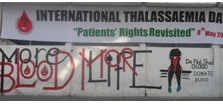
The inequalities in the services available to the thalassamia patients in Male’ and    on other islands was noted as a key problem in the statement released by  Maldivian Thalassaemia Society (MTS) on the occasion of World Thalassaemia  Day, marked on May 8.

While the world marks thalassaemia day with the motto “Patients Rights Revisited”, MTS contended that today authorities have “largely neglected” the rights of thalassaemia patients who face numerous challenges to stay alive, especially those in small inhabited islands of the Maldives.

The statement read: “We see huge inequalities in the provision of medical treatments and services to thalassaemia patients living in the islands and services available from the centre established by the government in Male.”

Even though the government has arranged for blood transfusions on the islands, MTS says that for various reasons the service and necessary medications are unavailable, forcing patients to bear high costs of travelling to other nearby islands or to the capital in order to get blood transfusions, without which they will die.

Meanwhile, Program Manager of the Maldives Thalassaemia Society, Imaan Mohamed, noted that the organisation was receiving numerous complaints regarding problems receiving services under the national health insurance scheme, Aasandha.

“We have received several complaints from thalassaemia patients and their parents that hospitals and health centres are charging for medical treatments, including blood transfusions, because they have reached the outpatient coverage limit. But, we were  informed during the scheme’s inception that thalassaemia patients would not have the Rf10,000 limit allocated for outpatient services,” Imaan explained.

“So we are discussing with relevant authorities about how to solve this problem, but we have not received a good response,” she added.

Aishath meanwhile called for authorities to make mandatory blood donor tests and other associated treatments free.

“Around Rf1000 is required to test a blood donor,” she said. “That money is deducted from their Aashandha account or we have to pay the donor. So it will be a huge relief if the tests are available for free,” she noted.

The Aasandha Office was not responding at time of press.

“More awareness”

With contributions from the government and NGOs across the country, thalassaemia awareness increased dramatically after 1992 and the word became a household name.

The intitiatives included the Thalassaemia Prevention Program, comprising health education, population screening and genetic counseling  by the Society for Health Education (SHE), while in 1993 the National Thalassaemia Program was  formulated and in December 1994 the National Thalassaemia Centre  inaugurated with a 17 bed ward, blood bank facilities and a diagnostic laboratory service.

Of those screened for thalassemia in 1999, 21.9 percent were carriers, while this rate fell to 18.3 percent in the same period while the number of new thalasaemia cases decreased by almost 50 percent from 43 in 1999, to 24 in 2003.

However, Imaan from the Maldives Thalassaemia Society warned that with “no existing comprehensive national  program” to address thalassaemia in the Maldives, the success rates may not be maintained in the future.

“In the past five years, 30 new cases of thalassaemica  have been registered while earlier statistics show that the figure was lower,” Imaan observed.

She noted that the Health Ministry’s National Thalassaemia Program, which ended in 2006, included important elements such as population screening, thalassaemia education, prenatal diagnosis and medical termination of pregnancies of foetuses with thalassemia major.

“It is very upsetting that we don’t have a national program now. People need these services and more awareness programs need to be conducted for prevention of Thalassaemia,” Imaan concluded.

Likes(0)Dislikes(0)

Stop buying iPads, computers and phones, ACC tells government

The Anti Corruption Commission (ACC) has ordered the Finance Ministry to cancel plans to buy computers, iPads and phones for government ministries, claiming that only the People’s Majlis can approve ministerial salaries and benefits.

The Finance Ministry on April 30 released a circular approving the purchase of mobile phones, computers, and iPads for ministers from state funds allocated to the respective ministries. Furthermore, the finance ministry said the treasury would cover up to Rf 4000 (US$260) in monthly payments for ministers’ phone bills.

However, the ACC has told the Finance Ministry that no state institution could approve salaries and benefits for its staff, claiming that the task fell under Majlis’ jurisdiction.

“Article 102 of the Constitution authorizes the People’s Majlis to allocate salaries and benefits for the President, Vice-President, Judges, Members of Parliament and staff of the state institutions. Instead of state institutions deciding for themselves on matters within Majlis jurisdiction, we have ordered the Finance Ministry on May 7 to approve such benefits through the Majlis,” an ACC statement read.

“We would like to remind you the Auditor General has repeatedly criticized such actions in his audit reports and called on state offices not to do so without Majlis authorization. Further, when this commission asked the Majlis for advice on phone allowances, the Majlis Finance Committee told us in a letter on 30 March 2011 to act according to the salary structure approved by the Majlis on 28 December 2011 until the Majlis decides otherwise,” the statement noted.

The Auditor General Ibrahim Niyaz last week released a report on the Department of Judicial Administration (DJA) noting that between October 2008 and December 2011, Supreme Court judges had paid their phone bills amounting to RF 281,519 (US$18,280) from the state budget, despite the fact that the parliament had not allocated phone allowances to the judges.

Niyaz has recommended the amount be reimbursed and that the granting of phone allowances be determined by the parliament.

The Supreme Court on 16 May 2011  released a statement claiming that no Supreme Court judge had received phone allowances, after local media accused judges of misappropriating state funds for phone allowances.

Meanwhile, Chief of the IMF mission in the Maldives, Jonathan Dunn, warned parliament in April that if the country does not reduce its expenditure, it risks running out of reserves and miring the country in poverty.

Furthermore, the Majlis Finance Committee last week has projected that the Maldives budget deficit will reach 27 percent of the GDP by the end of year 2012, a 175 percent increase on earlier forecasts.

Government spending in 2012 is expected to increase by almost 24 percent, reaching Rf17.45 billion (US$1.13 billion) at the end of the 2012, while government revenue for 2012 will be Rf2.6 billion (US$168.6 million) less than the projected amount of Rf10.87 billion (US$704 million) – a 23 percent plunge.

With the shortfall of revenue and increased government spending, Head of the Majlis’s Financial Committee, Deputy Speaker and People’s Alliance (PA) MP Ahmed Nazim observed that the budget deficit will exceed from Rf 3.9 billion (US$ 252 million) to Rf9.1 billion this year (US$590 million), amounting to 27 percent of the country’s GDP.

Finance committee member and MDP MP for Kulhudhufushi, Abdul Ghafoor Moosa, told reporters that unplanned spending on police and military personnel and planned reimbursement of civil servants pay cuts in 2010, are both significant causes for rising costs to the government.

He observed that the largest shortfall in revenue is a direct result of the US$135 million pulled out from the budget with new government’s recently revised policy on lease extension payments for resort islands.

Maldives Inland Revenue Authority (MIRA) anticipated receiving a total of Rf375 million (US$ 24 million) for lease extensions, however the income received dropped to Rf23 million (US$1.5 million) as a result of the decision to accept the lease extension fees in an annual installment instead of a lump sum as decided by former administration.

The loss of concession fees from Ibrahim Nasir International Airport (INIA), the result of a successful Civil Court case to block the Airport Development Charge (ADC) filed by the Dhivehi Qaumee Party (DQP) while it was in opposition, also saw the government receive only US$525,355 from the airport for the quarter, compared to the US$8.7 million it was expecting.

The government-aligned PA’s Deputy Leader Nazim however contended that the 23 percent drop in government income was caused by unrealised revenue from privatisation schemes and a shortfall of Rf 166.7 million and Rf435 million (US$28 million) from the projected dividends of Dhiraagu and import duties respectively.

Likes(1)Dislikes(0)

“Dire economic outlook” as budget deficit estimated to reach 27 percent of GDP

Parliament’s Financial Committee has projected that the Maldives budget deficit will reach  27 percent of the GDP by the end of year 2012, a 175 percent increase on earlier forecasts.

While the 2012 budget put the deficit at less than 9.8 percent of Gross Domestic Product (GDP),  the figures revealed by the committee last week shows that the amount will increase up to a staggering 27 percent.

These figures confirm the International Monetary Fund (IMF)’s earlier warnings that the Maldives had “substantially understated” its budget deficit, by underestimating its spending and “probably” overestimating tax revenues.

Head of the Majlis’s Financial Committee, Deputy Speaker and People’s Alliance (PA) MP Ahmed Nazim, revealed to the reporters that government revenue for 2012 will be Rf2.6 billion (US$168.6 million) less than the projected amount of Rf10.87 billion (US$704 million) – a 23 percent plunge.

Meanwhile, government spending in 2012 is expected to increase by almost 24 percent, reaching Rf17.45 billion (US$1.13 billion) at the end of the 2012.

With the shortfall of revenue and increased government spending, Nazim observed that the budget deficit will exceed from Rf 3.9 billion (US$ 252 million) to Rf9.1 billion this year (US$590 million), amounting to 27 percent of the country’s GDP.

“The information shared by the Finance Minister Abdullah Jihad shows a dire economic outlook for the Maldives,” he warned, echoing the IMF’s recent predictions on the Maldives’ economic frailty.

Chief of the IMF mission in the Maldives, Jonathan Dunn, warned parliament in April  that if the country does not reduce its expenditure, it risks running out of reserves and miring the country in poverty.

Although 2012 budget put the deficit at less than 10 percent of GDP, Dunn told Minivan News that “the IMF team sees the figure as more likely to be 17.5 percent of GDP, and perhaps larger than this.”

As a result of this, he warned that the economic growth and stability in the Maldives were unlikely to be maintained “in the medium term” unless the government substantially cut spending.

Dunn emphasised that the only sustainable solution was for relevant parties to rationalise the budget by boosting revenues and cutting expenditure, despite the political difficulties.

“These may be politically difficult measures, but the consequences of not reducing the budget deficit are likely to be even more difficult,” he warned.

New government increases spending

Despite urgent calls to reduce spending to curb widening deficits, parliament’s finance committee projects the government spending will have to be increased to cover additional costs which were not included in 2012 projections.

These expenses include food subsidies worth Rf270 million (US$17.5 million), electricity subsidies worth Rf250 million (US$16.2 million), capital expenditure by government institutions Rf735 million (US$47.6 million) and an allocation of Rf200 million (US$12.9) to the Aasandha Health Insurance  scheme’s budget, according to Nazim.

Visiting Hirimaradhoo island last weekend, President Waheed said he would allocate Rf 30 million (US$1.9 million) in the 2013 state budget for development.

A total of Rf3.4 million (US$220,500) is also said to be allocated as benefits to former President Mohamed Nasheed of Maldivian Democratic Party (MDP) which alleges that Nasheed was ousted in a coup on February 7.

However, committee member and MDP MP for Kulhudhufushi, Abdul Ghafoor Moosa, told reporters that unplanned spending on police and military personnel and  planned reimbursement of civil servants pay cuts  in 2010, are both significant causes for rising costs to the government.

He observed that the largest shortfall in revenue is a direct result of the US$135 million pulled out from the budget with new government’s recently revised policy on lease extension payments for resort islands.

Maldives Inland Revenue Authority (MIRA) anticipated receiving a total of Rf375 million (US$ 24 million) for lease extensions, however the income received dropped to Rf23 million (US$1.5 million) as a result of the decision to accept the lease extension fees in an annual installment instead of a lump sum as decided by former  administration.

The loss of concession fees from Ibrahim Nasir International Airport (INIA), the result of a successful Civil Court case to block the Airport Development Charge (ADC) filed by the Dhivehi Qaumee Party (DQP) while it was in opposition, also saw the government receive only US$525,355 from the airport for the quarter, compared to the US$8.7 million it was expecting.

The government-aligned PA’s Deputy Leader Nazim however contended that the the 23 percent drop in government income was caused by unrealised revenue from privatisation schemes and a shortfall of Rf 166.7 million and Rf435 million (US$28 million) from the projected dividends of Dhiraagu and import duties respectively.

He noted that the committee has decided to increase the treasury bond limit up to Rf1 billion following a request by the  Finance Ministry to increase the limit from Rf727 million to Rf 1.5 billion. The ministry says that all monetary transactions will be halted if the limit is not extended, according to Nazim.

The IMF’s Dunn has however stated that further domestic borrowing “will be difficult to achieve, as it is unclear whether the banks have much more appetite for buying treasury bills.”

Meanwhile,  in a bid to address spiraling costs, the committee is reviewing the Aasandha universal health scheme to block the Rf200 million extension of its budget, cut the budget of all institutions by 10 percent to save nearly Rf 1.5 billion, and save a further Rf300 million by issuing a moratorium of the further employment of staff.  These measures will reduce state costs by Rf 2.2 billion (US$142 million), Nazim estimated.

However, recently released figures from Finance Ministry show that between January 1 to April 26, state expenditure exceeded over Rf 4 billion (US$259 million) while the income remained at Rf 2.10 billion (US$136 million), a deficit of Rf 1.5 billion (US$100 million).

Likes(0)Dislikes(0)

Female police officer attacked near MDP protest area

A female police officer was attacked on Friday night while she was waiting near a food cart on Boduthakurufaanu Magu with friends, police have said.

In a statement, police said the officer was attacked by people gathered near ‘Usgandu’, an area given by Male City Council to the Maldivian Democratic Party (MDP) to conduct political activities, following the dismantling of their protest site at the tsunami monument by authorities.

Police said the incident occurred at about 9:20pm on Friday night while the officer was not in police uniform.

According to the police, the woman suffered injuries to her back and chest and was admitted to ADK hospital for treatment.

Police are trying to determine the persons responsible for this attack, police said.

Speaking at a meeting held with police officers and Maldives National Defence Force (MNDF) officers last Saturday night at Kulhudhufushi in Haa Dhaalu Atoll, President Dr Waheed Hassan Manik said the police and army had been having hard time over past three months, and that the government understood that it needed to increase the security of police and army officers, their property and families.

Newspaper ‘Haveeru’ reported Waheed as telling the police and army officers that he appreciated the work of security forces, and condemned accusations made by people against police and army officers as an attempt to cause public disturbance.

In the meeting, Dr Waheed also assured the police and army that he and his cabinet ministers would not give any unlawful orders to the security forces, reported Haveeru.

In March, two police officers, one male and a female, were attacked by a group of people while they were patrolling on the roads near Nalahiya Hotel in Maafannu Ward.

They were admitted to hospital for treatment, according to police.

Three men were also alleged to have entered a policeman’s house with knives.

In the same month a group of two men attacked a police officer and his two brothers on the island of Gemanafushi in Gaafu Alifu Atoll.

Police at the time stated that two men assaulted the police officer and fled, and an hour later stabbed the officer’s younger brother in the head and another of his brothers in the stomach.

Likes(0)Dislikes(0)

Ruling coalition’s attacks on international community “irresponsible”: Thinvana Adu

Thinvana Adu, a coalition of Maldivian NGOs, have sent an open letter to the country’s political leaders, including President Dr Mohamed Waheed Hassan, voicing concern over what they describe as “irresponsible” allegations made against international bodies seeking to mediate in the current political dispute.

The open letter argues that assistance from the international community is vital in consolidating the rule of law in a young democracy such as the Maldives.

In response to strong criticism of the role the Commonwealth is playing in Maldivian politics from some political leaders, Thinvana Adu has argued that international interest and concern in the Maldives is normal and should not be perceived negatively.

“Instead of fostering hatred among the people toward the international community, the Thinvana Adu group urge the government, stakeholders, and political actors to strengthen relations with international community to achieve sustainable development,” the letter said.

“In a globalised world, one country’s interest is of another country’s concern. No country can remain isolated from the world, especially a country like the Maldives, a country that is economically vulnerable,” it continued.

Ahmed Nizam, spokesman for the Thinvana Adu coalition, said that the open letter hoped to address the “anti-foreign sentiment” that the group had observed in the parliament.

“We feel that most countries in the Commonwealth are friends in the region too. Being a small country with a small population, we are dependent on other countries,” said Nizam.

“Anti-foreign sentiment”

Criticism over the role of the Commonwealth Ministerial Action Group (CMAG) began shortly after its first statement in March when it called for “the earliest possible expression of the will of the people was required to establish universal faith in the legitimacy of those who govern the [Maldives].”

This statement provoked an “astonished” response from the government. PPM MP Abdul Raheem Abdulla said, “[the] statement is biased and that it harbours the interests of a particular individual”.

State Minister for foreign affairs Dhunya Maumoon added: “My hope is that the UN and other neighbouring countries help the Maldives on its request. It is not for them to impose their interests on us.”

CMAG’s April statement brought even heavier criticism of the government which, in turn, prompted a greater backlash from coalition politicians. The composition and impartiality of the government body tasked with investigating February’s change of power, the Committee of National Inquiry (CNI) was strongly criticised.

CMAG’s threat of “further and stronger measures” should the CNI not be revised within four weeks of the April 16 statement was met with criticism of CMAG’s research methods and arguments that it had not provided assistance when requested.

On April 23, Dhivehi Qaumee Party (DQP) MP Riyaz Rasheed, voiced his support for the country’s withdrawal from the Commonwealth.

“There is no reason to have international relations with a group like this, who don’t even know how to ensure justice,” he said. “I propose to disaffiliate ourselves from the Commonwealth for now.”

After statements from former President Maumoon Gayoom suggested a “rethink” of the Maldives’ need to be part of the Commonwealth Riyaz was joined by Ahmed Ilham of Gayoom’s Progressive Party of Maldives (PPM) in submitting a bill to withdraw from the organisation.

The bill was submitted on April 29 and had not been considered by the Majlis before it broke for a month’s recess last week although the leader of the Dhivehi Rayyithunge Party (DRP) Ahmed Thasmeen Ali, a member of the government’s coalition, declared that his party would not support the bill.

Speaking shortly after being sworn in as Vice President, Mohamed Waheed Deen, said last month that, although the government intended to cooperate with the Commonwealth, he added a warning that outside interference in the Maldives’ domestic affairs would be seen as an “attack on our independence and national sovereignty”.

Voices of dialogue

The repercussions of dislocation from the Commonwealth were described to Minivan News recently by the New Zealand geopolitics consultancy, 36th Parallel Assessments.

The consultancy discussed the case of Fiji, which was suspended from Commonwealth in 2009 after its failure to restore democracy following a military takeover. The group described an “estrangement” from western aid and technical programmes and a shift in attitudes toward investment in the country, citing tourism as a prominent example.

“[Fiji’s] brand of authoritarian government caused aid donor nations and bodies (most significantly donor funds from the European Union) to be cut. Donors became reticent to commit development funds to Fiji, and indeed the Commonwealth member states in the Pacific region used this withdrawal of aid funds as a lever to pressure Fiji to return to democratic rule,” explained Selwyn Manning of 36th Parallel.

Thinvana Adu, whose name translates as ‘Third Voice’, comprises Transparency Maldives, Maldivian Democracy Network, Democracy House, and the Maldives NGO Federation which itself represents 59 organisations.

The letter urged politicians to refrain from isolationism and to work in the best interests of the country rather than personal self-interest.

Instead, the group argues that as much assistance as possible ought to be sought from the international community.

Since the civil society coalition was formed, it has met with government and opposition politicians from both the government coalition as well with Commonwealth, United Nations, and European Union representatives.

The group had hoped to act as observer on the CNI but has decided to step back whilst the appropriate composition of the commission is determined. Nizam explained that the group will write to the CNI today, expressing their continued desire to observe once the CNI is reformed.

The groups professed aim is to enhance dialogue across the political divide that it feels has grown wider since February 7.

The group hopes to hold a public forum at the end of the month which will enable an open discussion of the most important issues afflicting the country.

Likes(2)Dislikes(0)