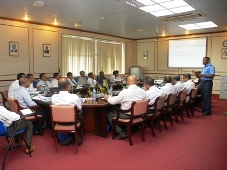
Salaf attacks government’s decision to deploy MNDF soldiers as UN peacekeepers

Jamiyyathul Salaf, one of the Maldives’ largest and most active religious NGOs, has called on the government to withdraw a decision made by the cabinet to sent Maldives soldiers to UN conflict zones and take part in UN peacekeeping operations.

The Cabinet during last Tuesday’s meeting decided to finalise the participation of Maldivian soldiers in United Nations peacekeeping operations, noting that it was be” important for the Maldives to contribute to the efforts of these international agencies and institutions to ensure every country, every society and every individual had the opportunity to live in peace and security.”

However, “Taking part in the UN peacekeeping operations will force Maldivian forces to fight against Muslims which is unacceptable,” said Salaf in a statement. ”Everyone understands that the most of the wars against Muslims have been started without reasonable grounds, just because they are Muslims.”

Salaf claimed that biological weapons were used in these wars despite UN prohibitions concerning their use or manufacture.

“The history of such wars proves that non-believers have gathered and committed inhumane activities against Muslim women and children,” Salaf argued. ”The war in Iraq and Afghanistan are examples of places where such activities were practiced.”

Salaf noted that the Maldives had a very high crime rate and that civil defence was a higher priority than contributing to overseas peacekeeping operations.

”Disregarding our own society and getting involved in these matters for the sake of earing respect from powerful countries shows how much the future of this nation is being disregarded,” Salaf said. ”It will invite dangerous attacks on the country, from outside and within.”

Jamiyyathul Salaf furthermore claimed that any Muslim who assisted non-Muslims in a war against Muslims would themselves be branded infidels.

”Muslims will be obliged to treat him as a non-Muslim in all ways, such as if dead, burying without enshrouding the body, burying the body with other non-believer, and when dealing with inheritance matters the terms and condition that applies to a non-believer who dies in a war against Muslims will be applied to him,” the NGO said.

Referring to the incident where Prophet Mohamed’s (PBUH) uncle Abbas Bin Abdul Muthalib secretly embraced Islam and was forced to fight against Muslims in a battle where he lost his life, Salaf said the Prophet applied the same procedure as to what would be applied to non-believer if he died in a battle against Muslims.

During last week’s meeting, Cabinet agreed that participating in UN peacekeeping operations would enhance the country’s security capability through an improved understanding of the international security environment and integration with the international security architecture, according to the President’s Office.

”The Maldives’ participation in peacekeeping operations would also consolidate the country’s credibility on the international stage,” the President’s Office said.

UN peacekeepers include 98,863 uniformed personnel from 114 countries. The organisation’s limited terms of engagement led to widespread criticism of its inaction during the 1994 Rwandan genocide, in which 800,000 people died.

Since then UN peacekeepers have been more proactive in troubled countries, such as its current siege and helicopter strikes on the palace belonging to Ivory Coast President Laurent Gbagbo, who refused to step down and launched a campaign of ethnic cleansing after losing the country’s 2010 Presidential Election.

Correction: An earlier version of this story translated the Dhivehi term used in Jamiyyathul Salaf’s statement, ‘Kaafarun’, as ‘Christians’. A more accurate translation is ‘non-believers’.

Likes(0)Dislikes(0)

Resorts must now invest after not doing enough for security, says MATI

Tourism insiders say that the industry has not done enough to provide security at the country’s resorts as authorities, while security officials and businesses continue to work on outlining new protective measures for properties across the country.

As security officials continue to await the outcomes from consultations by a steering group formed following a security seminar and workshop held last week to outline methods to reduce possible threats facing the country’s resorts, some property owners and managers appear divided over the severity of the challenges faced.

Speaking to Minivan News, ‘Sim’ Mohamed Ibrahim from the Maldives Association of Tourism Industry (MATI) said that despite ongoing attempts to outline a nationwide resort security initiative since 2008, no such policy had as yet been put in place.

Following last week’s security seminars, Sim said he was confident that by working with the Maldives National Defense Force (MNDF), the police, and the coastguard, progress was now being made in outlining long-term security strategies for tourism. He conceded though that the industry would need to bare more of the financial brunt to protect its interests in the future.

“Resorts do need more investment in regards to security, we haven’t done enough so far,” said the MATI head.

Sim said that last week’s seminar reflected growing industry concerns of late raised by the active Minister of Tourism, Arts and Culture as well as industry bodies over protecting the country’s lucrative resort islands from possible theft and attack.

The country has this year alone faced two isolated, yet high-profile incidences of intrusion at properties such as Kihaadhuffaru resort and Baros Island Resort and Spa highlighting for some the magnitude of the threats facing the country.

Sim claimed that these concerns were not an “isolated” issue for tourist properties alone, but rather a symptom of rising levels of crime on inhabited islands such as the Maldivian capital of Male’ that had spilled onto resorts.

“This is not to say that the government is working on this issue [of crime], but really they need better laws in the country for offenders,” he claimed.

To try and combat fears over criminals targeting resorts, the MATI Secretary-General said he believed that improved networking between different resorts and ease of communication was a vital part of limiting potential attacks in the future.  He added that the closer cooperation between tourism officials and the police and armed forces in the country was also seen as another key aim.

However, Sim claimed that rather than bringing wide-ranging reforms to tourist and resort security, the country would be better prioritising commitments in areas where it was able to ensure effective changes could be put in place.

He added that a committee containing government and tourism industry figures was now working to address what sort of commitments should be prioritised on the back of last week’s security seminar.

“The best thing to come from these talks is that we are now attempting to work together [with the government and security forces]. We know we are not alone as an industry,” he said. “In the past, we have tended not to mix the leisure side of holidays with security, but this is something that we need to do.”

Security advisor

Speaking today to Minivan News, National Security Advisor Ameen Faisal said that he still haven’t received feedback from the steering committee of government and industry figures regarding outlining new proposals for resort security.

While Faisal added that he was not sure of the exact nature that potential changes could mean for how defence forces worked with the tourism industry, he was convinced it would not lead to a rise in their presence on resort islands.

“Personally, I don’t think operational changes will be seen in the manner that police and the MNDF operate regarding tourism,” he said. “There will probably be some training programmes conducted by police for resort security, but I don’t think we will see a physical presence by defence forces at these resorts.”

In addressing any perceived threats posed by Maldivian gang crime reaching the isolated environs of the country’s tourist properties, not all resort groups appeared to have share MATI’s beliefs that security problems were generated solely by offshore criminals.

One general manager for a leading multinational brand of resorts in the country said under anonymity that he believed the resort robberies were more likely to have resulted from serving or former employees with knowledge of the properties than from random attacks by gangs or opportunistic thieves.

In taking this view, the general manager said that he believed it was often imperative to try and effectively manage staff and their grievances that could often occur from very small and often easily rectified measures.

Likes(0)Dislikes(0)

Comment: Doublethink culture

On the night of December 21, 1954, a cult of worshipers gathered together in a room in Chicago.

Having carefully removed all metallic objects from their person, including bra straps and metal zippers, they sat together in a silent huddle. Many of them had quit their jobs and colleges, left their spouses and sold their houses in preparation for that night.

They wouldn’t need any of those where they were going – for indeed, they were awaiting the arrival of a flying saucer that would take their small group of true believers away before the prophesied end of the world the next morning.

As it turned out, the flying saucer never arrived – and the world continues to spin majestically over half a century later.

Having their superstition proven so utterly false, one would reasonably expect that the cult would have disbanded and died out immediately afterward.

But, as chronicled in the famous book ‘When Prophecy Fails’, written by a group of authors who had infiltrated the cult to observe them first hand, the cult actually grew in strength after the failure of their central prophecy.

One of those authors, Stanford psychologist Leon Festinger, famously described this phenomenon as ‘cognitive dissonance’.

According to this theory, when faced with incontrovertible proof against a held belief, people tend to eliminate the dissonance by resorting to either denial or justification.

The cult members, upon realising that their alien saviors failed to show up, promptly decided that the Earth had been given a second chance as a reward for their night-long perseverance. Armed with this new theory, the formerly media-shy cult went on a recruiting drive and the cult expanded more than ever.

Cognitive dissonance would also explain the resurgent practice of ‘Baccha baazi’ in Afghanistan, where powerful warlords and other self-described Muslim men engage in pederasty with ‘bacchas’ or pre-pubescent dancing boys, attired in women’s clothing.

The men candidly admit to the practice on camera, denying that it was sodomy because they were not ‘in love’ with the boys, and providing the justification that they were able to judge the young boys’ looks beforehand, unlike the niqab covered women where it was more of a hit-and-miss.

In the dark alleys of Bangalore and Mysore in India, the hashish and heroin trade is known to be run by old Muslim men with prominent prayer marks on their forehead where it touches stone five times a day,

They too, justify their actions with an assortment of explanations about profits and business.

In these cases, one appears to have an inner moral conflict, as is clearly visible in the confused expression of the pious old Dhivehi woman with a fondness for traditional raaivaru and folk songs, when suddenly confronted with a religious ruling on TV from the leading sheikh of the day that music is forbidden.

The dissonance is then placated by subconsciously finding a convenient explanation that flies in the face of available statistics, just as a smoker finds a justification to smoke, or a motorist finds a justification to not wear helmets or seat belts.

The theory of cognitive dissonance is often used to explain the unintentional hypocrisy of individuals and social groups.

In the Maldives, however, it appears that hypocrisy has given way to something far more unpleasant – namely, self-deception.

The Ministry of Truth

As described in the dystopian society portrayed in George Orwell’s novel 1984, Maldivians seem to have embraced the practice of ‘doublethink’.

The novel describes doublethink as :

“To know and not to know, to be conscious of complete truthfulness while telling carefully constructed lies, to hold simultaneously two opinions which cancel out, knowing them to be contradictory and believing in both of them, to use logic against logic, to repudiate morality while laying claim to it… to forget, whatever it was necessary to forget, then to draw it back into memory again at the moment when it was needed, and then promptly to forget it again.”

Perhaps due to remarkable upheavals in their recent history, Maldivians appear to have mastered the art of effortlessly holding two utterly incompatible, conflicting ideas in their head.

The anecdotal evidence is overwhelming.

A casual stroll down the Artificial Beach in Male or the neighboring islands during the night reveals dozens of young girls – proudly wearing the Islamic head scarf – in various stages of embrace, undress or coitus with their partners under the veil of darkness.

There’s the story of the outwardly devout graphics designer who declined an assignment to draw a female figurine, citing religious principles. Notably, the man was later found to be downloading explicit pornography on his office workstation.

During one energetic debate on Facebook, one of the most vocal defenders of the faith was a young man with a colorful vocabulary. In case his demeanor and menacing threats didn’t make his tough gangster credentials clear, he also spelled out, in bright red letters, on his profile image, ‘Blood, Sex and Booze’.

To be precise, the young Maldivian man, who swore by ‘blood, sex and booze’ on a public social network, was the first to step in to defend morality and religion against perceived threats.

These are hardly isolated cases.

There are plenty of Maldivians who proudly embrace the creed that Islam is a ‘religion of peace’ and that those that create conflict are not ‘true Muslims’, but in the same breath, applaud Bin Laden, the Taliban, and other random militants who place bombs in schools, markets and mosques in Pakistan as righteous ‘mujahideen’ whose actions are sanctioned by the religion.

Young girls and boys, often wasted on drugs and given to casual sexual relations, often vocally argue for the imposition of an un-codified ‘Shariah’ law system that, if implemented, could very well see them stoned to death or worse.

The national doublethink is no doubt helped by the country’s dramatic swing from a heady, westernised disco-era to a rigidly conservative religious society almost overnight.

The 2008 Maldivian constitution forbids any law or regulation that contradicts loosely defined ‘tenets of Islam’.

In May 2010, the Maldivian government invited salafi preacher Zakir Naik who, during a heavily promoted lecture televised on prime-time national television, proclaimed to a gathered audience of ten-thousand, that income made from tourism was ‘haraam’.

But as recently as last week, the President of the Republic, Mohamed Nasheed, reiterated that the tourism industry – fueled by alcohol and, as the Mullah prefers to put it, ‘fornication’ – is the mainstay of the country’s economy that must be safeguarded at all costs.

The easily inflammable pseudo-religious groups that assemble on the streets at a moment’s notice to protest against everything from news editors to co-education, gathered in in late 2009 to protest against the restricted sale of alcohol in ‘inhabited’ islands.

Nevertheless, their screeching rhetoric against the sale of alcohol in the capital was in stark contrast to their meek acceptance of the availability of alcohol on the adjacent airport just five minutes away.

It could also be contrasted with their monk-like silence on the widespread child abuse and pedophilia, reports of which have hit local media with alarming frequency throughout the past year.

The same government alternatively claims that tourism is haraam and absolutely vital. The same television channel that plays music throughout the day also airs religious programs that proclaim music is forbidden. The same school that teaches that bank interest is forbidden in Islam also teaches students modern banking, and how to calculate interest.

The effect of this national doublethink on the young Maldivian democracy is a cause for concern.

Citizens who have given up the intellectual tools of reasoning have also inadvertently given up their ability to choose, leaving the country vulnerable to either sliding back into a dictatorship, or morphing into a theocracy.

Confirmation bias

The first comment on a recent Minivan News article about alleged bestiality involving the rape of a goat on a rural island, incredibly enough, appeared to blame the incident on ‘LIBERAL DEMOCRACY’.

This is further evidence that the Maldives is steeped in a strong confirmation bias, where the population disregards evidences that are in plain contradiction to their viewpoints, but jumps at even unverified hearsay supporting their prejudices.

Fifth grade science teachers have reportedly taught their students that the Apollo moon landings were ‘fake’, thereby insulting the achievements of thousands of scientists and engineers, while simultaneously robbing young students of the wonders and amazement of science, leaving them vulnerable to a lifetime of conspiracy theories.

Meanwhile, tiny moon rocks have been on display for years at the National Museum in the Maldives.

Openly biased reporting on the Middle East abound in the local media, as are outlandish conspiracies such as the easily discredited allegations that a team of Israeli doctors were ‘organ stealing Zionists’.

If this keeps up, Maldivians as a nation will be no better than the alien cult worshipers, who bend reality to suit their convenience and bask in an atmosphere of mutual-misinformation.

The vital essence of a successful democracy is the ability of its citizens to make critical judgments.

Once that ability is clouded by confirmation bias, dissonance and doublethink, the end-result closely resembles the confusion and noise that characterises Maldivian society today.

All comment pieces are the sole view of the author and do not reflect the editorial policy of Minivan News. If you would like to write an opinion piece, please send proposals to [email protected]

Likes(3)Dislikes(0)

Dollar shortage threatens to ground local airline sales

Sales agents for some international airlines operating in and out of the Maldives have said that a lack of US dollars circulating within the economy is causing concerns, and in some cases, temporary cessation of their day-to-day operations.

Galaxy Enterprises, which operates as a general sales agent for Sri Lankan Airlines in the country has said that it has temporarily stopped selling airline tickets in the country. The group have forwarded potential customers to the Sri Lankan Airlines official website to process booking requests.

The announcement comes as financial institutions like the Bank of Maldives concede that the high level of imported goods bought into the economy are not being matched by US dollar generating industries inside the Maldives. The bank has said that the disparity had created a “lag” in terms of supply and demand for the currency.

The situation this week led to police – with the assistance of the Madives Monetary Authority (MMA) – trying to crackdown on sales of the country’s US currency beyond the pegged rate of Rf12.75 per dollar at black market rates as high as Rf16.

In the statement issued by Galaxy Enterprises and printed in newspaper Haveeru today, the group said it had been forced to suspend sales of Sri Lankan Airlines flights as it was not receiving sufficient US dollars through the banks to pay the airlines after selling tickets to its customers in rufiyaa. The group said that it will resume selling Sri Lankan Airlines tickets once the dollar shortage was perceived to have “eased”.

Galaxy Enterprises is not alone in witnessing operational difficulties as a result of the state of the nation’s finances.

Tyronne Soza, Maldives Country Manager for Mack Air Services Maldives, which represents the local interests of multinational aviation group John Keells Airlines, said that dollar supply was a major concern for its operations, although it continues to sell tickets.

“We are having some issues with obtaining and paying in dollars right now. As we are part of the John Keells group we have been able to manage the situation though,” Soza said. “It’s illegal to charge customers in dollars and obviously we accept rufiya, but it is difficult.”

John Keells serves as a holding company for aviation groups link Jet Airways and Sri Lanka-based Mihin Lanka.

Not all operators have shared these currency concerns though, with senior management for one of the world’s highest profile airlines, which works through Universal Enterprises in the country, claiming it was “business as usual” despite reports of dollar concerns amidst some competitors.

Last week, Peter Horton, the recently appointed CEO of Bank of Maldives told Minivan News that he believed the country desperately needed new ways of creating a US dollar income to try and overcome the crisis.

“A reality of the economy is that we are importing so very much, and we have so few dollar generating industries. In very simple terms, any downturn in the economy incur losses in the economy when turnover drops below break-even level. That is where we are as an economy – our revenue in dollar terms, in terms of the imports we require, is lagging,” the CEO, a British national, claimed.

“We need to look at ways of keeping dollars in the country as much as possible. [A] number of entitites are taking money out of the country – and are free to do so without exchange control. I think we also need to look at other ways of enhancing dollar revenues through fresh or new industries – and I would include financial services among those industries.”

Horton added that the issue had been compounded by economic uncertainty within international financial markets during the last few years, representing a massive national challenge that needed to be overcome.

However, police attempts to crack down on potential black market dollar sales are claimed by some low-wage expatriate workers to have exacerbated difficulties faced in trying to transfer and provide funds abroad.

Many of the country’s 100,000 foreign workers, particularly a large percentage of labourers from Bangladesh, are paid in Maldivian rufiya by their employers and are forced to change the money on the blackmarket at rates often higher than the government’s pegged rate of Rf12.85, before sending the money to their families.

The set dollar rate in the Maldives is Rf12.75, however during the dollar shortage it has increased to 13, 14, 15 and sometimes even as high as 16 on the black market.

However, banks routinely refuse to change rufiya into dollars, and experts have claimed that the crackdown will do little to address the demand for foreign currency or the budget deficit, which has led to the pegged rate not reflecting the value of the rufiya.

Likes(0)Dislikes(0)

Comment: In power by default

Throughout Maldivian history, the system of government has been clearly structured on those who had property and connections. The leading positions of the government institutions as of late 2000 were unquestioningly a privilege to those born into aristocratic and landowning families and not based on merit. While they did not contribute to a productive Maldivian society, it was clear that, that system of government was the result of the society’s class structure and the institutional positions they maintained were by default and non debatable.

The system continues to exist even with the change of government and has been replaced by a group of hardcore political activists backed by the affluent and financially successful businessmen that the last regime fostered, holding more than 90 percent of the national wealth. The underclass, which covers at least 75 percent of the Maldivian population, continues to exist as one entity deprived of social standing while selected individuals both in the political and economic environment enjoy individualism and rights to become contributors and producers.

As the underclass continues as a permanent feature of both the regimes, both governments seemingly relied heavily on the pledges of the international community to bring about change. The promised change has been frustratingly slow and political representatives partly blame the lack of timely response and unfilled pledges by the international community being cause for non or slowed down government delivery. Although the country graduating from a least developing country this year onwards based on its per capita GDP of US$4600 (graduation criteria is US$900) the country’s social infrastructure has been heavily financed by development funding and donations. It is further characterised by low income families (16 percent of the population lives in poverty and unemployment rate is over 14 percent), weak human resources and a low level of economic diversification.

As before, most of the government ministries remain dysfunctional, lacking capacity and capability to perform, staffed by the people who are unable to produce results, lead by ineffective but loyal political activists of ruling political party.

Guarding the domain

A large underclass must exist for this model of society to function so that power hungry politicians can continue to dominate the country’s leadership. Within this exist the power hungry businessmen who are unwilling to let members of underclass enter into the realm of the “the privileged rich”. Within this exist the power hungry religious leaders, who try to formalise their control using religious mechanism. The three groups co-exist together relying heavily on each other to protect their existence. At the same time Maldives has a growing underclass indicating political, economic and religious control as three groups struggle to keep their supremacy over each other.

The privileged and the underclass need each other to function. Both the governments maintained the underclass by creating a large and dependent workforce making government the biggest employer in the country, a strategy to safeguard and retain loyalty. People’s values are formed by the structure in the society according to Karl Marx. To maintain functionality, the three groups work to create beliefs and conformity through various social, political and religious tools.

Functionalism at the cost of democratic principles

All the three groups work to create a consensus of belief and behavior (as functionalism has been described by Herbert Spencer (1820 – 1903) and upholding the norms is a function of society. The norms are further defined by rules and regulations that the society needs to adhere to function as a body. Within this type of societal model, anyone who upsets or threatens the norms has to be removed to recreate balance, taken away to prison and removed from mainstream society.

There is no individualism in the Maldivian society except for those in control. Individual’s needs are not validated and only the overall function of society is important. The Maldivian society is thus a singular being – something that can be manipulated and changed as a whole and poverty and inequality are just valid parts of society, so are juvenile delinquency, crime and domestic violence.

The functionalist approach is extremely convenient for politicians and others, who assume to be the sole representatives of the Maldivian citizens and speak out loud for the people while the underclass are not consulted nor are allowed to have any access to the political sphere. The MPs increasingly act in their personal interest as they try to add to their financial remuneration and privileges, political status and social standing.

Behavior has to be acceptable or punished in the functionalist society. As the gaps between the leadership and underclass widen and the income disparity grows, uprisings such as those in the tourism industry will occur. The outbreak of unhappy employees in tourism industry has drawn calls for measures to curb their activities and expression, regulating behavior and introducing new punishments. Attempts to unify religious behavior are an ongoing effort of religious leaders who condone religious freedom of individuals in the Maldivian society.

Don’t rock the boat

Democracy promoting change contradicts functionalism as change in society is seen as disturbance. It is the “don’t rock the boat” model. The groups within the society such as family must promote the norms and children are to do what their parents do and to be what their parents are. Employees are supposed to work without negotiating and be grateful for the hand that feeds them. Religious practices must be observed without questioning. Traditions that do not work for the three leading groups mentioned earlier may be discarded and new practices may be invented through their own consensus as long as they can maintain status quo and their power. Needless to say but people are comfortable when there is stability, status quo and life continues without disruptions.

Conflicting functionalism is people’s economic and spiritual needs that must be satisfied being human nature and cannot be controlled by regulated mechanism. Neither fear as a control tool is effective over a long period nor may rightful behavior as translated into rules serve to control people in the short run. For the society to develop, the change has to happen although it is irritating, but eventually leading to a new adjusted society where balance is restored.

Alliance for power

Would it not be great if the underclass could defeat the “ruling” class? Maldivians were elated in 2003 when the reform movement started. The Maldivians (along with the international community) thought this was the underclass and the suppressed breaking out of a rigid fascist regime. Those hungering for leadership were made up of three power hungry groups tapping on the ignorance of the underclass Maldivians to think they can expect and own a better share of the wealth that the country was earning. Maldivians were willing prey to promises of the leadership following the parties they thought would serve the purpose.

The affluent business community saw it was time to shift over and contribute a puny percentage of their wealth to bring the change. They also saw this as an opportunity to take positions of control so that their wealth could expand further. Later extension of resort lease deals was up for debate in the Parliament where politicians-cum-businessmen sat representing the citizens’ voice. Some MPs and activists in party leadership still claim they are first and foremost businessmen.

The pact between the religious party Adalaath and the then-opposition MDP at the time of the elections in 2008 was the only way religious leaders could secure a powerful position within the new government. Alliance with the likely party to win in the second round of elections was made on mutual advantage of holding power within their domains.

The main opposition saw their advantage in an alliance with the two groups mentioned above, business men representing resources and religious leaders representing norms and practices that the average (underclass) Maldivian did not dare contradict and commanded total obedience to their leaders. Both the groups taking a stand beside the main opposition won the elections.

Democracy is a threat to Maldivian politicians, businessmen and religious leaders because it calls for sharing or wealth and privileges, position and power. Democracy dilutes society as a entity, through its principles promoting equality, fairness and tolerance where the individual and minority are validated and majority will is respected.

Aminath Arif is the founder of SALAAM school.

All comment pieces are the sole view of the author and do not reflect the editorial policy of Minivan News. If you would like to write an opinion piece, please send proposals to [email protected]

Likes(1)Dislikes(0)

Under-aged girl arrested over alleged involvement in Basheer murder

An under-aged girl is being held in custody over suspicion of involvement in the murder earlier this month of Ahusan Basheer, police have said.

No further details were given regarding the female suspect other than that she is being held in custody over an alleged connection to the murder of Ahusan Basheer, 21, who was stabbed to death in the early hours of March 17 near Alikileygefaanu Magu, one of the main streets of the capital Male’.

Following a week-long manhunt, police arrested Ibrahim Shahum, 20, as the main suspect in the murder.  Shahum had recently been released by the Criminal Court after being kept in detention for six months on suspicion of stabbing a 17 year-old to death on July 30, 2010.

Head of the Maldive police Service’s Serious and Organized Crime Department (SOC) Abdul Nawaz confirmed that Ahusan’s murder case was still unresolved.

‘’We have only one under-aged person in connection to this case and the person is a female,’’ Nawaz said. ‘’We can’t provide further details of the case as it may compromise the investigation.’’

Special operations

Crime-Prevention Committee MeetingNawaz additionally claimed that special operations being conducted by police to curb gang violence in Male’ was working successfully.  He added that the intiative had led to the arrest of 155 people, the transfer of a further 21 suspects to house arrest and another 101 people being searched.  Additionally, 53 houses were checked and five vehicles were impounded.

Despite praising the initiatives, Nawaz appealed to the public to be more careful while carrying cash around the country, requesting those who need to transfer large amounts of money from one place to another to seek police assistance beforehand.

Meanwhile, the recently-formed National Crime Prevention Committee met members of the parliamentary security services committee yesterday to discuss immediate measures that could be taken to combat the rise in organised crime and gang-related violence.

As the required legislation would take longer to complete, the committee has reportedly decided to formulate regulations in collaboration with parliament to empower police to hold suspects in custody for longer periods.

Likes(0)Dislikes(0)

Inviligilator assisted students with Cambridge Maths Exam answer, alleges Police

The head of the police’s Property Crime Unit, Chief Inspector Mohamed Jamsheed, has claimed that an investigation into the conduct of a Cambridge Mathematics examination taken last year at a Shaviyani Atoll school concluded that an invigilator had assisted students with their papers.

The examination process at Milandhoo school was subjected to a police investigation after the University of Cambridge International Examinations (CIE) awarding body annulled the grades of mathematics students in the island.

”Most of the students have confessed that they copied with the help of this invigilator, who told them the answer for the last question in the paper,” said Jamsheed.

The answer given to the question by all students in the Milandhoo School Hall was consistent but wrong, which made the  CIE markers raise concern.

One person from the island whose name cannot be yet disclosed was arrested and is still in pre-trial detention, said Jamsheed adding that some of the students in the island had denied the allegations of copying.

Three exam monitors at Milandhoo School were suspended after the issue was handed over to police.

A student who sat for the examinations told local newspaper Haveeru that the students “were tricked as someone changed the contents of the papers [after completion].”

Milandhoo school was ranked second in the Maldives last year in terms of the strength of its O’Level exam results.

Deputy Education Minister Dr Abdulla Nazeer said earlier this week that the affected students were expected to be able to resit “the next available exam”.  “I don’t think there are any restrictions,” he said.

Nazeer added that the Education Ministry had pledged to investigate the matter “as thoroughly as possible”, and take action if malpractice was identified.

Likes(0)Dislikes(0)

Maldives invites royal wedding couple to honeymoon in the sun

Tourism authorities in the Maldives have sent an official invitation to Britain’s Prince William and his future wife Kate Middleton to travel to the Maldives for their honeymoon following the royal wedding, scheduled for April 29.

Minister of Foreign Affairs Ahmed Naseem confirmed a formal invitation had been sent to British authorities, and that the Ministry was awaiting a response to the offer.

State Tourism Minister Thoyyib Waheed told Minivan News that the invite was sent through diplomatic channels in the hopes that the high-profile royal couple would opt to honeymoon in the country,  an offer he claimed  would be “a great honour for the Maldives” and its international reputation if accepted.

“It is a dream for any destination to be considered as a venue [for the royal honeymoon],” he said.  “With this invite, we hope there is a possibility it may happen.”

Bookkeepers in the UK are offering odds of 14:1 that the couple will choose the Maldives as their honeymoon destination, with other contenders including Sicily, The Seychelles, Kenya, Bermuda, and even Australia.

The wedding of Prince William, who is second in line to the British throne, has drawn massive levels of press coverage since the forthcoming nuptials of the country’s potential future king and his girlfriend were announced in November 2010.

Since that announcement, a wealth of companies, organisations and media outlets have moved to associate themselves with the huge international interest in what may become one of the year’s most viewed events.  From speculation over final designs for the wedding cake and bridal dress to the quality of commemorative crockery, all have become major headlines in the run up to event in the UK press.

The ceremony itself will take place at London’s Westminster Abbey on April 29. The UK government has declared the day a public holiday in honour of the royal couple.

Likes(0)Dislikes(0)

“Very bad” time for Maldivian youth: Parties talk crime, activism and opportunity

Ahead of an election contesting the first presidency for the Maldivian Democratic Party’s (MDP) youth arm later this month, standing candidates and opposition politicians claim the country is at a critical juncture to ensure its largest demographic is not denied a voice and role a within national development.

The MDP is trying to attract a sizable youth vote in the next election, and has mimicked the opposition Dhivehi Rayyithunge Party (DRP) by establishing a Youth Wing to outline policies and opinion from the perspective of younger voters. Serving opposition party youth representatives claim that the country’s twenty-somethings are keen supporters of hard line measures to offset fears of gang culture and its perceived prominence among their peers.

Alongside the upcoming elections for MDP President scheduled for April 30, members will also be given a vote for selecting a candidate to represent young people in the party.

The candidates include Hussain Waheed, serving councilor for Medhu Henveiru Lufshan Shakeeb in Male’, and former Minivan News journalist now working in the President’s Office,  Aminath Shauna.

According to Shauna, statistics show that the largest age group in the Maldives is represented by 20 to 24 years of age, followed closely by citizens aged between 25 to 29 years. Despite this apparent numerical prominence, she believes that for over 30 years there have been a scarce number of programmes to prepare young people of working age to responsibly lead initiatives or to take part in higher education beyond a minority of people, setting back the role of young people in the Maldives democratic transition.

For MP Ahmed Malouf, who is responsible for the Youth Wing for the opposition DRP, the appointment comes at a “very bad” period of time for young Maldivians, particularly in relation to gang violence and crime.

The DRP MP told Minivan News that after having previously spent nine years in the Ministry of Youth, he believed that long-standing gang violence between young people in the country had further intensified of late, creating an environment that have made the streets of Male’ unsafe for both local people and foreigners at night.

Mahloof said that having spoken and met with a wide sway of young people from across Maldivian society, the issue of gang violence had arisen as a foremost challenge to his work as Youth Wing head for the DRP.

“We need to find a way to save young people and give them a way out of this [gang] lifestyle,” he said. “Often they become trapped and are unable to get out even if they want to.”

As part of his attempts to appeal to young voters, Mahlouf said he has pressed ahead with promoting tighter legislation. This legislation includes an amendment sent to parliament last month to alter the age by which young people were recognised by the law as an adult to 16, as opposed to the current age of 18.

The MP has claimed the amendments, which have attracted criticism from some human rights bodies, were designed to try and reduce youth crime by ensuring young people suspected of engaging in serious crimes would be treated as adults and face full responsibility for their actions.

”The purpose of changing the age is due to the significant increase in the involvement of minors in crimes sinister in nature, and they cannot be sentenced to the full extent as they are considered minors,” said Mahlouf after announcing his proposed amendments. ”Although they are considered as minors, they are sometimes very dangerous.”

In addition, Mahlouf said he has also forwarded amendments to the Act on the Prohibition of Gang Violence to the Majlis in an attempt to remove the right for suspects linked to police investigations into gang violence to remain silent and for release from custody, providing judges with the power to enforce such restrictions.

To try and finalise these aims, the DRP Youth Wing head claimed that he did not wish to politicise the need to address gang issues and was calling on Maldivians to pressurise all parliamentarians – regardless of party – to pass pending legislation relating to crime needed to curb what he believed was a worsening gang situation.

Mahlouf claimed that having consulted with young artists, including local musicians, he was aware there were also issues of a lack of alternative amenities and youth centres available for young people to engage in nationally.

“From what I have seen things are going backward here. Young people I have spoken to, including musicians in rock bands, say they are fed up,” he said. “Services aren’t being delivered and gang violence is at a very high level, we need to talk with them and find solutions.”

Although critical of the role that the Ministry of Human Resources, Youth and Sports was playing in trying to overcome these alleged concerns, Mahlouf conceded that government and parliament alone could not shoulder the responsibility to overcome gang problems, claiming parents and families also needed to take responsibility and a role.

From an MDP perspective, Shauna claimed that she believed the party, through activism and campaigning, had been a vital part of bringing young people into national politics through democratic reform over the last few years. However, she conceded that the sufficient challenges facing young people in the Maldives had meant it was now vital to address the difficulties beyond partisan political thinking.

“The time is now to act. We have to put pressure on the government. We have to put pressure on political parties, on the MDP, the National Council and everyone to help us develop a youth programme to make us better people and a part of the whole [national] development process,” she said. “We have to provide opportunities and make sure there are things besides going to work and drinking cups of coffee everyday. What I mean specifically is that we have to have entertainment opportunities as well as jobs.”

“Desperately needed”

Shauna claimed that rather than being seen as a token position within the party, the MDP Youth president was “desperately needed” to play a vital role in outlining policies for young voters that directly affect their future – something she believed was currently missing from the party.

“Over 50 percent of the MDP’s membership is under the age of 35, so we cannot move forward without their opinions, without their input and without really developing people of our age,” she said.

“The few people who make decisions are older and they are not the majority of the country. This is alright, but then again you have the middle management sector who are not very prepared to do what is needed right now,” Shauna added. “There is so much work to do in terms of nation building and state building to do. Yet the majority of the civil service are saying that they have just barely finished high school. This is the kind of environment that we are having to develop from. It is a hard thing to do and a lot of the time, younger people are only doing simple things, administrative things, like drafting letters, that is it.”

At present, Shauna claimed that even in politics, the involvement of young people was generally consigned to putting up posters and going out on the streets, while there remained an apparent lack of activism and representatives responsibly speaking out about the needs of their peers in relation to developing democracy and human rights.

“Very few young people have been trained or have been given the tools to achieve these things,” she said.”I think it’s imperative that we have a voice and a group that advocates for training, scholarships and entertainment opportunities. Unfortunately the only thing that is discussed about youth is the violence and the drugs and crime.”

Shauna’s fellow MDP Youth Wing candidates, Hussain Waheed and Lufshan Shakeeb, were contacted to outline their positions but had not responded to Minivan News at time of press.

Likes(0)Dislikes(0)