Presidential election regulations unveiled as rival parties slam state commitment to free and fair polls

The Elections Commission (EC) has unveiled new regulations  for the presidential election set for September 7 this year, claiming “comprehensive changes” have been made to the legal framework used five years ago.

EC Vice President Ahmed Fayaz told Minivan News that the latest regulations were drawn up with consultation from political parties and NGOs – providing more than just a “cosmetic change” to the framework used for the country’s first ever multi-party democratic elections in 2008.

Both opposition and government-aligned parties competing directly against President Dr Mohamed Waheed in September have alleged that even with new regulations in place, there were concerns that the incumbent was using state resources unconstitutionally to unfairly influence voters.

The allegations have been denied by the President’s Office, which maintains that it has done nothing to try and unfairly influence voters.

EC optimism

EC Vice President Fayaz said that despite the allegations raised by various parties this week, the commission was “very optimistic” about its ability to ensure elections were free and fair in September with the new presidential election regulations – said to have undergone drastic changes since 2008.

“The 2008 regulation was actually formatted in a rush and the EC was given about 60 days to do its work,” he said of the legal outline used for the last presidential election. “From the feedback we have received [regarding the new election regulation] nobody has said that they were bad,” he claimed.

The Regulation on the Presidential Election was published online Monday (May 20) in the Government Gazette.

Fayaz added that the EC had so far received “no formal complaints” from political parties in the country regarding concerns that September’s elections would not be free and fair.

Opposition Maldivian Democratic Party (MDP) MP and Spokesperson Hamid Abdul Ghafoor said he had not personally had chance to review the new regulations for September’s election at present.

Undermined

Ghafoor said that despite concerns about the functioning of the country’s independent institutions, the MDP had been “comfortable” with the ongoing work of the EC.

Yet no matter how comprehensive the new elections regulation for September’s vote was, he said MDP continued to hold concerns that credible elections were being undermined by both the recent conduct of the government and the country’s police and security forces.

Ghafoor claimed that party fear’s were partly based around the recent conduct of police around the country, as well as ongoing concerns raised by both the party and independent experts over the independence of country’s judiciary, as well as its watchdog body, the Judicial Services Commission (JSC).

Meanwhile, the Maldives’ Police Service has previously denied arresting approximately 50 people – primarily MDP supporters – the night prior to President Mohamed Waheed’s arrival in Addu City on May 8.

Addu City Mayor Abdulla Sodig told Minivan News that before Waheed’s arrival, close to 50 people were arrested, “and about 90 percent of those taken in were MDP supporters”.

These arrests were made under the “’Our Peaceful Addu City” operation, which the police have said was established to make the atoll “crime free”.

Political ends

Ghafoor also leveled criticisms at President Waheed directly, accusing him of unconstitutionally spending state fund on his own campaigning, while also making development pledges not included within budgeted funds during recent tours of the country.

He also pointed the centralised utilities ‘Fenaka’ corporation that was formed last June as an example of President Waheed’s use of government-owned enterprise to provide his own supporters with jobs.

“We have seen this government rape institutions like the police and state companies for their own political ends,” Ghafoor claimed. “These are unconstitutional actions we are seeing by the state.”

PPM “concerns”

MP Abdulla Yameen, presidential candidate for the government-aligned PPM, this week told local media that he understood “concerns” raised by MDP candidate Mohamed Nasheed regarding President Waheed’s use of state resources for campaigning.

“That is, the way [the government] is doing things, there are problems over whether we could reach free and fair elections. The Auditor General and ACC [Anti-Corruption Commission] have taken note of this,” Yameen told local media.

While accepting an incumbent would have advantages for campaigning while in power, Yameen called on the government to consult with the Auditor General’s Office and ACC to put rules in place for campaigning within legal bounds and in line with the principles of good governance.

The PPM parliamentary group leader also criticised the government’s decision to sack Dr Mohamed Jameel Ahmed from his position of home minister following his decision to stand against President Waheed as Yameen’s running mate.

The government at the time cited Dr Jameel’s decision to stand as Yameen’s running mate as representing a conflict of interest, claiming any other cabinet minister standing directly against Dr Waheed would also have to be dismissed ahead of September’s voting.

Cabinet ministers in a coalition government are not obliged to assist the president’s election campaign, Yameen added this week.

He also claimed that PPM has not been given the number of government posts promised by Dr Waheed more than a year ago with the formation of the coalition government.

Former Home Minister Dr Jameel, meanwhile said he believed that appointments to government posts and creation of government-owned companies ahead of the election was intended to influence the outcome.

Government response

The President’s Office has rejected allegations that the government was working to exert undue influence on voters through state resources or funds, accusing both the MDP and PPM of making allegations without any evidence.

President’s Office Media Secretary Masood Imad said that politicians seeking to run for office should therefore act responsibly and avoid making baseless accusations against the government.

“I will say on the record that we are not engaged in any activity that would give us an unfair advantage [in September’s election],” he said.

Responding directly to the MDP’s allegations that the state were using government-owned bodies such as the Fenaka Corporation to gain political influence, Masood claimed that the company was presently headed by a PPM member, leaving president Waheed’s Gaumee Ithihaad Party (GIP) with little influence to do so.

“Fenaka has much more PPM and MDP members working for it than it does GIP supporters,” he said. “Fenaka is headed up by a PPM member, so we do not have any control over this. We do already have difficulty with GIP members ringing us up and asking for jobs,” he said,

Masood concluded that President Waheed had done nothing to exert his influence on voters, claiming appointments made to state institutions following the controversial transfer of power remaining almost unchanged since they were formed under the present administration.

Likes(0)Dislikes(0)

Chief suspect in Afrasheem case changes testimony, confesses to MP’s murder

The chief suspect in the MP Dr Afrasheem Ali murder case has confessed to the crime in Criminal Court today, after previously denying his involvement in the attack earlier this month.

Hussain Humam, of Male’s Henveiru Lobby, told the court today (May 22) that he carried out the fatal attack on Afrasheem with the help of Ali Shan of Male’s Henveiru Hikost, and that the juvenile suspect in the case was also present.

Earlier this month, Humam confessed in court to multiple stabbings, robberies and at least one murder, but denied murdering the MP.

State prosecutors told the court that Dr Afrasheem’s DNA was found on the jeans Humam was wearing that night, local media reported.

During the court hearing today, Humam was given the opportunity to respond to the evidence produced against him.

Humam told the judge that “now that this is very clear I have nothing to say.” When the judge queried as to whether he was confessing, Humam replied “yes”.

The prosecution lawyers produced the statement Humam gave on December 7, 2012, when he was brought before the court to extend his pre-trial detention period, the statement given by the minor arrested in connection with the case, evidence supporting that Humam went to Dr Afrasheem’s house that night, evidences of Humam’s attack and evidence that Dr Afrasheem died of injuries caused to his body from the attack.

The prosecution told the court that the statement given by the minor and the statement given by Humam on December 7 matched the evidence, and told the court that Dr Afrasheem’s DNA samples were obtained from the jeans worn by Humam the night of Dr Afrasheem’s death.

The prosecution also said that there were witnesses who wanted to testify in court that they had learned Humam and a group of people had planned to murder Dr Afrasheem. The lawyers requested the judge keep the witnesses statements closed to the public.

When the judge asked Humam for his response was, he replied that he had already spoken of how Dr Afrasheem’s murder was carried out, and requested the judge to read out his statement given on December 7.

Humam then said that the idea of killing Dr Afrasheem was given to him by Maldives National Defence Force (MNDF) officer Azleef Rauf, who he met at the a baibalaa tournament held in 2012.

He said that at the baibalaa tournament Azleef had asked him not to get arrested, and that night sent him to pick up a kilogram of drugs from the airport that were smuggled in to the country by a Pakistani man. He said he dropped the drugs off to the house where a person he identified as ‘Mukkar’ lived.

Humam said he did it because Azleef had told him he would get half of the profit from selling it.

He said he was later sent by Azleef to Velidhoo island in Noonu Atoll to sell drugs, but the drugs they took did not sell and so he took it himself with a group of friends on the island.

Humam said he stayed on Velidhoo for three weeks and came back to Male’ on September 25, after Azleef called and asked him to come back.

According to Humam, after he came to Male’ he was invited to a coffee with Azleef, Javid and his brother ‘Jana’, where Azleef said that “I promise you will get MVR4 million if you murder Dr Afrasheem,” to which Javid’s brother ‘Jana’ replied “yes you will.”

Humam told the court that later he had met with a person called ‘Spy’ and Azleef where he asked them why he had to attack Afrasheem.

He said that they replied that one of the reasons they had to get rid of Dr Afrasheem was the remarks he made the day former President Mohamed Nasheed resigned.

Humam said Azleef had provided him with an identity card and money to buy SIM cards and mobile phones.

According to Humam, during that meeting ‘Spy’ and Azleef told him that they would meet again after Afrasheem had been murdered.

He said that on the evening of October 1, the night Afrasheem was killed, he went near the MP’s house to take a look after Azleef had asked him to do so.

The weapons and tools used in the attack were hidden in the house of a person called ‘Nangi’, Humam said.

He said he called ‘Nangi’ that night and asked him and Ali Shan [the second suspect charged with the murder] to come to his house.

When Shan and Humam went to Nangi’s house he came out with a big black dustbin bag which had jeans, tshirts, gloves, a machete and a bayonet knife.

The three of them went to the Henveiru park, got changed inside the park, and walked to Dr Afrasheem’s house. Humam said he waited inside the house for Shan to signal, who was waiting outside.

He said after a while Shan came inside and told him that Afrasheem was on the way, and 10 seconds later Afrasheem entered the house.

He said he then attacked Afrasheem with the machete and he felt to the ground, and then Shan came and attacked him with the bayonet knife.

Humam said he left the scene with Shan on a motorbike and stopped at the Shaheed Ali Mosque to wash his hands because he had blood on his jeans and tshirt.

He said he then went back to Henveiru Park and got changed again, and went to the Blue Bay Café where he again washed his hands.

Then he went inside the Henveiru Football ground to lie down, where he fell asleep and woke up the next morning when Azleef called him.

He said he walked out of the football ground to the near the State Bank of India, where he was arrested.

Humam said he had not received any amount of money from the murder, but said Azleef told him that he had received MVR1 million in advance.

He said he had seen himself hanged in his dreams and had talked about this to police officers. He also confessed that he had sent notes to Azleef through people released from pre-trial detention, and had tried to produce evidence in his defence.

Humam stated that on Ocotber 1, he spent the whole day drinking alcohol and smoking hash oil and did not go home after 3:00pm. He said that he finished four bottles of alcohol and smoked lots of hash.

He said he initially denied to the charges before thinking about what might happen to his family. But he said now wished to apologise to Dr Afrasheem’s family and repent.

When the Judge asked if there was anything else he would like to say, he said he would like to request the judge not sentence him to death.

MP Afrasheem was stabbed to death on the night of October 1 2012. His body was discovered by his wife at the bottom of the stairs of their apartment building shortly after midnight.

Humam’s next court hearing date has not yet been decided, Criminal Court Spokesperson Ahmed Mohamed Manik told Minivan News today.

“A lot of procedures need to be completed prior to Humam’s next hearing,” said Manik. “Afrasheem’s family will be brought in to see what they want [in regard to whether they call for Humam to receive the death penalty].”

Shan’s Criminal Court case has yet to start.

It is unclear whether police intend to make additional arrests in light of Humam’s allegations.

Given that the investigation process is ongoing, the police will “reveal information as it progresses,” a police spokesperson told Minivan News today.

Earlier this May, the Juvenile Court sentenced a minor arrested in connection with Dr Afrasheem Ali’s murder to eight months imprisonment after the court found him guilty of misleading the police investigation.

Police Commissioner Abdullah Riyaz has previously claimed the child “deliberately misled” police by providing false information during their investigation into Afrasheem’s murder. The minor was the “lookout” during the stabbing and subsequent murder of the moderate Islamic scholar, Riyaz had alleged on December 4.

Rauf and Javid were also previously detained by police over their alleged involvement in the case. Both were later released by the court.

Javid spent 45 days in detention in connection to the Afrasheem murder, after which time at the time his lawyer argued his continued detention was unconstitutional given there was no evidence to support keeping him in custody.

On the day of Javid’s release (January 17), his brother Shahin Mohamed was taken away “without any warning” by police whilst waiting with Javid’s family outside of the court. Mohamed was released from police custody three hours after he was taken away by police.

In December last year the MDP accused the police of attempting to pin Afrasheem’s murder on its members, instead of going after those guilty of the crime.

Commissioner of Police Abdulla Riyaz has previously alleged that the murder of the MP was “well planned” and worth MVR 4 million (US$260,000), the same amount stated by Humam in court.

Humam’s confession closely follows a statement from the UN team in the Maldives calling for the abolition of the death penalty.

At the same time, a US State Department report into religious freedom released earlier this week noted that one of the “more prominent theories” about the murder of moderate Islamic scholar and parliamentarian Afrasheem Ali was “that violent extremists viewed Afrasheem’s very public moderate approach to Islam as apostasy and killed him to send a message to moderate Muslims that a strict interpretation of Islam is the only acceptable approach.”

Likes(0)Dislikes(0)

Maldives UN team calls for abolition of death penalty, flogging

The UN country team in the Maldives has issued a statement calling for the abolition of both corporal punishment and the death penalty in the Maldives.

While the Maldives still issues death sentences, these have traditionally been commuted to life sentences by presidential decree since the execution of Hakim Didi in 1954, for the crime of practicing black magic.

Recent calls for presidential clemency to be blocked led former attorney general Azima Shukoor to draft a bill favouring the implementation of the penalty via lethal injection. It was met with opposition by several religious groups such as the NGO Jamiyyathul Salaf, which called for the draft to be amended in favour of beheadings or firing squads.

More recently, the state has called for a High Court verdict on whether the practice of presidential clemency can be annulled.

The Maldives continues to issue and implement flogging sentences for certain crimes, notably extra-marital sex. The vast majority of those sentenced are women.

An earlier call by UN High Rights Commissioner Navi Pillay in 2011 calling for a moratorium on flogging as a punishment for extramarital sex led to protesters gathering outside the UN building, carrying placards with angry slogans including “Islam is not a toy”, “Ban UN” and “Flog Pillay”.

Earlier this year, widespread global publicity of such a sentence handed to a 15 year-old rape victim led to two million people signing an Avaaz petition calling for an end to the practice of flogging in the Maldives.

In its statement, the UN team in the Maldives called for the Maldives to ensure its legislation and practices fulfilled the international human rights obligations to which it was signatory.

“The Maldives made a commitment following its Universal Periodic Review by the United Nations Human Rights Council in 2010 to maintain a moratorium on the death penalty, in line with its vote in favour of UN General Assembly Resolution 65/206,” the UN statement read.

“In view of the country’s more than 50-year moratorium, the United Nations calls upon the Maldives to take the opportunity to reaffirm its commitment to its international human rights obligations, and abolish the death penalty,” it added.

The UN noted that flogging as a punishment was prohibited under the Maldives’ international commitment “to prohibit torture and other cruel, inhuman, or degrading treatment or punishment under the International Covenant on Civil and Political Rights, the Convention on the Rights of the Child, and the Convention against Torture and other Cruel, Inhuman or Degrading Treatment or Punishment” – to which all three the Maldives has signed.

“The United Nations Country Team notes with particular concern the possibility in the Maldives of sentences of death, as well as corporal punishment to persons who committed crimes while below 18 years of age. These concerns have also been expressed to the Maldives by the United Nations Human Rights Committee in 2012, and the United Nations Committee on the Rights of the Child in 2007,” the statement read.

“Article 6(5) of the International Covenant on Civil and Political Rights provides, ‘Sentence of death shall not be imposed for crimes committed by persons below eighteen years of age’,” it noted, “while Article 37(a) of the Convention on the Rights of the Child provides, ‘No child shall be subjected to torture or other cruel, inhuman or degrading treatment or punishment. Neither capital punishment nor life imprisonment without possibility of release shall be imposed for offences committed by persons below eighteen years of age.’”

The UN noted that more than 150 countries have no either abolished the death penalty or ceased to practice it, “a global trend also seen among countries of the Organisation of Islamic Cooperation.”

“The United Nations Country Team stands ready to support the Maldives to ensure its legislation and practices fulfil its international human rights obligations,” it added.

Earlier in May the Juvenile Court issued the death sentence to two 18 year-olds found guilty of the February 18, 2012 murder of Abdul Muheeth of Galolhu Veyru House.

Three minors were charged in the case, and one was acquitted by the court. The two sentenced to death are both 18 years-old, although both were underage and minors at the time of the murder.

The sentencing led Amnesty International’s Deputy Asia-Pacific Director Polly Truscott to warn that the Maldives was “entering new and dangerous territory – imposing death sentences for crimes allegedly committed by children is alarming.”

The death penalty is widely supported in the Maldives as either adherence to stricter interpretations of Islamic Sharia, or as a perceived method of reducing violent crime.

Public opposition to the death penalty tends to rest more on a widespread lack of trust in the capabilities of the judiciary to implement such punishments fairly, with 50 percent of the country’s 207 judges reported to have less than grade seven education, rather than objections on human rights grounds.

Current revision to the new penal code by the parliamentary committee responsible have been challenged on religious grounds by figures such as Sheikh Ilyas of the Adhaalath Party – presently in coalition with President Mohamed Waheed’s Gaumee Ithihaad Party (GIP).

The chair of the religious conservative AP’s scholars’ council and member of the Fiqh Academy was summoned to the committee last week after claiming that the draft legislation (in Dhivehi) did not include Shariah penalties for fornication, apostasy and violent robbery.

The initial draft of the penal code was prepared by legal expert Professor Paul H Robinson and the University of Pennsylvania Law School of the United States, upon the request of the Attorney General in January 2006. The project was supported by the United Nations Development Program (UNDP).

“If it is passed, there is no doubt that there will be no religion in this Muslim society that claims to be 100 percent Muslim. There will be no Islamic punishments,” Sheikh Ilyas stated in a sermon delivered at the Furqan mosque in Male’ on March 23.

Likes(0)Dislikes(0)

US calls for Maldives to address rights abuses, lift restrictions on religious freedom

The Maldivian government’s respect for freedom of religion has declined in the past year, according to the US State Department’s 2012 Report on International Religious Freedom.

The report highlighted “increasing reports of abuses of religious freedom, religious intolerance and governmental restriction of religious freedom and pressure to conform to a stricter interpretation of Islamic practices” in the Maldives.

The report concluded these concerns were especially relevant after the controversial transfer of power in February 2012.

The US State Department said it had emphasised during regular missions to the Maldivian government the importance of the right to religious freedom. It detailed that “the embassy advocated for the right of all residents of the country to practice the religion of their choice, and encouraged efforts to promote religious tolerance.”

Pointing out that the Constitution of the Maldives and other laws and regulations restricted freedom of religion, the report found the government to have enforced these in practice.

“The law prohibits citizens’ practice of any religion other than Islam and requires the government to exert control over all religious matters, including the practice of Islam. There were reports of societal abuses and discrimination based on religious affiliation, belief or practice,” the findings reported.

“There was an increasing trend among political leaders to call for greater limits on religious groups and activities. There was an increasing use of religion in political rhetoric, which led to derogatory statements about Christianity and Judaism, and harassment of citizens calling for a more tolerant interpretation of Islam. Anti-Semitic rhetoric among conservative parties continued.”

The report added that according to government records, all 350,800 citizens are required to be Muslim, with the majority of this number practicing Sunni Islam. Non-Muslim visitors to the country are only allowed to practice their religion in private, it added.

Increasing abuse of religious freedom

The US issued study claimed there was also an increase in reports of abuse of religious freedom, ranging from detention of individuals to pressure to conform to a stricter interpretation of the religion.

Pointing out that conversion to Islam from another religion can lead to the rescinding of the convert’s citizenship, the report stated that no such incidences were reported in 2012.

“The government subjected individuals who made public calls for religious tolerance to extended extrajudicial police detention”, the US State Department said in the report.  It added that the government had also “deported individuals found with Christian images” while detaining “several individuals for periods of several weeks on charges of ‘anti Islamic’ behaviour before releasing or deporting them”.

The report found that the government continued to control all religious matters, mainly through its Ministry of Islamic Affairs.

The State Department also stated that the Ministry published a weekly newsletter advocating a line of religion thought as that of the ministry itself.  The report added that government officials had said the newsletter was aimed at “maintaining a moderate Islamic environment.”

Banning ‘unauthorised gatherings’, state inaction against violence

The US State Department noted a number of incidences that occurred in 2012 to back its findings.

These included a government ban on discos and the deployment of police to conduct patrols to close down ‘unauthorised gatherings’. It also refers to the mob attack on the National Museum, which saw pre-Islamic artifacts destroyed. The attack occurred at the time of last year’s controversial power transfer on February 7.

“The ministry continued efforts to curb what it described as the ‘prevalence of un-Islamic practices’ in the country due to lack of religious awareness,” the US State Department claimed.

The report highlighted the case of a Bangladesh national who was kept in detention for 23 days prior to deportation, without being charged with any crime. According to the report, his employer alleged that he was deported after police discovered books on Christianity in his possession.

The report also accused the government of inaction over the attacks on local freelance journalist Ibrahim ‘Hilath’ Rasheed, who is described in the report as being “known for his moderate views on Islam.”

The report states that Hilath believes the “attack was carried out by violent extremists in the country.”

The report claimed that the blocking in the country of Hilath’s personal blog by the Ministry of Islamic Affairs in 2011, on the justification that it had anti-Islamic content, remained in effect.

Meanwhile, the US State Department said that one of the “more prominent theories” about the murder of moderate Islamic scholar and parliamentarian Afrasheem Ali October 2, 2012, was “that violent extremists viewed Afrasheem’s very public moderate approach to Islam as apostasy and killed him to send a message to moderate Muslims that a strict interpretation of Islam is the only acceptable approach.”

The report highlighted incidences of societal harassment and abuse targeted towards citizens, especially women, who do not conform to strict, narrow “acceptable guidelines”.
Religion in political rhetoric

The report claimed there had been an increased use and continuation of anti-Semitic rhetoric by public officials throughout the last 12 months.

One example given was a pamphlet titled “President Nasheed’s Devious Plot to Destroy the Islamic Faith of Maldivians”, authored by a former home minister of the current administration, Dr Mohamed Jameel Ahmed.

Dr Jameel was recently removed from his cabinet post by President Waheed over concerns of a potential conflict of interest after he became the presidential running mate for the Progressive Party of Maldives (PPM) – becoming a direct rival of the incumbent.

“The pamphlet received wide-spread attention upon it’s release and played a role in the events that eventually led to the February 7 transfer of power,” it read.

The report further refers to statements made by President Waheed, who came to office following last year’s transfer of power.

“During the year, President Waheed warned the nation that foreign parties were attempting to influence the country’s ideology and promote secularism; he urged citizens to resist these impulses,” the report read.

Laws governing religion

According to the findings of the report, the government interprets the Constitutional clause naming Sunni Islam as the official religion and the government regulations being based on Islamic law as imposing a requirement that all citizens must be Muslim.

Stating that Civil Law is subordinate to Islamic Law, the report points out that the law prohibits the making of public statements which are contrary to Islam, leaving offenders subject to a two to five year jail sentence.

Furthermore, all are prohibited to publicly discuss Islam unless by prior government invitation, and Imams are not allowed to prepare sermons without government authorisation.

Several constitutional articles declare the practice of Islam as mandatory, and all schools are required to “inculcate obedience to Islam” and “instill the love of Islam” in students.

The report said that any actions found to breach the country’s Religious Unity Act were subject to criminal penalties.

Specific crimes included in the act, which is highlighted in the US issued report, include “working to disrupt the religious unity of Maldivians”, “delivering religious sermons or engaging in public discussions in a way that infringes upon the independence and sovereignty of the country” and “propagating any religion other than Islam”.

Likes(0)Dislikes(0)

Four MTCC harbour projects stalled over lack of construction material

The Maldives Transport and Contracting Company (MTCC) has suspended harbour projects on four islands over the lack of construction material.

The government-owned public company said in a press release today that construction has stalled in Noonu Manadhoo, Shaviyani Komandoo, Raa Ungoofaru and Faafu Feeali as the remaining work required reinforcement rock boulders or conglomerate.

“Continuing such large projects while conglomerate is not available from India has resulted in a more than 100 percent increase in the price of materials as well as many logistical difficulties,” the press release stated.

It added that the company won the bids for the harbour projects based on the prices of construction material available from India at the time.

“In the past three months, the company has tried in various ways to purchase aggregate. At the same time, the company is also working with all the institutions involved in this matter to speedily resolve this issue,” the press release concluded.

On February 15 this year, the Indian government revoked a special quota afforded to the Maldives for the import of aggregate and river sand. The move led to a shortage of the supply of construction material and subsequent rising costs for construction companies.

The Indian government’s decision followed a diplomatic row with Maldives over the current administration’s termination of a concession agreement with Indian infrastructure GMR to upgrade and develop the Ibrahim Nasir International Airport (INIA).

In December last year, Indian authorities also tightened visa restrictions for providing medical visas to Maldivians, leading to people queuing outside the Indian High Commission to obtain visas to travel for medical treatment.

In some instances, local people complained of queuing for over 24 hours outside the High Commission’s building in Male’ to try and get a limited number of daily tokens.

Likes(0)Dislikes(1)

MIAL to take over airport operations by July 1, says Finance Minister

The government has declared it intends to transfer the operation of Ibrahim Nasir International Airport (INIA) from the Maldives Airports Company Limited (MACL) to a new state-owned company, Male International Airport Limited (MIAL).

Finance Minister Abdulla Jihad told local media that MIAL would take over the airport’s operations by July 1.

“The company has been registered. Now remains the work by MACL to hand over operations. It will begin soon, without delay,” the Finance Minister said, according to Sun Online.

“The new company will run the airport. The ownership of the airport will remain with MACL until arbitration is completed. But the work on transferring the employees and such will continue, when they take over operations. An official handover of the assets will also be conducted,” Jihad was reported as saying.

His comments follow the leaking of a letter recently sent to the Finance Ministry by Axis Bank, one of backers of the GMR-Malaysia Airports (GMR-MAHB) consortium which the government evicted from the Maldives in December 2012, after declaring the concession agreement signed under the former administration “void from the start”.

A copy of the direct agreement attached to the leaked letter showed the Finance Ministry guaranteed the loans taken by GMR-MAHB, which was signed and stamped in November 2008 by both MACL and then-Finance Minister Ali Hashim.

Axis Bank has called in the guarantee and is currently seeking US$160 million from the government and MACL. In the letter copied to both the Finance Ministry and MACL, the bank expressed concern that the government was attempting to turn MACL into a shell company while arbitration was pending, and warned it not to transfer the company’s assets or function to a new entity.

“Given that Axis Bank’s claim under the direct agreement is against MACL, you will understand that Axis Bank views with the greatest concern any attempt to dissipate the assets of MACL in favour of MIAL or any other third party,” wrote Axis Bank’s CEO Bimal Bhattacharyya in the letter, dated April 22.

“If MACL ceases to manage and operate Male’ airport, and MIAL instead performs that role, then MACL will lose almost all of MACL’s revenue stream, and become a shell,” he wrote.

The letter demanded the government “undertake not to allow any assignment, transfer or disposition of any of MACL’s rights to manage and or operate Male airport to MIAL or any third party… or allow MIAL or any third party to perform any function of managing or operating Male’ airport which is presently performed by MACL”.

“Please understand that Axis Bank views any dissipation of MACL’s assets with grave concern, and will take the necessary legal action to prevent such a dissipation”, the bank advised.

MIAL’s appointed CEO Bandhu Saleem at the time told Minivan News that “until the arbitration is complete, I think it will be very difficult to start a new company.”

Meanwhile, uncertainty over the fate of the airport and the outcome of both the arbitration process and the upcoming presidential election led the global body representing the world’s airports, Airports Council International (ACI), to issue an alert to its members advising them to “conduct due diligence while considering any investment in the Maldives, considering the latest developments, uncertainty of outcome of elections, the legal and financial risks of the current arbitration and the nascent legal framework.”

ACI informed its members that the takeover was the subject of arbitration proceedings expected to last 9-12 months, and further noted that as the government had guaranteed the bank loans used by the developer, these were also the subject of separate proceedings.

With elections scheduled for September, ACI advised it was possible that “any leadership changes arising out of the elections [could] have a material impact of the future of the Male’ airport and the decision of expropriation.”

Likes(0)Dislikes(0)

Jumhoree Party undecided over joining election coalition ahead of national conference

The government-aligned Jumhoree Party (JP) has said no decision has been made on whether to join a coalition backing President Dr Mohamed Waheed in September’s election, as it prepares to officially choose it presidential candidate and leader.

Vice-chair of the JP’s Congress Committee Mohamed Haleem has told Minivan News that the party’s candidate for this year’s presidential election will officially be announced in June during its national conference.

He said that the party’s leader chosen at the conference would then go on to become presidential candidate of the JP.  However, Haleem added that he was presently unaware if anyone would be contesting against current party leader and founder MP Gasim Ibrahim.

Earlier this month,  the government-aligned Dhivehi Rayyithunge Party (DRP) announced it would be joining the religious conservative Adhaalath Party and the Dhivehi Qaumee Party (DQP) in a coalition backing President Waheed. The DRP is the largest party in terms of MP numbers to so far back President Waheed, whose own Gaumee Ithihaad Party (GIP) party  has no political representation in either parliament or local councils.

Despite serving with the DQP, GIP, Adhaalath Party, DRP and Progressive Party of Maldives (PPM) in the present government, Haleem added that the JP was committed to unveiling its own presidential candidate, as well as preparing contests to appoint other senior leadership during its three day national conference.

The JP was founded by MP Gasim, a resort tycoon, business magnate and member of watchdog body the Judicial Services Commission (JSC), who is considered presidential candidate for the party having already stood during the country’s first multi-party democratic election in 2008.

However, Haleem told Minivan News that the party’s presidential candidate would only be known when announced next month during the three day congress scheduled to run from June 27 to June 29.

“The main aims of the conference will be to amend certain party regulations as well as host an election for the position of party leader and other appointees like deputy leader,” he said. “We will also look to appoint members to different wings of the party.”

Haleem claimed that no discussions would be held during the conference over the possibility of joining President Waheed’s coalition, adding that any agreement on power sharing was presently considered a separate matter from its internal elections.

Coalition consideration

MP Gasim was reported in local media last month as claiming he would be prepared to form a coalition with other parties ahead of September’s election, but would not stand as a running mate of another candidate.

Just a day earlier, JP Spokesman Moosa Ramiz said the party had ruled out the idea of forming a coalition with fellow government-aligned parties ahead of this year’s elections, despite its involvement in recent power sharing talks with President Waheed.

“National stability”

As rival candidates begin to position themselves ahead of elections, GIP spokesperson Abbas Adil Riza last week claimed voters would shun the country’s two largest political parties in favour of the “national stability” offered by a coalition representing the current government.

Meanwhile the fellow government-aligned PPM – the country’s second largest party in terms of number of MPs –back in March elected MP Abdulla Yameen to stand as its presidential candidate and has continued to reject calls to join a coalition against the opposition Maldivian Democratic Party (MDP) ahead of elections.

Former Maldives President and founder of the PPM, Maumoon Abdul Gayoom, previously told local media that Dr Waheed’s coalition presented no threat to the election bid of its own candidate MP Abdulla Yameen.

Meanwhile, MDP presidential candidate Mohamed Nasheed contended during an interview with state broadcaster Television Maldives (TVM) on May 16 that President Waheed and the DRP has been forced to form a coalition out of necessity.

Nasheed questioned the coalition’s claims that it presented a “third way” for voters as opposed to the policies of the MDP and PPM and reiterated his belief that power-sharing coalitions were not compatible with a presidential system of government.

“I do not see a citizen who wants ‘another way.’ What is the path to deliver this way [to development]? We do not hear [political parties] talking about that,” he said. “We are presenting one path to that [development]. We believe MDP’s policies will bring prosperity to the people. I do not see this third way you referred to as ‘a way.’ I see it as two men with no other way. That is not a political philosophy,” he said.

Likes(0)Dislikes(0)

Maradhoo detainees allege physical abuse in police custody

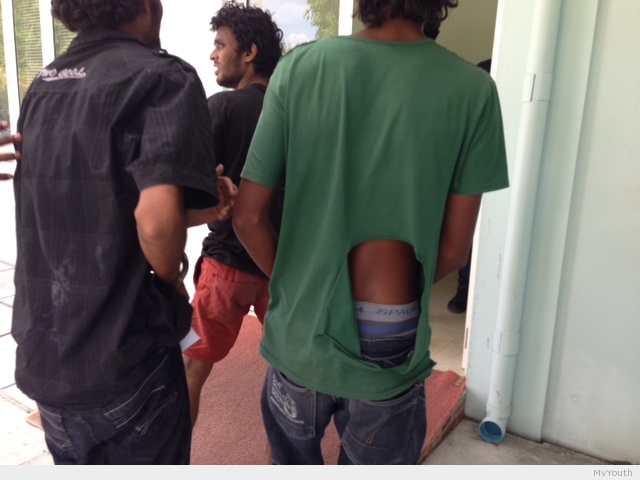
Eight young men arrested on the island of Maradhoo in Addu City last week have alleged that they were physically abused by Special Operations (SO) officers while under police custody.

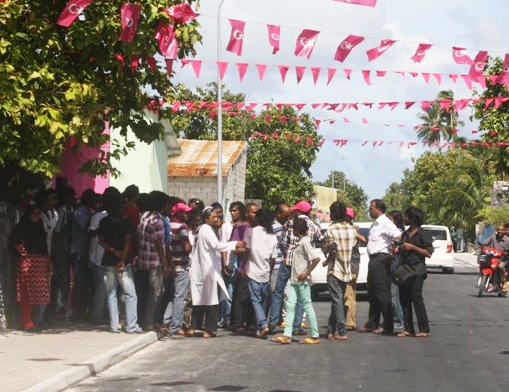
Police arrested the youth on Wednesday (May 15) for allegedly obstructing police duty outside a Progressive Party of Maldives (PPM) campaign office, which prompted clashes between SO officers and members of the public.

Eyewitnesses told local media that the SO officers used pepper spray and excessive force to arrest the Maradhoo youth.

Former Home Minister Dr Mohamed Jameel Ahmed – dismissed from the post earlier this month following his appointment as the running mate of PPM presidential candidate Abdulla Yameen – told local media that Maradhoo islanders have made a number of allegations concerning police brutality and the behaviour of SO officers during the arrests, including the use of foul language.

Dr Jameel reportedly met PPM members and families of the detainees in Addu City this weekend to gather information. The arrested youth included PPM members as well as Maldivian Democratic Party (MDP) members.

Photo from MVYouth.com

Jameel told newspaper Haveeru that the party would provide legal assistance to the PPM members, whose detention was extended to 10 days by the Hithadhoo magistrate court on Thursday (May 16). One of the eight detainees was however released by the court.

The former home minister said he advised the families to file complaints with the Police Integrity Commission (PIC) for investigation.

Asked if he believed police could have been violent towards civilians, Jameel said he “could not say that such actions  would not be seen from police.”

Dr Jameel was not responding to calls at the time of press.

Commissioner of Police Abdulla Riyaz meanwhile tweeted on Saturday (May 18) that a Professional Standards Command (PSC) team was “already in Addu to investigate the complaints against police.”

Following the arrests last week, former President Mohamed Nasheed also took to twitter to condemn “the actions of a few policemen who’ve arrested members of pol parties, used excessive force, violated the sanctity of their premises.”

Nasheed resigned on February 7, 2012 in the wake of a violent mutiny by SO officers, who have since been accused of using excessive force against demonstrators.

Speaking at a campaign rally in Maradhoo on Friday night, MDP lawyer Ahmed Abdulla Afeef said he met the detainees  separately and all of them claimed to have been physically abused in custody.

The detainees said they were driven around in a police vehicle, taken to a bridge and beaten, Afeef said.

“For about half an hour, they were kept there and beaten with police ankle boots, police helmets and with their fists,” he said. “I did not see them being abused, but there are still fresh injuries on their bodies. So this has happened.”

They were then taken to the police station and stripped naked before being subjected to more physical abuse, Afeef continued.

The youth alleged that their hands were cuffed behind the back and police jumped on the handcuffs while the detainees were made to lie on the ground, Afeef said.

Photo from MVYouth.com

The detainees also claimed that the SO officers told them that they “toppled the government” and were untouchable, he added.

Afeef said he would file complaints at the PIC and Human Rights Commission of Maldives (HRCM) but doubted that any SO officer would be held accountable.

“The Police Integrity Commission will come here and taken statements. But in the end their report will say, ‘there are allegations of abuse but we cannot identify [the responsible officers], so we cannot take any action.’ That is how it has happened in the past,” Afeef said.

Afeef said the clashes with SO officers occurred after four police officers stopped in front of a young man sitting near the PPM office and demanded that he remove a necklace.

The young man had long hair that was dyed in the back, Afeef noted.

“In any case, when police started asking these questions and harassing him, he asked, ‘what’s the problem? am I not free to wear a necklace?'” Afeef recounted.

Police responded by dropping him to the ground and cuffing his hands, Afeef continued, which prompted his friends to intervene and clash with SO officers.

Afeef observed that individual liberty was guaranteed by article 19 of the Maldivian constitution, which states, “A citizen is free to engage in any conduct or activity that is not expressly prohibited by Islamic Shari’ah or by law. No control or restraint may be exercised against any person unless it is expressly authorised by law.”

Custodial abuse

Meanwhile, PPM-aligned news website MVYouth.com published an account yesterday of one of the young men arrested on Wednesday and released after 24 hours without being taken to court.

Mohamed Zaufnaz ‘Zauf’ Shinaz, an employee of a community news site called Maradhoolive.com, told MVYouth that he went to the area upon learning of a disturbance outside the PPM office.

Photo from Addu Online

Zauf said he saw two young men – currently in police custody – being manhandled by plainclothes police officers and was urged by the people there to take video footage of the incident.

More plainclothes officers soon arrived on a police vehicle, he recounted, and one of the officers grabbed Zauf by the neck and asked him if he had a media pass.

Zauf said he was hauled into the van before he could respond.

The police took off with Zauf and three others, he continued, noting that the police officers used obscene language inside the vehicle.

The officers tried to intimidate the detainees and threatened to smash Zauf’s camera, he added.

The four young men were taken to the Hithadhoo police station and shoved and pushed up the stairs, Zauf said.

They were taken inside a room and made to kneel down facing the wall, he said. Everyone except Zauf was in handuffs.

A police officer asked Zauf to delete the pictures and videos on his camera while the others were beaten for about 20 minutes by the officers in plainclothes, he continued.

A second group of detainees were soon brought in and Zauf learned from them later that they were taken to the Hankede bridge and beaten.

Shortly after their arrival, Zauf said he was taken to a room for interrogation. Two officers then took him inside another room and forced him to undress.

After he took off his boxers, the officers forced Zauf to walk naked around the room twice. He was then kept facing the wall while an officer took videos from a mobile phone.

Zauf said he heard the police officers sniggering behind his back.

“I heard the police mocking and laughing at me while I made the two rounds. But I hung my head down and did not look at them,” Zauf was quoted as saying.

After he was allowed to sit down again, Zauf said the officers made him lift his arms up and down three times. When he emerged after being frisked, a statement was prepared and he was made to sign it without reading its content.

Zauf was kept kneeling down again and heard the second group being beaten.

A plainclothes officer gave Zauf his camera back after deleting his photos and videos. An officer had bitten and damaged the memory card on the camera.

Zauf said he saw police officers jump on handcuffs while the others were kept on their knees. Zauf saw an officer smash Aafaq’s head against the wall.

Another officer told one of the young men to cut his hair and threatened that he would do so by force, Zauf said.

Zauf was then handcuffed and placed in a cell with the others. The detainees were given a meal at around 9:40pm. All eight men were forced to sleep in handcuffs.

The detainees complained of impurities in the drinking water and was promised clean water the next day, Zauf said, adding however that he was not given clean water when he was released in the late afternoon the following day (Thursday, May 16).

MVYouth reported today that Zauf’s family has decided to send him to Male’ for counselling as the young man appears to have been traumatised by the experience.

Likes(0)Dislikes(0)

Maldives Green Fund to merge “scattered” climate finance

Transparency Maldives has called for stronger anti-corruption climate finance safeguards, following the government’s declaration it would establish a ‘green fund’ that would merge all climate change, conservation, and sustainable development project trust-funds.

President Mohamed Waheed Hassan Manik’s cabinet proposed a Maldives “Green Fund” be established, which would merge all the currently established trust funds in accordance with the government’s Biosphere Reserve sustainable development policy.

The purpose for merging the funds would be to enable cost reductions and strengthen operational efficiency for foreign investments for waste management, water management and renewable energy projects.

Shortly following this April 30 announcement, Transparency Maldives called for “stronger anti-corruption safeguards in climate finance” as part of the civil society recommendations presented to the Minister of Environment and Energy Dr Mariyam Shakeela during the “NGO Forum on Environment and Sustainable Development 2013” held May 5.

During the NGO forum, Transparency Maldives Chairperson Mohamed Rasheed Bari called on the government to strengthen governance mechanisms by including stronger standards of transparency, accountability and integrity.

Currently, climate funds are “scattered” because there is no consolidated national governance mechanism with a proper internationally governed governance structure in the Maldives, Transparency Maldives Climate Governance Senior Project Manager Azim Zahir told Minivan News today (May 19).

“In principle establishing a ‘green fund’ to consolidate climate change mitigation and adaptation money is ‘ok’ as long as it adheres to international best practices and good governance standards,” said Zahir.

The Environment Ministry had not responded to inquiries at time of press.

No overarching climate policy

“The government lacks an overarching climate change policy,” a civil society source familiar with the challenges facing climate governance in the Maldives, told Minivan News. “There are no specific goals, which has resulted in project-based, ad hoc and climate change mitigation and adaptation initiatives.”

The source explained that conflicting ministerial mandates and unclear rules have created redundancies and left civil servants “confused”.

“The root cause of the problem is administrative – the lack of clear mandates between who is doing what,” the source said. “There are also ministerial rivalries regarding certain projects because clear mandates are lacking.”

“I find it strange the Ministry of Environment does not have a climate change department, considering they are the people in charge of the entire amount of funds,” the source added.

“One person is in charge of massive [amounts] of funds. There is a lack of human resources within the Environment Ministry. Only a couple of people have dominated [climate change projects] since the 1990’s,” claimed the source.

Some people within the ministry working on foreign aid projects write themselves in as project staff as well to in order supplement their “really low” monthly government salaries of MVR 6000 to MVR 8000 (US$ 389 to US$ 519), alleged the source.

“The same people work on each project, they don’t have new people,” the source claimed.

“These senior civil servants say the Environment Ministry lacks capacity and young people with knowledge and technical skills, however they are not providing training and opportunities [to the newer civil servants].

“They have a complete monopoly on knowledge” which is not being properly diffused, the source added.

Politics and bureaucracy

After the Foreign Ministry has signed a bilateral agreement the funds are transferred to the Finance Ministry, which then allocates the money to the applicable ministry or government agency, according to the source.

Most climate projects were handled under the Ministry of Housing and Environment during former President Mohamed Nasheed’s administration, the source explained. Additionally, the President’s Office also undertook many climate change initiatives and established the Presidential Advisory Council on Climate Change in 2009.

“The council still exists on paper and while some people within the President’s Office said the council members have been changed [following the controversial transfer of power February 7, 2012], no one has been informed if they have been fired. They have no idea what’s going on,” alleged the source.

Additionally, the National Planning Council (NPC) – chaired by the president and consisting of various ministers and civil society representatives – was formed in February 2009 to coordinate equitable sustainable development nationwide.

Currently the NPC website states: “Due to the change of the Government , the work of the National Planning Council is currently under reform. Therefore all proposals and issues submitted to Department of National Planning/ National Planning Council is on hold for the time being.”

Under President Waheed’s government the Ministry of Housing and Environment was split to form two new entities, the Ministry of Housing and Infrastructure as well as Energy and Environment.

Due to the these changes and ongoing government instability “There has been a significant change in the process of how the project [cycle] works,” explained the source.

“For various political reasons – and the delicate nature of politics since February 2012 – climate change funds have not been consolidated,” the source continued. “It takes a lot of work to channel climate funds. Even under Nasheed’s previous administration there were the same problems.”

An additional reason Waheed’s administration “differs” from Nasheed’s is the current government “has not been ‘very keen’ on cooperating with civil society,” alleged the source.

“Previously they behaved really unprofessionally toward certain NGOs, however since the latter half of 2012, the government has started to try and engage NGOs and civil society – maybe to increase the administration’s legitimacy,” the source continued.

“A positive is the Environment Ministry under Waheed’s administration has been very active. They actually try to do things,” the source noted.

“However, the government consults civil society stakeholders after they’ve already decided everything. They invite NGOs to listen to their opinions, but do not seek their input during the project planning phase,” the source added.

“Ultimately, most [climate finance] problems apply to both administrations, under Nasheed and Waheed,” the source added.

Existing trust funds

“There are three umbrellas – the Maldives Environmental Management Project (MEMP), the Climate Change Trust Fund (CCTF), the Sustainable Renewable Energy Project (SREP) – under each there are different components,” Environmental Protection Agency (EPA) Environment and Social Safeguards Coordinator Ibrahim Mohamed told Minivan News earlier this month.

“The idea is that these projects be developed in such a way that the entire nation becomes a biosphere reserve, that’s the overall goal,” he added.

The MEMP umbrella is a US$ 13.88 million World Bank loan, approved in 2008 and set to close in 2014.

“The MEMP is a soft loan in the sense the interest is very less, and this project also has several components,” said Mohamed.

“Only one component is solid waste management, focused in Ari Atoll. Other areas include environmental monitoring, training and capacity building, and a bachelor of environmental science was established at the Maldives National University (MNU),” he continued.

“There is also a renewable energy component to install solar roofing of public buildings on Thinadhoo [Island in Huvadhoo Atoll], so at least 25 percent of their energy will come from solar. That component also has awareness and training on energy efficiency and conservation of energy.

The US$ 9.5 million CCTF picks up where MEMP left off, according to Mohamed.

“Under the CCTF umbrella we have three components: clean energy for climate mitigation, wetland conservation and coral reef monitoring, as well as solid waste management,” Mohamed explained.

“The World Bank is managing the donor money from the CCTF. They don’t finance directly to the government, because they want it to be managed by a reliable, transparent, international fiduciary system.

“The CCTF idea is that the project(s) we develop becomes an exemplary example for other small island states,” he added.

The CCTF was established in 2010 after the signing of an MOU between the Maldives government, the World Bank Group and the European Union with the aim of targeting solid waste management, capacity building for environmental management, and technical assistance for monitoring and managing key natural assets.

The US$138 million SREP was established in 2012 to generate 16 megawatts of renewable energy on 50 islands in the next five years.

The SREP scheme was directly related to the Scaling-up Renewable Energy Program (SREP) originally planned to be submitted to the World Bank in February 2012, but was not due to the political upheaval that resulted from Nasheed’s controversial resignation February 7, 2012.

Additionally, the Maldives has received Global Environment Facility (GEF) grants totaling US$14,443,426 – that leveraged US$35,176,820 in co-financing resources – for 10 national projects, four regional projects, and eight small grants. The project areas focus on climate change, biodiversity, international waters, land degradation, persistent organic pollutants, and the ozone layer.

The GEF is an independently operating financial organisation that supports national sustainable development initiatives and addresses global environmental issues by working in partnership with the United Nations, United Nations Development Programme (UNDP), and Asian Development Bank (ADB) as well as civil society organisations and the private sector.

The GEF “unites” 183 countries with these actors and claims to be the largest public funder of projects to improve the global environment.

“The EU has suggested that the Maldives’ government look at one atoll with the potential for populations to move and to live and do more projects there – such as waste management, clean energy, protection, preservation, adaptation – all things in one big area, so that these things will be more visible,” said Mohamed.

“If all the components go into one atoll they will become more climate resilient,” he added.

Likes(3)Dislikes(0)