Plans revealed for overdue development of IGMH

The US$7 million (MVR118 million) renovation of Malé’s Indhira Gandhi Memorial Hospital (IGMH) is set to end the concerns of patients with no choice but to use the capital’s only public hospital.

Following yesterday’s announcement, dissatisfied users of IGMH – a gift from India – have told Minivan News that they are currently forced to use its services due to the lack of reasonably priced alternatives.

“The state should be able to offer better and more reliable services than this,” said Ahmed Arshad whose father recently passed away while on the hospital’s waiting list for a bed.

“While I am deeply displeased with the services there, I go there because there is little other choice,” said Shahid Ameen, 35.

According to a statement issued by the hospital’s management, the plans – which include a new 11-storey wing – represent the first major development undertaken since the hospital’s construction 19 years ago.

Plans also include renovation of the hospital’s infrastructure and the upgrading of the Villimalé Health Centre to a 15-bed hospital. IGMH’s new wing – set to be finished by December – will be dedicated to prenatal care and paediatrics and the current dialysis centre expanded.

In his capacity as acting health minister, Minister of Defence and National Security Mohamed Nazim has also announced that the government is seeking to employ 225 additional doctors, who will enjoy revised pay structures – the details of which are yet to be revealed.

Current services

Aishath Inas – a 28 year old teacher – welcomes the proposed development, noting that it is currently “very difficult and time consuming” to get services at IGMH.

“There are long waiting lists even to get a bed in the ward, and people need to wait days to get the medical attention they seek,” she said.

Shahid Ameen noted that the current facilities were hard to locate, despite saying he frequently visits the hospital.

“As for getting appointments with specialists – especially those in the Internal Medicine or Orthopaedics department – well, better to just forget about it. You have to stand in queue for hours, sometimes even days, before you can get an appointment,” he said.

61-year-old Shaheeda Mansoor says she avoids going to the hospital if at all possible.

“It costs a bit more, but it is worth the money to go to clinics instead as you can get faster, and more quality services there when it comes to consultations. However, I still go to IGMH to do some tests as those services are rarely available in the clinics,” she explained.

Development

Indian company Renaatus Projects Pvt Ltd will be undertaking the development work which commenced on May 18 and is estimated to be completed within 15 months.

Under the project, the in-patient wards, attached bathrooms, the Intensive Care Unit, operation theaters, labour rooms, emergency room, and the hospital’s basement will be renovated.

Equipment worth MVR4.5 million (US$291,451) has been donated  to the dialysis centre by MedTech Pvt Ltd and Medicom Pve Ltd while a special consultation room will be set up for a recently-recruited specialist in kidney related illnesses.

The new Villimalé Hospital will contain a three-bed labour room, an operation theatre, five consultation rooms, and an emergency services room.

Nazim – who local media reports to be currently heading the Ministry of Health – announced that the state is looking specialists across numerous areas of expertise, including anaesthetists, cardiologists, dermatologists, gynaecologists, paediatricians, and psychiatrists.

At the press conference, State Minister of Health and Family Hussain Rasheed said that the state will complete the hiring of doctors within 45 days, with 91 medical officers to be placed in health centres across the country and specialists assigned to atoll and regional hospitals.

Likes(1)Dislikes(0)

Former home minister questions government’s sincerity regarding death penalty

Former Home Minister Hassan Afeef has questioned the government’s intention to carry out the death sentence under recently introduced regulations.

“I think they are just playing to the minds of the people because they say they want to protect the religion and protect the country as one of their campaign pledges,” he said.

Afeef – home minister between 2010 and 2012 – also questioned the ability of the current tainted judiciary to provide the certainty required for implementation of the death penalty under Islamic law.

“The judiciary might pass the sentence, there may be a verdict, but I don’t think the current regime will carry it out,” said Afeef.

“They know how politically influenced the judiciary is as the present government are the people who politically influence these judicial decisions – so they know why they make these decisions.”

Afeef’s comments follow further international headlines regarding the new regulations.

The AFP has described the recent murder conviction of a minor to be a “test case” for the new law, although the home minister had previously said that the rules will be applied retroactively to all pending death sentences.

In a statement released yesterday, the International Federation for Human Rights (FIDH) joined the growing international criticism accusing the Maldives government of being out-of-step with its international commitments.

“The decision to reinstate the death penalty in the Maldives, in particular against minors, is an outrage and gravely at odds with the growing international momentum towards abolition,” said FIDH President Karim Lahidji.

Lack of capacity

Speaking with Minivan News today, Afeef said the government’s attempts to carry out death sentences in accordance with Islamic Shariah were not possible with the criminal justice system as it is.

Afeef argued that those found guilty of such crimes beyond any doubt should be punished according to Islamic law, but questioned the capacity of the police and the judiciary to provide this certainty.

“According to Islam, when you pass the death penalty it has to be proven beyond doubt that the person has committed that crime and, according to the present situation – the present judiciary and the autocratic regime – we may find a situation where the person sentenced may not be the actual culprit,” he said.

The impartiality of the police and the judiciary has continued to be questioned this month, with the opposition Maldivian Democratic Party describing failures investigate the multiple charges against Supreme Court Judge Ali Hameed as “awe-inspiring”.

The statement said the failure of the police and the Judicial Services Commission to conclude investigations or to prosecute Judge Hameed were a clear indication of the status of the Maldives’ criminal justice system.

“Such a judge sitting on the supreme court bench is not recognised by any judicial or legal system in the world. And surely it is the general public who are facing injustice because of this,” said the party.

Hameed – who stands accused of appearing in a sex-tape as well as corruption – adjudicated on both the annulment the first round of last year’s presidential elections as well as the dismissal of the elections commissioner prior to parliamentary elections in March.

Both incidents were denounced by the international community, which has consistently called for judicial reform. Current Attorney General Mohamed Anil has pledged review and reform of the courts as part of the government’s legislative agenda.

Dheen and Qawm

Home Minister Umar Naseer’s January announcement that the government was making preparations to end the country’s 60-year moratorium on the death penalty culminated in the publication of new procedural regulations last month.

Following the gazetting of the new guidelines, Naseer said the chances of killing an innocent person after completing all the procedures in the regulation were “far-fetched” and “almost impossible”.

The regulation – which only allows implementation of death penalty when the sentence is delivered by the Supreme Court – will establish a death penalty committee to assure all procedures have been adhered to.

Mediation between the Islamic Ministry and the victim’s family is also mandated, with family members who are ‘warith’ (heirs in Shariah law) given an opportunity to pardon the convict with or without receiving blood money.

After having previously been opposed to the practice, President Abdulla Yameen announced a “change of heart” just weeks after winning his party’s presidential primary race last year.

Suggesting that “murder has to be punished with murder” in order to “save society”, Yameen embarked on a campaign of ‘dheen and qawm’ – religion and country – winning a drawn-out election in the second round last November.

Likes(0)Dislikes(0)

Ambassador to EU illegally paid US$17,000 as allowance in 2011, reveals audit report

The former Maldives Ambassador to the European Union (EU) was paid US$17,000 as a special allowance from September to December 2011 in violation of regulations governing allowances and benefits for employees at diplomatic missions, auditors have revealed.

The audit (Dhivehi) of the Foreign Ministry for 2011 has found that the Maldives embassy in the EU was instructed by Foreign Minister Ahmed Naseem in August 2011 to pay former ambassador Ali Hussain Didi US$3,500 a month as a ‘special representational grant.’

As the allowance was not given to other ambassadors, Auditor General Niyaz Ibrahim recommended recovering the funds from the responsible officials.

The report noted that allowances and benefits for staff at overseas diplomatic missions were specified in regulations enacted by the President’s Office and that the foreign minister did not have the power to authorise such payments.

Auditors also discovered that the former ambassador withdrew the US$3,500 allowance twice in October 2011.

Additionally, €7,566 was deposited to the ambassador’s bank account as a representational grant.

The regulations state that representational grants should be provided as reimbursement once bills of expenses incurred in the performance of diplomatic duties are submitted, the report explained.

However, the report noted that the ambassador did not submit bills for €7,566 worth of expenses.

Former ambassador Didi resigned from the post in July 2012 after 32 years of service.

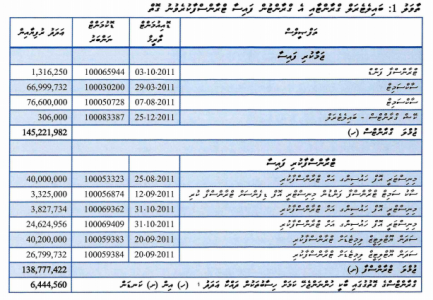
The audit report also flagged discrepancies between the Foreign Ministry’s annual financial statement and its general ledger at the Finance Ministry, which were not reconciled.

While MVR145 million (US$9 million) was included in the general ledger as bilateral grants, officials at the ministry informed auditors that they were unaware of the inclusion.

Auditors discovered that the Finance Ministry transferred MVR138 million (US$8.9 million) of the grant aid to various state institutions, leaving MVR6.4 million (US$415,045) unaccounted for.

Other cases

The auditor general recommended an investigation by the Anti-Corruption Commission into the hiring of a British national as a senior advisor at the Maldives mission to the EU in March 2010.

Auditors discovered that two employment contracts were signed with the advisor in March 2010 by the foreign minister and state minister respectively, noting that auditors could not confirm which of the two agreements was valid.

While the agreement signed by the foreign minister stipulated that the advisor must be given six months notice before termination of the contract, the agreement signed by the state minister stipulated a four month notice period.

The advisor was paid €25,992 as salary and health insurance for six months when the contract was terminated in June 2011.

Among other cases flagged in the report, auditors found that MVR52,122 (US$3,380) was spent on business class plane tickets for the deputy high commissioner to the UK and his wife to travel to the Maldives in late 2011 in violation of the regulations, which state that only the high commissioner could travel on business class.

A total of MVR64,080 (US$4,155) was meanwhile spent in 2011 to celebrate the ministry’s 78th anniversary in violation of regulations.

The report also noted that the state-owned residence in London – Rosemont Avenue number 10 – had fallen into disrepair as a result of poor maintenance.

While the residence was transferred under the care of the Education Ministry in mid-2011, the report noted that it was not fit for use.

The audit report further revealed that the Maldivian Ambassador to Saudi Arabia as well as the embassy’s counsellor were paid allowances for periods when the pair were away on official trips and vacations.

As 13,957 Saudi riyals and 11,568 Saudi riyals respectively should have been deducted from the allowances in accordance with the regulations, the auditor general recommended recovering the money either from the pair or the officials at the Foreign Ministry responsible for the oversight.

The auditor general also recommended recovering MVR137,676 (US$8,928) spent out of the ministry’s budget to pay mobile phone bills for the foreign minister in 2011 as a phone allowance for ministers had not been approved by parliament.

Moreover, MVR192,416 (US$12,478) was spent to settle mobile phone bills of foreign ministry staff in violation of rules set by the Finance Ministry and Civil Service Commission.

The ministry’s audit report for 2010 had revealed that MVR235,001 (US$15,240) was spent to pay the minister’s phone bills.

Likes(0)Dislikes(0)

Maldives must empower Anti-Corruption Commission, says Transparency International

The Maldives must empower anti-corruption agencies to investigate and prosecute cases in order to fight corruption, says Transparency International.

“Maldives and Sri Lanka must ensure that their anti-corruption agencies are granted ‘suo motto’ powers to instigate both corruption investigations and prosecutions on their own initiative without prior government approval,” suggested the Fighting Corruption in South Asia (FCSA) report released today.

At present, the Maldives Anti Corruption Commission (ACC) can only initiate investigations, but not prosecutions. Instead, it has to forward cases to the Prosecutor General for any further action to be taken.

Analysing 70 institutions across 6 countries, the anti-corruption NGO concluded that a “serious lack of political will on the part of governments to make laws work” was hampering the regional fight against corruption.

The report also called on the government to enforce the Right to Information Law and ensure protection of whistleblowers.

Independence and Accountability

Although the report advocated greater independence for oversight bodies, it highlighted the need to balance independence with accountability.

Too much of either can lead to abuse of power, the report noted, arguing limited judicial accountability has resulted in the Maldives Supreme Court exerting excessive use of power over other branches of government.

One example that the FCSA uses to demonstrate their findings is the Maldives Supreme Court’s much-criticised decision to convict the president of the Elections Commission Fuwad Thowfeek for contempt of court earlier this year. The apex court acted as prosecutor, judge and jury during the trial.

The Maldivian Anti Corruption Commission itself has raised concerns over a Supreme Court rulings, in which the apex court ruled the body does not have the authority to prevent the state from entering into questionable contracts.

ACC President Hassan Luthfee has said a ruling on a legal battle involving Department of Immigration, the Anti-Corruption Commission (ACC), and Malaysian IT firm Nexbis in 2012 had rendered the organisation powerless.

“If this institution is simply an investigative body, then there is no purpose for our presence,” he said.

“Even the police investigate cases, don’t they? So it is more cost effective for this state to have only the police to investigate cases instead of the ACC,” Luthfee said.

Referring the court’s, Luthfee said the ACC had no power to prevent corruption, arguing that anti-corruption bodies in other countries had powers of investigation, prevention, and awareness raising.

“If an institution responsible for fighting corruption does not have these powers then it is useless,” he said.

Right to Information

Another key finding highlighted in the FCSA report was what it regarded as the weak implementation of the Freedom of Information act, ratified earlier this year.

“In Maldives, although the new law has only just been passed, there are concerns about the level of citizens’ awareness of their rights, an issue which will need to be addressed as a matter of urgency,” the report states.

Under the act, an appointed commissioner has the power enforce a fine on information officers who deliberately refuse access to information. The President’s Office has today called for applications for the post which must be filled by mid July according to the new law.

The FCSA report categorises both the Maldives’ capacity to implement the law, and citizens’ awareness of the law as “weak”.

Additionally, the report highlighted the safety and protection of whistleblowers as a being major barrier to anti-corruption activities in the Maldives.

Noting the Right to Information Act provides protection to whistleblowers, the FCSA report called for more comprehensive whistleblower legislation with a broader scope covering both the public and private sectors.

Aiman Rasheed, Advocacy and Communications Manager at local Transparency branch Transparency Maldives said one the key findings of the report was the reversal of judicial reform after the February 2012 transfer of power.

“We had a new government set up. It was a positive environment. That has been reversed,” Aiman said.

He noted a “huge gap” between current systems and practices as politicians enjoyed an atmosphere of impunity following the controversial removal of President Mohamed Nasheed.

He went on to note that public engagement in holding officials accountable have been hindered by the lack of public debate in the local media.

“We have published a lot of reports on the public opinions of corruption, but we don’t see these being discussed in the media,” Aiman said.

Likes(1)Dislikes(0)

Convicted drug kingpin Shafa caught in Colombo

Convicted drug kingpin Ibrahim Shafaz Abdul Razzak has been caught in Sri Lanka’s capital city Colombo in a joint operation by the Maldivian and Sri Lankan security services.

Shafaz, commonly known as Shafa, was temporarily released in February for three months to seek medical treatment said to be unavailable in the Maldives.

However, he failed to return during the allocated time period and did not ask for an extension.

“He will be brought back to the Maldives on the next flight. His failure to return in the designated time period is an offense,” Home Ministry’s media coordinator Thazmeel Abdul Samad told Minivan News.

The Criminal Court in November 2013 sentenced the 30-year-old to 18 years in prison and levied a fine of MVR75,000 (US$4,860) for drug trafficking.

Shafaz’s temporary release has garnered controversy, with news agency Haveeru claiming the Maldives Correctional Services (MCS) violated procedures in authorising his release.

The newspaper said it has documents suggesting widespread corruption and negligence by the medical board at the MCS and doctors at state owned Indhira Gandhi Memorial Hospital (IGMH) in Shafaz’s release.

Regulations require inmates to obtain signatures from two specialists to leave the country for medical treatment abroad, but only one doctor had signed the forms, Haveeru said.

The other individual who signed the document was not a doctor, but a prosthetist and orthotist – an individual who provides care for people requiring artificial limbs.

The Anti Corruption Commission (ACC) issued a warrant in April prohibiting the doctor from leaving the country. Haveeru has identified the doctor to be Indian national Dr Ganga Raju.

Although doctors at Indhira Gandhi Memorial Hospital (IGMH) are required to hold discussions on cases where inmates need to seek medical care abroad, no such discussions took place, the newspaper alleged.

Further, although the MCS medical board noted the lack of two doctors’ signatures on the form, the board still authorised the release.

Moreover, the documents presented to the board did not contain details of why Shafaz required “urgent” medical care abroad for pain in his neck, and did not say that treatment was unavailable in the Maldives, the newspaper added.

Only two of the four members on the board authorised the release. They were representatives of the Maldives Police Services Dr Mohamed Fazneen and the Home Ministry’s Ishaq Mohamed. IGMH’s Dr Moosa Murad and MCS’ Deputy Commissioner of Prisons Hassan Zilal were on leave at the time.

Dr Mohamed Fazneen resigned from the board in mid March.

Commissioner of Prisons Moosa Azim has previously told Minivan News all due procedures were followed in the case.

When inmates are released for medical treatment abroad they are not accompanied by MCS employees and are not subject to any restrictions, the MCS has said.

“A medical officer does not have to accompany the inmate. He was allowed to leave under an agreement with his family. Family members will be held accountable for his actions, including failure to return,” Azim told Minivan News at the time.

Shortly after his departure to Sri Lanka, local media revealed that Shafaz had appealed his sentence at the High Court.

Shafaz was arrested on June 24, 2011, with 896 grams of heroin from a rented apartment in a building owned by ruling Progressive Party of the Maldives MP Ahmed ‘Redwave’ Saleem.

Former head of the Drug Enforcement Department, Superintendent Mohamed Jinah, told the press at the time that police had raided Henveiru Fashan based on intelligence information gathered in the two-year long ‘Operation Challenge’.

Jinah labeled Shafaz a high-profile drug dealer suspected of smuggling and supplying drugs since 2006.

He claimed that the network had smuggled drugs worth MVR1.3 million (US$84,306) to the Maldives between February and April 2011.

Likes(0)Dislikes(0)

New regulations require Supreme Court permission for attending overseas events

The Supreme Court has formulated new regulations making it mandatory for judges and judicial employees to seek permission to attend overseas workshops, seminars, conferences, or training programmes.

Made public yesterday (May 20), the regulations (Dhivehi) require judges and staff to submit an “overseas travel permission” form to the Supreme Court for approval if expenses are provided from the judiciary’s budget or by a foreign party.

The regulations appear to lend credence to what critics regard as the increasing centralisation of judicial administration, with the potential effect of compromising independence and increasing tension within the system.

Should permission for overseas travel be granted, the regulations state that a second form providing details of expenses must be submitted to the Department of Judicial Administration, after which approval must also be sought from the Ministry of Finance and Treasury.

Moreover, a report must be submitted to the Supreme Court at the end of the trip.

The regulation also states that equal opportunity must be provided for judges and judicial employees to participate in overseas programmes while all expenses must be made in accordance with public finance rules.

The regulations, however, exempt overseas travel by judges and judicial employees for participation in workshops or seminars in their personal capacity, so long as expenses are not covered by the state.

“Centralising administrative decisions”

The Supreme Court stated that the rules were formulated under authority granted by articles 7, 141, and 156 of the constitution.

While Article 141(b) states that the Supreme Court “shall be the highest authority for the administration of justice in the Maldives,” Article 156 states, “The courts have the inherent power to protect and regulate their own process, in accordance with law and the interests of justice.”

Referring to the articles, the Supreme Court earlier this month introduced new regulations requiring the Department of Judicial Administration (DJA) to function under its direct supervision.

The DJA – tasked with management of the courts – was formed by the Judicial Service Commission (JSC) in October 2008 to replace the Ministry of Justice following the adoption of the new constitution.

While the DJA was to function under the JSC, in December 2008 the Supreme Court brought the department under its control before the Judicature Act in 2010 transferred the DJA to the new Judicial Council.

The Judicial Council was subsequently abolished by the Supreme Court in late 2010, however, in a ruling that struck down the relevant articles of the Judicature Act.

The apex court’s move to cement control over judicial administration is in contravention to the constitutional concept of the independence of courts, former JSC member Aishath Velezinee told Minivan News earlier this month.

The new regulations were the culmination of a “systematic takeover” of the DJA, she contended, as the department “should stand as an independent institution solely facilitating administration of the courts.”

In a comprehensive report on the Maldivian judiciary released last year, United Nations Special Rapporteur Gabriela Knaul wrote that “the dissolution of the Judicial Council and the direct control of the Supreme Court over the Department of Judicial Administration have had the effect of centralising administrative decisions in the hands of the Supreme Court.”

“This has undoubtedly contributed to the strong impression that lower courts are excluded from the administration of justice and decision-making processes,” the report stated.

Knaul also expressed concern with reports of the Supreme Court “not following due process in many of its decisions.”

It is also troublesome that some of the Supreme Court’s interventions are perceived as arbitrary and as serving the judges’ own personal interests. Such misinterpretation of the independence of the judiciary needs to be urgently resolved both with regard to the public perception of the judiciary and the internal functioning of the justice system,” she advised.

“The Special Rapporteur heard several complaints about internal tensions in the judiciary, where lower courts are left with the feeling that the Supreme Court only works for its own interests, without taking into account the situation of other judges and magistrates.”

Likes(0)Dislikes(0)

Chief Judge Abdulla Mohamed takes over ‘Sun’ Shiyam’s case

Criminal Court Chief Judge Abdulla Mohamed has taken over the alcohol smuggling and possession trial of Maldives Development Alliance (MDA) leader MP Ahmed ‘Sun’ Shiyam.

Citing a letter sent from the criminal court secretariat to Judge Ahmed Sameer Abdul Aziz, who was previously overseeing proceedings, Haveeru has reported that the action was taken in response to a letter from the Supreme Court.

The decision has come amid media reports that Judge Aziz was to be replaced with Judge Shujau Usman after a request from government coalition leader Shiyam

According to the court spokesperson, the action was taken following complaints regarding the case, and was done under Article 55 (e) of the Judicature Act.

The article specifies that it is the responsibility of the senior judge in superior courts to “take action in relation to delays and other complaints related to cases submitted to the court”.

Shiyam request allegedly stated that Judge Aziz’s “hand gestures and facial expressions” indicated a personal grudge against him which could lead to an unfair trial.

According to reports, in addition to making the request for the removal of Judge Aziz from the Criminal Court and Supreme Court, Shiyam wrote a letter to Chief Justice Ahmed Faiz stating his belief that his complaints regarding the judge had further increased the risk of receiving an unfair trial.

In a letter addressed to the chief justice, which was acquired by the media, Shiyam was reported to have said he had received reports that the judge may be “considering a hastened and strict verdict” against him.

Denying reports that the case had already been handed over to a new judge, the court today said it still remains with Chief Judge Abdulla.

Shiyam was charged with smuggling and possession of alcohol in March 2012 after customs officers at Ibrahim Nasir International Airport (INIA) discovered a bottle of alcohol in his luggage.

The case remained in the investigation stage for a year after the Prosecutor General’s Office sent it back to the police in August 2012 citing a lack of necessary information.

Since the trial began in November 2013, the Criminal Court has cancelled four scheduled hearings after being unable to deliver the summons chit to Shiyam.

He appeared before the court for the first and the only hearing held in the case on March 13 this year after a court order was issued to bring him before the court under police custody. Shiyam denied the charges and requested more time to research the case.

The second hearing in the trial has been rescheduled three times, the most recent instance occurring earlier this week.

In late March, CNM reported that Judge Abdulla – prior to the official schedule date for the second hearing – had attempted to hold an unofficial hearing while judge Aziz was on leave.

If found guilty Shiyam could lose his seat in parliament as per Article 73(c)(2) of the constitution which states that members of the parliament will be disqualified upon receiving a criminal sentence of more than twelve months.

Meanwhile, a hearing in the trial of Shiyam’s brother, Ahmed Salim Mohamed, for disobedience to order have also been cancelled this week, on the same date Shiyam’s latest delay.

Haveeru reports that Chief Judge Abdulla has on several occasions asked presiding Judge Muhtaz Hussein to hand the case over to him, though the court informed Minivan News today that this has not yet happened.

Likes(1)Dislikes(0)

Are efforts to keep Malé City clean going to waste?

“As we increase our efforts to clean Malé, the amount of garbage dumped on to the street is also increasing,” said Mayor Mohamed Shihab.

The purpose of cleaning Malé’s streets and providing public dustbins – for which 260 people are now employed – is not to collect household waste, but to clean up litter, the Mayor tells Minivan News.

It is important to cultivate a habit of keeping the streets clean and using trash bins in the community, he said, suggesting that the implementation of laws was also required to address the issue.

However, keeping the streets free from litter is just the tip of the rubbish pile explains Shihab, revealing the difficulties the council continues to face in finding a sustainable way to manage the capital’s waste.

Regulation

The waste management regulation which came into partial force on February 5 imposes an MVR100 (US$6.5) fine for littering and a fine between MVR10,000 (US$ 648.5) and MVR100,000 (US$6,485) if any authority in charge of public spaces fails to provide dustbins.

The regulations also require boat owners to place dustbins on sea vessels, imposing a maximum fine of MVR100 million (US$6.5 million) on boats that dump waste into the ocean.

Speaking to Minivan News today, Ahmed Murthaza – assistant director at the Environmental Protection Agency (EPA) – said that no one had yet been fined under the regulation.

The main focus of the EPA up to now has been to create awareness and to advise offenders to correct their actions, although he warned that the agency would start imposing the fines beginning on World Environment Day (5 June 2014).

The EPA will be working with councils and the Environmental Police Unit in implementing the regulation – all of whom are authorised to issues fines.

Waste management

Mayor Shihab has suggested a long term solution for the issue would be the door to door collection of household waste.

“This is is how it is done everywhere around the world. And in all countries, they charge a fee for the service.”

“So in the future the council will be collecting and disposing the garbage. This will be discussed. Even now each house is spending money, 100 or 200 rufiyaa, monthly for this purpose.”

Most households in Malé currently employ garbage collectors – usually migrant workers – who carry the garbage on their bicycles or private pick-up trucks. This garbage is then carried dumped on a barge in the island’s south-west harbor, which then transports it to the landfill ‘garbage island’ of Thilafushi.

This arrangement, however, was intended to be a temporary one initiated in 2013 after garbage piled up in Malé’s two primary waste yards following damage to the collection vehicles.

While the industrial junk yard is once again in use today, the household waste yard remains abandoned as its foundation structure is damaged to a point that it would be harmful for the environment to utilise the place without funding from a reluctant Finance Ministry, explained Shihab

According to the council, the current arrangement will remain in place during the Islamic month of Ramadan – beginning on June 30 – when the household waste produced can be expected to double.

According to shipping industry sources, an estimated 15- 20 percent increase in imported goods is expected during Ramadan.

Environment Ministry data from 2007 put daily food waste produced in Malé at approximately 25 tonnes, while 2012 statistics indicated that 89,797 tonnes of domestic waste was dumped on Thilafushi annually.

“Dumping waste on to the barge was a temporary measure, but this operation will continue in Ramadan with more barges. Instead of keeping a huge pile of waste in Malé, we will work to transport it as soon as possible,”  explained councillor Shamau Shareef.

Tatva solution

For the council, the immediate hope for a solution to Malé waste management is in India-based Tatva Global Renewable Energy.

The Tatva agreement has faced delays after the government of President Dr Mohamed Waheed renegotiated the agreement signed by his predecessor Mohamed Nasheed in 2011.

The new agreement, which will not include collection of garbage from household in its first phase, now requires the final approval of the Finance Ministry to begin operations.

Under the Tatva agreement, the council’s equipment – including trucks and excavators – has to be to handed over to Tatva in working condition. However, as the council’s equipment has been damaged for over a year, funds are needed for repairs before the handover.

“Our concern is that the government is spending MVR7 million [monthly] to rent this equipment, such as excavators, landing craft, and the barge. This money belongs to the people,” said Shihab.

Suggesting that the council could get the same results for just MVR2-3million, he said that the ministry had repeatedly ignored requests for repair funds.

The existing arrangement must be replaced with permanent and sustainable solution, said the mayor, noting that the smell alone from the garbage barge was becoming unpleasant for people living in the vicinity.

Minivan News was unable to obtain a comment from Ministry of Finance at the time of press.

Likes(4)Dislikes(0)

“I am a ‘gunda’. I will show that to you”: PPM councillor threatens deputy mayor

A recording understood to be of suspended Malé City Councillor Ahmed Mamnoon, reveals the Progressive Party of Maldives (PPM) member threatening Deputy Mayor Shifa Mohamed.

“What are you trying to do, filing my case with the Local Government Authority, what you all are trying to do is not very nice, you will not be able to anything,” a voice believed to be Mamnoon says in the tape.

“You can’t do whatever you want here, you see, I am not a politician, I am a ‘gunda’ [thug/gangster]. I will show that to you.’’

The recording aired on Raajje TV a day after the Local Government Authority (LGA) decided to suspend Mamnoon for five days following his alleged use of offensive language to address Shifa.

Minivan News understands that the recording relates to a second incident, after the initial complaint was filed.

“The incident is regrettable. Not only because this is the council, but this type of incidents should not occur at any working place,” said Mayor Mohamed Shihab today.

“We will keep informing the concerning government institutions about all these incident.”

In the video, the voice alleged to be Mamnoon can be heard saying that Shifa will not be able to take any action against “Hameed” and that, if any action was taken against “Hameed”, action would be taken against Shifa as well.

Controversial Supreme Court Judge Ali Hameed has been in the headlines again this week, with the Maldivian Democratic Party (MDP) releasing a statement criticising authorities’ failure to pursue the multiple crimes of which the judge is accused.

The 11-member Malé City Council is currently dominated by the MDP. Shifa was formerly the minister of education, while Mayor Shihab was home minister, during the administration of Mohamed Nasheed.

“Go and take action if you can,” continued the voice in the recording. “We took the Dharubaaruge chairs. In the future, if there is anything that belongs to Dharubaaruge, we’ll take it. We can’t be stopped.’’

The ruling PPM government has continued its predecessors moves to retrieve public areas granted to Malé City Council, with police moving in to assist the takeover of the Dharubaaruge convention center earlier this month.

PPM MP Ahmed Nihan said today that he was not aware of the incident.

Likes(1)Dislikes(0)