MDP files corruption case in ACC over delay in HRCM report

The opposition Maldivian Democratic Party (MDP) has filed a case in Anti-Corruption Commission (ACC) alleging corruption involved in Human Rights Commission of the Maldives (HRCM)’s delay in releasing its findings concerning a police crackdown on protesters on February 8.

In a press statement released (Dhivehi) yesterday, the MDP alleged that HRCM was “deliberately delaying” the release of its findings for “political interests”, despite stating in local media that it had completed the investigation process.

“Human Rights Commission of the Maldives has stated in the media that they have finished compiling the report following their investigation into the violent police crackdown on protesters on February 8, after the toppling of the legitimate government by a coup d’état,” the party said.

“This party condemns the commission’s delay in releasing the report, which we believe is because of  political interests,” read the statement.

The MDP alleged that the actions of HRCM were in violation of the regulation on right to information, and claimed that despite the commission’s statement to local media stating that it had released the report, it was not publicised anywhere.

“When [we] requested a copy of the report, the commission responded saying that a copy of report would only be made available after the commission decided on the matter during a meeting held on Wednesday, August 15, and said that they had sent the report to MDP office. But as of now, no such report has been received,” read the statement.

The MDP in the press statement said that these actions suggested that “members of the commission are involved in corruption – the use of power and authority for the benefit of certain parties”, and that therefore MP Ibrahim Rasheed would submit the case to the ACC on behalf of the party.

The MDP also called on the commission to immediately release its report to the public without delay.

HRCM response

Following MDP’s statement, the HRCM released a counter statement explaining the procedures it follows after releasing a report.

“This commission acts in accordance with the stipulations of article 24(c) and 24(d) of the Human Rights Commission of the Maldives Act.  Therefore, it includes issuing of the investigation report to the party that filed the case, and we also share a copy with those that we feel are responsible and the authorities,” read the statement.

Article 24 of the Human Rights Commission of the Maldives Act (Act no. 6/2006) dictates the procedures which the commission has to follow after completing its investigations.

Article 24(c) states: “The commission should present a report of the investigation to the party that filed the case to the commission and to those which the commission believes should take responsibility.”

Article 24(d) states: “The commission should present its investigation report to the relevant authorities, and must advise them on way to which issues concerned in the report be not repeated again.”

HRCM in the statement said that the publicising of an investigation report would be decided after meeting held by the members.

The commission also claimed that the investigation into  the events that took place on February 8 was “not an investigation that was initiated following a case filed to the commission” but rather a “self-initiated investigation”.

The commission also claimed that the report had been sent to concerned parties on May 28, and had also shared “necessary information” with the public during a press conference on July 18.

Minivan News understands that the report has been submitted to the government, but has not been otherwise circulated.

February 8

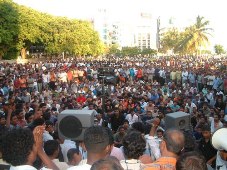
On February 8, thousands of protesters who took to the street in peaceful protest following the controversial toppling of former President Mohamed Nasheed were met by a violent crackdown by police.

The political chaos was triggered after Nasheed rallied MDP supporters, declaring that his resignation had been under duress, and called for the freshly-appointed President Mohamed Waheed Hassan to step down and call for elections.

“Yes, I was forced to resign at gunpoint,” Nasheed told foreign reporters after the rally. “There were guns all around me and they told me they wouldn’t hesitate to use them if I didn’t resign.”

Nasheed’s supporters then clashed with police and military forces near Republic Square, and were repeatedly tear gassed by the police. Dramatic footage of the crackdown has been shared on social media. More videos uploaded showed police kicking and beating protesters on the ground.

A Minivan News reporter was injured following what he described as a baton charge by former President Maumoon Abdul Gayoom’s ‘Star Force’ officers.

“They were beating old women with batons,” he said. “It was just like the old days.”

Police also confirmed at the time that there had been injuries to protesters.

HRCM investigation

The HRCM condemned the police brutality against civilian demonstrators.

“We highlight the fact that a lot of civilians and police officers have inflicted injuries of varying degrees during the demonstrations organised by the MDP, which became a confrontation between police and protesters,” a statement read at the time. “With regards to the demonstration, this commission is in the process of investigating the matters under its mandate.”

Addressing police forces and the public, the commission requested both parties to safely support the rights guaranteed in Article 32 of the constitution, which provides for the freedom of assembly.

“We advise the police to maintain their actions to standards that would not lose the public trust on the police service and we call the public to support and assist the police in executing their duties,” read the statement.

On May 29, HRCM stated that it had completed the investigation of the event and stated that its findings were sent to the authorities including the Prosecutor General’s office and parliament.

HRCM member Jeehan Mahmoud at the time said all but one of its investigations into the government changeover in February, and the events that led up to it, had now been completed.

One more report into the alleged human rights abuses conducted by police on the day of February 7 was left to be completed, she added.

Likes(0)Dislikes(0)

Comment: MDP decision revives hopes on Roadmap Talks

The opposition Maldivian Democratic Party (MDP) has now called off the daily protest demonstrations in the capital city of Male’, demanding early presidential polls ahead of those due in July-October 2013.

This in a way has revived the hopes of early resumption of the All-Party Roadmap Talks, initiated by President Mohammed Waheed Hassan at the insistence of visiting Indian Foreign Secretary Ranjan Mathai in March.

More importantly, the agenda for the Roadmap Talks have elements that have the nation’s long-term interests in mind, and on which a certain unanimity has emerged, owing to national compulsions that are for real.

Independent of existing expectations, both within the party and outside, the MDP leadership has gone ahead with the protest rally in the Islamic fasting month of Ramadan.

However with the Eid festival season arriving with consequences for the local community, including trade and business, the MDP seems to have thought better of it. The party said that the decision to withdraw the protests should lead to the revival of the peace talks, in which the MDP’s demand for fast-tracking presidential polls is a part of the agenda.

Reacting positively to the MDP’s decision, the President’s Office said that it would help in the revival of the Talks. Following protests against Vice-President Waheed Deen in suburban Hulhulumale Island, off Male’, President Waheed has since clarified that harassment of government officials should stop before he would consider participating in the talks.

President Waheed said that he was in continuous touch with Ahmed Mujuthaba, moderator for the All-Party Talks. He has also been promised by all participant parties that either their leaders or a senior deputy (with decision-making authority) would be fielded when the talks resumed. Earlier rounds had failed to reach any decision owing to the diffused focus of the talks and also improper representation by the parties.

Interestingly, the influential former President and founder-leader of the Progressive Party of Maldives (PPM), Maumoon Abdul Gayoom, who had refused to return to the talks until his successor Mohamed Nasheed tendered an ‘unconditional apology’ for charging him with a plot behind the latter’s February 7 resignation, has not reacted yet to the protest-withdrawal by the MDP. He was not satisfied with the ‘qualified apology’ tendered by Nasheed’s aides, and has also said that despite the international probe that is now on, he would not accept the ‘coup theory’.

Intermediate confusion however crept in after the MDP interpreted the All-Party Talks being called by Vice-President Deen for resuming the stalled Parliament session, as one leading to early elections. The government has since clarified that the Vice-President’s talks flowed from Speaker Abdullah Shahid’s decision to indefinitely suspend the proceedings of the Majlis on July 31, following days of interruptions in the house. In a way, any decision on early resumption of Parliament session will help create the right environment for the revival of the Roadmap Talks, too.

Will the CoNI report come in handy?

Independent of the agenda-point on early presidential polls, the Roadmap Talks concerns national priorities that have been overtaken time and again by the political developments of the past years. On presidential polls, there is a general agreement that the international probe by the Commission of National Inquiry (CoNI) appointed by President Waheed, holds the key. The probe, with a retired Singaporean Judge on board, is expected to submit its report by the extended deadline of August 31.

Some government parties have since murmured their protests about the inclusion of an MDP nominee in the probe. Yet, they did not contest the nominations when the government – of which they were all a part – made its original nominations.

However, there is a greater realisation that any advancement of the presidential polls can be done only by Parliament amending the Constitution through a two-thirds majority, or by President Waheed quitting office, based on a public statement to the effect after the MDP flagged the ‘plot theory’ in the aftermath of President Nasheed’s resignation.

In the latter case, too, there is no constitutional guarantee to the effect, nor is the constitutional position clear. Under the law, the Vice-President steps into the shoes of the President, as Waheed did, and unless the former too quits, there be no case for early polls, it is argued. Under the Constitution, the Parliament Speaker takes over if the top two jobs become vacant, and has to conduct presidential polls within three months. Whether the CoNI report could lead to such a situation, or if the MDP would return to the streets, either way are questions for the future.

Commonality yes, consensus, not yet

On larger issues that have been flagged at the Roadmap Talks, there is some commonality of approach in individual parties, and across the board in many others. On the issue of early elections, for instance, the Dhivehi Rayyathunge Party (DRP), which is a partner in the government, has said that it would support the MDP position (without saying so) if the CoNI report endorsed the ‘plot theory’. With the DRP’s backing as the party-wise position in Parliament now stands, the MDP could hope to get the Constitution amended to facilitate early polls. But there are ifs and buts there too.

However, a consensus of sorts is required to emerge, at least among the major political players, if only to ensure stability of the polity and continuity of policies, independent of the party or leader elected to power. It would be more so considering the inherent inability of the Maldivian polity to throw up a strong president with a first round victory for self on his own and his party’s steam. Worse still would be the situation of the kind that haunted the Nasheed presidency, when the government party did not enjoy a parliamentary majority, required for amending laws, reflecting the political agenda and electoral manifesto of the president or of the parliamentary majority – whenever it cannot be both.

On governance issues, on which the MDP had quarrels with the rest of the nation’s polity even while President Nasheed was in office, the party may be tempted to have a relook at its position since. For instance, the Civil Court and the High Court have consistently come down on the Maldives Police Force for forcing the MDP cadres out of their Usfasgandu ‘camp site’ in Male. A legal row has emerged between the government and the MDP-controlled Male Municipal Council over the usage of the Usfasgandu property, taken out on lease by the latter.

The MDP thus may have to relook its position on institutional reforms. In the case of the judiciary, for instance, the party should wait till the seven-year deadline for empowerment and training ends. Having talked about institutional reforms much while President Nasheed was in office, the MDP should instead be working on a roadmap with specifics on training and legislation, possibly as a part of its promised poll manifesto.

On other issues of common concern outlined in the agenda for the Roadmap Talks, economic issues take a high place. Independent of what individual parties have to say in public, there is a general acceptance about the need for relooking at the budget and economic issues. If the Nasheed Government was vociferous in proceeding with economic reforms, subsidies-cut and increasing the tax revenue to the government, the successor Waheed government has proceeded on similar and at times stronger lines. Government leaders are not shy of talking about austerity measures, and government parties cannot change halfway through.

On the equally sensitive issue of allowing resorts on inhabited islands, which was among the charges levelled against the Nasheed Government, the Waheed presidency has since granted permission for allowing a third party to set up a resort on Thanburudh island training and recreation facility of the Maldivian National Defence Force (MNDF), the nation’s army.

While it may be a stand-alone case, compared to sanction for resorts in other inhabited islands, the question remains if that third-party could involve overseas investors or partners, in the context of the controversy still surrounding the ‘GMR contract’ for the airport project.

In this context that the Waheed Government’s current initiative for amending the Finance Act, to give the Executive freedom from parliamentary oversight and passage for selling public assets to private parties assumes significance, in political and economic terms.

As may be recalled, Parliament rushed to amend the Finance Act in 2010 after the Nahseed Government had entered into the Male airport modernisation contract with the Indian infrastructure giant, the GMR Group. It is another matter that the GMR contract did not involve the sale of any Maldivian Government assets, yet the otherwise divided opposition of the times, all of them now on the Treasury Bench, joined hands, among other things, to depict the modernisation contract as an ‘assets sale’.

Questions also remain about the wisdom of the present government entering into a joint venture with the MNDF, for the new company to enter into businesses and investments, to augment the budget for the nation’s defence forces. Experience elsewhere in South Asia too has proved that independent economic resources in the hands of the armed forces, if only after a long time, have made the services independent of the nation’s political and bureaucratic leadership in other ways, too.

Though not mentioned in the Roadmap Talks, such are also issues on which a national consensus needs to evolve, and clarity and consistency thrown into the operationalisation of whatever decision that is arrived at.

All comment pieces are the sole view of the author and do not reflect the editorial policy of Minivan News. If you would like to write an opinion piece, please send proposals to [email protected]

The author is a Senior Fellow at the Observer Research Foundation.

Likes(0)Dislikes(0)

MDP commemorates ‘Black Friday’ anniversary

The former ruling Maldivian Democratic Party (MDP) commemorated the eighth anniversary of the brutal crackdown of the pro-democracy demonstration on ‘Black Friday’ August 12 and 13, 2004 with a special rally last night.

The rally featured video presentations about systematic torture under the regime of former President Maumoon Abdul Gayoom and testimony of victims of the crackdown on the unprecedented 22-hour public gathering at the Republic Square.

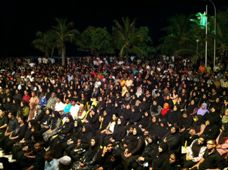
Addressing a capacity crowd at artificial beach last night, former President Mohamed Nasheed said that Black Friday was the day that the Maldivian people started to believe that they could assert their will and power over the government.

August 12, 13
Black Friday gathering

“It was the day when the Maldivian people found courage,” he said. “It was the day when the people started to believe that they could come out and reverse the autocratic rule of this country and eradicate torture and brutality.”

The former Amnesty International ‘prisoner of conscience’ paid tribute to the hundreds of demonstrators and reformist MPs arrested and beaten by the former National Security Service (NSS) on August 13.

Nasheed urged reformists to “continue the journey” begun on August 12 and 13 with the lessons of the past eight years, vowing not to stop the fight “until true freedom and independence is established in this country.”

The hopes of the Maldivian people for a better future was “tied to forming a civilised security forces,” Nasheed said, adding that everyone in the police and army were not “bad and ruthless people.”

It was MDP’s “duty” to work with numerous youth and experienced officers “of a national spirit” in the security services to reform the institutions, he continued.

Nasheed said he was “certain beyond doubt” that the Commission of National Inquiry’s (CNI) report would note that a number of mutinous officers of the security forces committed crimes and unlawful acts on February 7.

“After CoNI’s report, we should only go back home after bringing them to justice,” he said.

He added that the nation could not be held as the “spoils of war by a few police and army officers.”

‘The hidden baton’

Speaking at the rally, former Male’ MP and first president of MDP, Ibrahim ‘Ibra’ Ismail, argued that the “biggest success for the people” on August 12 and 13 was to show the outside world as well as the Maldivian people “the culture of brutality concealed by Gayoom.”

“The hidden baton” was made exposed through the efforts of reformists, said Ibra, which was put away after Gayoom’s election defeat only to be brought out again on February 7, 2012.

“This is not something the Maldivian people will accept. You cannot tie the tongues of the Maldivian people again. Today, the Maldivian people no longer fear that baton,” he said.

In a video message aired at the rally, Naushad Waheed – brother of President Mohamed Waheed Hassan Manik – spoke of torture in jails during President Gayoom’s 30-year reign.

Naushad, former deputy high commissioner to the UK, warned that those in power would not willingly relinquish it regardless of the conclusions of CNI’s report, urging MDP to remain vigilant and within legal bounds.

Former Special Majlis MP Mohamed ‘Nafa’ Naseem meanwhile said that the reformists drew courage from the months spent in Dhoonidhoo detention island following the crackdown on August 13.

“If I remember correctly, more than 300 people were put in jail for a long period,” he said. “I never saw anyone cry out of fear. Everyone was smiling. [We] crossed the threshold of fear.”

In a video interview, Mariyam Manike – mother of Evan Naseem, who was beaten to death in Maafushi prison on September 19, 2003 – recounted her treatment at the hands of NSS officers after her arrest outside her residence on August 13.

Manike said she was beaten by NSS officers after being taken to the main army barracks and was kept for hours with her hands cuffed behind her back.

NSS officers threatened to kill her while one officer told her that “this is the handcuff your son was wearing when we killed him,” Manike said.

Likes(0)Dislikes(0)

Police crack down on ‘harassment’ of politicians

Police are taking stronger measures against people who harass politicians and such incidents are falling, according to President’s Office Abbas Adil Riza.

The Maldivian Democratic Party (MDP) has meanwhile alleged that freedom of speech is being unfairly restricted by the crackdown.

Commenting on the arrest of an MDP activist known as Okay Zahir – who allegedly called the Islamic Affairs Minister a ‘baaghee’, or ‘traitor’ – Abbas said that Zahir stood accused of harassment.

Local media reported yesterday that Zahir’s period in detention had been extended by a further 10 days after his original arrest on August 7. Zahir is a former director of the Thilafushi Corporation (TCL).

Abbas alleged that the accused “verbally abused the Islamic Minister”, engaging in “indecent behaviour” towards Sheikh Mohamed Shaheem Ali Seed whom he claimed was in the company of his nine year-old son at the time of the incident.

Neither Sheikh Shaheem nor Police Spokesman Sub-Inspector Hassan Haneef were responding to calls at time of press.

A source who had seen the arrest warrant claimed that Zahir was accused of approaching Shaheem’s son on a number of different occasions, inquiring as to the whereabouts of “baaghee Shaheem”.

The source stated that police obtained the warrant due to their belief that this alleged offence would be repeated.

MDP spokesman Hamed Abdul Ghafoor stated that the charges against Zahir seemed “very bizarre”, and expressed his concern that “the scope of freedom of speech is being severely constrained.”

“One could argue it is unconstitutional,” continued Ghafoor. “I don’t see how giving your opinion of the truth equals harassment”.

Maldivian Democratic Party (MDP) Lawyer Hisaan Hussain used social networks to express her belief that calling someone a ‘baaghee’ is not a criminal offense.

Meaningful dialogue

Since his accession to the Presidency, Dr Mohamed Waheed Hassan’s public appearances have often been accompanied by heckling crowds disputing the legitimacy of his government.

As well as calling for early presidential elections, the anti-government demonstrations have attempted to mock and ridicule leading government figures as part of a well-choreographed non-violent strategy.

The harassment of politicians has recently been central to the government’s negotiations with the opposition MDP.

During the last round of the UN-mediated roadmap talks in June, pro-government parties presented the MDP’s representatives with a list of 30 suggestions for resolving political tensions in the country which included calls to stop the harassment of political figures.

However, the list also included calls for the MDP to stop the use of “black magic” and “erotic tools”, leading the MDP to interpret a lack of sincerity on the part of the pro-government group.

More recently, President Waheed said that he would not engage in the all-party talks until the harassment of his officials stopped.

The MDP announced last week that it intended to suspend its program of anti-government demonstrations in order to “facilitate meaningful dialogue”.

This move was initially welcomed by the government, before protesters targeted Vice President Waheed Deen as he attended a ceremony in Hulhumale, causing Abbas to tell local media that the government’s participation in talks may have to be reconsidered.

Freedom within limits

During a speech given in June, President Waheed stated his belief that freedom of expression ought not to be permitted to the extent that it impinged on the rights of others.

“People misuse the right to freedom of expression and yell whatever words that come to mind at other people. You have seen and heard this, not just on TV or radio, but on the streets, in front of houses and schools. This is not how it should be,” Dr Waheed was reported as saying.

As well as being enshrined in the Universal Declaration of Human Rights, the right to freedom of expression is listed in the 2008 Maldivian Constitution as one of the fundamental rights and freedoms of its citizens.

The right to freedom of speech, however, has long been met with caveats and provisos which in effect limit the ability of individuals to unrestricted expression.

Article 10 of the European Convention on Human Rights espoused the right to freedom of expression whilst delineating restrictions it describes as “necessary in a democratic society”.

The list of exceptions includes constraints “for the prevention of disorder or crime, for the protection of health or morals, for the protection of the reputation or rights of others”.

Similarly, the right to freedom of speech is guaranteed by the first amendment to the US constitution but has been restricted by subsequent Supreme Court rulings which have included issues concerning incitement, false statements of fact, and obscenity.

During the speech, Waheed expressed his hope that the People’s Majlis would move to curb the actions of those who, he felt, were abusing this fundamental freedom.

Likes(1)Dislikes(0)

Ruling coalition to reverse own restrictions on sale and lease of state property

The government is seeking to reverse restrictions concerning the sale and lease of state properties, that the ruling coalition parties themselves passed while in opposition.

Finance Minister Abdulla Jihad said the government requested parliament amend the Public Finance Act to remove the requirement for parliamentary approval for the sale or lease of any government property.

The controversial amendments to the Act, passed in June 2010 prior to the airport being award to Indian infrastructure giant GMR, sparked the resignation of then-President Mohamed Nasheed’s cabinet over the opposition-majority parliament’s “scorched earth politics”.

Jihad told local media that the request to amend the Act was made as government faced “difficulties” leasing and selling its property, including land, buildings, and infrastructure, as the law currently demanded that such transactions could only proceed after parliament approval.

Speaking to Minivan News, Jihad said he sent the request to parliament’s public finance committee, and that the government would propose the bill to the parliament floor as soon as parliament sessions reconvened.

“We will send the bill as a high priority bill to the parliament as soon as parliament reconvenes. This is a very important bill for the government,” he said.

He also added that it although the government did have an MP representing President Mohamed Waheed Hassan’s party – to present legislation on behalf of the  government – this was not required as the matter was “not a revenue bill”.

Amendments

The amendment concerning the requirement for a prior parliamentary approval was brought to the act on June 2010, by then opposition-controlled parliament.

The amendments were brought to article seven of the Public Finance Act: “any relief, benefit or subsidy by the state” must be given in accordance with laws passed by the parliament.”

The amendment to article 10(a) reads that financial benefits provided by the government in order to pursue its policies must also be issued in line with laws passed by parliament.

However, article 10(c) of the amendment bill states that the government could grant “some financial assistance” from the emergency funds allocated in the state budget under certain circumstances, such as to provide relief after natural disasters.

Meanwhile, 10(d) states that assistance could still be given “if the government believes providing financial assistance to a businessman or a business facing financial difficulties was in the public interest” or if the financial difficulty is believed to impact “the lives of a sufficiently large number of people in society”.

Moreover, article 34(c) stipulates that the government must implement recommendations of the parliamentary committee that reviews the state budget.

The Maldivian Democratic Party (MDP), the ruling party at the time, blasted the opposition claiming that the bill was passed to “obstruct the public private partnership policy of the government.”

Several MDP MPs expressed concern over the move, alleging that the opposition wanted to hinder the running of the government.

Among the concerned parliamentarians, MP Mohamed ‘Colonel’ Nasheed at the time said he regretted the bill had been passed and that he was “very concerned” over its approval.

”All the services the MDP has planned to provide for the people will be disrupted according to this bill,” said Nasheed.

”Right now there is a hung parliament and it is very difficult to bring out sufficient results from it.”

Nasheed said that responsibility for the country’s financial condition was the duty of the President and the Finance Ministry, according to the constitution.

”The bill was not approved in the best interests of the country,” he added. ”I regret the approved amendments [governing privatisation].”

MDP Spokesperson at the time, Ahmed Haleem, also echoed similar concerns claiming the bill was approved “according to the self-interest of two or three businessmen in parliament.”

”This bill will obstruct the public and private partnership policy of the government,” said Haleem. “It was not passed for the benefit of the people of the country.”

However, then main opposition Dhivehi Rayyithunge Party (DRP) dismissed the claims made by MDP.

DRP MP Abdulla Mausoom said at the time that the government was required to govern the country “according to the wishes of its people.”

”The parliament represents the people,” Mausoom said, “and according to the bill, the government will now need the approval of the parliament when leasing state assets or taking loans from other countries.”

Mausoom said the parliament “belongs to the people” and would only make decisions “for the benefit of the people.”

“I do not see any article in the bill that disrupts the government’s pledges,” he said. “Privatising Male’ International Airport was not a pledge of the government.”

Likes(0)Dislikes(0)

Criminal Court begins hearing VTV vandalism case

The Criminal Court has commenced the trial of five men accused of vandalising the offices of private broadcaster Villa Television (VTV) during protests held in Male’, on the day President Dr Mohamed Waheed Hassan Manik delivered his inaugural Presidential Speech.

VTV is owned by Jumhoree Party (JP) Leader Gasim Ibrahim, which is represented in President Waheed’s coalition government.

The Prosecutor General (PG) has pressed charges against Ismail Hammaadh of Maduvvari in Raa Atoll, Ahmed Hameeed and Hussein Hameed of Alifushi in Raa Atoll, Ahmed Naeem of Henveiru Ladhumaageaage, Hussein Shifau Jameel of Maafannu Nooruzeyru, Aanim Hassan of Ferishoo in North Ali Atoll, Ahmed Muheen of Galolhu Haalam and Mohamed Hameed.

Newspaper ‘Haveeru’ reported that a lawyer representing the PG’s Office pressed charges against the five suspects for their alleged violation of legislation banning threatening behaviour and the possession of sharp weapons.

All of the respondents have denied the charges against them.

Local media reported that the PG’s Office lawyer was given the opportunity to produce evidence including witness statements, pictures and video footage provided by VTV staff present at the area when the incident occurred.  Police and MNDF officers were also produced to the court for their accounts.

On March 19, President Dr Waheed Hassan Manik delivered his opening address to parliament amid widespread anti-government demonstrations, after the Maldivian Democratic Party (MDP) took to the street to prevent him from giving the speech. Violent clashes between police and protesters and sparked major unrest in the capital Male’.

Following violent confrontations between civilians and security forces during the day, 99 people were arrested, with a number of security officers and protesters reported injured.

Police Superintendent Ahmed Mohamed previously said that the attack on VTV was itself an act of terrorism and that those involved should receive “the harshest punishment possible”.

Likes(0)Dislikes(0)

Government has caused “irreparable damage” to investment climate: MDP

“The MDP is extremely worried about the deteriorating environment for investors and strongly condemns the continued threats posed by Dr Waheed’s administration to foreign investors,” read a press statement released by the party today.

The party’s spokesman, Hamid Abdul Ghafoor, stated that public-private partnerships (PPP) initiated under the MDP government have been suspended “in the interest of preserving the status and wealth of few local wealthy businessmen.”

The current government announced the suspension of any new PPP projects shortly after assuming power. The Minister of Economic Development, Ahmed Mohamed, whose department handles foreign investment in the Maldives, was not responding at the time of press. President’s Office Spokesperson Abbas Adil Riza was also not responding.

The MDP statement specifically mentions three projects which have encountered difficulties, claiming that they have been intentionally hindered by the current government, “causing irreparable damage to the foreign investment climate of Maldives.”

The World Bank’s ‘Ease of Doing Business Report’ shows that the Maldives has dropped one place in its overall list during the last twelve months, falling to 79th out of 183 countries ranked. In terms of protecting investors, the Maldives dropped five places in this year’s list.

Former Energy Advisor to President Nasheed Mike Mason told Minivan News in June that, before Nasheed’s controversial resignation, the World Bank had given verbal approval to a plan which would have brought an immediate US$200million of renewable energy investment to the country.

The resulting political instability caused the plan, which had been intended to wean the country off its dependency on oil imports, suspended indefinitely as potential investors backed away.

Meanwhile, proposed austerity measures sent to Parliament by the Finance Ministry last week include a three percent increase in oil import duty.

One of the most high profile foreign investments in the Maldives is the GMR-MAHB project to develop Ibrahim Nasir International Airport (INIA). This US$400 million deal for the upgrade and management of the airport represents the country’s biggest ever private investment contract.

The deal has foundered on a dispute over the implementation of an Airport Development Charge (ADC) of $25 per passenger which was agreed as part of the initial contract. This charge was opposed by the Dhivehi Qaumee Party (DQP), now a member of the coalition government, whilst in opposition. The party last year successfully sued for the blocking of the ADC, claiming that it represented an unauthorised tax.

The case led to an arrangement with the Mohamed Nasheed administration whereby the ADC money would be deducted from the concession fee payable to the government. The subsequent shortfall in funding for the project has seen the government’s anticipated US$14.3million in fees replaced this quarter with a bill from GMR for US$1.5million.

A number of pro-government parties, including the DQP, have renewed calls for the re-nationalisation of the airport. The dispute has now been referred to a court of arbitration in Singapore.

All three projects mentioned in today’s press release involve partnerships with Indian firms, the other two being a social housing development project with the TATA group, and a solid waste management project in Thilafushi with environmental engineering company UPL.

During President Dr Mohamed Waheed Hassan’s official state visit to India in May, he confirmed that all contracts with Indian investors would be honoured and was keen to discuss further Indian investment projects in the Maldives.

The MDP statement noted that its PPP projects would have generated revenue over MVR23.1billion (US$1.5billion) for the country.

The Finance Ministry’s austerity measures are an attempt to reduce this year’s budget deficit, which is forecast to reach MVR9.1billion (US$590million).

Likes(0)Dislikes(0)

Police send case concerning MDP MPs Hamid and Bonday to Prosecutor General

Police have sent cases concerning opposition Maldivian Democratic Party (MDP) MPs Hamid Abdul Ghafoor and Ibrahim ‘Bonday’ Rasheed to the Prosecutor General’s Office.

An official from the Prosecutor General’s Office has confirmed to matter to local media today and has said the PG Office was currently researching the case.

Local newspaper ‘Sun Online’ reported that police have requested to press charges against MP Hamid for obstructing police duty and requested MP Rasheed be charged for obstructing police duty, assaulting police officers, threatening and creating unrest.

On August 4, Ibrahim Rasheed was arrested and the Criminal Court placed him under house arrest for five days on charges of threatening and attacking a police officer and obstructing police duty.

According to a statement issued by the MDP, Rasheed was taken into custody at 12.30am from a popular cafe in the capital Male’ by “20 militarised police.”

“MP Ibrahim Rasheed was arrested under a warrant obtained by the police relating to an incident two days back on 30 July when it was reported that the MP was ‘bitten’ on his back by a policeman in the process of being arrested while participating in a protest rally,” the statement said.

Photos surfaced on social media showing bruises on the MPs’ back and the prescription letter from private hospital ADK where he was treated.

On July 22, Hamid Abdul Ghafoor was arrested after he broke through the police barricades near the Maldives Monetary Authority (MMA).

“We warned him and let him go as he first broke through the police barricades. We arrested him for obstruction of police duties after he broke through again,” police said in a statement.

In a statement following Hamid’s arrest, the MDP said Hamid and other protesters were arrested in violation of the laws stipulated under the constitution and international covenants Maldives is party to.

Likes(0)Dislikes(0)

CNI committed to August deadline as co-chair temporarily departs for Singapore

The revised Committee of National Inquiry (CNI) charged with investigating February’s controversial transfer of power has said it remains committed to releasing its findings later this month, despite its Singaporean co-chair returning to Singapore until August 25.

Former President Mohamed Nasheed’s member on the commission, Ahmed ‘Gahaa’ Saeed, said today that the CNI’s investigations were continuing, despite co-chair G P Selvam – a retired Singaporian Judge – having to return to his home country to work on an arbitration case.

Saeed maintained that the commission’s report was expected to be sent to authorities on August 29, before being publicly released the next day, with Selvam believed to be working on the findings during his trip. Local media, citing a source in the CNI, reported yesterday that Selvam had been out of the country on business since August 3.

Without wanting to discuss the commission’s findings so far, Saeed told Minivan News that in previous cases where Selvam had been called to Singapore, any interviews with “important”, high profile witnesses had been rescheduled to allow him to hear such testimonies.

“When working with international partners, in some cases they will have existing commitments,” he said. “However, the commission’s work is continuing. Right now, [Selvam] is also preparing the report.”

A person familiar with the CNI’s workings meanwhile told Minivan News on condition of anonymity that there was some concern that the absence of the judge’ “may constrain” the panel’s ability to investigate at full capacity.

President’s Office spokesperson Abbas Adil Riza said the government had been aware of Selvam’s plans to return to Singapore, and believed that the CNI’s work would be completed “on schedule”.

“The CNI has not requested any additional time from the government to complete its findings,” he said.

CNI deadline

Earlier this month, Selvam stated at a press conference that the CNI’s findings would not state against whom the state should press possible charges.  He contended that this was for the Prosecutor General (PG) to decide.

Days earlier, former President Maumoon Abdul Gayoom, said he would not accept that the toppling of former President Nasheed’s government on February 7 was a coup d’état, even if the Commission of National Inquiry (CNI)’s report came to such a conclusion.

Initially, the commission was mandated to release its findings on July 31, but CNI members stated that their final report will be delayed, after hundreds of people have come forward offering new information.

Selvam at the time said that the new date for the report’s completion would be the end of August, which was later approved by the government.

Saeed said at the time that 244 people had registered to provide information to the commission following the reforming of the CNI.

“There has been a lot of interest. We will speak to each and every single one,” he said.

The new names joined the 87 spoken to by the government’s original three member panel, taking the total number of contributors to 331.

“That’s one contributor for every 1000 of population,” Saeed remarked.

Following the remarks by the commission, President Mohamed Waheed Hassan extended the deadline by which the CNI must conclude its report into February’s transfer of power by August 30, 2012.

The first three-member CNI was appointed by President Mohamed Waheed, following a police and military mutiny and Nasheed’s resignation, in what he and his party have described as a coup d’état.

Facing pressure from the Commonwealth and civil society NGOs, the government eventually agreed to reform the commission to include a retired Singaporean judge and a representative for Nasheed.

The former CNI subsequently released a ‘timeline’ into events that took place from January 16 to February 7.

The MDP accused the commission of trying to prejudice the work of new commission, and then released its own version of events in response – the ‘Ameen- Aslam’ report based on interviews with the security services. The government described the publication of this report as a “terrorist act”.

Likes(0)Dislikes(0)