Supreme Court disqualifies MDP MP Musthafa

The Supreme Court has disqualified former ruling Maldivian Democratic Party (MDP) MP Mohamed Musthafa over a decreed debt which the court concluded makes him constitutionally ineligible to remain in the seat.

Monday’s ruling came following the case filed against Musthafa in July 2009 by opposition Progressive Party of Maldives (PPM) Vice President Umar Naseer, shortly after Musthafa won the election for Thimarafushi constituency against former President Maumoon Abdul Gayoom’s son, Gassan Maumoon.

Umar Naseer contended that Musthafa had not still this date repaid a loan of US$31,231.66 (Rf481,952) borrowed from the Bank of Credit and Commerce International (BCCI) according to the court order and therefore must be removed from Parliament for the violation of article 73(c)1.

According to the article 73(c) 1, “person shall be disqualified from election as, a member of the People’s Majlis, or a member of the People’s Majlis immediately becomes disqualified, if he: 1. has a decreed debt which is not being paid as provided in the judgement.”

The verdict came following a bench opinion which had an interesting split between the seven residing judges of the apex court, where four were in favour of removing Musthafa from the post as they deemed he was responsible for the decreed debt while the three remaining judges shared different views.

Two judges, including the Chief of Justice Ahmed Faiz concluded that it cannot be ruled Musthafa had a decreed debt as the loan had been taken on the name of Musthafa’s company Seafood and Trade International and added that in August 1997 the lower court had ordered the “company” to repay the loan.

Judge Muathasim Adnan meanwhile said that Musthafa and his company are two different legal entities and said the company’s decreed loan cannot be attributed to Musthfafa until a corporate veil is lifted.

Corporate veil is a legal decision to treat the rights or duties of a corporation as the rights or liabilities of its shareholders.

Following the ruling, former Attorney General Husnu Suood tweeted that the Supreme Court’s decision is “wrong”. He shared the view of Judge Adnan: “I think the debt is not his, but his company’s which in technical terms a separate legal person.”

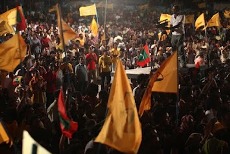
Meanwhile, speaking at the MDP rally tonight Musthafa had dismissed the ruling as “unjust and politically motivated”.

He also vowed for a comeback announcing that he will contest for the same seat in the next elections and win. “Only former President Mohamed Nasheed can defeat me,” he claimed.

Suood says that Musthafa can compete in the bi-election after discharging the debt.

However, Musthafa  insists that he won’t repay the loan, citing deceptions from the food supplier General Meat Ltd.

Musthafa has also threatened legal action against the Maldives Monetary Authority (MMA) in November if it did not pay the US$500,000 that the Bank of Credit and Commerce International (BCCI) owed Seafood International.

Musthafa alleged that the sum was due to be paid to his company according to a 1991 London court ruling.

Citing MMA as the “live branch of BCCI in the Maldives,” Musthafa previously stated that “the debt of a dead person has to be paid by a living legal parent. If the MMA does not pay us within seven days we will sue the MMA in court and when we sue, we will ask the court to take the amount of money for the loss we have had for the past 20 years as a cause of not having this money.’’

The Supreme Court was due to rule on a case against Musthafa on October 20, 2010 however proceedings were interrupted when MDP called for a nation-wide protest against the judiciary during an emergency meeting.

Speaking to Minivan News at the time, MDP MP and spokesperson for the party’s Parliamentary Group, Mohamed Shifaz, said judges had been blackmailed and that the party would protest the politicised judiciary indefinitely.

Amid the government’s attempt to reform judiciary, when Criminal Court Chief Judge Abdulla Mohamed was arrested by military on January 16, the opposition subsequently took up the protest baton and demanded the release of  the judge – whose arrest  set in motion the series of events that culminated into the resignation of former President Mohamed Nasheed on Febrary 7 in what he called was a coup.

Likes(0)Dislikes(0)

Criminal Court dismisses corruption case against Deputy Speaker Nazim

The Criminal Court ruled today that the Deputy Speaker of Parliament Ahmed Nazim cannot prosecuted on charges of defrauding the now-defunct Ministry of Atolls Development, in the purchase of 220 harbour lights worth Rf1.95 million (US$126,000) in 2004.

Minority opposition People Alliance (PA) Leader and MP Nazim, along with MP Ahmed “Redwave” Saleem (then-finance director at the ministry) and Abdullah Hameed, former Atolls Minister and half brother of Gayoom was charged in late 2009 on multiple counts of conspiracy to defraud the Atolls Ministry.

The scam – first flagged in an audit report released in early 2009 – involved paper companies allegedly set up by the defendants to win bids for projects worth several hundred thousands dollars, including the fraudulent purchase of harbour lights, national flags and mosque sound systems.

The prosecution began in late 2009, after police uncovered  evidence that implicated Hameed, Saleem and Nazim in a number of fraudulent transactions.

At a press conference in August 2009, police exhibited numerous quotations, agreements, tender documents, receipts, bank statements and forged cheques showing that Nazim received over US$400,000 in the scam.

A hard disk seized during a raid of Nazim’s office in May 2009 allegedly contained copies of forged documents and bogus letterheads.

Police maintained that money was channelled through the scam to Nazim who laundered cash through Namira Engineering and unregistered companies.

The first count focused on charges that Nazim used equipments and employees of Namira Engineering while he was the company’s Managing Director to submit bids in the name of two companies called Tech Media Service Pvt Ltd and Standard Electric Works Pvt Ltd to provide 220 harbour lights to the Atolls Ministry without the company’s prior knowledge in 2004.

The prosecutors requested the court to recover the money paid to Nazim for the supply on the grounds he defrauded the ministry.

However, during the trial Nazim had submitted six witnesses to prove the companies were aware of the submission of bid and presented Saleem as a witness to establish that the ministry received the 220 harbour lights.

The prosecution meanwhile presented as evidence the police investigation report, cheques issued by the state and bogus letterheads found during a police raid on Namira Engineering in May 2009.

Further, the prosecutors presented employees of Namira as key witnesses to prove they are acting on Nazim’s orders.

However, Judge Saeed Ibrahim today dismissed the testimonies of the prosecutor’s witnesses on the grounds that they were the employees who had prepared the fraudulent bid estimates which were submitted.

Even though the witnesses had told the court that they had prepared the bid estimates on Nazim’s order, the judge concluded that it does not mean Nazim had ordered them to prepare the bids fraudulently.

Judge Ibrahim also argued that the act of asking was not enough to prove criminal intent.

Therefore, in reference to article 51 of the constitution which guarantees the rights of the accused, the judge concluded that the charges cannot be filed against Nazim.

Multiple counts

However Nazim is also facing other counts of fraud for setting up four paper companies to win a bid worth US$110,000 to provide 15,000 national flags for the former atolls ministry in 2003.

In the ongoing case, prosecutors are heavily relying on the findings stated in the audit report, which concludes that the four companies which submitted the bid to the project were connected to Nazim’s Namira Company.

According to the report, the documents of Malegam Tailors, the company which won the bid, show that it shared the same phone number as Namira. Fast tailors, another company that applied also shared a different phone number registered under Namira.

The other company Needlework Tailors that submitted the bid had an employee of Namira sign the documents as the General Manager while the fourth company named “Seaview Maldives Private Maldives” did not have any record of its existence, according to the report.

However, the auditors noted that Searview bid documents had an exact date error found on Fast tailors documents, which according to the auditors prove same people had prepared both company’s bids.

Likes(0)Dislikes(0)

MDP agrees conditional participation in “interim government”

The Maldivian Democratic Party (MDP) has agreed to join an interim government that would pave the way for an early presidential election on the condition that five senior officials of Dr Mohamed Waheed Hassan Manik’s government are removed from their posts.

At a press conference yesterday, Male’ City Councillor ‘Sarangu’ Adam Manik read out a statement from an advisory sub-committee of MDP’s national council outlining the party’s position, which holds that “a government installed in a coup d’etat does not have the constitutional authority to form a national unity government.”

The former ruling party’s national council had passed a resolution on February 8 declaring that it would not recognise the “illegal government” of Dr Waheed.

“As President Mohamed Nasheed always places public interest first, his advice was, given that this problem can only be resolved with the participation of the people, to call for an early election,” Manik explained.

In response to Dr Waheed’s invitation to join a national unity government, Manik said the party considered the formation of such a government unlawful.

“However as the party also believes that the national interest would not be upheld without the participation of the largest political party, the Maldivian Democratic Party, and because this party has also worked in the interests of and for the benefit of the people, the party has informed Mohamed Waheed Hassan Manik that we are ready to participate with conditions in an interim mechanism to be formed to prepare for an early election,” he stated.

The MDP’s condition is for Dr Waheed to dismiss Defence Minister Mohamed Nazim, Home Minister Dr Mohamed Jameel Ahmed, Commissioner of Police Abdulla Riyaz, State Minister for Home Affairs Mohamed Fayaz and Chief of Defence Forces Ahmed Shiyam.

The party contends that the individuals in question were actively involved in the coup d’etat. On the morning of February 7, following the police mutiny, Nazim, Riyaz and Fayaz entered the MNDF headquarters to negotiate with President Nasheed and announced to the protesters that they had demanded Nasheed’s “unconditional resignation” by 1.30pm.

Meanwhile, MDP’s national council convened for an emergency meeting this afternoon and decided to hold a primary to choose its presidential candidate as required under party regulations.

Likes(0)Dislikes(0)

Commonwealth delegation departs, ahead of extraordinary CMAG meeting

The Commonwealth ministerial delegation sent to investigate the circumstances surrounding the sudden transfer of power in the Maldives on February 7 has departed.

The information collected by the delegation will be reviewed and presented to the Commonwealth Ministerial Action Group (CMAG) at an extraordinary meeting to be held in London this week.

The delegation, led by the Minister for Foreign Affairs and Communications of Trinidad and Tobago, Surujrattan Rambachan, gave a brief but vague statement to the media on their departure. He was accompanied by Dr Dipu Moni, Minister for Foreign Affairs of Bangladesh, and Dennis Richardson AO, Australian Secretary of the Department of Foreign Affairs and Trade and former head of Australia’s secret intelligence agency, ASIO.

The objective, Rambachan said, was “to develop a better understanding of the circumstances surrounding the transfer of power in this country earlier this month, as well as to promote adherence to Commonwealth values and principles. We believe we are returning with the enhanced understanding of the situation that we came to seek.”

“We have held detailed discussions with a wide range of stakeholders, including President Waheed, former President Nasheed, the Speaker of the Majlis, the Chief Justice, several political parties, independent institutions, relevant military and police personnel, as well as others. We have also consulted international partners and civil society,” Rambachan said, reading the delegation’s departure statement.

“The Maldives is a valued member of the Commonwealth and the Commonwealth has had a long association with the democratic transition in this country. It will continue to support Maldives in every possible way as it seeks to find a way forward at this difficult time.”

Answering questions, the delegation resisted being drawn into discussion as to their preliminary findings, or their position on early elections, stating that the mission was non-judgemental and that much of the information received was still to reviewed before a report was compiled ahead of the CMAG meeting.

“We cannot pronounce at this stage whether something is illegal or legal, constitutional or unconstitutional,” said Dr Moni. “We have collected information and we really need to sit down and go through it. We came here with a very neutral mind. We will report our recommendations to CMAG.”

Whatever conclusion was arrived at “must be according to the interest of the Maldivian people,” noted Rambachan.

“We had discussions with political parties on the topic of a way forward. Early elections are something people are considering and we have asked for views and opinions. That will form part of our deliberations in London. The wishes of the Maldivian people must be taken into full consideration.”

Likes(0)Dislikes(0)

Q&A: “Silent coup has become the armed coup” – Aishath Velezinee

Aishath Velezinee was formerly the President’s Member on the Judicial Services Commission (JSC), the watchdog body assigned to appoint and investigate complaints against judges. Two years ago she turned whistleblower and alleged the JSC was complicit in protecting judges appointed under the Gayoom’s government, and was colluding with parliament to ensure legal impunity for senior opposition supporters. In January 2011 she was stabbed twice in the back in broad daylight.

JJ Robinson: What do you think of the international community’s initial reaction to the events of February 7?

Aishath Velezinee: I think they fail to see the dynamics behind this country – it is all very personal and based on individuals.

[Maldivians] have a very deep understanding of this – the actors involved. The international community does not. So the international community is taking much at face value, and they are measuring what they see against the standards they hold.

These are not our standards – what I’ve seen in the Judicial Services Commission (JSC) is far below the standards of what you would expect from ordinary people in any democracy. An ordinary person would not act like the duty bearers here have done. It is absolutely unbelievable.

JJ: You have often spoken about a ‘silent coup’ – a collusion between the judiciary, the JSC and opposition-aligned members of parliament to preserve the pliability of the judiciary as it was under former Justice Ministry and President Maumoon Abdul Gayoom. What do you mean when you said ‘the silent coup has become the armed coup’?

AV: The heart of the silent coup was the Criminal Court. The former regime wanted to maintain their influence on the criminal court.

You can see that a number of powerful and influential politicians and businessmen – and businessmen who are politicians – have cases pending against them. This gives reason as to why they would want to keep a hold on the criminal court.

Chief Judge of the Criminal Court Abdulla Mohamed was the man facilitating them to carry on with that, giving cover to the very serious corruption that has been continuing for a number of years in this country. This is highly entrenched corruption – state corruption.

When Abdulla Mohamed went missing – as they say – I believe the opposition feared they were losing control over the judiciary, and that is why they came out on the streets. If you look at the so called public protests, it was opposition leaders and gang members. We did not see the so-called public joining them – they were a public nuisance really.

For nearly three weeks they were going around destroying public property and creating disturbances. It wasn’t a people thing – we can say that. We locals – we know who was there on the streets. There is footage and evidence available of it. We’ve seen the destruction they were causing in Male’ every day.

To the international community it’s a crowd of people – and to them that’s the public. It’s a public protest to them. But it was not.

Then we need to consider who was involved in the free Abdulla Mohamed campaign. These are the same people I have previously accused of covering up and being conspirators in the silent coup. Amongst them was Independent MP Mohamed Nasheed – currently the chair of the parliamentary oversight committee on independent commissions – who has a duty to investigate the JSC.

On 6 February 2012, I finally got in writing from the Anti-Corruption Commission (ACC) their response to my complaints about the JSC in May 2010.

They said that the matter of Article 285 and the JSC’s high treason was forwarded to Parliament for further investigation on 9 September, 2010.

Where is it? We haven’t heard anything of it. So why was MP Nasheed not doing his duty and investigating this? Why was he out on the street campaigning to free Abdulla Mohamed when this question is before him and he needs to look into it? Why was MP Abdul Raheem bragging on VTV – immediately after the national security committee meeting – that he had deliberately disrupted the meeting to prevent me from speaking? It’s a huge cover up.

JJ: Why do you think the international community is unaware of this?

AV: The international community is not fluent in the Dhivehi language. And all of the evidence I have – on tape – is in Dhivehi. I cannot get them to listen to that. All they hear is me talking, and as you know, nobody else has dared to come out publicly and take this up.

JJ: Where does this place you now? Considering you have all this evidence you must have some concern for your safety?

AV: All I have is with the police, the Maldives National Defence Force (MNDF), the ACC, and with parliament. So I don’t know. They could easily destroy it. It’s not being shared with the parliament. I have asked MPs in the independent commissions committee if they are aware of this letter from the ACC – they are not. Since 2010 we have been working with the judiciary whose legitimacy is actually in question.

The issue was not taken up by anybody. The issue of Article 285 and JSC’s high treason was taken up by myself, as a sitting member under oath, and I think that should be enough reason for them to investigate. But the only response I get from people is: “There were 10 people in there. Why just you?”

In a conspiracy where a majority of the people join together to commit a crime, why would they come out and speak about it? High treason was committed in the JSC with the confidence that there would be no investigation.

I believe the Speaker sitting there has been the cover for the JSC to cater to their old masters. They are very confident that the silent coup will remain uninvestigated.

JJ: On paper, the reappointment of the judges in 2010 occurred before parliament had passed the requisite legislation determining the educational, moral and ethical criteria for a judge? Does that not undermine the legitimacy of all verdicts issued after that period?

AV: Article 285 is not tied to any law. It is to prevent politicisation of the judiciary. The JSC is supposed to be working independently as an institution, and although it includes people from various parties – MPs and the Attorney General – each of us had a conduct of conduct under which we were supposed to be impartial. But that’s not how the JSC was functioning.

Everyone assumes because I was appointed by the President that I was colluding with the President. But if anyone bothered to look at the evidence – the recordings of the meetings – they would find the reality is different.

JJ: This evidence you have – are people just not bothering to look at it, or are they unable to do so because of the language barrier?

AV: Nobody has looked at the evidence. It has all been based on weight – nine to one. Woman to nine men. I feel very insulted.

JJ: Some of the visiting media expressed an interest in the situation with the judge and the lead up to the judicial crisis which precipitated these events. But how can you explain that in a two minute soundbite?

AV: You can’t. It is too complex. All of this is very complex and we can’t take anything at face value. We need to access available documentation, and we need people to access the other evidence available. But all the fact finding missions and investigation teams are based on just talking to people.

If you just talk to people, the story you get depends on who you talk to. The facts are the evidence.

People have asked me why I did not take it up with groups like HRCM. There is no place I have not taken it to – and I could not access the international community when I did not even have an office. I was under oath as a JSC member, but the commission put me out on the street to work. I was working like an activist – and alone.

JJ: On the bright side many people must be feeling they should have listened to you a long time ago?

AV: Yes. But it seems we missed the chance to fix it – to fix Article 285.

Now it’s politics that will solve this. In 1957 we had a constitution for seven months. Now we have had one for three years and failed again. We have to do what we failed to do and focus on strengthening judiciary. But when a serious national security issue being examined in parliamentary committee is disrupted and it ceases to continue with investigation, what does it say?

The Maldivian Democratic Party needs to focus on 285. They need to start talking constitution, about how they got into this. They need to back me – I submitted these cases and President Nasheed was still waiting for a response. You can’t run a state without a judiciary – and the judiciary is still under the control of the former regime

JJ: Even if early elections are called, that would not help the judicary?

AV: There is no judiciary as guaranteed to the people under this constitution.

JJ: What do you make of the new Attorney General, Azima Shukoor?

AV: I know her from primary school. We were in the same class until grade 10. I know her quite well – and I also know what she’s been doing in recent years.

I also know Gayoom’s government because I worked in that government for 19 years and six months. I know all of the individual players in this game, very, very well.

Gayoom had this practice of moving around people he found difficult, so I had the opportunity to work in a number of government departments and ministries, and to get to know quite a lot of powerful players in the opposition today. I know how they operate – their modus operandi. I know how they function.

My mistake was to trust. I trusted members of the JSC to uphold the constitution. I trusted the Speaker to uphold the constitution. And where I saw they were acting against the constitution I found it really hard to comprehend. It was happening every day. But I couldn’t believe it until the last moment.

JJ: Where to from here? What do you think happens now?

AV: Article 285 is going to be buried in history. I do not think we have the willingness or capacity in any of the state institutions to fully investigate exactly what happened in the JSC.

But what happened in the JSC must be haunting some of its members, if, months after I was stabbed, they are still discussing in a recorded sitting about how to silence me. On 17 Janurary 2011, two weeks after I was stabbed, MP Dr Afrashim Ali said I was “dangerous”, and the high court appointee was saying “We have to think about our future, our security. We have to silence her.” I have audios clips of that meeting on the 17th. I have the whole 1.5 hour recording – it’s there, you can hear it. A friend helped me do cuts and I have circulated it on Facebook. I put it on YouTube (Part one, two, three).

They fear an investigation because if there is an investigation, what I have said will be proven. All they are betting on is using their political weight to prevent an investigation.

JJ: You are making copies of the evidence?

AV: When Nasheed resigned I put everything away – I have nothing in my home any more. These are probably the only copies we have now.

Considering that the JSC actually tampered with and edited the audio recordings when they submitted them to parliament in 2010, they have shown they will destroy the evidence.

I have copies of audio tapes of proceedings in the JSC during Article 285 – and after. As well as from when their focus was on covering it up.

JJ: It is interesting that they continued to record the meetings, given all the other procedures not followed.

AV: They were not recording meetings when I initially joined the commission. They were working completely unconstitutionally.

The JSC refused technical assistance from the International Committee of Jurists (ICJ) and others. Instead they were themselves talking about strengthening the judiciary. What judiciary was there to strengthen when it was unconstitutionally appointed? It’s actually the people who have lost, not President Nasheed or the so-called President Waheed. The people have lost.

JJ: What do you make of Dr Waheed? Given his UN background and benign demeanour, he seems an unlikely leader of a coup d’état.

AV: He might have thought it was a power grab and that he was the man who was going to lead this. But he may be realising that he too is being played, is a tool of the opposition – of Gayoom’s family. I think he found out too late. He’s either an idiot or a tyrant. Right now it looks like both.

Let’s say President Nasheed did resign under duress. Is it the man who resigns, or is it the government who resigns? If it is the government, then Dr Waheed should be walking out with the President. Then it is the Speaker who takes over for the interim period.

This national unity government should be formed with the Speaker leading it. You can’t have a politician from a party that does not have a single seat in parliament or in a Council, heading a national unity government.

If he would step aside and permit the Speaker to form a national unity government, that would have more credibility. That would also bring this whole situation back into alignment with the constitution.

Right now we seem to be in a gap. We have a man who was put there by the police and military to lead a national unity government. We haven’t seen the public supporters – the so-called people behind him – anywhere. So what national unity government are we talking of here? Just because the cabinet seats a shared across a number of parties, is it a national unity government? No.

I think it is time the Speaker took charge and led a national unity government, and organised elections, and let the people speak again. Just because the international community is upset with Nasheed’s behaviour, doesn’t mean that they should legitimise a government that the people do not support.

We are talking about the government of the Maldives. And that government should be one that the people of the Maldives want and trust.

JJ: There is a lot of public baiting of police officers at the moment. How helpful is this?

AV: Waheed’s first public statement was to praise the police mutineers. How could he?

What happened on February 8 – that peaceful walk – that was absolutely uncalled for. And we haven’t seen anybody talking about it. Not Waheed, nobody. Why was that? What was the reason for such a violent and brutal attack by the police? Why were they picking on certain people? Why did they chase me saying they would kill me? Why?

JJ: The police chased you?

AV: The police, yes. Why did they spray me at close range?

JJ: They pepper sprayed you?

AV: My eyes – I could not open them – it took me 24 hours to clean myself of it. There was a police commander – I was walking in the middle of the crowd. When they chased us I ran with the people. There was this lane – I went in and I think President Nasheed was there. I pulled him by the shirt, then I ran in front and his men came and surrounded him. I passed the shop where he had gone in for cover. Then I came face to face with the police. There was a commander – he screamed out: “That’s the bitch, kill her!”.

Someone stepped in front of me and pepper sprayed me. I grabbed someone running away and said “I’m blinded, they’re going to kill me. Take me, take me.”

Somebody helped me across the street and took me to a safe place.

JJ: Are you concerned for your safety now?

AV: I’m very scared. You have seen their whole approach to my allegations. To deny it – not by arguing over the substance, but by slandering me, and ignoring it. They either slander or ignore.

I’m afraid that considering their approach, they are not going to make a big deal of taking me to court and trying me. They will find other ways of silencing me. It was scary.

This is not about Nasheed or Waheed. It is about the constitution. I really wish the international community would see beyond the obvious. What the opposition is afraid of is separation of powers, and the institutuion of a democracy. It is not Nasheed – Nasheed they can defeat in an election, if they have the people power. But they are afraid of a democratic system where they cannot carry on high level corruption, where they cannot control the judiciary or the independent commissions – and the media. That they fear.

A lot of the younger politicians who have played different roles in covering this up I don’t think are aware of the depth and dirtiness of this coup. It sounds like a conspiracy novel – but it is reality. And people are finding it hard to believe becasue of that.

JJ: To what extent is this about people power? What happens if police or the army are given an order they don’t want to comply with?

AV: I don’t think Waheed is controlling them. We’re seeing [Defence Minister Mohamed] Nazim – Nazim is from the National Security Service (NSS) of before [under Gayoom]. The police and the military were separated in 2005. Nazim is pre-2005. Nazim probably controls the police though [Police Commissioner] Abdulla Riyaz, while he controls the MNDF. Jameel’s role, as Home Minister, is the judiciary. He is the former justice minister. He knows individually all the sitting judges – he wrote the handouts they learned from.

JJ: Do you think people played politics too long with the judiciary – including the MDP side? People are asking why, if this was the issue, Nasheed did not act earlier?

AV: He would know. For one thing I think it was very difficult for him when his own Attorney General [Husnu Suood] was not taking up the matter. Suood was sitting in the JSC with me. But it was only me and Sheikh Shuaib Rahman – the member appointed from among the general public – who went to the ACC.

The Attorney General removed himself from the JSC at the time. I think he realised the politics of it, and took the safe road.

I put myself in danger, taking this up, knowing quite well the politics behind this. But I didn’t feel I had a choice. I was required as an office bearer under oath to work in the interest of the people and the constitution. And my interest in bringing it out to the public was to give them a chance to get their judiciary.

JJ: Will things get worse when the international media and the diplomatic community move on?

AV: Everyone is going about their daily business and to the outside world it looks normal. But the moment they leave, I believe we are in danger.

It is scary – the hatred. These men – the men in action on the 8th – it was their emotions that came out. This was something they carry inside. The hatred. What I fear is that it seems like the police, since their mutiny, can act with impunity. Individual police officers can take up their own greviances against individuals with impunity.

JJ: Do you think the military is in a similar situation?

AV: No, I think the military have largely managed to keep themselves outside the politics. But the leadership of today – which we see has not gone according to rank – is politicised, and part of the conspiracy.

JJ: Have you considered moving somewhere safer?

AV: I don’t see a real solution to this. I think I owe it to people to write this down. I should seriously sit down and write. But it is too heavy at the moment; being amongst events here and the people, fearing for my own safety, I cannot comfortably sit down. But I need to write the story of the silent coup – of how the constitution has been killed without changing a single letter. They have managed to commit high treason under the cover of the constitution.

Today we are in a far more dangerous situation than we were pre-constitution 2008. Then everyone knew it was autocracy, and that all the powers of the state were constitutionally given to one man. Today it is taken at face value that there are separation of powers.

I have policemen bragging on my Facebook page: “We brought down this government. Next time we see you in a rally we are going to kill you.”

Policemen on Facebook. They don’t seem to mind doing it publicly. Before they might have been more subtle – now there seems to be no order at all.

JJ: While the new government is seeking to establish its legitimacy – and the resorts are losing money – do you think there is risk of further crackdowns?

AV: There is no public support for government. And the international community wants to legitimise it. I would like to see Dr Waheed hold a rally, with his 12 parties. Let’s count numbers.

Likes(3)Dislikes(0)

Two MNDF, two police officers resign to join MDP protest

Two officers each from the Maldives National Defence Force (MNDF) and Maldives Police Service joined the ongoing Maldivian Democratic Party (MDP) demonstration last night after resigning in protest of the security forces’ role in the change of government on February 7.

The four ex-officers – Staff Sergeant Shafraz Naeem and Fire and Rescue Lance Corporal Mohamed Imram from MNDF, along with Staff Sergeants Imran Abdulla and Mohamed Niyaz from the police – were introduced to the cheering crowd shortly after midnight by former Housing Minister Mohamed Aslam as “honourable and patriotic sons of the Maldives.”

The four officers were “not alone” in their decision, said Aslam, insisting that a number of officers in the police and army were “of independent thought.”

Speaking after Aslam, former Defence Minister Ameen Faisal urged protesters to stop harassing and taunting security personnel with chants of’ “Money, money, yes sir!” as “only a few officers” participated in the police mutiny demanding President Mohamed Nasheed’s resignation in the early hours of February 7.

Former Youth Minister Hassan Latheef meanwhile suggested changing the slogan to “Money, money, no sir!” in recognition of the officers who resigned.

President Nasheed and members of his cabinet took to the stage to shake the ex-officers’ hands while the crowd saluted them.

The army has since issued a statement contending the two officers had not resigned and were absent without leave (AWOL). According to MNDF, the pair also had a history of disciplinary problems and administrative action had been taken against them.

Day three

Meanwhile the MDP’s mass protest demanding a date for an early presidential election entered its third consecutive day today, with more boatloads of supporters continuing to arrive in Male’.

Protesters from Thaa Madifushi swam ashore after 4:00pm today claiming they were not allowed to dock at the harbour while a large vessel from Haa Dhaal Kulhudufushi arrived this morning.

Addressing the gathering after midnight on the first day, President Nasheed urged supporters to “not do anything apart from expressing merriment.”

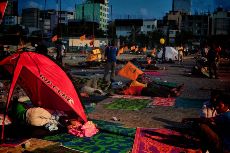
A number of protesters spent the night at the tsunami memorial area while the protest resumed the next day with a carnival atmosphere. Volunteers cooked rice with sausages while a children’s evening was arranged in the late afternoon.

On the second night, bodu beru (traditional Maldivian music) groups and local musicians entertained the crowd with improvised songs taunting the police. Among the performers were Sameeu, Fasy, Shiuz and musicians associated with the Dinba family.

Police have meanwhile told local media that the institution would not attempt to obstruct the gathering as long as it remained peaceful.

Speaking for a few minutes after 5pm today, President Nasheed said what was at stake was the freedom of future generations.

“One of the main reasons we can’t stay home indifferent is because we are very much assured in our hearts that there would be nothing more important for us to do than this after giving up our future,” he said.

Likes(0)Dislikes(0)

President Waheed appoints housing, environment ministers

President Dr Mohamed Waheed Hassan has appointed Sheikh Mohamed Shaheem Ali Saeed as Islamic Minister, and Dr Mohamed Muiz as Environment Minister.

Former President Maumoon Abdul Gayoom’s daughter, Dhunya Maumoon, was also appointed State Minister for Foreign Affairs.

Sheikh Shaheem was ranked one of the world’s top 500 most influential Muslims in 2010 by the Royal Islamic Strategic Studies Centre (RISC) in the Kingdom of Jordan.

He resigned from his post as State Minister of Islamic Affairs under former President Mohamed Nasheed’s government, in December 2010.

His resignation followed the burning of the Israeli flag in Republic Square over opposition to a visiting delegation of Israeli eye surgeons, whom Islamic NGOs had accused of coming to the Maldivies to illegally harvest organs. Shaheem was one of the speakers at the event, along with current Vice President of Gayoom’s Progressive Party of he Maldives (PPM), Umar Naseer, voicing anger at the acceptance of aid from Israel.

Former Press Secretary for Nasheed, Mohamed Zuhair, told Minivan News at the time that in light of a recent number of protests against government policy allegedly involving Shaheem, “it was possible that the State Minister may have decided his position was untenable”.

Sheikh Shaheem was subsequently employed as a lecturer at Villa College, owned by Jumhoree Party (JP) MP and resort tycoon Gasim Ibrahim.

Shaheem has been an outspoken proponent of the study of comparative religion at higher secondary level, stating that “it is important for both Muslims and non-Muslims to compare their religions and cultures, and to compare philosophies.”

However he also warned against a move by the Education Ministry to make Islam and Dhivehi optional at higher secondary level.

Presenting himself as the face of moderate Islam in the Maldives, in early 2010 he became the first Islamic scholar from the Ministry to visit the UK with a government delegation.

He attended discussions on counter-terrorism with a range of relevant authorities, including the Foreign and Commonwealth Office, Cabinet Office, Home Office and heads of counter-terrorism in the Justice Ministry, and met with Abbas Faiz of Amnesty International.

“The main objective was to discuss rapidly growing concerns around extremism and terrorism with relevant stakeholders in the UK,” Shaheem told Minivan News at the time: “There was a lot of discussion on ideas, such as how to fight ideologies and radical ideas. It was a very nice trip.”

More recently, he was accused of sexual misconduct in a video broadcast by Raajje TV, although the allegations were never clarified as Raajje TV claimed the station could not release further footage “in the interest of public decency”.

Shaheem responded at the time that he did “not wish to comment on matters regarding my private life while I am waiting for evidence. I will issue my comment when the time is appropriate.”

Cabinet appointments

All but a few of the cabinet ministers remain to be appointed by President Dr Waheed, and will need approval from parliament when it resumes on March 1.

The Maldivian Democratic Party (MDP) has accused Dr Waheed of replacing the cabinet with mostly Gayoom supporters and senior opposition figures, particularly to the positions of Defence Minister (Mohamed Nazim), Police Commissioner (Abdulla Riyaz), Youth/Human Resources Ministry (Mohamed ‘Mundu’ Shareef, Gayoom’s spokesperson), Attorney General (Azima Shukoor, Gayoom’s lawyer), and Home Minister (DQP member Dr Mohamed Jameel).

Dr Waheed has dismissed the claims as misleading, saying that “Anything other than President Mohamed Nasheed’s government is now being painted as the old government, as a return to the old regime. In this country most of us grew up and got education during the last 33 years, and most of the well educated people in this country worked in government. The government was the biggest employer in the country and continues to be so.

“Therefore don’t be surprised that some people served in President Gayoom’s government. That doesn’t mean that anyone seen in the last 33 years has allegiance to a particular person. This is a very narrow way of looking at it. If you look at cabinet you can see I have been very careful in my selections.”

Likes(0)Dislikes(0)

Three injured, one dead in stabbing attacks

One person is dead and three were injured following a series of stabbings in the Maldives capital Male’ last night.

A 21 year-old man, identified as Abdul Muheeth of G. Veyru, was rushed to Indira Gandhi Memorial Hospital (IGMH) after he was stabbed at 1:45am near the Finance Ministry building. He later died during treatment.

A second victim, a 43 year-old man, was also attacked at 1:45am by two men on a motorcycle.

A 17 year-old man was also seriously injured after he was stabbed at 7:40pm, and is being treated in IGMH.

The fourth stabbing victim was a Sri Lankan man who was also attacked by two men on a motorcycle.

“Police are trying to find out how this happened,” said Police Sub-Inspector Ahmed Shiyam.

“There have been no serious stabbings for a long time and all of a sudden this happened in one night. We are trying to determine the motive behind it.”

A spate of stabbings in early 2011 that resulted in the deaths of several young men were blamed by police on gang related activity. Following a police crackdown, relatively few violent attacks were reported for the remainder of the year.

Shiyam said it was too early for police to determine if last night’s stabbings were gang related, or connected to the ongoing political turmoil in the country.

No arrests have been made so far, although police have seized a motorcycle in connection with the investigation, reports local media.

Likes(0)Dislikes(0)

EU targets judicial reform discussions with President Waheed

The European Union has said it will continue trying to work with Maldivian authorities to reform the country’s judiciary following requests for assistance made by Mohamed Nasheed “shortly” before Dr Mohamed Waheed Hassan became president this month in an alleged “coup d’etat”.

Nasheed was replaced by his Vice President Dr Waheed after “resigning” his presidency on February 7 – a decision he  later claimed had been forced upon him by opposition figures  and security forces unhappy, in part, with his commitments to reform the nation’s judicial system.

A spokesperson for Catherine Ashton, the Union’s High Representative for Foreign Affairs, has said the bloc now hoped to open discussions with Dr Waheed’s government over judicial reform on the back of concerns raised by former President Nasheed about the conduct of the nation’s judges.

“Shortly before the events of February 6 to February 7, we were asked for assistance [with judicial reform], as were the UN and Commonwealth. We were ready to look into this matter and hope to discuss the matter further with the Maldivian authorities,” added the spokesperson for High Representative Ashton.

“The HR/VP’s spokesman has already reiterated the importance we attach to the correct functioning of the democratic institutions in the Maldives; we had previously offered the Nasheed government support under the Development Cooperation Instrument for the improvement of governance across the board.”

The country’s judges and their conduct became a major focus for President Mohamed Nasheed in the run up to him being replaced by Dr Waheed earlier this month.  Nasheed had raised concerns over allegations of perjury and “increasingly blatant collusion” between senior judicial figures and politicians loyal to the former autocratic President, Maumoon Abdul Gayoom.

However, Nasheed came under criticism from some international bodies after detaining the Chief Judge of the Criminal Court, Abdulla Mohamed.  The former president claimed the detention was designed to prevent the judge from sitting on the bench whilst charges against him were investigated.

Last year, the International Commission of Jurists (ICJ) unveiled findings suggesting that the Maldives’ legal system was failing to serve its citizens despite many “positive developments” that have been made in an effort to depoliticise the courts; with many of judges found lacking in qualifications and independent attitude.

Catch-22”

Nasheed’s government had eventually consulted international organisations like the UN, the Commonwealth and the EU after describing itself in a “Catch-22 situation” in terms of a lack of mechanisms to investigate the judiciary independently. In November, the national court watchdog, the Judicial Service Commission (JSC), was ordered to cease an investigation into Judge Abdulla Mohamed by the civil Court under an action he himself instigated.

Amidst the violent upheaval and pro-government and anti-government protests that have taken place since President Waheed came to power, the EU has said the issue of the country’s judiciary was among a number of concerns foreign governments wished to investigate in light of the transfer of power.

Judicial interference

In an interview with local and foreign media on Friday, President Waheed confirmed that Judge Abdulla Mohamed had taken a month’s leave from his post for “personal issues”, but did not elaborate whether he had been reinstated to the bench.

“It is for the judiciary to decide what to do with him, not for me. I don’t want to interfere in the judiciary. I want our constitution to be respected, and work with everybody to make our constitution work. This is a new constitution, and it is the first time we are trying it out. And so there are difficulties in it,” the president claimed.

“We need to find ways of solving it. It is time for us to work together, and if there are problems with the judiciary we need to work together to solve them – they are intelligent good people in the judiciary and the Judicial Services Commission (JSC). We welcome assistance from the Commonwealth and United Nations to develop programmes and build the capacity of the judiciary.”

EU position

While currently preparing an official statement on the main concerns the EU holds over the ongoing political disputes facing the Maldives, the spokesperson for High Representative Ashton said the bloc hoped to see more consensus by rival political groups including the MDP to move forward democratically.

“It is essential that the business of government can continue and that multi-party democracy and the constitutional checks and balances are preserved,” the spokesperson added. “The army and police should exercise maximum restraint in the execution of their duties which must remain strictly within their constitutional mandate. Further violence must be prevented.”

The spokesperson claimed that the EU continued to support calls for an impartial investigation to ascertain whether President Waheed came to power legitimately or under a “coup”, though provided no details of how this may be achieved within the country’s highly partisan political arena.

“The EU supports an impartial investigation on this. In the mean time we hope there is a general understanding, following our Heads of Mission (HoMs’ ) visit to Malé, that all parties, including Mohamed Nasheed’s party, the MDP, need to cooperate to prevent the country falling victim to political factionalism, which can only lead to further unrest,” the spokesperson added.

In a statement released earlier this week by the European Parliament’s Delegation for relations with South Asia, “deep concern” was expressed by the group’s chair Jean Lambert over a “sword of Damocles” he said was hanging over ousted President Mohamed Nasheed.

“The European Union had deployed a team of experts to observe the first democratic Presidential elections held in the country in 2008; a sword of Damocles now hangs above the winner of these elections, with his arrest warrant already issued on unspecified grounds,” said a statement from Lambert.

“We understand a number of MPs and local councillors have also been detained or are in hospital following continued police violence,” Lambert added, further noting that several EU countries have issued travel advisories for the Maldives as “public resentment and violence are now spreading well beyond the capital.”

Since the statement was made, Dr Waheed has denied setting a deadline for the MDP to join with other parties in forming a “unity” government up until the next general election presently scheduled for 2013.  The MDP has maintained it’s belief that Dr Waheed’s government is “illegitimate” and called for power to be transferred to the parliamentary speaker ahead of early elections.

Likes(0)Dislikes(0)