Comment: Death penalty for infanticide is infantile

Among the many paths in life that lead a woman to kill her newborn baby, it is never this: one day she wakes up with an overwhelming urge to kill.

In order to satisfy that urge, she goes out and seduces/forces a hapless, innocent man to have sexual intercourse with her and to impregnate her. Still with the ultimate end-goal of killing in mind, she covertly carries the baby inside her. After nine-months of ingenious methods of hiding her ballooning figure from all eyes, she gives birth in perilous conditions without any medical attention.

Finally, she experiences the pleasure of killing which she had anticipated and meticulously planned for nine long months. And with immense gratification, she reaches out and makes sure her baby’s first breath is also its last.

Infanticide is not a new phenomenon – cases of it have been recorded from the time human records began, and research has shown a myriad of socially-generated causes behind the offence. Rates escalate in patriarchal societies where women are regarded as second-class citizens, and where crimes against women are on the rise. A recent report published by TrustLaw Women, an online organisation that offers free legal assistance to women, shows that infanticide is a common marker among countries that offer the worst environments for women to live in.

What is driving our women to such desperation? We do not know for sure, because we have invested neither time nor effort to find out. Crime statistics, however, give more than just a hint.

The thin line between perpetrator and victim

Police statistics for 2010 show over 500 sexual offence cases and 299 arrests for the same. By April this year, 58 cases of sexual offences had already been reported to the police.

In the last few months, Minivan News has reported on a whole range of random violent sexual offences against women from gang rape to rape of a 74 year-old. Added to these are less random rapes and sexual assaults occurring closer to home that run the whole gamut from decades-long sexual abuse of daughters by fathers to the attempted to rape of a mother by her son.

In the latest case, reported last month, five men are alleged to have raped an 18-year-old girl in Laamu Atoll Maabaidhoo. Her mother found her after two hours of searching, slumped under a coconut palm, her clothes in tatters and unable to walk from all the injuries the men had inflicted on her.

In March this year, a gang of 15 men abducted, drugged and raped a 20-year-old woman on the island of Hithadhu in Seenu Atoll. They recorded their vile acts on a mobile phone, for post-rape pleasure. Yet, as a coalition of NGOs highlighted recently, ‘not a single case of ‘rape’ [was] in the statistics maintained by either the PG [Prosecutor General] or the Criminal Court’.

Why? Rape is not a crime under our current Penal Code.

We live in a society where years of ‘religious’ preaching and traditions that have refused to bow to the winds of progress have taught women to accept it as their due to be beaten up by husbands for perceived marital transgressions.

Seventy percent of our women believe this to be the case. One in every seven secondary school students are sexually abused, according to an unpublished 2009 report by UNICEF, a vast majority of them girls. A Gender Ministry report in 2007 found that over 12 percent of Maldivian women between the age of 15 and 49 are sexually abused as a child.

The situation is worse for girls in Male’ than elsewhere, where more than 16 percent of girls under the age of fifteen are sexually abused. This means that of every 100 girls you walk by on the streets of Male’ and its auxiliary islands, 16 have suffered sexually at the hands of a man. How many of these offences end up in unwanted and enforced pregnancies?

Some of the girls are in a position to travel abroad for abortions – and yes, whether we like it or not, it is happening; and it will continue to happen.

Refusing to see that this behaviour is not merely a sin, but also a social issue that affects every human society, does not make it into a religious problem alone with only the harshest of religious solutions. Those who cannot have their unwanted babies surgically removed, resort to dumping them somewhere, drowning them, or subject them to worse forms of mutilation and death. These girls/women need help.

Capital punishment is not a deterrent as evidence from various countries where it is in force has shown. The fate of previous perpetrators would be the last thing on the mind of a woman about to commit such an act. If she were capable of rational thought during those desperate moments, killing a baby would be the last thing she would do.

Immaculate conceptions?

The learned men at Adhaalath see only one reason for the rise of infanticides: the “rising popularity of fornication“, and have called for the death of mothers guilty of the crime. It is not sufficient that some of the women have been jailed for life while the men, who must surely have been involved, have walked scot-free.

Without the existence of a crime defined as ‘rape’, it is easy to categorise every such brutal violation of a woman as ‘fornication’ – the type that is only ever ‘popular’ among depraved, misogynistic men who seem to view preying on vulnerable women as a popular sport. By calling for the death of the women who become victims of such men while remaining wholly silent on the men themselves, the ‘scholars’ at Adhaalath are encouraging such behaviour among the men.

And, by taking such a stance on this pressing social concern, Adhaalath is making itself not just a misnomer, but is turning a blind eye to its own slogan proudly displayed on its masthead taken from Surath An-Nisã (The Women): ‘Allah commands you […] that when you judge between people, you judge with justice’ (4:58).

Criticism of Adhaalath’s views, and that of other religious bodies in the country, do not always arise from ‘mad secularists’, as is their constant accusation. Nor is criticism of these views meant to suggest that religion has no role to play in our society. It does; and there is much Adhaalath and other such institutions can do.

Why not preach against rape in their Friday sermons when they have the ears of most of the country’s male population within their reach?

Why not speak then of the respect with which Islam says women are to be treated?

Why not drive the point home that at least 50 percent of the blame [in cases where the conception arose from consensual activity] lies with the men?

Why not repeat the message until it penetrates through the thick haze of misogyny that seem to envelop many among them that women have not been put on this earth for their depraved ‘pleasures’, sexual or otherwise?

Adhaalath, and other religious bodies, could also use their proven ability for fundraising to raise money for proper research into the rising problem of infanticide.

Or to help boost the adoption programme under Islamic teachings that the Gender Department has been trying hard to get off the ground. Or perhaps to provide funding for a shelter for abused young women or a safe place for young girls turning to juvenile delinquency. None of them have proper care; none of them have a place to go. The buruga may cover, but it does not shelter; and being covered up is not the same as being protected.

There are many different ways to help, and many ways that Islam obliges its followers to help those in need; but they can only become clear when the dogma is put aside and room for reason made.

No doubt the next ‘religious’ edict calling for the death of yet another disturbed or disadvantaged group in society would be prefixed with the customary Bismillah. If only, instead of repeating it like some meaningless chant, a moment is taken to consider its meaning: ‘In the name of Allah, the most compassionate, the most merciful…’ Wither the compassion, Adhaalath?

All comment pieces are the sole view of the author and do not reflect the editorial policy of Minivan News. If you would like to write an opinion piece, please send proposals to [email protected]

Likes(1)Dislikes(0)

MIRA concedes profit tax challenges following door-to-door push

The Maldives Inland Revenue Authority (MIRA) has taken a door-to-door approach in trying to prepare Maldivian enterprises for the introduction of a new Business Profit Tax (BPT) that comes into effect on July 18.  MIRA says informing and registering every national enterprise in the country under the scheme will be a considerable challenge.

The BPT is to be charged to all businesses operating in the Maldives,that makes a profit  of more then Rf500,000 (US $32,425).  The tax will be a first for companies operating in the Maldives, a country that launched a similar 3.5 percent Tourism Goods and Services Tax on all travel industry income as of January 1 this year.

Business owners and industry representatives, while said to generally welcome direct revenue in the country, have called for a gradual introduction of financial reforms like the BPT, which are being sought by the government to balance national budget deficits and protect smaller enterprises.

Under the present BPT system,  businesses that make a profit of more than Rf500,000 (US$32,425) will be asked to pay 15 percent of their earnings to the state.  This sum will effectively rule out small businesses operated by individuals and places  like corner shops that mainly caters to the local residents from having to pay BPT.

Moomina Abdul Sattar, 49, who runs a small tailor service, is one such businesswoman.

“I don’t have to pay the BPT tax; it is applicable only for those who make a profit of more than Mrf 30,000 (US $ 1945) a month,” she said.

Sattar added that she had previously attended an information session held by MIRA and was not therefore concerned about the tax as it does not affect her operations.

“My income per month is around Mrf 15,000 (US $ 973), from this I have to pay the salary of my three tailors,” she said.

Nonetheless, Sattar added that she still wasn’t aware that registration of her business was required by MIRA, even after attending the meeting.

For other businesses in the country, beyond the registration process itself, BPT is still expected to provide a significant challenge, at least in the short-term.

“We are not fully ready for BPT, but we are taking it positively,” said Ibrahim Hameez, Managing Director of Ryan Pvt Ltd. A design consultancy firm, Ryan has about 40 employees and would be seen as a medium and growing business.

“A lot of things that affect businesses were introduced this year, pension scheme, BPT, Income tax,” he said.

Hameez added that it was the timing of the introduction of taxes that posed a problem. “If we had known one year in advance, it would have been better. At the end of last year, we had not foreseen and planned for all these expenses in our cash flow for this year.”

The BPT Act was published in the government Gazette on 18th January, with the tax to come into effect 6 months from the date of publication.

Despite the problem of timing Hameez believes taxation is a good thing.  “BPT is going to be tough to adjust to, but we can and we will.”

Business of all sizes

As part of the act’s requirements, businesses of all sizes, including small and medium enterpises have to be registered with MIRA. This is a first for the Maldives, where small businesses run from home have generally not had to register themselves in the country.  

MIRA says they are having great success in their door to door campaign to spread awareness.

“The response from the public has exceeded our expectations, people are very cooperative and even fill up the forms for registration on the spot most of the time” said Fathimath Rasheeda, Director of Tax Payer Education and Facilities for MIRA.

 Landlords had also previously been exempt from having to register their operations or interests.  It is these type of earners that Rasheeda has said have been the target audience for its door-to-door campaign.

“As a society we don’t tend to think that renting places, giving tuition, or selling sliced arecanuts are doing businesses,” she said.

Until this month, individuals or partnerships running small businesses like making short eats or cakes from their homes had only been required to get permission from the Ministry of Health to operate.  Similarly, anyone renting accommodation, no matter the size, had not been required to register their property unless the place in question was to be used as a shop.

“Even a person renting out one room for Mrf 2000 (US $130) or teaching a small Quran class should register. But we will be taxing only those who earn more than 500,000 (US $ 32425) annually as profit,” said Rasheeda.


Challenges and Penalties

Alongside businesses, MIRA also has its own concerns over such a large scale operation being conducted for the first time.

“This is a big challenge for us also, as this is the first time a lot of businesses in Maldives would be registered,” she said.

MIRA’s 70 staff will be participating in an awareness campaign set for next Saturday. While next week the campaign will be taken to the islands.

“Due to lack of resources we cannot cover all the islands, but the city and island councils have been very helpful and have helped register the businesses in the islands,” Rasheeda added.

Among the challenges faced by MIRA will be taxing businesses that had never before declared their revenues publicly.

In addressing this potential difficulty, Rasheeda added that the BPT would operate like taxation systems in most other countries, where “individuals and businesses have to declare on their own the profits they make.”

The audit department of MIRA is expected to conduct a risk analysis to prioritize the first businesses it will audit to ensure the system is being adhered to.

“We hope to audit all the businesses within a five year period.  Those businesses and individuals eligible to pay taxes will be asked to file a tax return annually,” Rasheeda added.

The penalties for enterprises omitting or filing false tax returns will include fines of up to Rf100,000 (US$6,485), six months to two years of house arrest and imprisonment or banishment, as per the BPT act.  Rasheeda added that “if businesses or individuals fail to pay their taxes, aside from the wide ranging penalties, we can also seize their property in order to get the amount owed to the authority.”

Likes(1)Dislikes(0)

Dengue hospital situation “stable”, despite high patient demand

Hospitals in the capital have said they continue to screen significant numbers of patients for dengue fever, yet claim that the situation remains “stable” as authorities raise fears that an ongoing outbreak of the virus may be more persistent than originally thought.

As officials today confirmed that a 41 year old man from Addu Atoll had become the eighth person to have died during the latest dengue outbreak, health care representatives in the capital have said that they remain “busy” dealing with cases and had not yet seen significant declines in patients coming through their doors suspected of contracting the virus.

After declaring this week that the current outbreak of the virus around Male’ and several islands was being treated as an “epidemic”, the government has since established a task force to try and coordinate its ministries, the military and NGOs in preventing further spreads of dengue. The task force was originally budgeted to run for seven days, by which time the situation was expected to be under control.

However, upon admitting yesterday that the suspected number of dengue cases in the country had slightly risen after a perceived fall in infection rates earlier during the week, a media spokesperson for the task force suggested that the operations were now likely to run beyond the original seven day time-frame.

Meanwhile, for hospitals on the front-line of dealing with the “epidemic,” the Clinic, a Male’-based private hospital, has said it has been busy collaborating with the task force in trying to identify infection cases.

A spokesperson for the Clinic, which begun offering free dengue fever screening services on Tuesday (July 5), said it was continuing to receive a steady number of patients looking for dengue testing and had been working to the emergency protocols recently imposed by the government.

“At the moment I don’t think we are seeing the number of patients [with suspected dengue] going down,” she said. “From the first day [of the screening service], we have received large number of pediatric enquiries regarding dengue infections among children, though adults are coming for testing now in large numbers.“

Panic fears

The Clinic spokesperson revealed that the medical centre remained concerned about the impact panic was having on the general public.  She said this this concern reflected the limited amount of knowledge about the symptoms and severity of dengue fever within Maldivian society as a whole.

“Trying to create knowledge [about dengue] among the public is one of the main challenges we are facing. People who may have symptoms are sometimes sitting at home and relaxing trying to overcome the fever, which means that some cases of the virus are being missed,” she said.

“Dengue fever has to be better managed by people. Members of the public with the virus need to take more fluids, but they are lacking awareness of this.”

The spokesperson added that the Clinic was currently working to put together a leaflet that she said would try and provide more details about the virus.  During the current panic over dengue infections, the Clinic spokesperson suggested that some members of the public were staying at home instead of coming to be checked.

Despite concerns that the public may begin inundating hospitals beyond their capacity as a result of panic over the virus, Cathy Waters, Chief Executive of Male’s Indira Gandhi Memorial Hospital (IGMH) said that increased patient numbers were to be expected during an outbreak like that presently taking place in the country.

“We have seen a lot of children being bought in by relatives because of the virus. I think that some panic is to be expected as people are concerned about dengue, but the situation is definitely stable here at the hospital,” she said. “I think the message has got out about the virus and its symptoms and people are responding to this.”

In trying to treat patients found to be suffering from the effects of dengue, Waters said that the hospital had moved to adapt additional wards and services to dealing specifically on trying to deal with the ongoing dengue outbreak, yet she added that the overall situation was under control.

“At the moment we would describe the situation as relatively stable, but definitely very busy here,” said the hospital chief executive. “We have set up an additional fever clinic, which means people can be seen relatively quickly for testing and then be given the necessary treatment.”

Waters added that the current dengue situation had required the hospital to develop contingency plans to allow for the provision of increased bed capacity as well as bringing in additional nurses to cope with demand.

The hospital chief executive said that this had in certain cases meant that some surgeries had to be cancelled to accommodate dengue testing and treatment, a situation that would continue to be reviewed regularly to ensure patient demands were being met as best fitted the situation.

The government taskforce has said that it is expecting to address members of the media concerning the latest developments later this evening.

While pledging to support efforts to try and cut dengue infection rates in the country, opposition politicians have been critical of the speed by which the government has responded to the present outbreak.

Ibrahim ‘Mavota’ Shareef, Spokesperson for the opposition Dhivehi Rayyithunge Party (DRP), saidthat he believed that the government had “bungled” their response to trying to control dengue fever.

“From what we have seen the government is just not doing enough. We don’t believe they have been willfully negligent, but there has been negligence in their approach [to dengue outbreak],” he claimed. “They have not responded fast enough, which could be inexperience on their part. But I think this will be a wake-up call for them to change policy in dealing with these type of situations.”

Likes(1)Dislikes(0)

Cabinet consultations continue over hospital upgrade plans

The cabinet is working to finalise proposals for upgrading Kulhudhuffushi Regional Hospital and Addu City Regional Hospital in order to match the services provided at Male’s Indira Gandhi Memorial Hospital (IGMH) and better meet the challenges facing the country’s health sector.

The Ministry of Health was not able to detail the exact nature of these proposed upgrades when contacted by Minivan News, but said discussions would continue in cabinet over the next few days regarding the “improvements” required to the hospitals and the wider health sector.

According to the President’s Office, a steering committee of cabinet ministers has been drawn up to try and outline the direction of the hospital upgrades and identify present shortcomings within the country’s health services.  Efforts for combating the spread of dengue fever are also said to be a part of the discussions.

Likes(0)Dislikes(0)

Comment: Dengue fever, a problem for everyone

Although the MNDF has been drafted in to help combat the problem of dengue fever that is affecting Male and several other atolls, it is important that people don’t stand back and think that this action alone will solve the problem.

Experience in many other countries has shown that a ‘top-down’ or vertical campaign against dengue fever is only part of the solution to preventing outbreaks of the virus from getting worse.

Most people know that dengue fever is spread by a mosquito that takes the blood of an infected person. The blood contains a virus that causes dengue fever and this is passed on to a new person when they are bitten in turn by the mosquito. The mosquito seems fine – but people infected by the virus may become very seriously ill and a small proportion may die.

Most action to prevent the spread of dengue fever is aimed at the mosquito itself. If the mosquitoes are stopped from breeding then the transmission of the dengue virus from person to person will be interrupted and no new cases will occur. Often the strategy against the mosquito relies on spraying chemicals and treating water storage containers. But without having fully integrated community involvement, this strategy has failed almost everywhere in the world that it has been tried. The mosquitoes will always find ways to outwit their human adversaries unless locally tailored eradication programmes are implemented.

Community involvement is key to the success of the eradication programme and every member of the community should be involved in understanding the problem of controlling the mosquitoes (vector control). Within each community the local community leaders should be involved in forming a dedicated steering committee that can create formal task forces or community working groups that will undertake environmental management. The working groups will need to know in detail exactly what they are supposed to be doing and precise training sessions need to be organised. Every locality is different so each community task force needs to identify the exact local conditions in which their mosquitoes will be breeding. Precise local knowledge is the most important resource for beating the disease. In particular waste water needs to be evacuated efficiently; water pipelines and water storage containers must be protected and communal waste collection improved.

A research programme in Cuba compared the usual ‘top down’ ways of combating dengue fever with a community activist approach as described above. They found that the community based environmental strategy was much more effective that the usual eradication programme. You can read more about this research on:

http://www.bmj.com/content/338/bmj.b1959.full

Garbage: a special problem throughout the Maldives

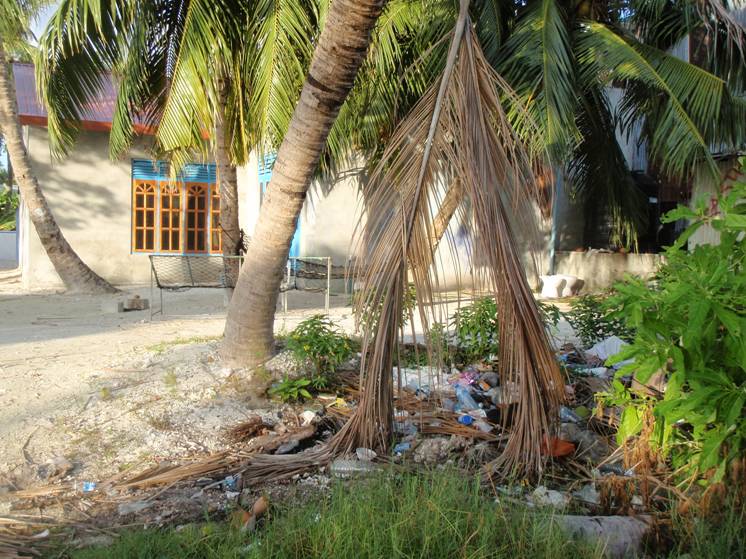
The mosquitoes love little collections of water. When I was in the Maldives as a volunteer for the Friends of Maldives health programme I noticed that outside almost every house there is a little collection of garbage. This includes plastic drink containers, tins, discarded tyres, containers and invariably a pile of half coconuts. These are ideals breeding sites for the mosquitoes that carry dengue fever. Unless each and every one of these piles is cleaned up, dengue fever will continue to be a problem throughout the Maldives in urban and rural areas.

Mosquitoes love the little collections of water that form in garbage piles.

Dr Tom Heller is a Senior Lecturer in the Open University’s Faculty of Health and Social Welfare.  He has previously visited the country as a medical volunteer for the UK-based NGO, Friends of Maldives.

All comment pieces are the sole view of the author and do not reflect the editorial policy of Minivan News. If you would like to write an opinion piece, please send proposals to [email protected]

Likes(0)Dislikes(0)

Maldives customs reveal million rufiya heroin haul

The Maldives Customs Service has said it last month foiled a “major” attempt to smuggle Rf1 million worth of heroin int0 the country after 100 packets of the drug were found to have been swallowed by a Pakistani national.

Customs representative Mohamed Ibrahim told Minivan News today that 100 packets of “high-grade” heroin,  a combined total weight of 797 grammes, were found to have been swallowed by a 23 year-old male from Pakistan when he had arrived at Male’ International Airport on June 25. Police are now said to be investigating the case, which is said to remain at an early stage.

The seizure come as the government pledges to crackdown on the sale, packing and distribution of hard drugs in the country.

In committing to this crackdown, Mohamed Ibrahim said the challenge of detecting drug packages that have been swallowed by smugglers was nothing new for customs and did not require authorities to review their screening processes in the future. The customs spokesperson claimed it had made similar “significant seizures” in the past.

However, Ibrahim added that the financial value of drugs found during the seizure was particularly significant.
“[The seizure] was worth quite a lot. Heroin like this is very expensive when you compare it to cannabis leaf or hash oil,” he said.

Just last month, the government has vowed to crackdown further upon significant players within the country’s hard drugs trade.  Police announced on June 24 that they had arrested an individual suspected of being one of the country’s most high-profile drug kingpins following months of investigation.

About 896 grammes of drugs were said to have been discovered inside the suspect’s apartment during its investigation. The apartment, which was rented in a building belonging to MP ‘Redwave’ Ahmed Saleem, contained a number of tools that could be used to pack drugs, while powdered narcotics were also found, according to police. Saleem was not himself linked to the drug operation.

Speaking following the police raid last month, President Mohamed Nasheed promised a more compassionate approach would be adopted for dealing with the country’s addict population. However, he additionally pledged to directly target any individuals profiting from the trade of substances like heroin, even if it led back to friends or family.

“We can seize the hard drugs that enter the country. We can find out how it enters, too. And as I envision it we can stop [the trafficking]. While undertaking these efforts, it is now becoming very much certain to me…for example, what happened the other day [the raid] was the sort of thing I find quite shocking,” he said. “800 packets of heroin a night were getting sealed in the house of an honourable member of parliament. 800 packets of heroin were being distributed in the ground floor of this house. True, there might be no connection between the MP and his house to the people doing [the drug dealing]. But what I know is, in my home, in my own home…the laws of the country definitely say this. That I should know what happens in my own home, under my own shelter.”

Likes(0)Dislikes(0)

Over 1000 Maldivians set for Umra pilgrimage

An estimated 1,120 Maldivians are expected to take part in a pilgrimage to Mecca, Saudi Arabia, later this month in celebration of the Islamic holy month of Ramazan, according to local media.

Miadhu reports that 10 different organisations within the country are said to be involved in providing Umra packages that include transportation to Saudi Arabia, as well as accommodation and food. Each year, around two million people are said to take part in the Ramazan Umra pilgrimage.

According to the report, packages are believed to cost around Rf30,000, though these costs are thought to have increased by 15 percent since changes imposed to the fixed US dollar exchange rate came into effect earlier this year.

A spokesperson for the Ministry of Islamic Affairs was unavailable to confirm the figures when contacted by Minivan News at the time of going to press.

Likes(0)Dislikes(0)

Tata announces government link-up for residential developments

India-based construction giant Tata Housing Development has announced a multi-million dollar cooperation agreement with the Maldives government to construct residential and resort properties in the country.

The Wall Street Journal newspaper reports that as part of a Maldives government-commissioned programme valued at an estimated US$190million, Tata will develope around 350 residential flats and a number of island villa properties that will be sold both to the state and on the open market.

Tata estimates that about 80 per cent of the flat developments from the project would be sold to the Maldivian government, with the remaining properties sold privately in the country. No plans were mentioned for the proposed island villas.

Tata Housing Managing Director and Chief Executive Brotin Banerjee has told media that the project is expected to be completed within two to three years, with work carried out by a company called Apex Realty, part of the SG18 Developers group.

Likes(0)Dislikes(0)

Media bodies slam police questioning of reporter accuracy

The police service has come under renewed criticism from media bodies like the Maldives Journalist Association (MJA) over claims it continues to stifle free speech by questioning reporters over both the identity of sources and the accuracy of their stories.

The MJA’s concerns relate specifically to the recent decision by police to summon DhiFM News Editor Mohamed Jinah Ali for questioning to prove the accuracy of a news report from December 29, 2010.  The report itself alleged that an international standard O’ Level examination paper was leaked and found hidden in a fish container in the country.

MJA founder and President, Ahmed ‘Hiriga’ Zahir, has told Minivan News that he is “very worried” that police were operating outside of their constitutional role by questioning journalists and media outlets over the accuracy of news reports. Similar concerns have been shared by the Maldives Media Council (MMC), which has said it also holds reservations over the nature of police questioning of journalists, despite itself calling for more professionalism and training within the national media.

In addressing these criticisms, Police Sub-Inspector Ahmed Shiyam confirmed to Minivan News that authorities had spoken with the DhiFM editor in regards to the examination paper story, after it received complaints concerning the accuracy of the report and its relation to an ongoing investigation.

“Before we go ahead with any case on this matter, we needed to confirm if [DhiFM] are standing by their story,” Shiyam said. “We requested that if the story is true, then the reporter had to prove the details to us.”

The Department of Public Examinations that oversees handling of the papers has reportedly denied there is any truth to claims in the report that an international examination had been leaked.

According to police, the DhiFM report had claimed that an unidentified source within the Department of Public Examinations had revealed details of the alleged loss of the examination paper.

However, in responding to concerns from organisations like the MJA that it was for specialised authorities like the MMC and not the police to decide upon the legitimacy of a story, Shiyam said that law enforcement authorities had to respond to complaints received by members of the public, even in regards to the media.

“We don’t want to have to deal with issues like this, but there are presently many problems with the report,” he said. “Once we have confirmed whether the report is factual or not, then we will decide whether to send any case to the media council (MMC).”

However, the Police sub-inspector was unable to share the exact nature of the its concerns or the complaints made regarding the report when asked by Minivan News.

In responding to the police questioning of the DhiFM editor, MJA president Ahmed ‘Hiriga’ Zahir claimed that whether the report was true or not, the country had a specific journalism authority in the MMC that deals with potential issues of ethics and professionalism in the media. Hiriga said that he believed it therefore remained important to keep the police from overseeing media in this way.

The MJA founder gave a hypothetical example of the problems he believed police questioning posed for the media. Hiriga pointed out that if the media was confronted by a source within police detailing possible unethical practices by law enforcement officials, the media should be free to report this without possible prosecution.

“This really raises questions over freedom of expression in the country,” he said. “I don’t know if the report is true or not, but it is not the role of the police to decide this.”

Hiriga added that the country’s journalists were also protected under article 28 of the Maldives’ constitution. This article prevents reporters from having to give up the identities of their sources to police if they did not wish to do so.

The President of the Maldives Media Council (MMC) Mohamed Nazeef said that it had been made aware of the questioning issue by DhiFM, but added that no decision had been taken yet on its next course of action.

Nazeef added that he was concerned however that police had appeared to become involved in deciding upon issues of media ethics and the factual nature of an article’s content, which was the main purpose of the MMC.  The media council, which has an elected board of eight representatives from the media and seven public members, has stated aims of trying to safeguard a free national press that acts in a responsible manner, as well as reviewing complaints over coverage.

Rather than a problem that should be seen solely as an issue for police to resolve though, the MMC president said that it was important for society as a whole to break away from a long-standing culture of looking to punish the media for its reportage.

“There is a culture within society to want to punish the media through measures like giving prison sentences to journalists for their reporting. The way of thinking has changed now and we can’t penalise the media just because of something we might not like,” he claimed. “However, I think we need to see changes both within the media and the public too.  Society needs to accept that media is now free and can report on any issue, while the media has to be more professional in how it reports the news and trains journalists.”

As a wider concern, media freedom – and the industry’s responsibility in exercising it – has remained a prevalent issues for the country during the last year, both in terms of the right of police to question reporters and editorial independence.

Back in May, the International Federation of Journalists (IFJ) released a report entitled ‘Press Freedom in Peril‘ relating to the South Asia region that claimed there were a number of issues in the Maldives where “discord between journalists and the government is rife”.

In the findings, SAMSN stated that “going beyond the perception-based indexes of press freedom that have put Maldives among the most rapidly improving countries in terms of media reform, there are certain difficulties that journalists in the nation continue to face, even if these are not reflected in the broad numerical indexes, which are admittedly of limited value.”

However, the Maldivian media – including the government-owned Maldives National Broadcasting Company (MNBC) – is frequently accused of overt political bias in favouring one or other of the major political parties, viewed as a legacy of decades of autocratic governance and a state-controlled media establishment.

Several opposition-allied MPs and businessmen remain key owners of much of the country’s private media, and visiting journalism trainers have previously voiced concerns from young Maldivian journalists that senior editorial management obstruct them from reporting ethically.

Iraq Editorial Manager for the Institute of War and Peace Reporting (IWPR), Tiare Rath, observed in September 2010 following a series of journalism workshops that “one of the major issues all my students talked about is resistance among newsroom leadership – editors and publishers.”

“Even if the journalists support and understand the principles being taught, they consistently tell me they cannot apply them,” Rath said.
“This is a very, very serious problem that needs to be addressed.”

However, despite the issues of self-regulation facing the media, local press associations have continued to raise concerns about the conduct of police in questioning journalists over controversial and politically sensitive issues.

In February, the MJA spoke out along with other prominent media figures like the editor of the Haveeru newspaper to criticise police for requesting to speak with some of its journalists regarding the identity of sources on which it based a report.

The story focused on an alleged blackmail ring that reportedly obtained pornographic images of some high-profile national figures through the internet, which has been the basis of an ongoing police investigation. Haveeru said at the time that its staff declined to reveal the identities of its sources.

Likes(0)Dislikes(0)