“Weakening faith” opportunity for foreign powers to influence Maldives: President Waheed

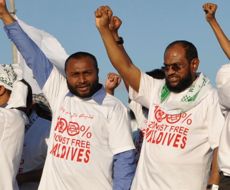
President Dr Mohamed Waheed has today spoken of his concern that the “weakening faith” of Maldivians was allowing unspecified “foreign powers” to increase their influence over the country’s  internal affairs.

Despite the number of differing political beliefs currently held by Maldivians, president Waheed called on the public to ensure that Islam and “national interest” were always their foremost priorities.

“Our national anthem, national flag, and national colours that symbolize the country should come first,” read an official statement quoting Dr Waheed that was posted on the President’s Office website today.

The opposition Maldivian Democratic Party (MDP) has meanwhile questioned President Waheed’s religious convictions, accusing him of being “double-faced” by trying to appeal to Islamists in the country for political gain, while claiming his comments more resembled the words of a “dictator”.

President Waheed made the comments today as he visited the island of Alifushi in North Maalhosmadulu Atoll as part of a tour to survey and break ground on a number of development projects in the area such as school and hospital constructions.

Speaking to local people on the island, President Waheed said that foreign powers would always seek to try and influence the country during times of conflict and instability.

Stressing the need for unity at both a national and community level, he therefore urged the public to try to prevent political views from coming between families.

President’s Office Media Secretary Masood Imad, who had not travelled with the president to Alifushi today, said he was not aware of the nature of the president’s comments when contacted this afternoon. Masood was not responding to calls for further clarification at time of press.

Unifying force

Meanwhile, MDP MP Hamid Abdul Ghafoor today rejected suggestions that President Waheed stood as a unifying force for Islam in the Maldives, accusing him of politicising the nation’s faith for his own gain.

“It is the mark of his total weakness in politics that [President Waheed] has put himself in this position,” he said. “There is no currency among the public in what he says.”

Hamid claimed that many Maldivians were aware that the president had sought to “play Islam” for political gain since he took office following the controversial transfer of power in February 2012.

President Waheed, who served as vice president under the former government, came to power after the resignation of former President Mohamed Nasheed following a mutiny by sections of the police and military.

Nasheed later alleged he had resigned under duress in what both himself and the MDP contend was a “coup d’etat”, despite a Commonwealth-backed Commission of National Inquiry (CNI) later concluding that President Waheed had come to power constitutionally.

Hamid alleged that President Waheed remained a “coup leader”, who had been backed by key businessmen in the country linked to its lucrative tourism industry.

“What is most bizarre is that it was certain tourism oligarchs who brought him to power.”

Coalition agreement

Just last month, President Waheed announced he would be forming a coalition between his Gaumee Ithihaad Party (GIP) and the religious conservative Adhaalath Party (AP) ahead of presidential elections scheduled for later this year.

The AP, one of five parties in the country meeting a recently approved regulation requiring any registered political body to have 10,000 registered members, is part of the coalition government of President Waheed following last year’s change in government.

Both Adhalaath and GIP do not presently have any elected members in parliament.

The religious conservative party was previously a coalition partner in the government of former President Nasheed, later leaving the government citing concerns at what it alleged were the irreligious practices of the administration.

This led the AP in December 2011 to join then fellow opposition parties – now members of Waheed’s unity government – and a number of NGOs to gather in Male’ with thousands of people to “defend Islam”.

During the same day, Nasheed’s MDP held their own rally held at the artificial beach area in Male’ claiming his government would continue to practice a “tolerant form” of Islam, reminding listeners that Islam in the Maldives has traditionally been tolerant.

“We can’t achieve development by going backwards to the Stone Age or being ignorant,” Nasheed said at the time.

Shortly after coming to power in February 2012, flanked by members of the new government’s coalition, President Waheed gave a speech calling on supporters to “Be courageous; today you are all mujaheddin”.

“Extremism” fears

Earlier this week, Dr Ahmed Shaheed, former Foreign Minister under both the governments of former Presidents Nasheed and Maumoon Abdul Gayoom, alleged that anti-semitism, racism, xenophobia and religious intolerance were “deeply entrenched” in political parties currently opposed to the MDP.

Dr Shaheed’s comments followed reports in local media summarising US Embassy cables first published by Wikileaks in 2009, and discussed during the then-opposition parliament’s efforts to impeach the foreign minister.

In particular, the Maldivian government’s engagement with Israel was the subject of a parliamentary debate November 9, 2009, in which Shaheed narrowly avoided impeachment following a no-confidence motion.

Opposition to the Maldives’ recognition of Israel was seized by then opposition groups in December 2011 as a sign of the Nasheed government’s “anti-Islamic” policies.

However, Dr Shaheed claimed that “Growing extremism hurts the Maldives rather than anybody else, because whenever a state is unable to deliver what is in the public interest due to intimidation from others, it is the state that suffers.”

Meanwhile, a recent report on extremism in the Maldives published in US West Point military academy’s Combating Terrorism Center (CTC) Sentinel has warned that growing religious extremism and political uncertainty in the country risk negatively affecting the country’s tourism industry.

“Despite its reputation as an idyllic paradise popular among Western tourists, political and religious developments in the Maldives should be monitored closely,” the report concluded.

Likes(0)Dislikes(0)

‘National Movement’ exercising freedom of assembly with artifical beach gatherings

The self-titled ‘National Movement’, comprising several NGOs and the religious conservative Adhalaath Party, has said it is exercising constitutional rights by holding gatherings at the artificial beach area in Male’, despite claims it has not been granted permission to do so.

State Finance Minister Abbas Adil Riza, a member of the National Movement’s Steering Committee, said the group’s followers had the right to freedom of assembly to express dissatisfaction with parliament.  He also today (April 11) claimed the movement’s supporters may “storm” the People’s Majlis to protect the national constitution.

The National Movement has held a series of gatherings in recent weeks that its supporters have said are targeted solely at parliamentarians and their conduct in the country. The group previously accused MPs of violating the constitution late last year and said they would consider a plan to “break up” parliament if its members’ constitutional concerns were not addressed.

Housing Minister Dr Mohamed Muiz today turned to social media site Twitter to claim in Dhevehi that the ‘National Movement’ had not obtained permission to hold its gatherings in the artificial beach area beyond April 8 this year.

Dr Muiz was not responding to calls at time of press.

Meanwhile, Male’ City Council (MCC), which claims to be responsible for providing the artificial beach area to political parties, said it had filed separate cases with the Maldives Police Service and Anti-Corruption Commission (ACC) over continued use of the land by a group proclaiming themselves as the ‘National Movement’.

Permission obtained, “Most probably”

Abbas Adil Riza told Minivan News today that one of the NGOs making up the National Movement had “most probably” obtained permission to use the land.

“We are of the opinion that the constitution allows every citizen the right of peaceful assembly,” he said.

Abbas claimed that the artificial beach area was a part of the capital where the public were free to gather, adding that he did not believe use of the space would be an issue if no other parties or groups had reserved the area at the same time.

According to Abbas, if the artificial beach area could not be made available for the ‘National Movement’, then MCC Councillors were required to provide land in the capital where they could continue to host gatherings.

He alleged that the MCC had tried to block National Movement supporters from holding their meetings at the artificial beach.

“Singular objective”

Regarding the ongoing series of gatherings, Abbas said the ‘National Movement’ was focused on the “singular objective” of not allowing parliament to damage the functioning of the Maldives constitution.

“We have given them the same warning that we gave to [former President Mohamed] Nasheed,” he said. “We will try to storm the Majlis if we have to protect the constitution.”

In December 2011, former opposition parties – now members of President Dr Mohamed Waheed’s unity government – and a number of NGOs included in the ‘National Movement’ gathered in Male’ with thousands of people to “defend Islam”.  Organisers said the rally was a response to what they alleged were the irreligious practices of former President Mohamed Nasheed’s government.

Nasheed’s government was controversially removed from office two months later following a mutiny by sections of the police and military.

Many of the parties in attendance at the “defend Islam” rally have taken cabinet posts in the new government.

Permit

Responding to Abbas’ claims today, MCC Councillor Mohamed Abdul Kareem claimed that the municipal council presently held the responsibility to provide permits for the use of the artificial beach area for events and gatherings.

He said that with work now being undertaken to ensure the area is ready for use around the time of presidential elections scheduled for September this year, the MCC had requested the land not be used at present by any political organisation or group.

Kareem went on to accuse the ‘National Movement’ of not being a registered organisation, but just a name used by Adhaalath Party President Sheikh Imran Abdullah for his own political ends.

He went on to allege that as a result of Sheikh Imran’s involvement with the movement, Housing Minister Muiz, who is also Secretary General of the Adhaalath Party, had previously provided permits for a limited period of time to use the artificial beach area for the gatherings.

Kareem also rejected accusations that the MCC had any involvement in attempts to try and block or sabotage the National Movement’s gatherings or work.

“Usfasgandu” dispute

The MCC has itself been locked in legal wrangling with the Housing Ministry over the last 13 months concerning its ability to lease an area of land known as “Usfasgandu” to the Maldivian Democratic Party (MDP) for use as a protest staging ground and other activities.

Usfasgandu was handed back to the MDP by the Male’ City Council last month.

The area was cordoned off by police in January after the High Court issued a warrant requesting the area be kept under police custody until it reached a verdict on the case.

Male’ City Council leased the Usfasgandu area to the ousted ruling party in March 2012, prompting repeated attempts by the government to reclaim the area on the grounds it was being used for criminal activity, including the practice of black magic.

The MDP had moved to the area after a previous protest camp at the tsunami monument was dismantled and completely repainted by police and military on March 19, 2012.

Likes(0)Dislikes(0)

New Indian High Commissioner emphasises “unshakable” relationship with the Maldives

The new Indian High Commissioner to the Maldives Rajeev Shahare has emphasised the “unshakable” long-standing relationship between between both countries during a meeting with local media yesterday (April 10).

The new commissioner, who speaks fluent Arabic, previously served in Saudi Arabia, Bahrain, Egypt, Yemen, Geneva, Mauritius, as well as held the position of Joint Secretary in the Indian Ministry of External Affairs’, West Asia North Africa division.

Shahare presented his credentials to President Mohamed Waheed Hassan Manik yesterday morning, before later discussing his initial observations on the country with local media.

“It is a great honour and privilege to represent the government of India in a country such as the Maldives. With its azure blue and turquoise water, this is a phenomenal God-gifted country,” he stated during yesterday’s media event.

“During my tenure, I will endeavor to further strengthen the relationship between India and the Maldives, which is already very strong with an unshakable foundation.”

“Highs and lows”

Shahare also stressed there had been no change in the relationship between the Maldives and India, despite media reports of increased tension between both nations in recent months.

“In any relationship there are highs and lows, but the relationship carries on its course normally,” he said.

“Engagement between the Maldives and India has been constant. We are pretty much on course.”

Shahare emphasised that the Maldives held a “special place in the hearts of Indians” given the deep historical ties, common language and ethnic background the countries share.

“India is home for many Maldivians, we share a strong ethnic affinity,” he said.

He claimed that India would continue to support the Maldives and provide for the country’s needs when requested.

“India has always been there for the Maldives. It is in a state of readiness to provide whatever the Maldives requires,” Shahare stated.

Shahare also thanked the Maldivian government for arranging the ceremony “in record time”, praising local authorities for their “magnanimity” in allowing him to meet senior government officials prior to presenting his credentials to the president.

Shahare has replaced former Indian High Commissioner D M Mulay, who left the Maldives last month to take the position as India’s Consul in New York.

Earlier this week, Mulay told the Times of India publication: “there is no expert on the Maldives in India and awareness regarding the country and its geopolitical situation is very low.”

He also emphasised the importance of understanding Maldivian political, economic and social changes which “may have a major impact on India”.

Referring to the large number of Chinese tourists outstripping Indian visits to the Maldives, Mulay stressed that “One must be aware about the clout of a country from which there is such a big tourist inflow”.

Mulay also discussed the “commensurate increase in the points of connectivity between the two countries”, adding that Indian investments in the Maldives are increasing.

Diplomatic strain

The Maldives’ relationship with India has appeared strained since the Waheed government’s decision last November to evict Indian infrastructure giant GMR from the country with seven days notice.

The US$511 concession agreement to develop Ibrahim Nasir International Airport was declared ‘void from the start’.

The government’s sudden eviction of the Indian investor did not appear on a list of 11 grievances handed to all senior Maldivian reporters by the Indian High Commission this January.

The list of Consular issues affecting the India-Maldives relationship included a number of concerns: discrimination against Indian expatriates, the keeping of passports of Indian nationals by employers, exploitation of Indian workers and repatriation of mortal remains.  Threats towards the country’s diplomats, a disparity in visa charges between the two countries and the repatriation of salaries were also raised as issues.

The list’s release was followed by the Indian High Commission issuing a statement in early February slamming local media in the Maldives for “misrepresentation and twisting of issues”.

“The High Commission has noted a recent trend in a section of local media to publish negative, unsubstantiated reports, while blacking out objective and positive news on Indian issues,” the Commission said at the time.

Shortly thereafter, political parties supporting the current government of President Mohamed Waheed Hassan criticised the Indian High Commission for allowing former President Mohamed Nasheed to seek refuge inside its protected diplomatic territory for 11 days.

The Adhaalath Party (AP) later condemned the Indian High Commission and the Indian government “for assisting a criminal fleeing from trial”.

The AP was also a vocal opponent of GMR and the concession agreement signed by the previous government to develop Ibrahim Nasir International Airport. During one of the party’s rallies last year, several senior government figures mocked and insulted the former Indian High Commissioner D M Mulay calling him a “traitor to the Maldives”.

Home Minister Mohamed Jameel Ahmed also expressed his disappointment over the Indian government’s decision to provide refuge to Nasheed in the Indian High Commission. He said that attempts by any country to prevent a person from facing charges pressed by an independent Prosecutor General (PG), could be described as interfering domestic matters of a sovereign state, local media reported.

Following Nasheed’s exit from the High Commission and subsequent arrest on March 5, Indian Prime Minister Manmohan Singh highlighted “free, fair and credible” elections as the “best course” for overcoming political uncertainty in the Maldives.

Likes(0)Dislikes(0)

Maldives records double-digit tourist arrival growth during first quarter of 2013

Tourism arrivals to the Maldives during the first quarter of 2013 were up 14.6 percent over the same period last year, as declining Western European demand failed to offset growing interest in the destination from Asia and Eastern Europe.

According to official statistics, 293,112 tourists arrived in the country between January to March 2013.  During March alone, 99,498 visitors were recorded in total – an increase of 30.1 percent on a year-on-year basis.

Over the last month, the tourism industry has faced several potential boycotts as a result of negative headlines, such as the controversial flogging sentence handed to a 15 year-old rape victim who admitted to having consensual sex with an unnamed man during a police investigation.

So far over two million people have signed an online petition backing a selective tourism boycott by Avaaz.org.  The petition aims to launch a media campaign targeting local resort businesses to pressure key decision makers to push for legal reforms in how sexual offences are dealt with.

Similar boycott action has been threatened in China, where concerns over alleged discrimination of Chinese nationals by one resort operator created negative publicity for the Maldives across local press and social media services.

However, tourism authorities told Minivan News late last month that after a“challenging” 2012 following political upheavals – a much more optimistic outlook was expected for the industry over the next two years. The country is presently well on target to meet a one million visitor target that it failed to reach by the end of 2012.

Regional visitors

During the last three months, China has continued to remain the key driver behind growth in tourism arrivals.  Some 70,570 arrivals were recorded for the first quarter of 2013, an increase of 51.2 percent over the same period last year. China accounted for 24.1 percent of all tourist arrivals to the Maldives between January and March, remaining the largest national market in terms of arrivals by over ten percentage points.

Total tourist demand from the Asia Pacific region was up for the quarter by 41.6 percent, amounting to 109,233 visitors, according to the statistics.

Meanwhile, European visitor numbers were up 0.3 percent over the same period last year, as demand from Central and Eastern Europe during the quarter rose by 24.2 percent – amounting to 39,273 people.

Russia remained the key market in the region, amounting for 8.3 percent of all arrivals to the Maldives over the first three months of the year. Visitor numbers from the country between January and March reached 24,255 people – up 21.8 percent over the same time last year.

In Western Europe, tourist demand fell 5.5 percent for the quarter, amounting to 69,747 visitors. This region still represented a 23.8 percent share of total arrivals to the Maldives for the first three months of the year.

During the same quarter, visitors from key markets including Germany and France fell by 2.6 percent and 11.3 percent respectively.

Elsewhere in Europe, arrivals from the United Kingdom and Italy – key traditional markets for the Maldives – were also down. Visitors from the UK for the first three months of the year fell by 7.6 percent to 22,550. Italy posted a 13.7 percent decline for the quarter – amounting to 23,247 guests.

In Africa, 1,588 people visited the Maldives during the quarter, up by 28.9 percent over the same period last year.

Across the Americas, demand rose by 31.8 percent for the first three months of the year, amounting to 8,006 people.  Between January and March, 2013, Middle Eastern arrivals increased by 53.4 percent over the same period last year, with 6,665 visitors.

Optimism

Ahead of the release of the March 2013 statistics, Deputy Tourism Minister Mohamed Maleeh Jamal told Minivan News last month that the outlook for the year ahead was much more optimistic than in 2012.  He pointed to protests in Male’ during the build up and aftermath of last year’s controversial transfer of power as a key difficulty faced by the industry last year.

With the bulk of protests following the change in government last year having been concentrated in the capital, Maleeh said that “false information” indicating that tourists staying at the country’s isolated island resorts would be affected by protests had since been dispelled.

However, in light of political uncertainty in 2012, the incoming government of President Dr Mohamed Waheed Hassan had sought to utilise public relations groups and advertising to try and offset the perceived impact of negative news headlines following the transfer of power.

This focus has included agreeing a US$250,000 (MVR 3.8million) advertising deal to promote the country’s tourism industry on the BBC through sponsorship of its weather services, as well as signing a £93,000 per month (US$150,000) contract with public relations group Ruder Finn to try and improve the country’s image internationally.

Despite some challenges posed by a reduced state budget for marketing this year, Maleeh said authorities were continuing to press for private funding to help with mainstream ad pushes on services like CNN and the BBC.

“We hope to have an announcement by the middle of the year,” he said.

Maleeh added that between April to August this year, a number of foreign journalists from all over the world would be invited to take part in ‘familiarisation trips’, which were claimed to have proved “very effective” the previous year.

Efforts are also expected to be undertaken in china to provide promotional focuses in mainstream media, such as state broadcasters state broadcasters, to promote the destination with local assistance.

Likes(1)Dislikes(0)

“Anti-semitism, racism, xenophobia and religious intolerance” deeply entrenched in Maldivian political discourse: Dr Shaheed

Anti-semitism, racism, xenophobia and religious intolerance “are deeply entrenched” in political parties currently opposed to the Maldivian Democratic Party (MDP), former Foreign Minister in both Nasheed and Gayoom’s government, Dr Ahmed Shaheed, has said.

Dr Shaheed’s comments follow reports in local media summarising US Embassy cables first published by Wikileaks in 2009, and discussed during the then-opposition parliament’s efforts to impeach the foreign minister.

In particular, the Maldivian government’s engagement with Israel was the subject of a parliamentary debate November 9, 2009, in which Shaheed narrowly avoided impeachment following a no-confidence motion.

Opposition to the Maldives’ recognition of Israel was seized by then opposition groups in December 2011 as a sign of the Nasheed government’s “anti-Islamic” policies. The previously disparate parties formed the ‘December 23 coalition’, following a large rally in Male’.

Dr Shaheed said “Growing extremism hurts the Maldives rather than anybody else, because whenever a state is unable to deliver what is in the public interest due to intimidation from others, it is the state that suffers.”

“The growth of extremism itself has numerous causes, but none of it is linked to government policy towards Israel or Palestine,” he added.

Many Maldivians firmly believe that policies pursued by Israel affect their solidarity with Arabs and other Muslims, Dr Shaheed explained.

“We care about how Israel treats the Palestinian people, because we care about the safety of the Muslim holy places under Israeli jurisdiction, and because we need to have a dialogue with Israel communicating our interests and concerns on these matters regularly,” he said.

More space for civic reasoning in Maldivian politics is needed for the Maldives to “behave like the rational nation-state, with friendship towards all, that we claim we are,” he said. “Silence may be golden but dialogue is the miracle tool of diplomacy.”

In the original cable referred to by Sun Online, Dr Shaheed told then US Ambassador Robert Blake that he believed “radical clerics ignited a reaction” among the Maldivian population and this was “a lot, but not a genuine undercurrent.”

Dr Shaheed “highlighted that former President Nasheed pledged to “renew ties” with Israel in his September 24 (2009) UN General Assembly speech,” that the Maldives Defense Minister and Minister for Natural Disasters would visit Israel later that year, and both nations “have already signed agreements on health, education, and tourism”.

Speaking to Minivan News, Dr Shaheed said he believed MDP’s rivals considered the cables “the perfect fog-machine to distract any discussion of bread and butter issues in the campaign.”

“Many in the Maldives see the Palestinian-Israeli dispute in religious terms, and religious sensitivities are played up during election time,” he added.

The Ministry of Foreign Affairs meanwhile told Minivan News the Maldives is “not against Israel”.

“The Maldives’ government always supports Palestinian citizens to have their freedom and urges this in the United Nations,” said Foreign Ministry Spokesperson Muaz Ali.

“This does not mean Maldives is against Israel,” he said.

“Anti-semitism, racism, xenophobia and religious intolerance”

“Neither former President Maumoon Gayoom nor former President Mohamed Nasheed divided the world into a Dar al- Harb and a Dar al- Islam as in classical Islamic international relations theory, which is what the Salafists in the Maldives want to do,” stated Shaheed.

Shaheed explained that “anti-semitism runs deep in certain sections of Maldivian society”, highlighting as an example an article published in Dhivehi on local news website Dhi-Islam in January 2011, reporting on the agreements made between the Maldivian and Israeli government.

“Under this heinous agreement, these people have thrown the little children and the youth of the Maldives, as well as the country’s education sector and the health sector and many other matters, into the lap of the evil Zionist Israelis, who, as we have been informed through the seven heavens, will never wish anything but evil for Muslims,” the article reads.

“Jews have even historically been an evil people who have been cursed because they had killed prophets and spread corruption on earth, and that they are the biggest enemies of Muslims is proven by the teachings of the Holy Quran and forms of the core beliefs of Muslims. This agreement will impose pressures to prevent the dissemination of these teachings,” it adds.

The report claims that Jews have falsely exaggerated “incidents” of torture and killings during the Holocaust “to inculcate sympathy towards Israel in the minds of Maldivian youths; to convince the Maldivian youths that the jews are the victims of oppression and to make them blind and insensitive to the occupation of Palestine, the seizure of Muslim holy lands, and the endless oppression the jews inflict on the inhabitants of the land.”

“This agreement is high treason or the highest form treachery against the noble Islam and Maldivian identity, upon which this country is founded. It is a matter far more dangerous and grave than can be treated lightly,” said the report.

Historical Maldivian – Israeli relations

There is no document to support the claim that Maldives ever severed diplomatic relations with Israel, in Maldivian or Israeli records, explained Dr Shaheed.

Instead, what appears to have happened is a downgrading of the relationship where no Maldivian president since the early 1970s has been willing to receive an Israeli ambassador formally in his office.

The Maldives voted at the UN to accept the legitimacy of Israel, on December 17, 1991, at the request of then President George Bush, by repealing the 1975 UN resolution equating zionism with racism.

“The Maldives was not alone in changing its policies towards Israel – there were a number of Organisation of Islamic Cooperation (OIC) states doing the same thing, or had even restored full diplomatic relations,” said Dr Shaheed.

“Under Gayoom, the Maldives categorically accepted the two-state solution. All of these actions were firmly grounded in international law and state practice,” he added.

The Maldivian government discussed the question of restoring ties with Israel following the Oslo Accord agreement in 1993, which established a peace process framework to resolve the Palestinian-Israeli conflict.

Israel agreed to recognize Yasser Arafat as its partner in peace talks and essentially exchanged land for peace. The Palestinians in turn recognized Israel’s right to exist while also renouncing the use of terrorism and its long-held call for Israel’s destruction.

The Gayoom cabinet agreed on a three-stage restoration of ties with Israel, beginning in June 1994. The Maldivian government “agreed to recognize Israeli passports and ended the travel ban” during stage one, explained Shaheed. Shortly thereafter stage two saw trade and commercial relations were fully restored. Restoring political ties occurred during stage three, with regular meetings at senior diplomatic levels, between 1995 to 2008.

“So what President Nasheed said at the UN – and that was my formulation – was that Maldives wanted friendly relations with all states in the General Assembly,” said Dr Shaheed.

“This does not and has not prevented Maldives from criticizing actions of UN member states when they violate peremptory norms of international law, but Nasheed was not going to divide the world into the good the bad and the ugly,” he declared.

In recent years, attitudes toward Israel have greatly fluctuated with collaborative engagement by the Maldivian government being countered by some anti-semitic ‘blowback’ from elements within Maldivian society.

In February 2010, a team of experts from the Israeli Foreign Ministry are training 35 Maldivian officials in emergency preparedness, with a focus on the management of mass casualties.

Later that year, in November, the Islamic Foundation of the Maldives (IFM) called on the government to break off all diplomatic ties with Israel, a day after Indira Gandhi Memorial Hospital (IGMH) announced that a team of seven Israeli doctors is due to arrive in the country to treat patients at the government hospital for a week.

The IFM reiterated calls to the Maldives government to “shun all medical aid from the Zionist regime” with a team of seven Israeli eye surgeons due to arrive in December 2012, claiming that Isreali doctors and surgeons “have become notorious for illegally harvesting organs from non-Jews around the world.”

The following month, Founders of the IFM NGO claimed that although they do not believe in “hysterical outbursts” and theories of an imminent “Jewish invasion” in the country, a week of anti-Israel protests and flag burning across Male’ has reflected “strong dissatisfaction with the government’s open attitude” to the Jewish state.

In May 2011, Ahmed Naseem became the first Maldivian Foreign Minister to visit Israel.

However, in September 2011, Deputy Leader of the Adhaalath Party Dr Mauroof Hussein has called for alarm after alleging that a delegation from an Israeli company, Teshuva Agricultural Products, was due to arrive in the Maldives to assess the country’s agricultural potential. The Israeli agricultural delegation that was supposed to arrive on Filadhoo cancelled the visit after the islanders warned that they would not let the delegation go further than the jetty.

In December 2011, Minister of Islamic Affairs Dr Abdul Majeed Abdul Bari requested parliament endorse a resolution forbidding the government to establish ties with Israel.

While in April 2012, MPs passed a resolution preventing Israeli national airline El Al from operating scheduled flights to the Maldives until Majlis’ National Security Committee completes further investigation into the matter. El Al applied to the Ministry of Civil Aviation in May 2011 requesting permission to fly to the Maldives starting in December 2011.

There was no direct flight from Israel to Maldives between 2009-2011, so the Maldives was “not able to maximize the benefits from the growing Israeli market,” Dr Shaheed remarked.

“Maldives could have significantly increased the direct income and benefits from Israeli tourism by accepting direct flights from Israel, resulting in a longer holidays and greater expenditure in Maldives while still making the holiday comparatively cheaper for the visitor,” he added.

Likes(0)Dislikes(1)

Umar Naseer refuses to apologise to PPM

Deputy Leader of Progressive Party of Maldives (PPM) Umar Naseer has said that he will not apologise to the party, after alleging that its recent primaries in which he stood as a prospective presidential candidate were rigged in favour of former President Gayoom’s half-brother, Abdulla Yameen.

Speaking to press in front of the foreign ministry after returning from Singapore, Naseer said that revealing the truth was not something a person should have to apologise for.

Umar said he did not believe that the party’s disciplinary committee would dismiss him from the party. He also said that if the committee decides to dismiss him, there would be a “massive earthquake” in the party and the PPM would be devastated.

Umar Naseer told the press that he did not file the allegations with the party’s committees because all the committees were under the influence of his opponent in the primaries, Yameen.

He also said that he was used to being suspended and dismissed from political parties – a reference to the events that saw him ejected from the Dhivehi Rayithunge Party (DRP) prior to its split into the PPM.

Umar Naseer reiterated that the persons who should apologise were the ones he claimed cheated in the party primaries.

On April 7, the PPM disciplinary committee accepted a case forwarded to the committee by the party council against Umar Naseer, after he refused to publicly apologise.

In September 2010, when Umar Naseer was the Deputy Leader of Dhivehi Rayyiithunge Party (DRP), the DRP council filed a case against Umar at the Disciplinary Committee for forging a press release and causing division in the party.

Later in December 2010, Umar Naseer was dismissed from the party – an incident that eventually led to a splintering of the DRP into a new party under Gayoom, the PPM.

The Disciplinary Committee of PPM has said that it might take two weeks to decide on Umar’s case.

An audio clip of a phone conversation leaked to social media last week depicts a professed Yameen supporter attempting to buy the votes of Naseer supporters through a person identified in the clip as Ahmed ‘Mujey’ Mujthaba.

Mujthaba – who seemed to have been involved in Yameen’s primary election campaign on Gemanafushi in Gaaf Alif Atoll – was given instructions to trade cash for votes on the island.

According to the audio recording, MVR 300,000 (US$ 19,455.25) was wired to Mujthaba, of which he was to distribute MVR 200,000 (US$ 12,970.17) among potential voters while he was to keep the remaining MVR 100,000 (US$ 6,485.08) for himself as “a small reward”.

The party made no comment on the clip.

Likes(0)Dislikes(0)

Reports of Speaker Shahid, DRP MPs’ defection to MDP unconfirmed

Rumours that Speaker of Parliament Abdulla Shahid and two other government-aligned MPs, Alhan Fahmy and Abdulla Abdul Raheem, have joined the opposition Maldivian Democratic Party (MDP) are being widely circulated by local media.

Minivan News was unable to confirm the reports at time of press as Speaker Shahid and the other MPs were not responding to calls. The DRP has acknowledged the rumours, but has said it has not been officially informed of the switch.

Local media has also reported that government-aligned MPs Mohamed ‘Colonel’ Nasheed, MP Ali Azim and MP Hassan Adil are also preparing to join the opposition.

Speaker Shahid, Ali Azim and Nasheed are all from government-aligned Dhivehi Rayithunge Party (DRP). The supposed reason for their defection, as reported in local media, was a clash within the party’s parliamentary group over its stand on recently scheduled no-confidence motion against Home Minister Mohamed Jameel Ahmed.

A source in the MDP familiar with the matter alleged to Minivan News that the defection of the MPs was prompted after DRP Leader MP Ahmed Thasmeen Ali brokered a “last minute deal” with the government in return for DRP not voting against the minister.

According to a 2010 report by former Auditor General Ibrahim Naeem, loans totalling Rf1 billion taken out by Fonadhoo Tuna, a company owned by Thasmeen at the time, and luxury yachting company Sultans of the Sea, connected to the party leader, had yet to see any repayments.

Together the loans accounted for 13 per cent of the total amount loaned by the bank in 2008. Naeem commented at the time that defaults on bank loans issued to “influential political players” could jeopardise the entire financial system of the country.

DRP MPs Mohamed Nashiz and Ali Azim were summoned to court in November 2012 regarding the debts, just as parliament was voting to determine whether no-confidence motions against ministers could be taken in secret.

Those summons were in relation to a Civil Court ordering Mahandhoo Investments and Kabalifaru Investments – two companies with ties to DRP Leader Ahmed Thasmeen Ali – to repay millions of dollars worth of loans to the Bank of Maldives Plc Ltd (BML). The verdict was also upheld by the High Court in October 2011.

MP Azim alleged at the time that President Mohamed Waheed Hassan and other senior members of the executive had approached him, offering to cancel the court summons if he agreed to vote for the secret balloting in a way they preferred.

According to the MDP source, ahead of the no-confidence motion on April 8 the DRP had “in principle agreed” to vote against the minister, but had changed their minds at the last minute. Speaker Abdulla Shahid was “left no choice but to call off the session”.

Shahid called off the parliamentary session following point of orders taken by opposition MDP MPs over the issue of the secret ballot, which the Supreme Court had overturned despite parliament’s earlier vote in favour.

Upon concluding the session Speaker Shahid announced that the matter raised by MDP MPs regarding Supreme Court’s decision had been sent to parliament’s General Affairs Committee. He said the committee will review the decision and begin working the following day.

Despite the rumours, the DRP MPs have been in no hurry to confirm the reported switch.

Speaking to Minivan News, MDP Spokesperson MP Hamid Abdul Ghafoor claimed that “a re-alignment in favour of the opposition is definitely happening”.

“I can confirm you as I am a parliamentarian myself that several parliamentary groupings who previously stood behind the old dictatorship are slowly dismantling now. They have now started to realise that backing an old dictatorship is wrong,” said Ghafoor. “I can guarantee you that a re-alignment is definitely happening and dismantling of the old dictatorship is imminent.”

However Ghafoor declined to reveal the names of those MPs involved in the claimed switch.

Dhivehi Rayithunge Party (DRP) Deputy Leader Ibrahim Shareef said the party had received no official confirmation that Speaker Shahid or any of the party’s MPs had resigned from the party or were  looking to switch to the MDP.

However, Shareef said he could not rule out the possibility of such a switch in the current political climate, citing that political defections “occur very fast in this country”.

“Anything is possible” he admitted. “As far as we are concerned, there are a lot of rumors right now about a political switch.”

Should the defections happen as rumored, the number of opposition MDP MPs will be 35 – just 4 MPs short of the parliament’s simple majority required for the dismissal of cabinet ministers and pushing through legislation.

Parliament breakdown by party (prior to rumoured defection of five DRP MPs):
MDP 29
PPM 19
DRP 11
JP 3
PA 1
DQP 1
Independent – 11
Likes(0)Dislikes(0)

Government pursues legal reforms with cabinet shake-up

The government has appointed Aishath Bisham as Attorney General (AG) to replace Azima Shukoor, who has taken the role of Minister of Gender, Family and Human Rights to oversee legal reforms previously proposed by the government.

President’s Office Media Secretary Masood Imad confirmed that the government had decided to transfer Shukoor as part of commitments to potentially end the use of flogging as a punishment for sexual offences – a practice it previously alleged serves to punish victims of rape and abuse in some cases.

Bisham’s appointment as AG comes as an Avaaz.org petition calling for a moratorium on flogging and better laws to protect women and girls in the Maldives reached more than two million signatures – more than twice the number of tourists who visit the country each year.

The campaign stems from concerns over the Juvenile Court’s sentencing of a 15 year-old girl to be flogged after she confessed to authorities of having consensual sex with an unknown man during investigations into a separate case of abuse.  The abuse was allegedly carried out by her stepfather.

Sources on Feydhoo in Shaviyani Atoll, where the 15 year-old girl originates from, last month told Minivan News that concerns had been raised by islanders since 2009 that the minor had allegedly been the victim of sexual abuse not just by her stepfather, but by a number of other unidentified men on the island.

During her time in the Attorney General (AG’s) Office, Azima Shukoor appealed the court’s decision regarding the minor’s sentence. Meanwhile, international pressure has continued to mount on the government to review the charges against the girl and push for reforms of how sexual offences are dealt with by the local court system.

President Dr Mohamed Waheed’s government has previously criticised the sentence, but warned this week that any form of boycott such as those proposed by Azaaz would serve to setback to the economic opportunities and rights we are all striving to uphold for women, girls and the hardworking Maldivian people in general.”

In a letter published on Minivan News on Saturday (April 6), Avaaz.org Executive Director Ricken Patel insisted that the organisation had not called for a outright tourism boycott.

“What we do stand ready to do, however, is to inform tourists about what action is and isn’t being taken by the Maldives government to resolve this issue and change the law, and to identify those MPs and resort owners who are using their influence to push for positive change – and those who are not,” Patel said.

“Around the world people are interested (and have a right to know) what kind of systems they’re supporting with their tourism dollars, and to make their holiday decisions accordingly,” he added.

Legal reform

The President’s Office has previously expressed hope that punishments such as flogging would be debated by relevant authorities to try and find an amicable solution to the problem.

The Maldives Constitution does not allow any law that contradicts the tenets of Islam, with the criminal charge of fornication outlined under Islamic Sharia.

However, President’s Office Spokesperson Masood previously noted that the Maldives had a tradition of turning away from practices such as the death sentence and various forms corporal punishment that form part of Sharia law.

He said that punishments such as removing the hand of a suspect in the case of theft had not been used since back in the 1960′s.  Masood maintained that there was a history of reviewing the country’s relationship with Sharia law in the past and that a similar process could be had with the debate about flogging.

He concluded that all authorities involved in proposed legal reforms would have to tread “a very fine line” in order to tackle long standing “traditions” and beliefs in the country.

Avoiding prosecution

A senior legal expert with experience of working under both the present and former governments has told Minivan News that that while the Maldives Constitution requires that laws in the country do not contradict Islamic Sharia, there were ways of avoiding prosecuting suspects on charges of fornication.

“There are many Islamic legal interpretations that place several conditions to fulfill before a prosecution on fornication be brought forward. Some scholars even go further and argue that hudood offences cannot be practiced in the legal justice systems at the current time,” claimed the legal source, who spoke on condition of anonymity.

“Their argument is that Islamic Sharia is a way of life and you cannot pick and choose which areas you need to implement. Basically, you cannot implement Islamic criminal justice system in its original form when Islamic commercial system or Islamic governance is not observed.”

Despite his government’s stance on flogging, President Waheed’s Gaumee Ithihaad Party (GIP) has recently declared itself part of a coalition with the religious conservative Adhaalath Party (AP), which has publicly endorsed the 15 year-old’s flogging sentence, stating that she“deserves the punishment” as outlined under Islamic Sharia.

The Adhaalath party, members of which largely dominate the Maldives’ Ministry of Islamic Affairs, stated that the sentence of flogging had not been passed against the minor for being sexually abused by her stepfather, but rather for the consensual sex which she had confessed to having to authorities.

Likes(0)Dislikes(0)

Tourism boycott would be “setback for economic rights of women” says President, as Avaaz petition reaches two million

President Dr Mohamed Waheed has issued a statement warning that calls for a boycott on tourism over the flogging sentence for a 15 year-old rape victim “will only serve as a setback to the economic opportunities and rights we are all striving to uphold for women, girls and the hardworking Maldivian people in general.”

The President’s statement comes as an Avaaz.org petition calling for a moratorium on flogging and better laws to protect women and girls in the Maldives reached more than two million signatures – more than twice the number of tourists who visit the country each year.

In a letter published on Minivan News on Saturday, Avaaz.org Executive Director Ricken Patel insisted that the organisation had not called for a outright tourism boycott.

“What we do stand ready to do, however, is to inform tourists about what action is and isn’t being taken by the Maldives government to resolve this issue and change the law, and to identify those MPs and resort owners who are using their influence to push for positive change – and those who are not,” Patel said.

“Around the world people are interested (and have a right to know) what kind of systems they’re supporting with their tourism dollars, and to make their holiday decisions accordingly,” he added.

President Waheed meanwhile thanked the international community “for their concern” in the case, noting that Attorney General Azima Shukoor had met the girl “and she is receiving the appropriate physical and psychological counseling.”

“This case should never have been presented in the courts and we are working to ensure that cases like this are never brought to the courts again,” President Waheed said.

“We appreciate the international compassion for this young woman and ask for your patience as this case moves through the judicial system. As both the President and as a father, I am fully committed to protecting and advancing the rights of women and girls in the Maldives and throughout the world and share your deep concern about this young victim,” he said.

“The Maldives is a young democracy working to balance our religious faith with our new democratic values. I ask that you support us and join us as partners as we work through this challenge.”

President Waheed’s Gaumee Ithihaad Party (GIP) has meanwhile declared itself in coalition with the religious conservative Adhaalath Party (AP), which has publicly endorsed the 15 year-old’s flogging sentence, stating that she “deserves the punishment” as outlined under Islamic Sharia.

The Adhaalath party, members of which largely dominate the Maldives’ Ministry of Islamic Affairs, stated that the sentence of flogging had not been passed against the minor for being sexually abused by her stepfather, but rather for the consensual sex which she had confessed to having to authorities.

“The purpose of penalties like these in Islamic Sharia is to maintain order in society and to save it from sinful acts. It is not at all an act of violence. We must turn a deaf ear to the international organisations which are calling to abolish these penalties, labeling them degrading and inhumane acts or torture,” read a recent statement from the party.

“If such sinful activities are to become this common, the society will break down and we may become deserving of divine wrath,” the Adhaalath Party stated.

A previous call for a moratorium on the flogging of women for the crime of extramarital sex was raised by UN Human Rights Commissioner Navi Pillay during an address to parliament in 2011.

Following her address, demonstrators gathered outside the UN building holding placards calling for Pillay to be “arrested”, “flogged” and “slain”.

Pillay’s statement was publicly condemned by the Progressive Party of the Maldives (PPM), Islamic Ministry, MPs and religious NGOs, while the Adhaalath Party called on then President Mohamed Nasheed to condemn Pillay’s statements “at least to show to the people that there is no irreligious agenda of President Nasheed and senior government officials behind this.”

“What’s there to discuss about flogging? There is nothing to debate about in a matter clearly stated in the religion of Islam. No one can argue with God,” said Foreign Minister Ahmed Naseem at the time.

More recently, a  report on extremism in the Maldives published in US West Point military academy’s Combating Terrorism Center (CTC) Sentinel has warned that growing religious extremism and political uncertainty in the country risk negatively affecting the country’s tourism industry.

“Despite its reputation as an idyllic paradise popular among Western tourists, political and religious developments in the Maldives should be monitored closely,” the report concluded.

Likes(0)Dislikes(0)