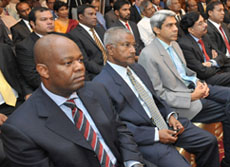
An own goal from Maldivian midfielder Assad Abdul Ghani was not enough to dent the country’s hopes of reaching the 2012 Asian Football Confederation (AFC) Challenge Cup finals as it overcame Kyrgyzstan 2-1 in Male’ yesterday to guarantee a spot in the upcoming tournament.
Male’ has this week been playing host to all the Group C qualifying matches that will decide which two teams out of the Maldives, Tajikistan, Cambodia and Kyrgyzstan will be among the finalists to contest next year’s Challenge Cup.
After already beating Cambodia 4-0 at Male’s national stadium on Monday (21 March), Ali Ashadh further added to the home side’s goal tally within five minutes of yesterday’s game. That goal remained the difference between the two teams until the second half when Shamweel Qasim appeared to put the contest beyond doubt in the 79th minute.
The visitors had been reduced to ten men three minutes before the second goal after Azmat Baimatov was sent off, yet the game still ended with the potential for Kyrgyzstan to spring some points after Ghani’s error bought the deficit to within a single goal with three minutes remaining. Despite the potential pressure, the Maldivian players were able to hold on to win the game, setting up a top of the table clash for its final group match on Friday in Male’ against Tajikistan.
During the other Group C qualifying match held in the capital yesterday, Tajikistan managed to put three goals past a Cambodian side that had already been soundly beaten by the host nation.
Cambodia were a goal down by the second minute of the match following a strike by Nurriddin Davronov, but managed to staunchly defended its goal-line well into the second half until two goals within the last ten minutes of the game from Ibragim Rabimov and Pulod Koridov ensured the victors would be joining the Maldives in the AFC Challenge Cup finals.
The Maldives will now compete with seven other nations including India, Turkmenistan and fellow Group C rival Tajikistan in the 2012 AFC Challenge Cup. A host nation has not yet been selected for the tournament, but a venue is expected to be drawn from among one of the eight finalists under AFC rules.
The last AFC Challenge Cup tournament held in Sri Lanka during February 2010 was eventually won by the Democratic People’s Republic of Korea.
Police have arrested Ibrahim Shahum Adam, 20, G.Kouzy while he was on an uninhabited island in Meemu Atoll.
He was arrested this morning around 7:00 am, said police on their website.
According to police, four others who were with him on the island were also arrested.
Police have been searching for Shahum for the investigation of the death of Ahusan Basheer, Seenu Hithadhoo, Varudhee who was allegedly murdered by a gang on March 17.
Previously police has appealed the public to report sightings of Shahum after the murder case and also warned the public not to confront him as ‘’he is too dangerous.’’
This is the second murder charge against Shahum. He was recently arrested in connection with the murder of a 17 year-old boy near Maaziya football ground in Maafannu.
Shahum was arrested and kept in detention for six months and was released by the Chief Judge of the Criminal Court Abdulla Mohamed.
Judge Abdulla said that Shahum had been kept in detention six months for investigation and that no probable evidence was brought against him to further hold him in detention and queried the police as to why their investigation was not concluded after six months.
Police answered that they were unable to conclude the investigation as the Health Ministry had not provided the medical-legal report on the death of the 16 year-old boy.
Keeping someone in detention for six months for not getting a response from the health ministry was ‘’too much’’, said the judge, explaining that there were rights of persons kept in detention and released him.
Ahusan Basheer was murdered last Thursday in Alikileygefaanu magu, one of the main roads in Male’.
Local media reported Basheer’s family saying that he was not dead when he was first taken to Indira Gandi Memorial Hospital (IGMH), and that inside the vehicle on the way to the hospital he had told the police officers who attacked him before dying.
Basheer’s family also said that according to sources at IGMH Basheer’s body was left in the Accidents and Emergency Room without any treatment provided for more than an hour, because the hospital wanted to identify who he was and to contact his family.
His family told local newspapers that he went out late that night to buy a cigarette and that was the last his family saw him alive.
After the death of Basheer, police conducted special operations in Male’ to curb the rise in gang violence in Male’ and arrested 47 persons who were not related to the murder case, according to Chief Judge Abdulla.
Most of the persons among the arrested 47 were brought before the court with no probable grounds to be arrested, he added.
The Maldives National Defence Force (MNDF) Fire department has said that investigation into the fatal fire in Orchid this week had revealed that the fire was sparked by a faulty electricity meter board in the house.
‘’The fire started from the meter board and spread, and turned to a huge fire,’’ said the MNDF in a statement, suggesting that the cause of the fire incident was electricity.
MNDF said that the fire department first received the information at 9:21am in the morning, and the fire department attended the area and tried to control the fire at 9:27 am.
At 9:57 that morning, MNDF said that “90 percent” of the fire was under control.
‘’While they were trying to control the fire firefighters received information that two persons were stuck inside , as soon as officers knew about it, a team from the fire department entered the house searching for the two persons,’’ MNDF said. ‘’When officers found the two persons they were inside a 15 ft-9 ft room build on a wooden deck which was severely damaged by fire when officers reached there.’’
MNDF said that officers had noticed that neither of the two persons were showing any movement when they were discovered and that their bodies had been severely burned by the fire.
There were three women and one man in the house when the incident occurred, two of them died while the third was a maid in the house who escaped on her own, said the MNDF.
The man received minor injuries during attempts to save the other two women, however after he escaped through the window to get someone to assist him to rescue to the two inside, the fire spread and he was unable to get back inside afterwards, according to the MNDF.
The identities of the two victims were identified as Iuthisham Adam and Dhon Sitthi of Haaji Edhuru, the mother of both Deputy Health Minister Fathimath Afiya and Permanent Representative of the Maldives to the UN in Geneva, Iruthisham Adam.
Rising prices for aviation fuel and increased ground handling charges made by GMR, the Indian infrastructure giant that is now managing and developing Male’ International Airport, are in line with international prices, the airport’s CEO Andrew Harrison has told Minivan News.
The price of fuel at the airport has increased 35.39 percent at the airport and 35.67 percent internationally, Harrison said, in an update on progress at the airport during an initial 180 day strategy period following the company taking the reins.
“We are not even passing over the full increase in prices of fuel – we’re sensitive to airline customers and what the price of fuel means to them,” Harrison said. “The escalating price is affecting the whole global economy, and affects airlines directly not just here but at all other locations.”
Harrison sought to head off concerns aired recently that the cost of fuel at Male’ International Airport was impacting airlines’ willingness to fly to the destination.
“No airline has come forward and said they are unhappy with our pricing, but they are concerned about the global price of fuel,” he said. “With all the volatility there are challenges there.”
“We are working on some strategies to reduce the cost of providing fuel to them. We’ve spent the last six weeks meeting airlines – some want credit terms, others a set supply criteria – we are trying to meet the need of the majority.”
“The pricing of fuel is not something we compare one place to another, because there are many variables including the method of delivery and the volume you’re buying. The size of the berth we have limits the size of vessel we can charter, and these factors affect the price we can buy and supply fuel at.”
GMR had signed a US$140 million contract with the State Trading Organisation (STO) to supply fuel, he added, switching the contract over from Dubai-based Galana Petroleum.
“Our sense was it was better to use a company right here with us that would share in the risk and opportunity and try to get us the best possible price – for instance, the STO has its own vessel, and may not need to charter one. They made an extremely competitive bid.”
Many airlines, he explained, used a middleman reseller who bought fuel and sold it by offering components such as credit terms.
“Resellers may be in a better position to do that, as we are not a company in the business of providing credit terms to airlines. But what we are saying is that because the airline is our direct customer we prefer a direct relationship with them.”
This had led, Harrison said, “to a number of airlines leaving intermediaries and coming to us directly. They have a choice – but they are coming to us.”
Ground handling spikes
GMR has significantly increased ground-handling charges to bring the price in line with other international airports, Harrison said.
The ground-handling charge for a B777, used by many airlines flying to Male’, was recently raised from US$1990 to US$2985 ( at daytime) and US$3585 ( at night) – an increase of over 50 percent.
“It’s not necessarily unreasonable or overpriced – it may seem like a jump but there’s been no increase in 12 years, and we are still more competitive than a number of international markets,” he claimed, noting that the comparable cost in an Australian airport was US$4286 and US$4388 in Europe.
Most other services, such as the provision of ground power, were either cheaper than comparable rates in India or included – airports such as Hyderbad charge airlines for services such as the provision of wheelchairs, or use of a scissor-lift for people unable to climb the stairs to the plane.
Free storage of airline baggage containers had actually resulted in the airport being inundated, “but instead of charging we are asking airlines to reduce them to realistic levels.”
Ground-handling charges were less that four percent of an airline’s operating cost, he noted, “but that doesn’t mean we want the issue to escalate.”
Corruption allegations
Despite persistent allegations from opposition parties that there was corruption in the airport bidding process, including several cases forwarded to the Anti-Corruption Commission which vowed to investigate, “we have not been approached by the ACC,” Harrison said.
“There has been no formal communication [with the ACC], and we are extremely confident of standing up to any scrutiny because of the way the bid was scrutinised by the World Bank’s International Finance Corporation (IFC).
“They been here recently as part of their due-diligence process, meeting members of the public, ministers and stakeholders, and holding a community meeting in Hulhumale’ about the impact of the development. They wouldn’t be here doing that if they felt they were part of something that had not been done properly. We are confident that irrespective of what is being discussed in the media that we followed a legal and due process that was transparent and respected.”
There were, he acknowledged, “people who believe in what we doing, people who feel they haven’t seen sufficient evidence of what we’re doing, and people who will never be convinced no matter what we do.”
Cultural construction
The first 180 days, Harrison explained, had been spent merging the cultures of the three organisations now operated under GMR Male’ International Airport – the former Maldives Airport Company Limited (MACL), Island Aviation’s passenger check-in and passenger handing operation, MIC’s interior cleaning, “as well as GMR’s culture.”
The company’s organisational structure had been unveiled with an emphasis on staff training, involvement in decision making and addressing issues such as a noticeable gender imbalance.
“We found a gender imbalance in the workplace – there were not many ladies operating at levels where they had significant levels of responsibility,” Harrison observed. “So we tried to address this – the new Head of IT Operations is a very qualified lady who is very good at her job, but she was many levels below and wasn’t being allowed to operate at a level that matched her potential.”
GMR was making an effort to communicate in both Dhivehi and English, he said, launching Dhivehi language classes for non-Maldivians and producing documents in both languages.
Staff suggestions and involvement had led to the creation of a non-punitive safety system, encouraging reporting rather than punishment, upgrade of the airport’s sea rescue capabilities and the replacement of 350 unbranded assembled computers with a consistent Dell IT infrastructure – and paid software licences.
Glitches in communication emerged as well – GMR took a dim view at the beginning of March when security staff began conducting pat down searches of every passenger trying to enter the terminal.
“A pat-down check is more efficient when people are experienced, but not when you introduce it on a peak morning with queues all the way down to the seaplane check in area, with no notification to the airlines or us,” Harrison said. “As a result of that we had unprecedented delays – nearly every flight that morning was delayed. Security took a line that nothing new was introduced, but after an emergency meeting the pat downs were stopped and the queues disappeared.”
He was, he said, happy to look at industry best practice and whatever technology was required, “but [I] am not prepared to introduce something not in line with international standards. Heathrow and Gatwick search 25 percent of those who don’t set off the alarm. Here we were searching 100 percent.”
CEO Andrew Harrison (left) at the airport handover
Physical infrastructure
Harrison was very conscious of public expectations regarding the airport upgrade – following the release of artist impressions of the airport, GMR has kept a low profile while introducing its organisational structure and attempting to win over staff to its nearly US$400 million vision for the airport.
Managing such expectations had been one of the key challenges, he said: “A lot of people felt there would be changes to the terminal the day we took over – but there have been many considerations, such as impact of work in peak periods, and understanding what work we want to do.”
Many physical improvements were scheduled to begin as the Maldives leaves peak travel season: “We weren’t in a position to remove even a single baggage carousel,” Harrison said.
GMR has a lot of work ahead of it if it plans to meet its target of upgrading the existing terminal by October. The refurbishment is “essentially throw-away” considering it will have less than a three year lifespan until the new terminal is completed in 2014.
During a tour of the present airport terminal Harrison provided a running commentary of planned improvements – including a food court (selling, among other foodstuffs, Turkish kebabs – a Male’ first) and raising the ceiling of the arrivals area so tourists could see the sea from the gate.
Harrison admitted that the scale of investment in the upgrade made it tempting to just bring forward the date of the new terminal, however he acknowledged the local appetite to see quick improvements.
“People will see changes in the coming months. For example, we’re about to start work on the domestic terminal, increasing the space available by 50 percent. This falls outside the concession agreement, which mostly concerns international travellers – but a lot of domestic passengers are Maldivian and deserve to benefit from the improvements as well.”
Other improvements will include redesigned and standardised tourist counters that are branded individually by resorts, a left luggage service, baggage wrapping service (“this is popular for a number of destinations, especially Eastern Europe”), porter service (“people particularly from the Middle East want the services of paid porters”), ‘fast-track’ immigration and customs as well as the potential for a ‘premium’ jetty.
There will also soon be a spa in the departure area offering 20 minute shoulder and foot massages, and possibly a nap and shower facility. Moreover, ‘soft skills’ trainers loaned from Singapore Airlines, “some of the best in the world”, had been invited to help train front-of-house staff at the airport.
Following construction of the new terminal, Harrison said the goal was to turn Male’ into one of the top five airports in the 1-5 million passenger category (the airport presently sees 2.4 million visitors through its gates a year).
“Look at the kind of experience a tourist coming to the Maldives goes through,” he said. “The natural beauty of the resort environment, and then the airport experience they go through at the end – it’s not right, standing in extensive queues, with a level of service so far apart from that of the resorts.”
Economy and marketing
Asked whether GMR had concerns about operating in the Maldives given the state of the country’s economy, Harrison said he believed the improved airport itself was part of the solution.
“An airport is an economic engine for a country,” he explained, “allowing trade, travel – both passenger and cargo – and employment. If the processes are made efficient, it has positive impact on the economy.”
Moreover, GMR’s involvement provided resources and expertise in opening up new tourism markets for the Maldives, Harrison explained, particularly undeveloped markets such as the United States.
“We want to talk to resorts, the Ministry of Tourism and the airlines about possibly marketing the Maldives in the US,” Harrison said.
“The US is the most underrepresented market in terms of direct tourism, however 14 percent – the highest single percentage – of tourists arriving coming into Delhi hold US passports. If they are willing to fly to India it’s only a short hop to the Maldives – I think it’s a matter of awareness and understanding connectivity and flight options, and most importantly, what’s here at end of the journey.”
The Maldives, he said, represented a “more interesting prospect” than traditional nearby island destinations visited by US tourists, such as the Bahamas and the Caribbean, adding that GMR was keen to explore this untapped market.
“We didn’t go to ITB [the recent travel industry trade show held in Berlin] this year because we didn’t think we had anything to say and I didn’t really want it to just be a jolly,” Harrison said. “But next year we’ll have a stand showcasing what we are doing here.”
One person is dead after an attempted robbery of Baros Island Resort and Spa early this morning, after a group of Maldivians arrived in a boat and were confronted by staff.
Police spokesperson Sub-Inspector Ahmed Ali confirmed that police were called around 4:00am this morning and are investigating the incident.
“A group of people went to the island and had a confrontation with staff. Staff at the resort held the suspects,” he said, confirming that they were Maldivian nationals. “When police arrived there was a body in front of the jetty.”
Sub-Inspector Ali declined to provide further details until the conclusion of the investigation.
General Manager of Baros, Jonathan Blitz, said the resort could not comment on the matter as it was under police investigation.
Minivan News understands that the deceased is 20 year-old Ali ‘Immortal’ Shafiu.
According to sources familiar with the incident, Shafiu was among a group of four masked men who arrived on the island at 3:30am.
He allegedly drowned while attempting to escape in one of the resort’s vessels, after security staff spotted the intruders.
One of the suspects was apprehended by resort staff, while the remaining two were arrested by police when they were found hiding in a resort boat in the lagoon.
It is not known if the men were armed, however no staff member or guest on the island was harmed during the incident, Minivan News was told.
Friends of the victim in Male’ who were present when the body was brought to hospital claimed Shafiu was dead when he was pulled from the water. The body appeared to have three head wounds, one of them “one and a half inches deep”, the source claimed.
The three remaining men are now under police custody.
Baros is the second Maldivian resort this year to suffer an attempted robbery by people from outside the island.
In Janurary, staff at Kihaadhuffaru in Baa Atoll were threatened by a group of masked men brandishing machetes and swords, who escaped in a dingy with the resort’s safe.
A receptionist was reportedly gagged with tape and restrained with a cable tie during the incident.
Sub-Inspector Ahmed Shiyam said at the time that he did not believe resorts would need to review existing security measures in light of the Kihaadhuffaru theft.
Management at the Conrad Maldives Rangali Island resort have confirmed that a “number” of it staff have resorted to strike action at the site over alleged disputes with management.
Minivan News understands that Maldives tourism authorities have sent a team to the site to try and resolve the dispute.
In a statement the resort, which is part of the multi-national hospitality group Hilton Worldwide, said that it was working to try and resolve the strikes as quickly as possible, while prioritising the safety and security of employees and guests.
Head of the Tourism Employees Association of Maldives (TEAM), Maldivian Democratic Party (MDP) MP Ahmed Easa, alleged that some staff at the resort had resorted to the action over concerns about possible discrimination between the earnings of local and expatriate staff.
The resort statement did not confirm any key grievances of staff involved in the strike action. The company did claim though that all its employees, or “team members” as they are known, received equal service charge payments, along with being offered the fourth highest service charge allocations of resorts operating in the country and various staff amenities including a gym and recreation areas.
Easa said that he believed that the Conrad resort was widely considered a “beautiful” property with a very good management that took care of its staff. However, he claimed that some staff at the resort were contending that there was an issue of discrimination relating to staff earnings based on nationality. He conceded he did not yet have full details of the strike action.
“From what I understand, the issue has been created by the resort’s general manager not communicating with staff over concerns about discrimination between European and Maldivian staff,” he said.
TEAM said it was therefore calling on the workers involved with the strikes to sit down and find an amicable resolution to potential concerns held by both parties and try to establish any truth in these grievances.
Easa said there had been claims from staff that Maldivian workers had been receiving different salary rates and accommodation standards when compared to their European counterparts. He added that there were also criticisms that local workers’ services charge payments were being split unevenly on similar grounds.
The TEAM president said that he would therefore look to clarify the current allegations concerning employers striking at the resort and what action could possibly be taken in regards to resolving the dispute.
“We hope that the company will meet with both sides and not just listen to senior management before deciding if the allegations are true or false,” he said. “However, if employees are wrong in their accusations, we will say they are wrong. Both the employer and the employee have rights under the Maldives constitution.”
In its statement, Conrad Maldives Rangali Island rejected claims that service charges were kept by the property itself or undistributed unevenly, adding that management were proud with the level of staff satisfaction in its annual team member survey.
“The resort has a sector-leading reputation for our team member training programmes. We offer opportunities for promotion and career advancement and wherever possible recruit from within,” the company stated. “We also have a highly developed employee representation structure to ensure all employees can express their points of view to the management team.”
The statement claimed additionally that management at the site constantly sought to review rates of pay in order to make adjustments based on “current market conditions” for its staff, which are made up of 70 percent Maldivian workers and 30 percent of expatriates from 25 different countries.
“In addition to the service charge allocation, team members receive a range of additional benefits including access to a team member soccer pitch, some of the best team member accommodation in the Maldives, a recreation area, gym, internet café and regular team sporting and social activities,” the statement said.
Back in November, a bill was passed to the Majlis’ National Security Committee concerning possible amendments to regulations for industrial action at the country’s resort properties
The bill was initially passed to pariliament in August by the Dhivehi Qaumee Party (DQP) in attempts to try and curb strikes such as those seen last year at Kurumba resort that reduced occupancy rates to zero for a period.
Parliamentary debate over the bill has seen both fierce opposition and support from figures across the tourism industry, who have argued that current unregulated strike action is detrimental to travel income.
Secretary General of the Maldives Association of Tourism Industry (MATI) Sim Mohamed Ibrahim, said at the time of the debates that that the organisation was not looking to prevent strikes.
However, Ibrahim added that the association was looking to prevent strikes from taking place directly on private resort property.
“No striking on the resort is a fundamental right of the owner,” he said. “You don’t strike on the shop floor.”
An resort employee told newspaper Haveeru that staff were protesting in the staff recreation area “in such a way that it would not cause any disturbance to the tourists.”
A taxi driver has been reported to police for allegedly trying to sexually assault a girl inside the cab.
Police Lance Corporal Abdul Majeed Moosa told Minivan News that the incident occurred in Male’ inside a taxi yesterday.
”No person was so far arrested in connection with the case,” he said. ”We are now investigating the case.”
Local media has reported that the girl was 20 years-old and had called the taxi dispatch to send a taxi to take her home during her break at noon yesterday.
Instead the cab driver allegedly took her to a pickup parking lot near the Customs Office in Maafannu and attempted to take advantage of her, according to local medias, tearing her dress in an attempt to remove her clothes.
Media reported that the girl cried out and tried to knock on the car windows during the attempted rape, but the car had darkly tinted windows.
Then the driver took to Chandanee Magu, where she escaped and ran home.
The driver had tried to hold her inside the taxi by covering her mouth using his hands, however the girl attacked him with a pin, local media reported.
The Supreme Court has said that refusing to follow a decision made by a superior court violates the constitution and violates the Judges Act.
The Supreme Court’s statement comes after Civil Court Judge Mohamed Naeem said he would not accept cases concerning the state because the parliament had not then decided whether to give consent to reappointed Attorney General Dr Ahmed Ali Sawad.
Sawad has now been dismissed by the parliament for the second time, following his second reappointment by President Mohamed Nasheed.
The Supreme Court’s statement said that judges should at all times avoid any matters that could harm the reputation of the judiciary or cause people to lose confidence in the justice system.
The court also noted that it was against the code of conduct of the judges to disobey a decision made by a superior court.
The Judicial Service Commission (JSC) has formed a sub-committee to investigate judge Naeem after he told the press that he had decided not to accept cases concerning the state, despite the High Court’s decision to accept cases.
Judge Naeem revealed that the Civil Court judges were split on the issue, however the majority of the judges said they wanted to accept and conduct trials of cases concerning the state despite the fact that Dr Sawad’s appointment procedure was then not completed.
President’s Member of the JSC, Aishath Velezinee, has stated on her Article 285 blog that “Judge Naeem has been under investigation since the interim Commission, [for] nearly two years. No updates on the investigation [have been] tabled despite the legal requirement that a report must be submitted in writing every 30 days.”
The Criminal Court’s Chief Judge Abdulla Mohamed has said that none of 47 persons arrested by police and brought to the court for extension of detention following the gang murder of 21 year-old Ahusan Basheer were connected with the case.
”Nobody arrested was brought in connection to the murder case,” said the Chief Judge, after the string of arrests.
Police began a special operation in Male’ after the murder case, and reported that more than 50 persons were arrested.
”Police said those persons who were brought before the judges were persons were planning assaults,” Abdulla said. ”Some of them were released but most of them are still kept in detention.”
Police will need some time to investigate and collect evidence, he added.
Local media quoted the Chief Judge as saying ”while persons were arrested to that amount there were nobody presented with adequate evidence, in fact there were persons who cannot even be arrested [according to laws].”
Police Spokesperson Lance-Corporal Abdul Majeed Moosa told Minivan News that those arrested during the special operation was to curb the rise in gang related crimes in Male’.
”They were arrested on different charges, but now there are only a few kept in detention,” Majeed said. ”Police are currently investigating the murder case and it’s very difficult to say anything at this time.”
Ahusan Basheer was murdered on Thursday last week on one of the main roads of Male’.
After the murder, police claimed that Ibrahim Shahum was a suspect in the case and called on the public to report sightings of Shahum, who has disappeared after the murder incident.
Shahum was charged with murder but was recently released from detention after serving six months.
He was then arrested in connection with the death f a 17 year old boy who bled to death after he was stabbed while on his way to home after watching a football match.
Before the attack on Basheer, another gang attacked occurred in Henveiru, with a ganging stabbed three persons in front of crowds before fleeing, reportedly on a police officer’s private motorbike.
The incident took place on broad day light in front of many children, men and women.
Witnesses of the incident said that when the first group of police officers attended the scene, the two gangs were attacking each other, but said that the police officers waited util the gang finished their fight.
Only this week Maldivian Democratic Party MP Ibrahim Rasheed presented and withdrew an amendment to the Clemency Act to execute murderers if ruling was upheld by the Supreme Court.
Presenting the amendment, he said it was the only way to curb the rise in gang violence and referred to the recent incidents. He said people had been “chopped and sliced like fish” in the streets of Male’ during broad day light, but withdrew his amendment moments before the vote stating that we would re-submit it after the evidence bill, criminal procedure bill and bill on penal code were all enacted.
Recently a person found guilty of murder and issued a death penalty according to the penal code of the Maldives has now appealed the ruling at the High Court.
The last time the Maldives executed a person was in 1953 when a person named Hakim Didi was executed by firing squad after he was found guilty of attempting to murder by performing black Magic.
 (0)Dislikes
 (0)
(0)