“Anti-semitism, racism, xenophobia and religious intolerance” deeply entrenched in Maldivian political discourse: Dr Shaheed

Anti-semitism, racism, xenophobia and religious intolerance “are deeply entrenched” in political parties currently opposed to the Maldivian Democratic Party (MDP), former Foreign Minister in both Nasheed and Gayoom’s government, Dr Ahmed Shaheed, has said.

Dr Shaheed’s comments follow reports in local media summarising US Embassy cables first published by Wikileaks in 2009, and discussed during the then-opposition parliament’s efforts to impeach the foreign minister.

In particular, the Maldivian government’s engagement with Israel was the subject of a parliamentary debate November 9, 2009, in which Shaheed narrowly avoided impeachment following a no-confidence motion.

Opposition to the Maldives’ recognition of Israel was seized by then opposition groups in December 2011 as a sign of the Nasheed government’s “anti-Islamic” policies. The previously disparate parties formed the ‘December 23 coalition’, following a large rally in Male’.

Dr Shaheed said “Growing extremism hurts the Maldives rather than anybody else, because whenever a state is unable to deliver what is in the public interest due to intimidation from others, it is the state that suffers.”

“The growth of extremism itself has numerous causes, but none of it is linked to government policy towards Israel or Palestine,” he added.

Many Maldivians firmly believe that policies pursued by Israel affect their solidarity with Arabs and other Muslims, Dr Shaheed explained.

“We care about how Israel treats the Palestinian people, because we care about the safety of the Muslim holy places under Israeli jurisdiction, and because we need to have a dialogue with Israel communicating our interests and concerns on these matters regularly,” he said.

More space for civic reasoning in Maldivian politics is needed for the Maldives to “behave like the rational nation-state, with friendship towards all, that we claim we are,” he said. “Silence may be golden but dialogue is the miracle tool of diplomacy.”

In the original cable referred to by Sun Online, Dr Shaheed told then US Ambassador Robert Blake that he believed “radical clerics ignited a reaction” among the Maldivian population and this was “a lot, but not a genuine undercurrent.”

Dr Shaheed “highlighted that former President Nasheed pledged to “renew ties” with Israel in his September 24 (2009) UN General Assembly speech,” that the Maldives Defense Minister and Minister for Natural Disasters would visit Israel later that year, and both nations “have already signed agreements on health, education, and tourism”.

Speaking to Minivan News, Dr Shaheed said he believed MDP’s rivals considered the cables “the perfect fog-machine to distract any discussion of bread and butter issues in the campaign.”

“Many in the Maldives see the Palestinian-Israeli dispute in religious terms, and religious sensitivities are played up during election time,” he added.

The Ministry of Foreign Affairs meanwhile told Minivan News the Maldives is “not against Israel”.

“The Maldives’ government always supports Palestinian citizens to have their freedom and urges this in the United Nations,” said Foreign Ministry Spokesperson Muaz Ali.

“This does not mean Maldives is against Israel,” he said.

“Anti-semitism, racism, xenophobia and religious intolerance”

“Neither former President Maumoon Gayoom nor former President Mohamed Nasheed divided the world into a Dar al- Harb and a Dar al- Islam as in classical Islamic international relations theory, which is what the Salafists in the Maldives want to do,” stated Shaheed.
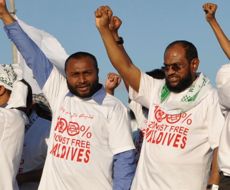
Shaheed explained that “anti-semitism runs deep in certain sections of Maldivian society”, highlighting as an example an article published in Dhivehi on local news website Dhi-Islam in January 2011, reporting on the agreements made between the Maldivian and Israeli government.

“Under this heinous agreement, these people have thrown the little children and the youth of the Maldives, as well as the country’s education sector and the health sector and many other matters, into the lap of the evil Zionist Israelis, who, as we have been informed through the seven heavens, will never wish anything but evil for Muslims,” the article reads.

“Jews have even historically been an evil people who have been cursed because they had killed prophets and spread corruption on earth, and that they are the biggest enemies of Muslims is proven by the teachings of the Holy Quran and forms of the core beliefs of Muslims. This agreement will impose pressures to prevent the dissemination of these teachings,” it adds.

The report claims that Jews have falsely exaggerated “incidents” of torture and killings during the Holocaust “to inculcate sympathy towards Israel in the minds of Maldivian youths; to convince the Maldivian youths that the jews are the victims of oppression and to make them blind and insensitive to the occupation of Palestine, the seizure of Muslim holy lands, and the endless oppression the jews inflict on the inhabitants of the land.”

“This agreement is high treason or the highest form treachery against the noble Islam and Maldivian identity, upon which this country is founded. It is a matter far more dangerous and grave than can be treated lightly,” said the report.

Historical Maldivian – Israeli relations

There is no document to support the claim that Maldives ever severed diplomatic relations with Israel, in Maldivian or Israeli records, explained Dr Shaheed.

Instead, what appears to have happened is a downgrading of the relationship where no Maldivian president since the early 1970s has been willing to receive an Israeli ambassador formally in his office.

The Maldives voted at the UN to accept the legitimacy of Israel, on December 17, 1991, at the request of then President George Bush, by repealing the 1975 UN resolution equating zionism with racism.

“The Maldives was not alone in changing its policies towards Israel – there were a number of Organisation of Islamic Cooperation (OIC) states doing the same thing, or had even restored full diplomatic relations,” said Dr Shaheed.

“Under Gayoom, the Maldives categorically accepted the two-state solution. All of these actions were firmly grounded in international law and state practice,” he added.

The Maldivian government discussed the question of restoring ties with Israel following the Oslo Accord agreement in 1993, which established a peace process framework to resolve the Palestinian-Israeli conflict.

Israel agreed to recognize Yasser Arafat as its partner in peace talks and essentially exchanged land for peace. The Palestinians in turn recognized Israel’s right to exist while also renouncing the use of terrorism and its long-held call for Israel’s destruction.

The Gayoom cabinet agreed on a three-stage restoration of ties with Israel, beginning in June 1994. The Maldivian government “agreed to recognize Israeli passports and ended the travel ban” during stage one, explained Shaheed. Shortly thereafter stage two saw trade and commercial relations were fully restored. Restoring political ties occurred during stage three, with regular meetings at senior diplomatic levels, between 1995 to 2008.

“So what President Nasheed said at the UN – and that was my formulation – was that Maldives wanted friendly relations with all states in the General Assembly,” said Dr Shaheed.

“This does not and has not prevented Maldives from criticizing actions of UN member states when they violate peremptory norms of international law, but Nasheed was not going to divide the world into the good the bad and the ugly,” he declared.

In recent years, attitudes toward Israel have greatly fluctuated with collaborative engagement by the Maldivian government being countered by some anti-semitic ‘blowback’ from elements within Maldivian society.
In February 2010, a team of experts from the Israeli Foreign Ministry are training 35 Maldivian officials in emergency preparedness, with a focus on the management of mass casualties.

Later that year, in November, the Islamic Foundation of the Maldives (IFM) called on the government to break off all diplomatic ties with Israel, a day after Indira Gandhi Memorial Hospital (IGMH) announced that a team of seven Israeli doctors is due to arrive in the country to treat patients at the government hospital for a week.

The IFM reiterated calls to the Maldives government to “shun all medical aid from the Zionist regime” with a team of seven Israeli eye surgeons due to arrive in December 2012, claiming that Isreali doctors and surgeons “have become notorious for illegally harvesting organs from non-Jews around the world.”

The following month, Founders of the IFM NGO claimed that although they do not believe in “hysterical outbursts” and theories of an imminent “Jewish invasion” in the country, a week of anti-Israel protests and flag burning across Male’ has reflected “strong dissatisfaction with the government’s open attitude” to the Jewish state.

In May 2011, Ahmed Naseem became the first Maldivian Foreign Minister to visit Israel.

However, in September 2011, Deputy Leader of the Adhaalath Party Dr Mauroof Hussein has called for alarm after alleging that a delegation from an Israeli company, Teshuva Agricultural Products, was due to arrive in the Maldives to assess the country’s agricultural potential. The Israeli agricultural delegation that was supposed to arrive on Filadhoo cancelled the visit after the islanders warned that they would not let the delegation go further than the jetty.

In December 2011, Minister of Islamic Affairs Dr Abdul Majeed Abdul Bari requested parliament endorse a resolution forbidding the government to establish ties with Israel.

While in April 2012, MPs passed a resolution preventing Israeli national airline El Al from operating scheduled flights to the Maldives until Majlis’ National Security Committee completes further investigation into the matter. El Al applied to the Ministry of Civil Aviation in May 2011 requesting permission to fly to the Maldives starting in December 2011.

There was no direct flight from Israel to Maldives between 2009-2011, so the Maldives was “not able to maximize the benefits from the growing Israeli market,” Dr Shaheed remarked.

“Maldives could have significantly increased the direct income and benefits from Israeli tourism by accepting direct flights from Israel, resulting in a longer holidays and greater expenditure in Maldives while still making the holiday comparatively cheaper for the visitor,” he added.

Likes(0)Dislikes(1)

Police to destroy all vehicles not reclaimed within three months

Police have announced they will destroy all vehicles towed over the past five years, unless owners pay the relevant fines and reclaim their vehicles within the next three months, reports local media.

Owners will have to pay 250 MVR (US $16) for the initial offence, 500 MVR (US $32) for the second offence, and 750 MVR (US $48) for each repeat offence if police towed their vehicle between April 14, 2009 and January 4, 2012

The fines for vehicles towed between August 31, 2008 and April 14, 2009 includes the cost of towing, plus daily fines, as announced in the Government Gazette.

Likes(0)Dislikes(0)

Cabinet approves implementation of SIM card user policy

The Maldives government yesterday (April 9) announced it will be initiating a SIM card user policy for all mobile phone services provided by Maldivian telecommunication companies.

According to the President’s Office website, cabinet had approved the implementation of the policy in order to tackle national security concerns over the “frequent misuse” of unregistered SIM cards in the country.

All SIM cards provided by Maldives-based telecommunications groups will now need to be registered following the cabinet’s decision to approve the user policy first presented in a paper from the Ministry of Transport and Communication.

Defence Minister Mohamed Nazim, who also serves as Acting Minister of Transport and Communication, was not responding to calls this morning.

Minivan News was meanwhile awaiting a response from the Communication Authority of Maldives at time of press about the SIM card user policy.

Likes(0)Dislikes(0)

India’s influence in the Indian Ocean not weakening: The Nation

Is India’s influence declining in the ocean named after the country? That seems to be the conclusion of some analysts after the Maldives’ cancellation of an airport development contract with an Indian company in November, writes Nilanthi Samaranayake for India’s The Nation.

These concerns are elevated by China’s increased engagement with smaller states in the Indian Ocean, including the Maldives.

Given the legacy of the 1962 war between China and India and ongoing competition for influence, New Delhi is right to have suspicions about Beijing’s intentions in its neighbourhood and whether smaller Indian Ocean countries are playing the two sides off each other. But the fact is that India’s position in the region remains strong due to longstanding and growing security cooperation with smaller neighbours as well as the Indian Navy’s expanding capabilities. New Delhi’s influence has been underscored by former Maldives president Mohamed Nasheed’s decision to seek refuge in the Indian High Commission in Male after a Maldivian court ordered his arrest.

India is a rising naval power and has the natural advantage of geography in the surrounding ocean. Moreover, India is connected to smaller countries in the region through entrenched ethnic and historical ties. President Mohamed Waheed has discussed the Maldives’ “preferential relationship” with India, and a former Maldivian foreign minister has stated that “nothing will change the fact that we are only 200 miles from Trivandrum”, referring to the Maldives’ proximity to the Indian city. India feels security obligations to regional states and has displayed its operational reach through campaigns in Sri Lanka and Maldives. In 1987, it intervened in the Sri Lankan civil war through the Indian Peace Keeping Force. Likewise, Indian armed forces intervened in the Maldives in 1988 following a coup, and after the 2004 tsunami the Indian Navy was first to provide critical disaster relief to Sri Lanka, the Maldives and Indonesia.

Still, New Delhi should not take for granted its dominant position in the Indian Ocean. The rejection in Maldives, though its significance should not be overstated, serves as a wake-up call for India to invest more in developing its backyard. Scholar Rani Mullen finds that India’s provision of aid lacks a cohesive strategy. India’s intelligence organisation Research and Analysis Wing recently called on the government to provide more economic investment and technological expertise in the Maldives and Nepal, following analysis of China’s IT and telecom industries’ interest in these countries.

Also, a Jane’s Defence Weekly article reported last July that National Security Advisor Shivshankar Menon called on Indian envoys in neighbouring countries to discuss ways to facilitate often delayed infrastructure assistance through the new Development Partnership Agency. Officials conceded that New Delhi’s assistance projects carried on “interminably” and that ties to regional states were “limited and haphazard.”

Read more

Likes(0)Dislikes(0)

Maldives Media Council submitting case against President’s Office “to create a free media”

The Maldives Media Council (MMC) has voted to submit a case against the President’s Office to “create a free media” in light of the discriminatory treatment of Raajje TV.

The President’s Office is violating equal rights by not inviting the opposition-aligned TV station Raajje TV to events and has not been adhering to the MMC’s requests that it give equal opportunities to all media, the MMC Secretariat told Minivan News (April 9).

The case will be submitted to the Prosecutor General’s (PG) office April 10.

“MMC members have voted to submit the case. Members have a strong feeling that it is a necessary step to take in order to create a free media in the Maldives,” said the MMC Secretariat.

The MMC has been very active the past two months trying to solve these problems and is now sending the case to the PG, Raajje TV Deputy Chief Executive Officer Abdulla Yamin told Minivan News.

The President’s Office has not been inviting Raajje TV to press conferences, has denied reporters entry press events in the President’s Office, and has not sent the channel any government press statements, Yamin claimed.

The President’s Office also asked government ministries and state-owned companies not to give information to Raajje TV and for these companies to stop providing private sponsorship to the media outlet.

Yamin said that they had observed this treatment was particular only to their channel.

“The President’s Office said they have not invited us because it is their privilege to decide whether to invite Raajje TV or not,” said Yamin.

“We are talking about rights granted in the constitution, not a privilege. There must be a situation [in the Maldives] where independent media can run.

“Article 28 of the constitution guarantees the right to freedom of the press and article 29 assures the right to freedom of information,” Yamin declared.

Yamin explained that the MCC had acted as a mediator to try and resolve the lack of cooperation shown by the President’s Office to Raajje TV.

“The President’s Office said if we do certain things they will cooperate. However, then the President’s Office is forcing their influence on our editorial policy,” said Yamin.

“We are not going to negotiate our constitutionally guaranteed right to information,” he added.

Ongoing government discrimination

Raajje TV filed a case against the President’s Office in the Civil Court in September 2012, complaining that the station had been boycotted from official events. Yamin expects the civil court to issue their verdict later this week.

Raajje TV also submitted a case to the parliamentary committee on government accountability regarding the president’s office discriminating against the media outlet. Parliament invited the president’s office to attend the committee twice, but never received a response, according to Yamin.

Additionally, Raajje TV lodged a complaint against the Maldives Broadcasting Commission (MBC) with the Anti Corruption Commission (ACC), alleging it was “using its power to give benefits” to other TV channels by providing them funding.

The Maldives Broadcasting Commission (MBC) was contacted by the ACC regarding the matter, but did not respond, according to Yamin.

“The MBC have not done anything regarding our right to information. They should be working on these issues to make sure rights are assured,” said Yamin.

Minister of Home Affairs Mohamed Jameel Ahmed previously named Raajje TV as an “enemy of state” in a press conference held in July, the same day on which the Maldives Police Services publicly stated its refusal to provide cooperation or protection to the channel.

Raajje TV also filed a case against the Maldives Police Services in September 2012 over their decision to deny cooperation or protection to the channel. In February 2013, the Civil Court ruled that the decision by the Maldives Police Service to cease cooperating with Raajje TV was unconstitutional.

Dismissing the police argument that it had the sole discretion to decide who to invite to press conferences and functions, the court stated that the action more resembled a deliberate attempt to limit the constitutional rights of freedom of expression, freedom of media and the right to information.

Raajje TV believes this verdict will apply to the President’s Office as well.

“If the court is fair and balanced a similar verdict will come. I believe the court won’t be that corrupt because the constitution and laws are clear. It’s written in black and white,” Yamin said.

Raajje TV is one of the five private broadcasters in the country and is the only television station aligned with the opposition Maldivian Democratic Party (MDP). The TV station has come under substantial pressure and criticism from groups including the government and political parties aligned with it.

RaajjeTV has been the subject of continuous verbal attacks by the state following the transfer of power in February.

In early August 2012, Raajje TV’s control room was sabotaged by intruders.

Press freedom organisation Reporters Without Borders at the time condemned this attack, stating “This targeted and well-prepared operation was the foreseeable culmination of the new government’s escalating verbal attacks on Raajje TV. How the authorities respond will be seen as a test of their commitment to media pluralism.”

The President’s Office Media Secretary Masood Imad and the Maldives Broadcasting Commission were not responding to calls at time of press.

Likes(0)Dislikes(0)

“Alarming” level of child abuse, neglect prompt Gender Ministry to push for guardianship amendment

Children’s neglect and abuse have increased to an “alarming level”, compelling the the Maldives’ Ministry of Gender, Family and Human Rights to submit an amendment that would transfer parental guardianship of children in cases of negligence.

The Ministry submitted the amendment to the president’s office Sunday (April 7), which would allow for strict legal action to be taken against neglectful parents, and guardianship to be transferred within the principles of Islamic Shari’a, according to local media.

Acting Gender Minister, Attorney General Aishath Azima Shakoor, said 59 cases of child sexual abuse were reported to the Gender Ministry in March and 37 of the abused children were transferred into state care.

She urged politicians and journalists to give more attention to the problem since “cases of neglect and abuse of children have increased to an alarming level”.

The number of babies abandoned after birth is also increasing, according to Minister of State for Gender and Family Dr Aminath Rameela. She noted “with dismay” that this “is being done by people with good jobs”.

Shakoor emphasised that “strict legal action” will be taken against parents who neglect their children.

“This is a situation the whole [Maldivian] society needs to take care of. Things need to be done to rehabilitate these children back into society,” said Shakoor.

“Non-profit organisations and private individuals should assume the responsibility of taking care of children who are abandoned by their parents until the children can be taken under the care of the state,” Shakoor added.

She said that close to 80 children were currently in the Villingili island orphanage ‘Kudakudhunge Hiya’ and that parents visit with gifts, but their children are “sad” the visits are brief.

The Ministry of Gender, Family and Human Rights, as well as the President’s Office were not responding to calls at time of press.

Problems with state care

The Human Rights Commission of the Maldives (HRCM) Vice President Ahmed Tholal previously stressed to Minivan News that the number of incidents occurring at state institutions caring for children were greatly concerning.

“Incidents are occurring repeatedly. Children under the care of the state need a safe environment; it’s a concerning issue.

“The fact is there is no special shelter or place for girls in trouble with the law. HRCM has raised the issue several times – both the need for education as well as psycho-social support and counselling,” Tholal added.

He said the Maldivian government has a responsibility to protect children from being “systemically” victimised, and once the state has been notified, children should not be put back in a situation of neglect or abuse.

“Vulnerable children are often from difficult families or are abandoned and are victimised over and over again. Currently [government] support is haphazard, and we are not properly equipped. A safety net needs to be established,” stated Tholal.

In March 2013, the Maldives’ Gender Ministry admitted transferring two children from the Villlingili island orphanage ‘Kudakudhunge Hiya’ to the Centre for People with Mental Disability on the island of Guraidhoo, without determining if they were in fact special needs children.

Earlier in March, police returned seven underage girls who escaped from the ‘Kudakudhinge Hiya’ orphanage on Villingili, otherwise known as Villi-Male’. Local newspaper ‘Haveeru’ reported another two girls who escaped from the orphanage were found on a ‘bokkura’ – a small local vessel – in the lagoon near Villingili with two boys.

In January 2013, an incident occurred where two underage females living in the Villingili orphanage were arrested and sent to Maafushi prison.

The parliamentary committee investigating their arrest learned that all concerning authorities had neglected their duties and responsibilities to protect the rights of children.

In 2011, police arrested a female staff member working at the Villingili children’s home, after she allegedly physically abused a boy living in the centre.

In October 2010, the Maldives Police Service and the Health Ministry commenced a joint investigation into “serious issues” concerning the mistreatment of children at Kudakudhinge Hiya, the only orphanage in the Maldives

Children’s rights

Tholal explained that the only other institutions for children are for boys, the Maafushi island Education and Training Centre for Children (ETCC) and Feydhoo Finolhu, a Correctional Training Centre for Children run by the Juvenile Justice Unit (JJU) of the Ministry of Home Affairs and the Maldives Police Service’s Child Protection Unit.

Acute staffing and budget shortfalls combined with the lack of children’s rights education and the exclusion of children’s feedback have “deprived [residents] of their liberty”. Staff caring for the children are often excluded from important decisions impacting children’s quality of life at the facilities, a recent HRCM report stated.

The report, ‘Child Participation in the Maldives: An assessment of knowledge’, highlights numerous participation and protection policy deficiencies putting Maldivian children at serious risk of harm.

Likes(0)Dislikes(0)

Foreign workers locked in house after allegedly “refusing to work and attempting to flee”

Police have discovered six foreign workers locked in a house after they were reportedly accused “of refusing to work and attempting to flee”.

All six of the male workers were found in a house located in the Male’ neighbourhood of Henveiru, according to local media.

While responding to a report made by a foreigner, the police discovered the the workers at approximately 10:30am Monday (April 8).

As the foreign workers exited the house, spectators claimed the workers had refused to do their jobs and as a result had not been receiving their salaries. The man responsible for the workers was also present, reported local media.

Immigration Controller Dr Mohamed Ali told Minivan News that police were investigating the case and would report back to the Department of Immigration and Emigration.

“We are working on it,” Ali said.

Police Spokesperson Chief Inspector Hassan Haneef was not responding to calls at time of press.

The workers’ nationalities, the conditions of their employment and housing have yet to be confirmed.

Migrant workers

Last week the Department of Immigration said 57 unregistered foreign workers were detained by police on April 1 and were being processed by authorities ahead of a decision on whether they will face deportation.

In February, a Maldivian trade union alleged that corrupt immigration practices and the use of unregulated employment agencies by private and state employers was limiting efforts to curb abuse of migrant workers and prevent illegal practices such as retaining their passports.

The Tourism Employees Association of Maldives (TEAM) claimed that while companies are not permitted to retain the passports of foreign workers, some hospitality operators – as well as unregulated third party agencies and government ministries – are still keeping employee travel documents without consent.

At the same time, a source with knowledge of the current immigration system told Minivan News that the practice of retaining passports – a long-standing habit of Maldivian employers – was a key contributor to human trafficking in the country.

In May 2012, a total of 47 Bangladeshi nationals working for a local security firm were seized by the Department of Immigration as part of a wider crackdown on unregistered migrant workers.

Immigration officials at the time claimed that the company the men had been working for had been in operation for 10 -12 years, yet no information could be found on its operations during a subsequent investigation by authorities.

In 2010, it was claimed that the exploitation of foreign workers in the Maldives rivals fishing as the most profitable sector in the Maldivian economy after tourism.

Human trafficking

The Maldives has appeared on the US State Department’s Tier Two Watch List for Human Trafficking consecutively for three years. Should the Maldives drop to tier three – the worst category – then the country is expected to face significant reductions in aid and potential travel restrictions on its citizens.

The Maldivian government recently launched a special campaign intended to raise awareness of foreign workers’ rights, while earlier this year eight “fundamental” International Labour Organisation (ILO) conventions were ratified in order to bring legislation on employee rights and trade unions in line with international standards.

However, independent institutions in the Maldives have maintained that the country – under successive governments – has yet to ratify a core convention on protecting migrant worker rights, while no legislation is in place to punish those involved in smuggling workers though the country’s borders.

The Prosecutor General (PG’s) Office has also confirmed that a lack of legislation has meant no cases have been prosecuted against human traffickers in the Maldives at present.

Meanwhile, the Human Rights Commission of Maldives (HRCM) has accused state and private sector employers in the country of lacking consistency in their efforts to address human trafficking, preventing “real” change in controlling illegal migration.

In January, President Waheed expressed concern about the rising number immigrants in the Maldives, claiming that the “foreign influence” threatens the country’s “Maldivianness”.

Likes(0)Dislikes(0)

India needs to re-examine relationship with neighbours: Hindustan Times

Recent developments in the Maldives and Sri Lanka suggest a need for a re-examination of India’s relations with its neighbours, write Charan Singh and Arvind Virmani for the Hindustan Times.

Some political pundits have expressed concern about China’s build-up on the Tibetan plateau, its plans to build numerous dams on the Brahmaputra and takeover of the management of Gwadar, a commercial port in Pakistan. China’s growing defence expenditures ($119 billion in 2013) — three times that of India’s $40 billion (2013-14) — have allowed it to extend its naval presence into the Indian Ocean, making it imperative for us to use our limited resources more efficiently.

Military and political strategy are generally intertwined, and sometimes buried inside a commercial one. The world respects power. India’s growth acceleration in the 1980s and 1990s created the conditions for a greater role in global politics, but it was Pokhran II that catapulted India onto the world stage. China’s military might, focused mission and astute diplomacy have been successful in resolving many border issues and fostering strategic economic relations with its immediate neighbours.

Read more

Likes(1)Dislikes(0)

BML chief auditor dies during air travel

Bank of Maldives (BML) Chief Internal Auditor and Chief Compliance Officer Lucian Jayakody has died while travelling on an aircraft from Dubai to Canada, according to local media.

Jayakody, a Sri Lankan national who has been working with BML since 2006, had 25 years experience in the finance sector and was reported by Sun Online to also be a member of BML’s Corporate Management Team and Executive Committee.

BML Managing Director and chief Executive Officer Peter Horton told local media today that Jayakody’s passing would be a huge loss for the bank.

Likes(0)Dislikes(0)