Parents at Guraidhoo Island School have refused to allow a polling station in the school for the upcoming presidential elections, due to concerns over black magic practiced by a local witch.
The parents alleged there was a witch on the island who, during previous elections, had cast spells to influence the outcome in favour of the Progressive Party of the Maldives (PPM) which had affected children after targeting the school premises.
Speaking to Minivan News on condition of anonymity, one islander said a ballot box was last allowed in the school during the local council elections in 2011.
‘’After the local council elections the school students started fainting inside the classrooms and this became a huge issue,’’ the islander said. ‘’The parents knew this was related to something like this and called in a group of spiritual healers.’’
He said the spiritual healers forced the spirits talk to them through the body of the possessed students, who told the healers that they were unable to leave the students as long as the products of sorcery remained inside the school grounds. The spirits reportedly told the healers the exact locations where the sorceress had placed the spells.
‘’A group of islanders, parents and the healers dug up the area and found a clay pot with Arabic letters all over it, and a big tumbled ball of cellophane with blood inside it,’’ he said.
He said after the objects were removed the spell was broken and the students were fine.
‘’When the spirits spoke to the healers it revealed the name of a lady from the island and said she was the sorceress and she was casting spells to make PPM win,’’ he added.
‘’If the school is going to be a polling station again, the sorceress will cast spells on the school and all the students will be affected,’’ he said.
Online newspaper CNM has today reported that the Elections Commission had decided to place the ballot box inside Guraidhoo School despite the concerns of the parents.
According to the paper, Elections Commissioner Fuwad Thowfeek had reassured the parents that the commission would take full responsibility if any such thing should happen.
National Museum staff and Male’-based arts NGO Revive have expressed concern over plans to move delicate exhibits for upcoming Independence Day celebrations to be held in the museum.
“We at the national museum believe the museum’s objects are very valuable and cannot be replaced if anything happens to any of the items,” National Museum Director Ali Waheed told Minivan News.
“I am concerned, we are not happy about this,” Waheed said.
He said that the President’s Office had sent a letter about holding the Independence Day event to the Tourism Ministry, which had in turn notified their Department of National Heritage.
“The department only informed us about the event three days ago,” Waheed claimed.
He said there were concerns that National Heritage Department Director General Zakariyya Hussain had not consulted museum staff about whether holding the event in the museum would be sensible.
“Zakariyya gave the approval but he didn’t say anything to us. He didn’t want to talk about it. At least he has to ask if this is good or not,” he claimed.
The President’s Office meanwhile said it had not been informed of the museum staff’s grievances, while rejecting claims that there would be any issues with holding such an event in the museum.
The President’s Office held an Independence Day event at the National Museum last year, which posed the same challenges to staff as it took place during Ramazan. The permanent exhibition items had to be shifted internally and placed against the walls to clear the middle of the hall, according to Assistant Curator Ismail Ashraf.
“[However,] it was quite different last year because there were many political issues and they were not able to get another venue,” noted Ashraf.
“During last year’s ceremony government agency heads and parliament members attended and there was no damage to the objects,” he continued. “However, there is the risk and probability of something happening [this year] when 400 plus people will be attending.”
Staff accepted that a similar event to celebrate the 2012 Independence Day had been held at the museum without incident – although the guest list is anticipated to be larger this year.
President’s Office Spokesperson Masood Imad told Minivan News yesterday (July 22) that the government did care about preserving Maldivian culture and heritage, but dismissed concerns that there were any politics involved in the event.
“There is enough time [for museum staff to prepare], we have not been informed [holding the event is problematic],” said Masood. “Nobody feels it is an issue. Minivan News is not the party that should be spreading these concerns, this is not a claim the museum staff are making, Minivan News is actually,” Masood said.
NGO Revive has meanwhile said it plans to submit a petition, signed by National Museum staff, to the President’s Office tomorrow (July 24) requesting the government reconsider its decision to hold the July 27 Independence Day celebrations inside the National Museum.
National Museum concerns
“We are caring about these things very much. The objects are very, very old and delicate. If they are moved several times, it may cause damage. I am responsible for their safety and security,” Waheed told Minivan News.
“I submitted a letter to Director General Zakariyya Hussain at 1:10pm on Monday (July 22) that we [the museum staff] are not responsible [for the damage that may be caused] when the objects are side by side in the hall,” he claimed.
Ashraf the assistant curator echoed Waheed’s sentiments that moving the artifacts to accommodate the event risked damaging them.
“It’s a permanent exhibition and we will have to move everything [on the ground floor] away to make a walkway for people for the ceremony,” Ashraf told Minivan News. “There are many artifacts to have to move, and having to do so quickly poses a risk of damaging the objects.”
“The other risk is that lots of people come in and not all will think the same way we do, [so] it is a risk that people may touch or take,” he continued.
Ashraf explained said that since the museum only has six permanent staff, the Maldives National Defence Force (MNDF) is supposed to help with moving the artifacts.
“They can help move the very heavy things, but we have to be there to supervise. We are in charge and if there is any damage [caused to the items] we are responsible,” he said.
Since it is currently the holy month of Ramazan, the amount of work National Museum staff can accomplish in preparation for the Independence Day event is also limited due to restricted working hours, Ashraf explained.
“In the month of Ramazan, museum hours are 9:00am to 1:30pm. This Independence Day event will take place Saturday night and Sunday morning we have to open the museum [to visitors],” he noted.
Ashraf urged the President’s Office to hold the event in another location.
“This year there are other options, so why still choose the National Museum?” he asked.
“The National Art Gallery has a full hall empty for temporary exhibitions, with enough space for the ceremony”.
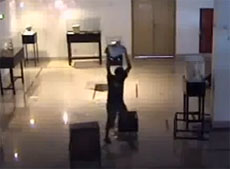
Ashraf also noted that artifacts were destroyed “the day the government changed”, during former President Mohamed Nasheed’s controversial transition of power last year – by people with “different thoughts” to those of the museum’s staff.
“A mob of people took advantage of the lack of security,” he explained. “These things happened and the risk [of it happening again] is still there. It shows the government doesn’t have much interest in this work,” he alleged.
Civil society support
Revive, a local NGO which works in collaboration with the National Archives and National Museum, has advocated in support of the museum staff’s concerns surrounding the event.
“I’m very surprised the government [is holding this event] but are not able to arrest those who vandalized the museum last year,” Revive President Ahmed Naufal told Minivan News.
“Moving permanent exhibitions is not done anywhere in the world, only temporary exhibitions,” Naufal explained.
“National Museum staff have a low budget and are unable to preserve [everything],” he continued. “There is a high risk items will be destroyed by moving the exhibition.”
National museum staff have signed the ‘Revive Petition’, which calls on the government to reconsider its decision to hold the Independence Day celebrations inside the National Museum, as it would require moving the permanent collection of artifacts which could cause damage that cannot be restored.
“Fifteen staff have signed the petition. That’s everyone who came to the [National] Museum and Heritage Department,” noted Naufal.
“This includes the only Maldivian archaeologist from the Heritage Department, Shiura Jaufar and the National Museum Director.”
The Maldives Bar Association (MBA) has called for the suspension of Supreme Court Justice Ali Hameed pending an investigation into his alleged sexual misconduct.
In a statement, the MBA challenged the independence and transparency of any Judicial Service Commission (JSC) investigation without the suspension of the judge in question.
Hameed is under investigation by both the police and JSC over the circulation of at least three sex videos apparently depicting him fornicating with unidentified foreign women.
Four members of the JSC voted in support of a motion last Wednesday (July 17) against suspending Justice Hameed due to “lack of evidence”, despite recommendations that he be taken off the bench until investigations were concluded.
Following the decision, JSC Deputy Chairman Abdulla Mohamed Didi and Latheefa Gasim resigned from the five-member committee investigating the matter.
The Bar Association, presided over by former Attorney General Husnu Al Suood, said in a statement (Dhivehi) released today that it was “against principles adopted in modern democratic societies” to allow Supreme Court Justice Ali Hameed to remain on the bench while he faced allegations of adultery and other concerning conduct.
The JSC last week disregarded a recommendation by its own investigating committee to suspend Hameed, leading the MBA to questioned whether the JSC was capable of reviewing the matter impartially.
The Bar Association said prompt action was needed to verify whether the allegations against the judge were legitimate, in order to maintain public confidence in the integrity of the Maldives judicial system.
Priority, the association argued, had to be given to uphold credibility, integrity and public trust within the country’s legal system rather than “defending the interests” of a single judge.
The statement also called on the JSC to appoint two members to the subcommittee investigated the judge’s conduct that had been left vacant by the resignations of Abdulla Mohamed Didi and Latheefa Gasim.
Transparency calls for investigation
NGO Transparency Maldives also expressed concern that leaked video footage purportedly of a supreme court judge acting in a “culpable manner” could jeopardise the integrity of the country’s apex court, and public confidence in the wider democratic system.
“There is a duty vested upon all relevant authorities to uphold and protect the integrity of such a important state institution,” the NGO said in a statement (Dhivehi).
“Therefore, Transparency Maldives believes that, in order to ascertain Supreme Court’s credibility and public trust, it is very important for all authorities to reveal the truth behind the accusations as soon as possible.”
The NGO called on authorities and the JSC to refrain from any conduct that could be deemed as “dubious” in their handling of investigations into the judge.
Chief Judge of the Supreme Court Ahmed Faiz has meanwhile urged the public and media to refrain from making statements that would give a negative image of the judiciary, and called for constitutional amendments.
Leaked footage
The video of the Supreme Court Justice allegedly indulging in adultery came into media limelight following the arrest of Ahmed Faiz – a senior Council Member of President Mohamed Waheed Hassan’s Gaumee Ihthihaad Party (GIP) and former Project Advisor at the Housing Ministry.
Snapshots taken from the video began circulating on social media networks Twitter and Facebook, prompting a police investigation. The police formally notified all relevant authorities including the JSC, the Prosecutor General and President Waheed regarding their investigation into the case.
The JSC is also investigating a further two videos involving the Supreme Court Judge, including spy camera videos of Hameed discussing political corruption of the judiciary with a local businessman, and a meeting with former Immigration Controller Ilyas Hussain Ibrahim.
‘Fake’ claims
The footage has been branded a politically motivated attempt to discredit the judge and dismissed as “fake” by local business tycoon, JSC member and presidential candidate MP Gasim Ibrahim,
Gasim has meanwhile said he personally saw no conflict of interest between his bid for the presidency and current role on the judicial watchdog. The presidential candidate voted against suspending Supreme Court Justice Ali Hameed during the JSC vote.
The public’s representative on the JSC, Sheikh Shuaib Abdul Rahman, was sharply critical earlier this year of the commission’s conduct and motivations, particularly its “open discussion” of its intent to eliminate Gasim’s rival presidential candidate, former President Mohamed Nasheed, from contesting the upcoming elections.
“It is common now to hear a lot of MDP and Nasheed bashing in commission meetings. This was not how things usually were before. I believe politically biased comments like this have increased since Gasim joined the JSC as a representative of the parliament,” Sheikh Rahman stated in March.
“Gasim even went to the point of asking the UN Special Rapporteur Gabriela Knaul when she held a meeting with us to state in her report that it was Maldivian Democratic Party (MDP) who torched the courts. I heard him say exactly that,” Sheikh Rahman said.
Handfuls of sand are sprinkled are carefully onto glass, and a single finger pokes the grains to magically morph them into a moving painting as an animation unfolds telling important narratives about the survival of a nation, against the soundtrack of haunting music.
The form of an old man takes shape, holding a cane in his hand. All around him a street scene of buildingsis developed under the sleight of a single hand sprinkling sand, asthe other creates perfectly drawn images. Behind the old man is a wall of people, and one of them is brandishing a Maldivian flag. Suddenly the music tempo changes. On the other side of the road a brace of helmeted police officers appear all brandishing riot shields and shaking their batons at the old man and the people. Suddenly, these images of the people are “wiped out” and in their place, a single menacing bulbous face appears.
All these scenes capture the moment that the Maldives was changed forever.
They were created by an enigmatic artist called Afzal Shaafiu Hasan, also known as Afu. He has decided to use his unique talent of drawing with sand to describe what he calls Baton Day, the day after the coup which destabilised the country and toppled the first democratically elected president the Maldives had seen in 30 years.
Afu learned his craft by watching you tube videos. In a short space of time, he had perfected it enough to perform a moving sand art play to a delegation of eight nations at the SAARC Summit in Addu. Later it was performed at an audience of thousands at Raalhugandu area earlier this year as part of an artists’ drive for democracy. Later his recorded performance went viral on Maldivian social media,
“Being noticed is a blessing, but it can bring pressures as well,” he said.
But how did he learn this incredible talent?
“About three years back I saw some videos of sand art by Ksenia Simonova and it was simply amazing. I wanted to try it,” said Afu. “So I taught myself how to do it through hours of experimentation and practice.
“Then just when I got the hang of it, I was given the opportunity to perform for the Heads of States of eight Asian countries, who all met for the SAARC Summit.
“The first performance I did after that was watched live by almost 8,000 people. That’s incredible for Male’.”
Of course practice makes perfect and it takes a lot of pre-planning to get right, just as any animation does. “It is important to get the story right and fit it into the least number of key frames and transitions, while keeping the emotion at all times,” he said.
“Since it is live I don’t have a second chance to get it right.”
To draw the images he uses his hand, and he has grown a long fingernail especially for the purpose of fine tuning details. He refers to this as his “paintbrush”.
Afu’s Sand Art has the air of the theatrical to it. Perhaps that is not so surprising as he counts the great performance artist and choreographer Mohamed Munthasir, known as Munco, among his friends from school.
In fact it was Munco who drew his attention to the very opportunity to perform at the SAARC Summit.
“Sand Art combines drawing, creative story-telling, skill and performance” said Afu.
“As soon as I started doing it, I fell in love with the medium, it expresses emotion on so many levels.”
He is also a classmate of the famous Dinba music creator Ishaantay Ishan. Music is a vital ingredient to Afu’s sand art performances. He often uses Hamy on the keyboard or piano and Shambe on the guitar to build up the drama and tension as Afu’s incredible artistic fingers work their unique magic.
Afu also sometimes performs sand art exhibitions to entertain tourists in resorts.
“Sand art is extremely versatile, it can be a pure art form as well as a commercial opportunity for tourism in resorts, but we still have a lot of work to do to develop this art in the Maldives,” he added.
“So far I am the only sand artist in the country. If people are interested in learning it, I would be more than willing guide them.
There is also a connection between Afu’s sand art and Maldivian tradition. Sand is used as a medium to teach children the alphabet and shapes. It is put in a large shallow container and the teacher uses their fingers or a little twig to write on it.
He currently has an exhibition in the National Art Gallery entitled ‘Breathing Atolls,” which features a video of “a sand animation based upon a traditional Maldivian fisherman’s life, called A Maldivian Tale.”
Afu believes that the Maldives is undergoing an artistic renaissance which is helping to enrich the culture of this island nation.
So what motivates Afu?
“The chaos of course, I feel it necessary to say something about it as an artist. That alone pushes me to do something – not just in my sand art, but in my paintings as well.”
And so, Afu’s artwork is constantly pushing boundaries. He is an enigma who seems to be constantly innovating and experimenting with any art form which takes his fancy. He has mastered everything from stamp design, to oil painting and now as his self -taught sand art proves, his talents to innovate know no bounds.
As well as politics, Afu’s oil paintings and sand art also showcase the simple lifestyle of Maldivians in the past.
He is also interested in the environment. One of his sand art animations called “Forever”, which was performed live at Thudufushi Resort in January 2012 shows how human interference and rubbish is causing the coral reefs to die.
He has a talent for showing the fragility and beauty of a moment, something which defines him as a truly great artist.
“Chaos. I feel it necessary to say something about it as an artist. That alone pushes me to do something -not just in my sand art, but in my paintings as well.”
Afu has painted since childhood, but surprisingly has had no classical training.
Asked how he learned of his talent, he said. “I was born with it, I guess. I was good at art at school so when I finished formal education, I joined the Post Office and drew stamps. This is the point I started taking art as a serious profession.”
During the 13-years he worked at the Post Office, he was responsible for creating almost a hundred stamp designs.
Later he was accepted to study a three-year diploma course in graphic design and multimedia in Malaysia.
“I did this, and then I developed my fine art side as a hobby with paintings, performing arts and sculptures. It is mainly all self-taught.”
He says he was encouraged from a young age by his father to be creative, although none of his siblings went into art.
“Dad was a man of many talents – carpentry, calligraphy, poetry and so on, and he inspired me to develop my artistic talent,” he said.
Afu says his inspiration includes local artists Maizan Hassan Maniku and Hassan of Pink Coral as well as more traditional muses such as Van Gough and Picasso.
Painting has always been one of his great loves. Over the years he has created many works of art, and many have been exhibited in the National Gallery.
However during some periods, some of his paintings have also been banned for being too evocative, especially during the Maumoon administration.
A series of paintings Afu did during this time was called the Man-Wall series, which saw man as the people, and wall as the Government. It deals with feelings such as hope, fear and freedom – themes which have returned since the events of 07/02/12.
“One particular painting was removed from the exhibition ‘Maldives Contemporary’ because the Government felt it was not appropriate. At that time there were a series of people going missing, in jails or just randomly disappearing. The wrapping says police line do not cross. The tree was our future and the zebra crossing was the point where our people will have to cross to reach that future,” he said.
“Religion is killing art”
Afu counts himself among part of a “new wave” of artists and craftsmen in Male’, who inspired by the political changes have been promoting innovative artforms and paintings.
All are facing challenges from the establishment, political and religious figures who believe creative arts are sinful.
“They have destroyed the ancient artefacts and they preach art as hara’am,” said Afu. “They have even preached against drawing human beings with eyes as this is supposedly directly ‘challenging God’.”
“In a country where the idea of art is limited to drawing it’s dangerous going beyond that limitation. Art has been off mainstream for a very long time, from the point we converted to Islam back in 1153 AD. That’s my opinion and there’s evidence to back it up too,” said Afu.
Art only very recently entered the mainstream – around 15 years ago due to religious restrictions. Psychedelic art in particular is growing fast, especially digital and doodle art, which is flooding social media right now.
Another artist, who goes by the name of K.D, acts as Afu’s agent. He was also the project coordinator for the SAARC Summit where the sand art was first displayed.
“The situation is as simple as this – religion is killing art,” said KD who is also a painter. “That’s my open view on it.”
He revealed how recently religious scholars in the Maldives had banned drawing human figures with eyes and noses, which they believe go against god. The exhibition was created by an artist known as Siru Arts who held an exhibition of political art without these features.
Afu said: “This exhibition was an asset to the current regime because it has a twisted narrative to the events of the coup.
“Some follow blindly because it’s about religion. It’s sad, but it’s happening all over the world, why not here?
“Here everything that happens reaches to every individual. It matters here more than countries with millions of people where only a little portion of it the population is directly affected.
“This can be dangerous because we’re a nation of just 350,000 people. Here everything is magnified.”
In the modern Maldives the art world is growing, but at the same time, due to religious restrictions, artists have gone in hiding and dare not express their opinions.
“The government needs to keep artists like Afu and others safe and secured away from all these dangerous people,” said KD, who classes Afu as his mentor.
“In my own personal opinion I believe that artists should be more open in their views because the more we stay hidden, the more damage will be done,” he added.
Education, KD believes, is the key to challenging these ideologies.
“This place is filled with talent but no proper guidance or guidelines are implemented. In the current situation we can see how art is growing.”
Former President Mohamed Nasheed’s government actively supported the arts, introducing venues and practice rooms, intellectual rights for the artist and open forums, the artists say.
Many people in the country have talent, but they have not learned the fundamentals.
Each artist is self taught and as yet no National Art School exists and for the moment art is off the mainstream curriculum. There was an art school called Salaam school, which collapsed following the tragic death of its founder in 2011, Aminath Arif ‘Anthu’.
As an event manager KD has worked with many painters, musicians and performance artists. His main concern is to encourage the government to invest in art in the mainstream education system.
“I believe if art is involved more in the current education system, Maldivian art will grow,” said KD.
Overall, Afu has taken Maldivian art in a new direction.
“My utopian view as a Maldivian is that I live in one of the most beautiful places. My community is small and loving and live a simple life. We are happy.
“But my view on the political chaos is different. I believe what we are going through is healthy and necessary for our country’s future.
“Change shall come, but at a cost. We will be the generation who has to deal with it.”
His beautiful images are crafted out of the very sand which makes up the dazzling beaches that so many tourists frequent.
This in itself is quite symbolic.
The medium makes a statement as much as the art. An image or scene can be wiped out in an instant to make way for a new image.
As the Maldives approaches crucial elections, this also says something about the state of the nation and the events of the last 18 months.
Sand is also strong and fragile at the same time. Can the sand beneath their feet holds the country together or will the single grains just blow away in the wind?
Jumhoree Party (JP) Presidential Candidate Gasim Ibrahim has told reporters he will not step down from his position on the Judicial Services Commission (JSC), stating that he saw no conflict of interest between his bid for power and role on the judicial watchdog.
The JP held a press conference yesterday with its two recently-unveiled coalition partners, the religious conservative Adhaalath Party and the Dhivehi Qaumee Party (DQP), following their defection from President Mohamed Waheed’s ‘Forward with the nation’ coalition last week.
According to local news outlet Haveeru, journalists repeatedly asked Gasim how he could possibly remain an impartial member of the JSC while running for president.
In response, Gasim said he saw no conflict of interest, and insisted that he would “not neglect his legal obligations” as a JSC member.
Following the investigation of Supreme Court Judge Ali Hameed sex tape scandal by a JSC subcommittee, Gasim voted against suspending the judge, in contradiction of the subcommittee’s recommendation.
Attorney General Aishath Azima Shukoor, President Waheed’s representative Latheefa Gasim, and Chair of the Civil Service Commission, Mohamed Fahmy Hassan, also voted against the judge’s suspension, citing “lack of evidence”.
Gasim meanwhile publicly declared that Hameed’s sex tape was “a fake” orchestrated by “external forces” seeking to take over state assets, introduce other religions to the country, and create infighting in Maldivian society.
His comments were followed this week with the leak of two more sex videos of the judge, including one depicting the judge fraternising with a topless woman with an eastern European accent. At one point, the judge leans right into the camera, and his face is visible.
JSC controversy
The public’s representative on the JSC, Sheikh Shuaib Abdul Rahman, has been sharply critical of the commission’s conduct and motivations, particularly its “open discussion” of its intent to eliminate Gasim’s rival presidential candidate, former President Mohamed Nasheed, from contesting the upcoming elections.
“It is common now to hear a lot of MDP and Nasheed bashing in commission meetings. This was not how things usually were before. I believe politically biased comments like this have increased since Gasim joined the JSC as a representative of the parliament,” Sheikh Rahman stated in March.
“Gasim even went to the point of asking the UN Special Rapporteur Gabriela Knaul when she held a meeting with us to state in her report that it was Maldivian Democratic Party (MDP) who torched the courts. I heard him say exactly that,” Sheikh Rahman said.
The special rapporteur stated that there was near unanimous consensus during her visit that the composition of the JSC was “inadequate and politicised”. This complaint echoed that of the International Committee of Jurists (ICJ) in 2010.
“Because of this politicisation, the commission has allegedly been subjected to all sorts of external influence and has consequently been unable to function properly,” said Knaul.
The JSC was responsible for both creating the court in which Nasheed was to be tried for his detention of Chief Criminal Court Judge Abdulla Mohamed in early 2011, and appointing the panel of judges overhearing the trial.
President Dr Mohamed Waheed has officially filed his candidacy with the Maldives Election Commission (EC) to stand in the upcoming presidential election.
President Waheed was joined by his running mate, Dhivehi Rayithunge Party (DRP) MP Ahmed Thasmeen Ali, as he submitted his candidacy forms to EC President Fuad Thaufeeq ahead of voting scheduled for September 7, his campaign team confirmed.
EC Vice President Ahmed Fayaz confirmed to Minivan News that the commission was now verifying the 2,000 signatures submitted by President Waheed backing his candidacy, before making a final decision on any approval.
“We would have announced his acceptance today, but he submitted 2,000 names that we will need to check,” he said.
Fayaz said it was possible the EC would make an official announcement concerning President’s Waheed candidacy tomorrow (July 22), once the signatures were verified.
Amidst the possibility of his Gaumee Ithihaad Party (GIP) facing dissolution for not having the 10,000 members required to officially register a political entity in the Maldives, President Waheed on Tuesday (July 16) announced his intention to stand for election as an independent candidate.
On Friday, President Waheed’s ‘Forward with the nation’ coalition announced he had obtained the 1,500 signatures required to register himself as an independent candidate.
Despite the recent defections of the government-aligned religious conservative Adhaalath Party (AP) and later the Dhivehi Qaumee Party (DQP) from his coalition, the DRP said Friday that the incumbent’s campaign was “going to plan”.
According to Sun Online, the EC will decide on all candidacies within 48 hours of their paperwork being submitted.
Meanwhile, former President Nasheed filed his own candidacy papers with the EC on Thursday (July 18). His candidacy was approved later the same day, according to the EC.
Nasheed and the MDP maintain he was compelled to resign during a police and military mutiny on February 7, 2012. His successor and former vice-president, Dr Mohamed Waheed, maintain the succession was legitimate.
Fraudulent party enlistment allegations
Investigations are meanwhile underway into 46 cases of fraudulent political party enlistment filed by the EC, as well as another case individually lodged.
The fraudulent political party forms are said to include 15 signed to President Waheed’s GIP, five from his DRP running mate Thasmeen, and 27 from prominent businessman and MP Ahmed Siyam’s Maldives Democratic Alliance (MDA).
Some of the people signed up to the parties were alleged to already be deceased at the time of their registration.
Resort tycoon and Leader of the Jumhoree Party (JP) Gasim Ibrahim has announced former Special Advisor to President Mohamed Waheed, Dr Hassan Saeed as his running mate for the upcoming presidential elections scheduled to take place in September.
The Chairman of Villa Group is among the five candidates who have formally declared their intention to contest in the presidential race. Other candidates include opposition Maldivian Democratic Party (MDP) candidate former President Mohamed Nasheed, Progressive Party of Maldives (PPM) candidate Abdulla Yameen, and current President Waheed – who heads the ‘forward with the nation’ coalition consisting of his party Gaumee Iththihaadh Party (GIP) and Dhivehi Rayyithunge Party (DRP). Former PPM Council member Dr Ahmed Saud has also declared that he will be contesting the polls as an independent.
Shortly after President Waheed’s controversial ascension to power in February 2012, Saeed was appointed to the position of Special Advisor. The Dhivehi Qaumee Party (DQP) – of which Saeed is the leader – was announced as part of Waheed’s new national unity government. Last April, DQP announced its plan to join President Waheed’s coalition and support his bid to seek re-election.
However, Saeed last Thursday made a sudden announcement that he and his party had decided to leave Waheed’s coalition, claiming that President Waheed was strongly influenced by his family and relatives, was making decisions from his “palace” instead of discussing with other coalition partners.
In a statement released by the DQP at the time, the party said its council had unanimously agreed to leave the coalition after accusing Waheed of being incapable of protecting the interests of his coalition partners.
“The president dissolved the steering committee established with coalition partners to resolve issues within the coalition and resorted to taking decisions within his palace,” read the DQP statement. “Therefore, despite repeated efforts, President Waheed’s failure to resolve these issues” forced the party to leave the coalition, DQP claimed at the time.
The accusations were dismissed by the ‘Forward with the nation’ coalition and claimed that DQP’s departure would have little effect on its campaign.
In a campaign rally held last Friday evening, Gasim Ibrahim declared that Saeed will be his running mate and that Jumhoree Party have come to a coalition agreement with Saeed’s DQP and the religious conservative Adhaalath Party. Gasim also said that the three parties will contest in the presidential elections as a coalition under his leadership.
The Adhaalath Party was also initially part of President Waheed’s coalition but later left, criticising the campaigning and claiming “unknown activities” were being carried out within the coalition.
The party’s decision to part ways with President Waheed came shortly after the party slammed Waheed for telling the AFP that it had “extremist” elements within the party ranks. Adhaalath responded strongly to the remarks dismissing that it held “extreme views” and claimed that the party did not promote extremism but had always stood by “Islamic principles”.
Addressing the small number of people gathered during the rally, Gasim Ibrahim spoke highly of both Saeed and the Adhaalath Party.
Gasim, who claimed he met Saeed while during the formulation of the current constitution, described him as an “educated, experienced and hard working person who would never be involved in any corrupt activity”.
He also praised the Adhaalath Party stating that the religious conservative party had proven its “sincerity and integrity” even in 2008 presidential elections by joining his party, and claimed that it was prepared to make “any necessary sacrifice” for the country.
“This is indeed a memorable night for all three parties. This coalition represents a group of individuals committed to uphold the national unity and Islam,” Gasim said.
He further said that the coalition, once elected, would steer the country towards a safe harbour and bring development and progress to the people.
Hassan Saeed addressed the crowd, praising Gasim’s efforts during the reform movement and claimed that the resort tycoon was behind a lot of reforms. Saeed described Gasim as an individual who would not waste time to make important decisions concerning the people and development.
“In our government, political-economic principles will be based on the principle which will make Maldivian multi-millionaires into billionaires, make millionaires into multi-millionaires, and make average businessmen into millionaires. It is the principle that will allow expansion of smaller businesses to medium and large ones,” he said.
Both Saeed and Gasim contested in 2008 presidential elections as separate candidates and came to third and fourth positions behind then President Maumoon Abdul Gayoom and Nasheed. In the run-off elections, both Saeed and Gasim backed Nasheed and campaigned strongly against former President Gayoom.
Once elected, Saeed was appointed as the Special Advisor to Nasheed while Gasim was appointed as the Home Minister. However three months into the new government, both Saeed and Gasim left government and joined the then opposition. Both Saeed and Gasim later played a significant role in ousting Nasheed’s administration from power.
Two more videos apparently showing Supreme Court Judge Ali Hameed engaging in sexual relations with foreign women have been leaked on social media.
Three other videos already in circulation, including a third sex tape and two videos of the judge meeting prominent Maldivian business and political figures, recently prompted the Judicial Services Commission (JSC) to form a five-member subcommittee to investigate the matter.
According to Maldivian law, the crime of fornication is subject to 100 lashes and banishment or house arrest for a period of eight months.
The courts regularly issue this sentence, overwhelmingly to women found guilty of extramarital sex. Sentences are carried out in front of the justice building next door to the Supreme Court, and occasionally attract high profile international media coverage, such as the sentencing in February this year of a 15 year-old rape victim.
Minivan News understands that one of the newly leaked videos, time-stamped January 24 2013, shows the judge fraternising with a topless woman with an eastern European accent. At one point the judge leans right into the camera, and his face is visible.
Afterwards, the woman repeatedly encourages the judge to drink wine from a minibar.
“If I drink that I will be caught. I don’t want to be caught,” the judge insists, refusing.
In that video, Hameed asserts that he was one of Progressive Party of the Maldives (PPM) Presidential Candidate’s Abdulla Yameen’s “back-ups”, and that his stand was “to do things the way Yameen wants”.
“Even [Speaker of Parliament] Abdulla Shahid will know very well that my stand is to do things the way Yameen wants. That the fall of this government was brought with our participation,” he appears to add, although the audio quality is poor (01:49).
One of the men claims to have heard plans to “kill off” leader of the Dhivehi Rayithunge Party (DRP) leader Ahmed Thasmeen Ali and refers to a “second person to be killed,” however, due to the unclear audio it is not clear what the parties are referring to, or the context of the “killing”. The person believed to be Hameed then promises, “If it comes into my hands, I will kill him off.”
That video appeared shortly after police arrested Ahmed Faiz – a council member of President Dr Mohamed Waheed’s Gaumee Ihthihaad Party (GIP) and then-Project Advisor at the Housing Ministry – while he was allegedly trying to sell another sex tape of the Supreme Court Justice.
Don’t make negative statements on the judiciary: Chief Justice
Chief Judge of the Supreme Court Ahmed Faiz has meanwhile urged the public and media to refrain from making statements that would give a negative image of the judiciary.
The judiciary could only be strengthened by the amending the constitution, Faiz claimed, according to local media.
“Based on our experience up until now, we know that in order to further strengthen the judiciary, the constitution needs to be amended, relevant laws need to be amended, and relevant laws required by the judiciary need to be introduced as soon as possible,” he said.
PPM Vice Presidential candidate Dr Mohamed Jameel meanwhile declared at a party rally over the weekend that the judiciary was the “worst the country has seen in its entire history”, according to local media.
“Today’s reality is that, even if we reflect upon the magistrates in the island courts to the judges who sit in the courts of Male’, they receive higher salaries and better privileges than all of the common people. But the question is, while the system and their salaries are being upheld by taxes, do the people get their justice?” said Dr Jameel, who served as Justice Minister under former President Gayoom’s administration.
“In what country, in what way can a country’s people be made to suffer, batter the people and intimidate them, kidnap them and use the people’s money through corruption, abuse the people’s property through millions and then sell them, but have no investigation, no trial for these people, these events require you to give considerable thought to the state of the country,” he said.
Dr Jameel then blamed the judiciary for allowing former President Mohamed Nasheed’s name to appear on the ballot for the September 2013 elections.
“Some of the people who are standing for presidency should not have their names on the ballot paper if the country’s laws are being followed, if the State’s policies are properly implemented. Somebody has to be responsible for this. I believe that the blame goes on the judiciary,” Jameel said.
Supreme Court Judge Hameed with businessman Mohamed Saeed
The Prosecutor General (PG)’s Office has appealed the Criminal Court’s decision not to extend the detention of Progressive Party of the Maldives (PPM) Council Member Ahmed ‘Maaz’ Saleem for alleged assault.
Saleem was released on Sunday (July 14), the day following his arrest, after police “obtained information necessary for the investigation”, a police spokesperson told newspaper Haveeru.
However some of the individuals arrested after the alleged assault on a ferry captain remain in police custody, following the Criminal Court’s extension of their detention, according to local media.
The PG’s Office called for Saleem to be arrested during the appeal hearing held at the High Court this morning (July 21).
“He was arrested and brought in front of the Criminal Court judge. The judge believed him and ordered his release,” High Court Spokesperson Ameen Faisal told Minivan News today (July 21).
“The Prosecutor General again called for his arrest, which is basically how an appeal case goes on, especially regarding detention,” explained Faisal.
He confirmed that the ruling for Saleem’s detention case is scheduled tomorrow (July 22) at 10:30am.
The Criminal Court and Police Spokesperson Chief Inspector Hassan Haneef were not responding to calls at time of press.
Saleem and three other men were arrested over the alleged assault of an airport ferry captain Saturday (July 13). Saleem allegedly instructed the group to attack the ferry captain after accusing him of stealing a bag containing an iPad, according to a police account of the incident in local media.
Following the alleged assault, police took Saleem and his three companions into custody, as well as the injured ferry captain.
“We have received information that Saleem accused the captain of stealing the bag. He then got off the ferry and returned with a group and assaulted the captain,” a police spokesperson told Haveeru.
PPM MP Ahmed Nihan said the reported arrest of Saleem was a personal matter and was not anything to do with the party.
He said that he had been informed of the arrest at about 12:25am by a party supporter that “something went wrong” outside at the jetty near the Nasandhura Palace Hotel involving a computer or tablet device, but had no further details at time of press.
Nihan added that Saleem had not been directly involved with PPM campaigning since the party’s primary election earlier this year, that saw MP Abdulla Yameen elected as its presidential candidate.
 (0)Dislikes
 (0)
(0) “I’m very surprised the government [is holding this event] but are not able to arrest those who